I always love listening to founders who go all-in on their venture. Not because burning everything down makes a company good, but because it shows exactly what building a startup was meant to be: choosing the thing you'd regret not trying.
If you were around SF this August, you might have already met Hina on X. She posted a 41-second video with Taro, her co-founder and husband, in which the two of them hold their wedding rings up to the camera. They have just skipped their wedding to build their startup in SF.
Hina's post announcing that she and Taro skipped their wedding to come to San Francisco.Source: X.
I come from an East Asian background, so I know how much weight that sentence carries. In East Asia, a wedding ceremony is rarely just the couple's day. It belongs to the family. Choosing a startup batch over it isn't a scheduling decision. It's a statement about what comes first.
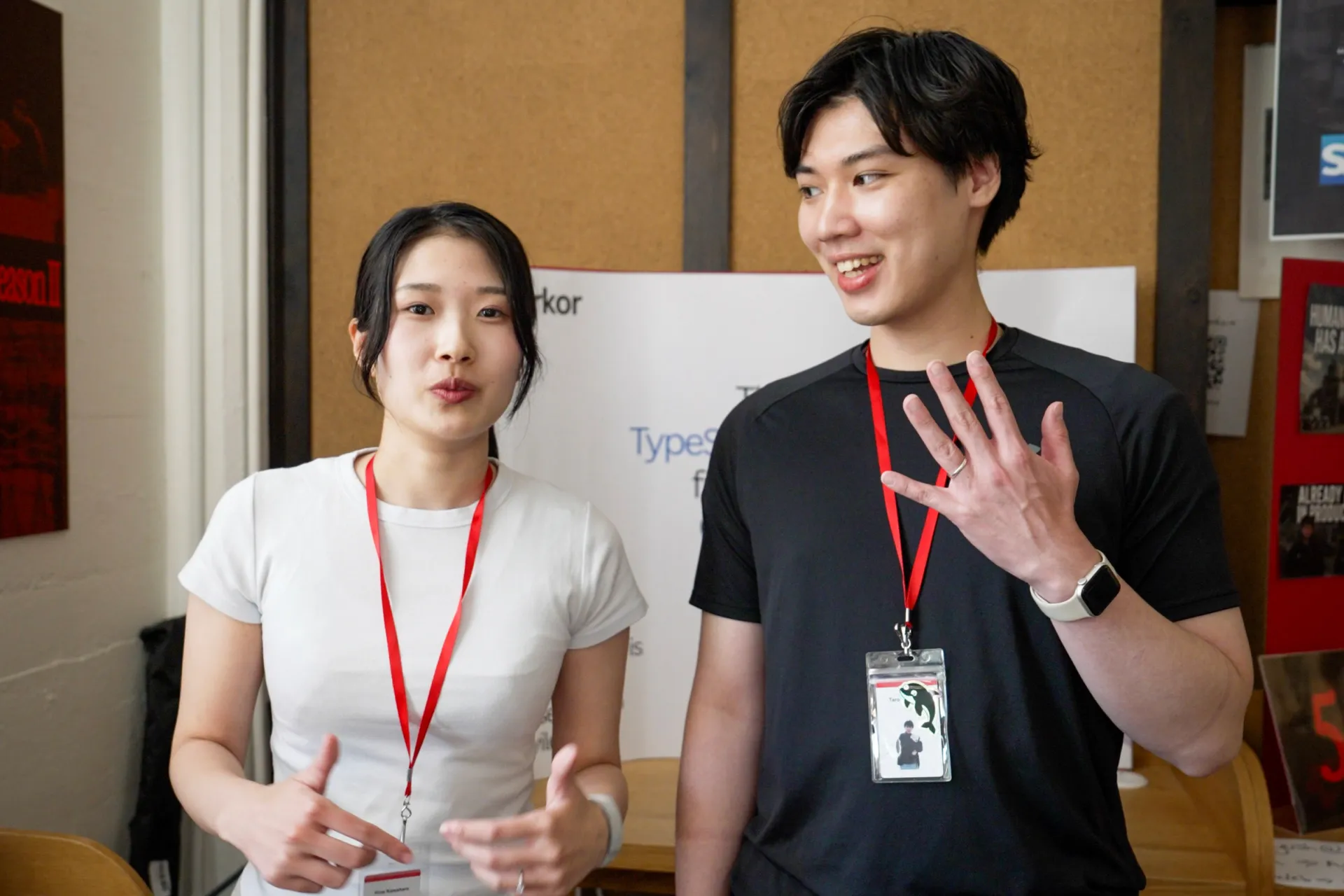
The two in the video are Hina Nakahira, co-founder and CEO, and Shotaro (Taro) Kawahara, co-founder and CTO, the engineers behind Arkor, a managed Next.js hosting service built on Cloudflare. Already married, they had hoped to hold their ceremony this summer, but with the plans still unsettled, they chose to spend it in San Francisco instead, in Founders Inc.'s Off Season batch.
I sat down with Hina to talk about what it takes to make that call, and where it comes from. It starts in Kobe, with a high schooler who realized she could rebuild her own phone's operating system.
The French Linguistics Major Who Couldn't Stop Coding
Q: Where are you from, and what first drew you to building software?
Hina: I'm from Kobe, Japan. It's right next to Osaka and famous for the beef. My parents encouraged my individuality and let me try many things growing up.
I first got into software in high school. I realized an Android phone, unlike an iPhone, could actually be customized, so I got a Google Pixel 4A and started building a free, lightweight custom Android OS on it. I kept building around it for three years. Building things myself was a big part of how I learned.
Q: You also started a 200-plus member Android learning community. How did that come about?
Hina: That happened when I was around 19 or 20. I'd just started learning Android app development, not just the OS internals, and the learning material out there was too sparse. It was pre-GPT times so it was genuinely hard. I tweeted asking if a learning community for Android existed, and said I'd start a Discord if not.
About 150 people joined within a few days. That's small by San Francisco standards, but for a Japanese engineering community, it was huge. I already had about a thousand followers from being an active student engineer, crushing hackathons and building stuff, so it spread fast. It grew past 200 members from there.
Q: So after all that, you went on to study computer science?
Hina: Actually, when I had to choose a university, I told my parents I wanted to do computer science. My dad hoped I'd have a more "normal" college life, so I went the liberal arts route and chose French linguistics. But the tech obsession never left.
Soon after I enrolled, I found University of London's online computer science program and signed up for that too. It was expensive, so I took a full-time, 8-hours-a-day engineering internship at Habitto, a fintech startup, to pay for it. It was still in its zero-to-one stage, and seeing talented people move quickly and build a company had a lasting influence on me. That was an important part of what made me want to start a company.
Hina in front of Habitto's office.Courtesy of Arkor.
Q: So you went to two schools and worked full-time at the same time?
Hina: Yes. Obviously I didn't do perfectly on all three. The internship was my top priority.
I wanted to choose my own life, so I moved to Tokyo and supported myself entirely on internship income while I continued the CS degree online. I eventually dropped the linguistics degree, and I'm suspending the CS one right now, not dropped. I still hope to get at least one bachelor's someday.
From Rivals to Co-Founders. Then Husband and Wife.
Hina and Taro winning first place at a hackathon.Courtesy of Arkor.
Q: How did you and Taro meet, and what was your first impression of him?
Hina: I went to 102 hackathons total, most of them with Taro, and I never lost a single one. We first met as rivals, though: finalists on opposing teams at Japan's largest student hackathon, in the winter of 2022. My team won (chuckles).
We got talking at the after-party, and I thought he was a jerk at first, but I also realized he was highly technical and operating on a different level. He had deep, lower-layer knowledge almost nobody around us had. Meeting him made me realize how much I still had to learn, and that got me excited. Our collaboration actually started with him teaching me that world.
Q: What is Taro's own background, and how did he get into tech?
Hina: This one story shows his obsession with how things work underneath: he once noticed Windows behaving differently from its own documentation, and instead of shrugging it off, he dug down until he was hand-typing machine language to understand how an Intel CPU actually works.
That obsession goes back to elementary school, when a robot kit ad in a kids' magazine got him into electronics. Hardware was expensive, so he switched to software on a single Raspberry Pi, where there's no ceiling. In middle school, he quit basketball to focus on open source and lower-layer software. That work eventually got him invited onto the core team of Auth.js, a widely used open-source authentication library, by the project's owner.
Q: When did you realize you two were a genuinely good team, and how did that turn into marriage?
Hina: The turning point was the first hackathon we entered as just the two of us, around the end of my first year of university. It was a large international one, and we won the grand prix. We didn't have to ask what the other person was doing. When one of us took something on, the other trusted it would get built.
We kept collaborating after that, and in July 2024, the internships covering my rent in Tokyo ran out. I didn't want to go back to Kansai or stay in Tokyo, so I chose Hokkaido, because the food is good and Taro was there. We started living together in his small room. Our friends were shocked we shared a space that small. We incorporated the company that December, off the back of a hackathon idea, and got married in January 2025.
We didn't have a period of being fiancé, or girlfriend and boyfriend. We were teammates, then we became a family. Not a typical marriage story, I know.
Hina and Taro at Tokyo Disney Resort.Courtesy of Arkor.
Q: You mentioned incorporating that December. How did the idea of starting a company come about?
Hina: One of the hackathons we entered required real business thinking, judges asking how we'd actually make money. I wanted to win badly enough that I started thinking about turning the idea into an actual company. That was the first time the idea of starting my own company occurred to me.
Q: How did you land your first investor in Japan with no traction?
Hina: We started raising in May 2025, because by then I'd stopped doing internships altogether to focus on the company and went broke covering our costs myself. I found our investor on Twitter and sent him a cold DM. The first call went well enough that he asked to meet in person, so we flew to Tokyo.
Over food, he said he was happy to invest. He then introduced us to his fund's other general partner, who came to the same decision after an informal, low-pressure conversation. The entire process took about ten days. No pitch deck marathon, no traditional fundraising hustle.
At the time we had no revenue, no users, and no real traction. He told me he just felt like we were going to make it, without being able to explain exactly why. He's taken a long-term view of our potential ever since, and we really respect that conviction, especially while we're still early.
Q: How did you first hear about Founders Inc.?
Hina: Through Twitter, the same way most people curious about San Francisco startups eventually do. We went as guests in the summer of 2025, on a two-to-three-week guest pass where the team decides whether to invest, and that was our real entry point into building a startup in San Francisco.
Founders Inc. campus at Fort Mason.Courtesy of Founders Inc.
Q: Why did it have to be San Francisco?
Hina: We'd tried B2B SaaS, a generic AI idea, and a consumer product, but only DevTools attracted us, so by that point we knew we wanted to build a DevTools company. If you're building a DevTools startup, you have to win in San Francisco. You have to catch the heart of engineers there. There was no alternative.
Skipping Their Wedding For Founders Inc.
Q: How did you land on the first version of Arkor?
Hina: We were in a long ideation maze that ran through all of 2025. We kept exploring through two more trips to San Francisco that summer and fall, and still had no real conviction in anything we were building. It felt like hell. It wasn't until around November and December that we accepted there's no such thing as a perfect idea. You have to work in a space you actually care about and let that be enough.
We already knew it had to be a dev tool, so what we fixed then was the rest: it had to sit at the model layer, not the application layer, and it had to be for TypeScript developers, since Taro has a lot of experience in TypeScript open source.
We spent the next four months teaching ourselves model optimization and fine-tuning from scratch. Then, after one final seven-day sprint, we shipped the first version of Arkor on April 28, 2026: an open-source TypeScript framework for fine-tuning and deploying open models. The whole search, from the hackathon idea we first incorporated around to a working product, took about a year and a half.
Oddphin stickers and handwritten letters at Arkor's booth at Founders Inc.Courtesy of Arkor.
Q: Once Arkor was live, what was the next step?
Hina: We got an invite to the Off Season batch through Founders Inc.'s newsletter, and that's what pushed us to apply. We submitted the application a few minutes before the deadline and got accepted just a few days before the cohort started. The problem was, we'd been married since January 2025, and we'd hoped to hold the actual ceremony at the end of July or August, but the plans weren't settled yet. We definitely wanted to be here for the summer, so I told my family we'd hold off on the ceremony. My mom went crazy. She was like, "What the heck are you even saying? There's nothing more important than the wedding." But this was a chance we didn't want to miss, so we flew out.
Q: Once you landed, what did you do differently from your earlier trips to San Francisco?
Hina: This time, we focused on making real friends, and Founders Inc. is really good about that. Everyone says you've got to go to networking events, but it really doesn't matter. Even if you meet random people, it doesn't matter. Just get started.
We also made sure people here knew Arkor. Almost everyone in this cohort has a sticker of Oddphin, our mascot. You can find them everywhere. We physically send them to our users worldwide too, and I handwrite the letters myself.
Q: What did Founders Inc. teach you about go-to-market (GTM)?
Hina: Building was never the hard part for us. GTM was. We came to realize that everyone can have the same idea, so the real question is always "why you, why now."
"Why you" is hard to answer as a 20-year-old with barely any work experience. Social credibility was really hard for us. Nobody knew us, and we didn't graduate from Stanford. So I have to earn it: yapping on X, recording talking-head videos of myself, all the public-facing work that's genuinely uncomfortable if you've never done it. That's still hard for me. But it's how you build credibility.
Hina and Taro in their Off Season II hoodies at Founders Inc.Courtesy of Arkor.
Q: How did you arrive at the Arkor of today?
Hina: Over time, the first Arkor narrowed from fine-tuning in general to on-device, task-specific models in TypeScript. We applied to YC with a referral from a founder friend, and after the batch, that product got us to an interview. We weren't accepted, and afterward we rethought the customer problem we actually wanted to solve.
The answer was already in our own code. Our app was built on Next.js, and we kept working around its performance and hosting costs, so we built a way to serve the cacheable parts through Cloudflare. Then we found developers with the same problem in GitHub Discussions and started reaching out to them.
So we pivoted. Arkor now provides managed Next.js hosting on Cloudflare. We started building it in mid-September and had more than 10 paying users by the first week of October, with no free tier and no marketing launch, just direct outreach and existing connections.
Next, we want to reach more developers while staying close to customers. We're still early. But this time we're starting from a problem we understand firsthand, one people already spend time and money solving.
Arkor's homepage after the pivot to managed Next.js hosting.Courtesy of Arkor.
Advice for Aspiring Founders: Just Build the Damn Company
Q: What advice do you have for young Japanese founders thinking about going global?
Hina: Many people think the biggest hurdle is the visa, but there's a bigger issue underneath. You have to decide, on day one, whether you actually want to go global or stay in Japan. That decision changes everything downstream: who you raise from, how you structure the company, who you end up building for.
If you raise from VCs tied to Japanese enterprises, you'll likely end up working the Japanese market whether you meant to or not. If you want to go global, you have to fight the way international founders already do. That means getting into YC, Founders Inc., investors in San Francisco. A company serving a domestic market might choose differently, and that's fine. Just choose early.
I've also been asked whether being Japanese puts you at a technical disadvantage. It doesn't. That's an individual issue, and we never once thought we were behind on it. The real gap is hunger. Founders from other countries are shamelessly willing to sacrifice anything to win, and I mean that as a genuine compliment. If you're spending this much time debating whether being Japanese is a disadvantage, you're already focused on the wrong thing.
Hina's post on being a Japanese founder in Silicon Valley.Source: X.
Q: What are the biggest mistakes to avoid as a founder?
Hina: The first one we made ourselves: falling for a future that sounds exciting instead of a problem people need solved today. YC calls it a "solution in search of a problem." With our earlier ideas, we sometimes had more conviction about where technology was going than understanding of who urgently needed what we were building.
The second is being too humble. East Asian humility is a real liability here. We're all trained to avoid saying things like a product sucks, or that some category is dead, but you actually have to be opinionated to get noticed at all. Staying nice just makes you invisible.
The third is being too nice with competitors. Go after their users. But competing hard doesn't mean talking down on them. I'm close friends with three other startups in Off Season working in a similar space to ours, and I share useful information with them freely: accelerators, market openings, ways we could grow together. Most people try to get ahead by withholding good information or talking down competitors. Don't, especially here. Everyone will know the good news and the bad news about you either way.
Hina and Taro at Fort Mason, with the Golden Gate Bridge behind them.Courtesy of Arkor.
Q: What's Taro's favorite part of venturing in SF?
Hina: His answer is that as a person, or as a company, you get to go after the entire world market, something you'd never be able to do inside a large corporation.
He used to say his only motivation was getting to program whatever he wanted, all day. Now he talks about the scale of the fight itself. He's also said he's never seen a more complex system than the one he's building with Arkor now, and that being a founder is the hardest thing he's done, harder even than reverse-engineering a CPU. He likes it precisely because it's hard.
Taro genuinely loves Founders Inc. and San Francisco, mostly because he's found people here who think the way he does. It's let him actually be himself and build a community around that, which never happened for him back in Japan.
Q: For you, what's the actual beauty of being a startup founder?
Hina: I get to put every second of my time into something I'm genuinely excited about. I turned down big tech offers for this, and I don't regret it at all. I get to do anything I want. If I keep going and it works, the upside goes way beyond what I'd ever get pushing hard as an engineer somewhere big: social standing, money, connections, people I've actually made happier. That kind of payoff is direct in a way corporate success never is. It gives me a lot of dopamine, honestly. I also get to be around ambitious young people in the Founders Inc. and YC world I'd never have met as a corporate engineer. That's where I belong. Best of all, I get to do it with Taro. We love the work, and we love doing it together.