Nov 05, 2025
From Google DeepMind to a $8B Superintelligence Startup
Interview with Misha Laskin, CEO of ReflectionAI
Founder Focused


💡
At a Glance
- Who: Misha Laskin is the CEO and co-founder of Reflection AI, and previously led post-training work on Google DeepMind's Gemini models.
- What: Reflection AI is building autonomous coding systems as its path to superintelligence, betting that solving autonomous coding solves general intelligence more broadly.
- Traction: Reflection AI raised $2.1B across two rounds in 2025, reaching an $8B valuation within a year of founding.
In 2025, investors backed Misha Laskin's new company, Reflection AI, with two rapid rounds of funding totaling $2.1B. He's the scientist who helped build Gemini, and now he's building something even smarter. From physics to DeepMind to Silicon Valley, his journey reveals what it takes to create true autonomy. This isn't another chatbot story; it's a glimpse into the age of superintelligence. An interview about focus, belief, and the next leap in AI.
Key Takeaways:
Superintelligence Looks Like a Move Everyone Thought Was a Mistake
AlphaGo's Move 37 against Lee Sedol looked like an error until it revealed a strategy no human had considered, and Laskin sees that same pattern arriving across every field of knowledge work. He expects Move 37 moments to start surfacing in math, research, and business within the next few years, expanding human creativity rather than replacing it.
How Misha Laskin Decided Real Customers Beat Any Internal Benchmark
Laskin and his co-founder left DeepMind because they believed the only evaluation that actually matters for an autonomous system is whether it solves a real customer's problem in production. A large organization with an established product direction is nearly impossible to course correct once its bets are set.
At Gemini's Scale, the Simplest Idea Usually Won
Frontier-scale training flipped a rule Laskin had absorbed in smaller-scale research: instead of complex, mathematically elaborate methods winning, simple objectives executed with extreme care and infrastructure discipline won instead. He points to RLHF's plain algorithms and the leap from IBM Deep Blue's brute-force tree search to today's simply-trained giant models as proof the pattern holds.
Superintelligence Won't Shrink the Job. It Will Make Everyone an Architect.
Laskin rejects the idea that AI labor is zero-sum, arguing each technological leap expands total output rather than dividing a fixed pie. He expects most knowledge workers to become architects managing an AI workforce, where the scarce skill shifts from execution to asking the right question.
The Hardest Skill in Research: Knowing Which Question Actually Matters
Laskin says his own highly cited CURL paper answered the wrong question, chasing training efficiency for reinforcement learning agents when the real breakthrough was inventing language models instead. He credits writing as his main tool for testing whether a research direction has real clarity before committing years to it.
What Does It Actually Take to Hire Your First Five Employees?
Laskin says the earliest, hardest problem at any startup is assembling a small kernel of elite people, because good people only join teams that already look excellent. Once Reflection AI's first hires cleared that bar, talent began compounding on its own.
A Real Setback Is Doing the Wrong Thing Forever, Not Once
Laskin doesn't count early missteps as setbacks as long as they generate new evidence and change direction; the only true failure, in his view, is persisting with an approach after you know it's wrong. He measures progress by the aggregate trend, not any single rejected hire or discarded idea.
Watch the full interview now on EO's YouTube channel! Below is the complete transcription of the interview. Minor edits have been made for clarity and readability.
Reflection AI's mission and vision
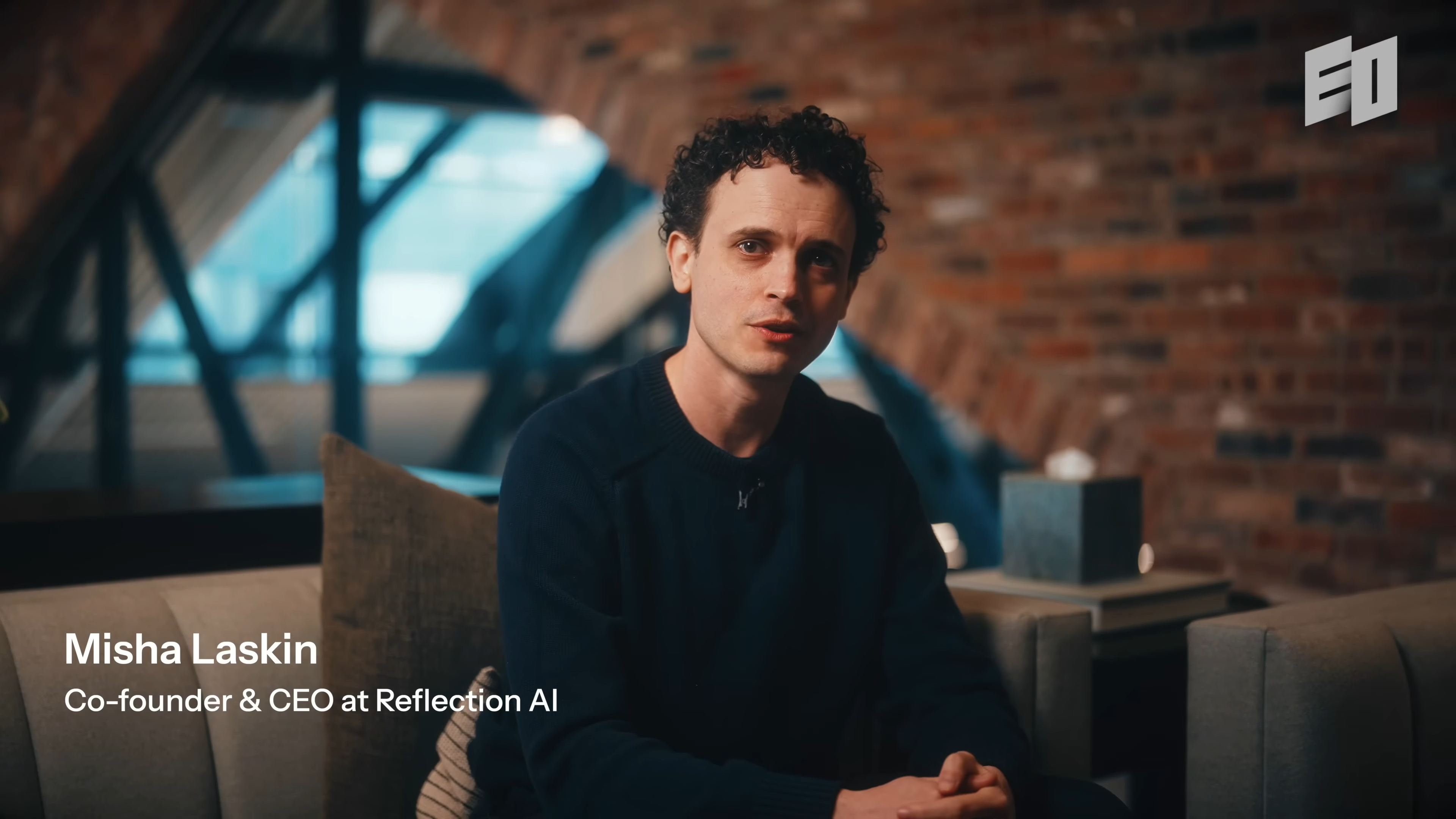
I'm Misha. I'm the CEO and co-founder of Reflection. At Reflection, we are building superintelligence. The question is how. Our belief is that if you solve the problem of autonomous coding, you will solve the superintelligence problem more broadly. That's our path.
In terms of how we got here, the team pioneered a lot of breakthroughs in AI over the last decade. My co-founder Ioannis was one of the key architects of systems like Deep Q-Networks and AlphaZero. Ioannis and I worked together very closely on Gemini, where we led a lot of the post-training work for producing Gemini 1 and 1.5.
We realized that two ingredients had come together that would enable you to take these language models and create not just useful co-pilots or chat assistants, but intelligent, capable, autonomous systems. These two ingredients: large language models are very broad in general, and the other ingredient was reinforcement learning as a technology, which enables scaling up the autonomy of language models. We thought these two ingredients had come together, were mature enough technologically, that you could combine them and produce a highly capable superintelligent autonomous system.
From a boy who loved physics to teaching myself AI
I was born in Russia, and when the Soviet Union collapsed, my family and I moved to Israel. I don't remember this, I was one. I grew up the first half of my childhood in Israel, the second half in Washington state, because we moved around fairly frequently. I didn't have the same long-form bonds that some other people do when they grow up, lifelong friendships going from childhood all the way to adulthood. As a result, I actually ended up spending a lot of time, especially when we were in the States, alone and with books. My parents brought a lot of books to the States, and I did have friends, but I also spent a lot of time after school just looking at my parents' library, reading various things. At the time, as a kid, you start feeling pretty lonely about that, but looking back, I don't think I would have cultivated the interest that I did if I didn't have a lot of time on my own to be bored and think. In some sense, boredom is a gift that you only appreciate in retrospect.
I was interested in physics and in literature when I had all this time on my hands, but ended up hard committing to physics. The reason was that when I read about all the most impactful science that had been done and the technology that produced, I would look back at the technological artifacts that we have today and try to derive how those originated. An example is a computer, obviously an incredibly impactful technology everyone uses today. I was asking myself, well, how was that invented? You can trace it back, you can go much further back as well, but really there are some core components invented that enabled this, and one of them was a transistor. A transistor was invented by a theoretical physicist named John Bardeen. Similarly, when you think of technologies like GPS and you trace back to what is the ingredient that enables those technologies to work, it turns out it's also physics. GPS relies heavily on Einstein's theory of special relativity.
I wanted to work at that root node of the science that will enable everything else that comes after it. I wanted to be working on the stuff that, if we look at the technology we have a few decades from now and trace back to what was the breakthrough that enabled that, I wanted to be working on those things. That's what got me interested in physics.
What I learned when I was in the PhD was that you have to think about the science, but not just the impactful science of any time, you have to think about what is the impactful science of the time today. The work in physics that I was reading about was basically done anywhere from sixty to a hundred years ago. That's when all of these impactful inventions were made. I realized that the field, at least for me, had crystallized a bit. It was hard for me to see what foundational breakthroughs I could be a part of, and not necessarily individually, but as a team that would enable the next generation of technology.
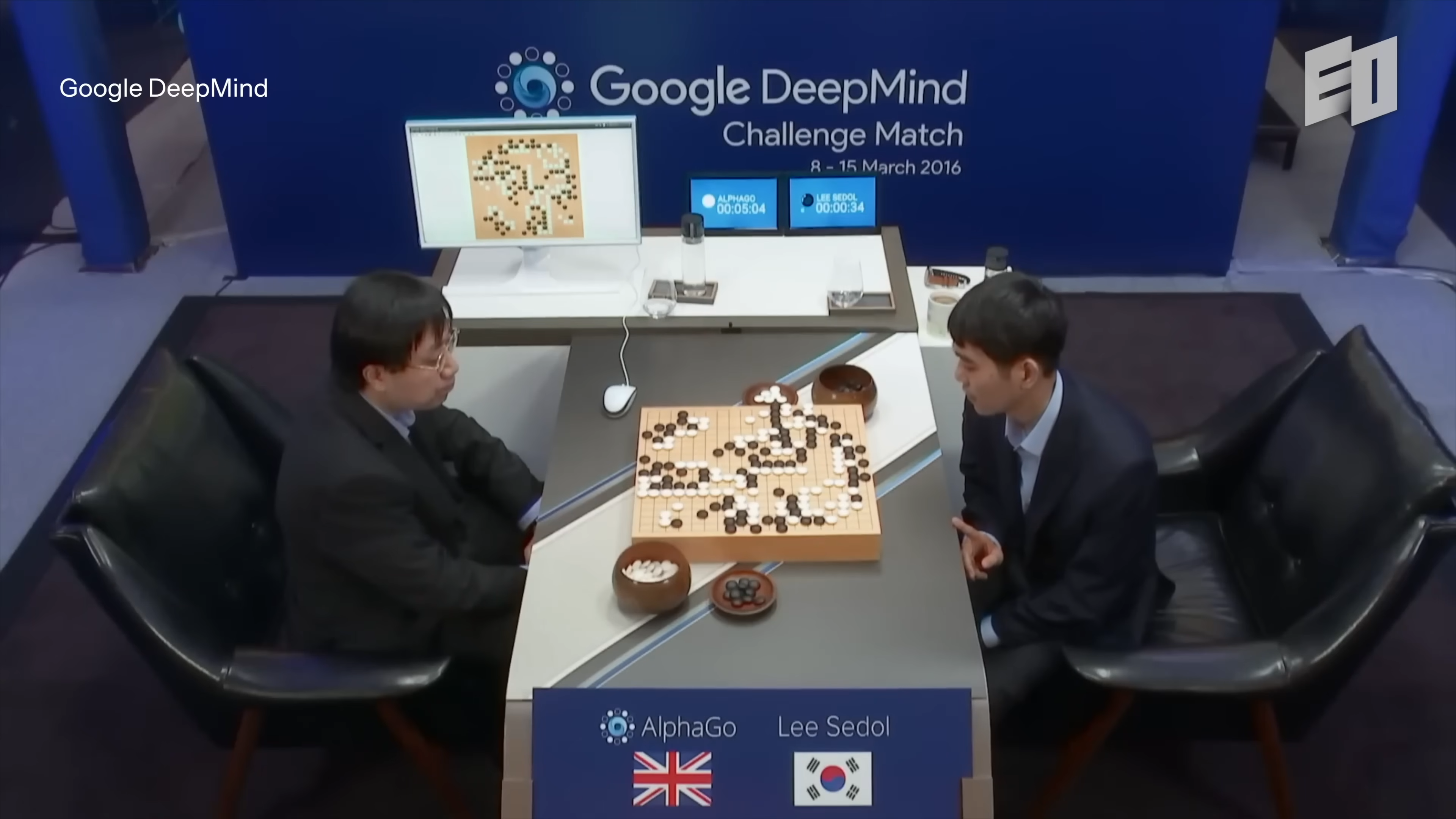
At the same time, I saw deep learning as a field taking off, and right around this time AlphaGo happened. AlphaGo was, I would say, the first major worldwide proof point of superintelligence, of a neural network being trained to master a very complex board game, Go, at a level that was more intelligent than the most capable human player. I thought there was something really fundamental going on here, and I had to understand it, effectively, inside out. So I actually ended up dropping what I was doing and self-teaching AI for it must have been four or five months, and made some progress there, where I started doing some independent research that opened up some doors after that. But it was really the realization that AI, and in particular deep learning and reinforcement learning, were these building blocks, these foundational ingredients of the science of our time that will lead to the most impactful technologies within the next few decades.
There are a lot of similarities between entrepreneurship and research and science, but it is this ability to look at a problem that looks really complex and messy and be able to reduce it down to some core set of principles that are actually guiding the direction of that problem. For research, it could be, the problem we're interested in, let's say, is autonomy. We really care about getting these large language models to be capable and autonomous, and the question is how do you do that? How do you train them to do this? There are all sorts of ways to pursue this question, you can go in many ways, but there are typically only one or two things that really move the needle in a very major way. This framework that physics gives you for thinking about things allows you to come in with that assumption and, rather than looking for hundreds of solutions, really try to find the most impactful ones, but then have some rigor in your thinking that allows you to reduce it to those base components.
I'd say that's true for all aspects of company building. There's the research part, there's the product part, there's the customer part, and typically in any one of the major buckets of company building, there's one or two fundamental problems, and everything else doesn't really matter. The question is, how do you identify those one or two fundamental problems that will move the needle, that will solve your customer's problems, that will be packaged in the right way as a product, that will make it easy to use, that will yield the research breakthroughs that you're looking for. I think physics is very helpful for thinking about these problems.
Why I left DeepMind and the key lessons from building Gemini
Big labs have a lot of things going for them. There's a lot of compute, there are a lot of talented people, there are many problems that are suitable for solving in a big lab. Ultimately, we thought at the time, this was after the launch of Gemini 1 and 1.5, the paradigm for how people were thinking about things was basically building more capable chatbots. What we were deeply interested in, since before this, kind of independent of our time at DeepMind, this is why we got into AI, is the problem of autonomy.
We really wanted to work on that, and we felt that it is both a research problem and a product problem, because suppose you build this really great, highly capable, autonomous intelligence, how do you know if it's actually working? How do you know if it's solving people's problems? One of the things we believe at Reflection is that the evaluation that matters most is the real-world evaluation. If you're not working with customers and you're not building product, you're not actually evaluating your technology in the place that matters. We just felt that we'd be able to move faster on the research with a smaller, more focused team, and we wanted to be coupled very deeply with product and customers, to make sure that we were steering our research in the right directions.
It's really hard to take a large organization that already has a product direction, it's a big ship that is going in a certain direction, and if you internally believe that it should be going in a different direction, it's really hard to course correct. It's basically impossible. This was the main impetus for starting as a company rather than doing it in a large lab.
There are several insights that continue to resonate today from building Gemini and systems before that as well, but I can keep it specific to Gemini. One is that the things that tend to work at this level of scale, these are giant models, it's hard to comprehend how big these models are. Maybe to give a baseline, the neural networks people were training say five years ago were ten-million-parameter neural networks. A hundred-million-parameter network was considered huge. DeepSeek came out, and it's over a six-hundred-billion-parameter neural network. These systems are massive.
What ended up happening in AI, before the era of scaling, is that sophisticated, complex ideas won. You'd take something small and have really complex, almost mathematically sophisticated ideas, and those seemed to work. In the era of training these large systems, and Gemini in particular, it's the opposite. The simple ideas implemented at a great level of detail are the things that work. You almost had to flip a switch in your mind about how to approach research problems, from adding increasing complexity until it works.
An example of that is IBM Deep Blue, the system that beat Garry Kasparov in chess. It was a very complex, tree-like structure that elicited all possible moves in chess, then picked some of the best ones.
The opposite is true for training these large language models. The objectives are very simple, like predicting the next token or the next word, is a very simple objective. The reinforcement learning algorithms tend to be pretty simple. My co-founder Ioannis and I led a lot of the work in what's called reinforcement learning from human feedback, or RLHF. If you look at public work on how other large-scale models were trained, like Llama or DeepSeek, they're very simple algorithms relative to what reinforcement learning researchers were thinking five years ago or a decade ago. These are very simple algorithms. Maybe that's a thing that stuck with me, that doing simple things with a great deal of craft and attention to detail, and building the right infrastructure to be able to support these large models and run them efficiently, is probably the biggest takeaway.
Why autonomous coding is the fastest path toward AGI
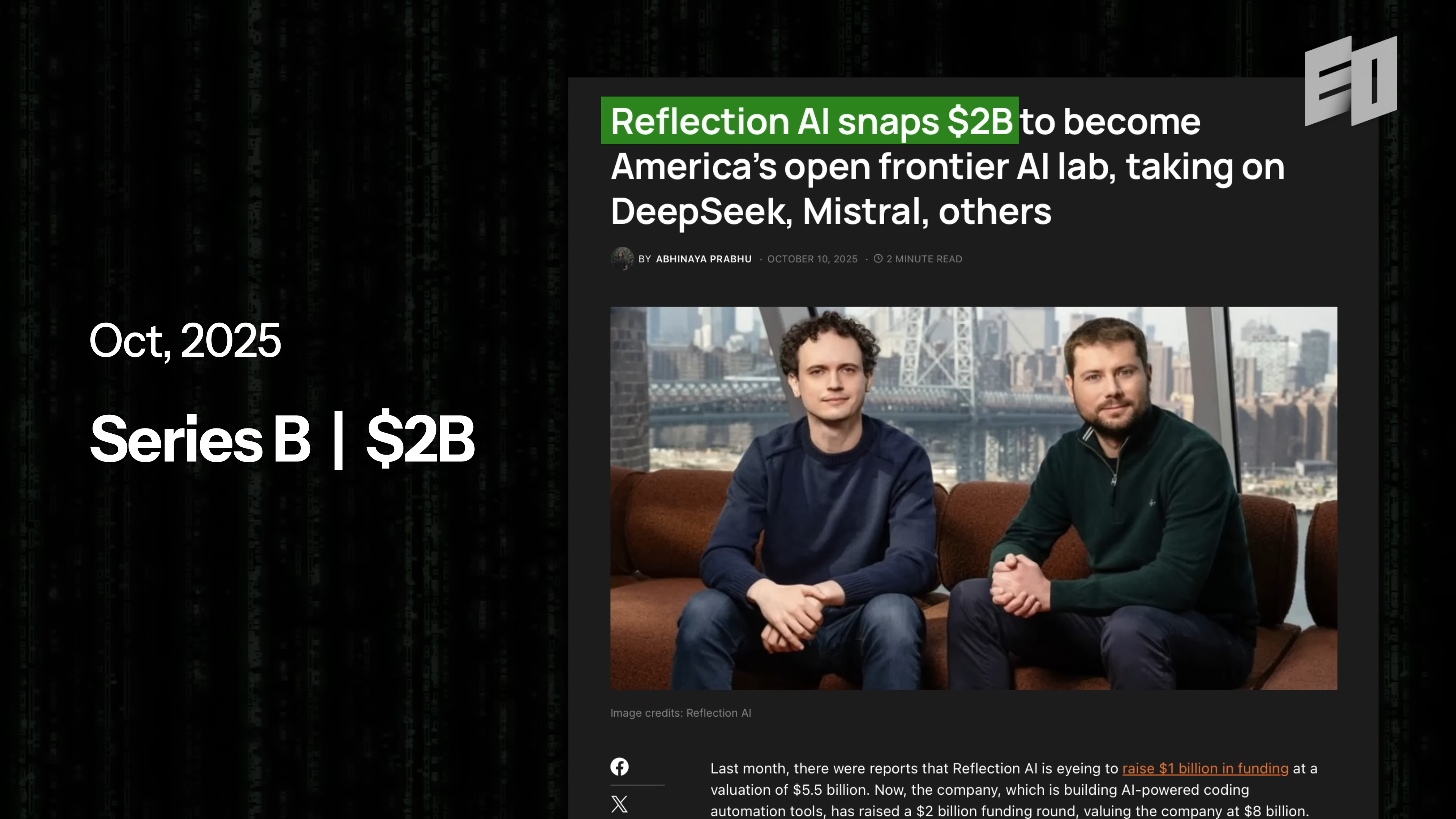
My co-founder was one of the people who made key contributions to the project of AlphaGo, and he was one of the handful of people who flew out to the match with Lee Sedol. I think the thing that really made me internalize deeply that there's a superintelligence here, and imagine what those things might look like in the future, and I think this was true for many other people as well, was Move 37. This was a famous move where AlphaGo, in its match against Lee Sedol, made a move that looked like a mistake initially. It looked like potentially a bug. Some members of the team thought that, in the same way that language models hallucinate, like they'll sometimes make something up, that this was the game agent basically making up a move that was incorrect. It seemed like Lee Sedol, or at least the commentators, thought that as well. A few moves later, maybe ten moves or something like that later, it turned out that this was actually a brilliant move that was smarter than anything that any of the humans who were viewing the match could have imagined. It was so smart that everyone thought it was dumb.
What that meant was that an AI system had discovered a strategy that was fundamentally more creative. It made me think about what a world will look like when you have Move 37s across every category of knowledge work. A mathematician asks an AI to do a certain task for it and comes back to it with a Move 37. It comes back with a proof that the mathematician had never even considered, that was correct.
What I think will end up happening is that in the same way that some people are starting to feel the AGI now, where there are semblances of sparks of intelligence, we'll start getting to this point in time in the not-so-distant future, probably in the next couple of years, where we're starting to feel the ASI, the artificial superintelligence, where Move 37s start popping up across different areas of knowledge work and doing things that basically expand our creativity. Because when Move 37 happened, it actually expanded our knowledge of the game of Go and what was possible. It happened, and now there's this new strategy that people are aware of. How do people who play chess or Go interact with AIs? They actually learn from them. They learn to get better from interacting with these AIs, and I think we'll start learning a lot from these systems in the coming years, and that's very exciting.
Given that, there are some things that I have maybe an unconventional opinion on that other people might not think about. I won't speak for other people, but I do think that one of the premises that we deeply believe in at Reflection is how fundamentally important the coding problem is, and specifically autonomous coding, the ability for an AI system to autonomously code something on a computer and go from task to something that's completed, and give that to the user. I think it's a common way to think about such systems, that they're going to be useful for software engineers. That makes sense, coding is what software engineers do. A point of view that I have, and it's not just myself but our team at Reflection, is that coding is going to transcend software engineering. It's going to go much further beyond that and touch basically every other category of work on a computer.
The reason for that is that when we think about how a language model is going to do work on a computer, we have to think about what is its embodiment. What is the natural way for a language model to interface with a computer? Effectively, what are its hands and legs? For people, we have really strong spatial priors that were evolved through millions of years of evolution, and so we have hands, we're dexterous, and we have really good innate spatial reasoning. We're born with it. Language models don't have that.
They were never evolved, they were trained on the internet, and so what's intuitive to us is not intuitive to them. They don't have the spatial reasoning that we do. But what's intuitive to them is coding. There's a lot of code on the internet, and the same way that we can very easily, almost trivially, without thinking about it, reason spatially about objects, language models are that way with code. It's just intuitive to them. When we think about what is the way in which a language model interacts with any piece of software in the future, it's likely not going to be by moving a mouse around like humans do and using the human UI, it's probably going to be through code. Most software we think will open up these language-friendly UIs or interfaces, and they're going to be mostly programmatic. A thing that we believe, that maybe isn't deeply internalized yet but is definitely internalized by some, is that if you solve autonomous coding you solve intelligence on a computer, and it transcends software engineering.
As I got started spending more time in AI, I think the ambition of what we'll be able to achieve, not me personally necessarily, but as a field, and this is something that personally drives me to be a part of, is that we are on the cusp of building a general superintelligence. Even a few years ago this would have sounded like complete science fiction, but this is going to be the most impactful technology of our time. It's hard to say what the world will look like after it, but it's hard for me to imagine being part of anything more impactful or exciting from a scientific perspective. This is not necessarily even a nice-to-have. A property of this that is pretty remarkable is that it's not just research, it's not just science in a vacuum, these systems are really useful today. You co-develop, instead of having to wait three decades to see your science have the impact that you're looking for, you're co-developing the science and the product together. That's what drives me, the mission of building superintelligence, because it is the impactful science of our time, and the luck, I would say that we have, is that this research is useful today.
My worldview on how humans interact with AIs, as these systems become superintelligent and start impacting the labor market, comes from a position that this is not a zero-sum game. It's not like there's a fixed quantity of labor that either a human does or someone else does. Each time there's been a technological advance, it actually just increased the amount of things we could produce. With intelligence, that increase is the amount of ideas and theories and experiments and software that you can build. What I think the world looks like a few years from now, as these systems start becoming extremely capable, is that they lift everything up, and we end up creating, in almost every field of computer-based work, and in the future also physical work, an order of magnitude more, or even more than that, than we're capable of creating today.
What that means, though, is that today, in the same way that we collaborate with colleagues, we have colleagues and we work with teams, and ambitious projects take big teams, not big in the sense of thousands of people, but you need a cohesive team to accomplish something big together. I think in the future it'll be that, take the example of an engineer, a software engineer will become more of a software architect. They have this AI workforce at their disposal. The same thing will be true for other areas of knowledge work, where we become architects that manage an AI workforce.
The thing that will still be really important is asking the right questions, because basically if you have a really competent AI system, it will do more or less what you ask it to do. The challenge will be how do you pick the right problems to work on, how do you pick the right questions, which, by the way, is the whole challenge today with starting a company or pursuing a career in research. The fundamental thing to ask is what is the right problem to solve, and then you also have to execute it. You have to put in a lot of work to execute it, and imagine in the future most of the burden will be on asking the right questions and designing those projects and problems correctly, and the execution will be done by an AI workforce for you. I think that's roughly the paradigm that we're going into.
A framework for clear thinking and asking the right questions
On asking the right questions, I mean it more in the concrete sense of, suppose you have a job in a creative pursuit and you want to do a good job at it, there's some uncertainty in it, either you have to build a new product, or figure out some research breakthrough, or make a piece of art that actually resonates with people. There's one thing of making art for yourself, but if you want to make art that will resonate with people, that's another thing. How do you know what to pick, how do you know you're going to be right? That's kind of what I mean around asking the right questions.
For example, in the next year there's going to be one or two breakthroughs in AI. Every year there are basically one or two breakthroughs in AI. How do you discover one of them? What question should you be asking to discover one of them? It's really hard. I don't have an answer to it, but I guess I mean it in that sense, suppose you had these really superintelligent AIs, you just needed to point them in the right direction. What direction would you point them at, and how would you ask them the questions to elicit those behaviors?
Another concrete example I'll give is that during reinforcement learning before language models, this is like AlphaGo days, it would take billions of steps for a reinforcement learning training to get an agent that was competent. People were looking at that and saying, wow, billions of steps, that's so long, how do we make it more efficient? That was the question people were asking. How do we go from billions to make it ten times more efficient, so now it's hundreds of millions, and ten times more efficient, so it's tens of millions. I was asking that question myself, and that was the wrong question to ask. The reason you wanted to make it more data efficient is because you wanted to get these general agents, and the way people thought about getting general agents was just make them really fast to train. It turned out that the right question to ask was basically to invent language models, because language models, without any of this reinforcement learning training, became very general. If I would have thought about it that way, then I would have picked a different research question to work on. There are plenty of examples where I made the wrong, even if it was locally the correct answer.
There was a question on the list around one of my papers called CURL, a highly cited paper, cited a thousand times, and it was an impactful paper locally, so it got citations, but it asked fundamentally the wrong question, which is why it was cited a thousand times and not a hundred thousand times. The people who are asking the right questions write the papers that become the first sentence in every other paper. The first sentence of every language model paper is, language models have become very powerful, cite GPT-4. Picking the right thing is the hardest thing, so I definitely will not claim mastery over this. It's something I think about a lot, but if I was a consistent picker of the right things, I would have discovered ImageNet, built AlphaGo, basically built every single breakthrough that's come out in AI, and more widely too. Picking the right thing is really hard.
But some frameworks that at least I use to think about it come down to clarity of thought. It's hard to just have off-the-cuff clarity of thought, you need to have some way of formalizing what it is that you're thinking, and for me personally, it's writing. Oftentimes when I try to express what it is that I'm trying to achieve, or a method that I'm trying to approach, I'll express it in writing. I'll write it down, and then kind of, almost in short essay format, revise it, because writing oftentimes exposes lack of clarity in thought. Every sentence should have meaning and should have a reason for being there. When you do a first pass on how you're thinking about a problem and you write it down, you realize how many holes there are in your thinking, or unnecessary parts of your thinking, and you can strip those out and iterate with yourself through a writing process. For me at least, this has come through writing, and maybe it's because, as a kid, when I was really interested in both literature and physics, I spent some time writing short stories. I wouldn't say those are any good, but I'll say that the version of the short story that I had written after several iterations was way better than the initial version. Making the right decisions and asking the right questions is a very hard thing, but I think that writing is one thing, and then discussing with other people that you think are very smart and trust, but in a critical way, in a way that you're not looking for someone who will just support your idea, but you're looking for someone who will challenge and find the holes with you. Those are the two main ways, at least for me.
How Reflection AI reached an $8B valuation in just a year
For any startup, I would say it's not like there's one particular hardest time. I think hard times accumulate over different stages of the company, and they're probably all equally hard. But in the very beginning, the thing that's hard is you come in and you have a blank slate, and it's about reducing that blank slate into something that is much more directed and focused, having clarity around how it aligns with your long-term mission, what you're trying to achieve, but also, short term, that it's a thing that will work and get you to the longer-term objective. Having clarity on that is really important, and it's quite hard in the beginning of a startup to develop that clarity. This is why when people call something a pivot, it's really a startup took a bet on something that did not work, and then they developed some clarity and pivoted to something else. I think that's the first trial that you go through in a startup, figuring out exactly what it is that you're doing today. You know what you want to achieve long term, what are the first steps to that.
The second thing is how do you get the best people in the world to work on this with you. There's a simple answer that's hard to execute, which is the best way to get the best people to work with you is by hiring the best people. What I mean by this is that it's really hard to build out a stellar team if you don't already have stellar people. Given that there's so much uncertainty around startups, people who tend to be attracted to startups are ones that are interested in building something from scratch and partaking in the growth and the upside of that. But why would they bet on you versus another company at a very early stage? Oftentimes, if you have an excellent team that you've assembled, even if it's a kernel, five really strong people, good people beget good people, and it's really important to make the first few hires extremely high-caliber people who you have a great deal of trust with. That was a challenge, but once that was solved, good people attracted good people, and it has these compounding effects.
In terms of motivation, it also comes down to what's your long-term strategy and what's your short-term strategy, and are both of those things compelling. It's almost like in AI there's this idea of system one and system two thinking, system two being more high-level, abstract planning, system one being kind of local, reactive. I think you need both of these components to build a company.
The nice thing is that when you set a really ambitious mission that's exciting, building superintelligence is exciting to a lot of practitioners in AI. That's why I got into it. I would join a company that was trying to solve superintelligence.
Having a really ambitious mission helps attract really good people, but that's not enough. You have to have clarity on what it is that you're going to do today that will get you there, and how is your bet. It's not about the bet being different, but why is your bet right? Why do you think you're correct when others are wrong? Because the alternative is to stay at a big lab that is also pursuing general intelligence, and these labs have cast a bet, and you can join a big lab and ride that bet out. You have to have good reasons for why you believe your short-term wedge into the broader mission is compelling, why this is correct, and in our case it's focusing solely on autonomous coding and nothing else, and we have reasons to believe why that is the correct bet if you want to aim at the problem of superintelligence.
I think that's the way you motivate people, by doing something really ambitious. I had a previous startup before this, and we did something much smaller, and it was actually really hard to attract good people to work with us, because you have one life, and people want to work on the thing that will be most impactful to them. Building superintelligence is, I would say, at a similar level of ambition as taking people to Mars, building rocket ships that go into space and take people to Mars. Even though that seems really out there and difficult to achieve, really talented people are attracted to very hard problems and very concrete approaches to solving those problems.
Three lessons that shaped who I am today
The way to deal with setbacks, I think there are basically two main things. The first one is to deeply care about what you're working on. It depends on what inspires you, but for us it's the mission that we're going after and the approach. We just deeply care, and I deeply care, and that's really motivating. You have to deeply care about the problem, and then you have to deeply care about the people who are working with you on the problem. With those two things, things that would otherwise feel like setbacks don't really feel that way. Maybe it's because researchers have operated their whole career in uncertainty. That's the whole game, you try to pick the right problem, there's a lot of uncertainty around it, there are a lot of setbacks, and you persist so long as the problem is really interesting to you and you feel like the approach that you're taking is fruitful. Unless you learn that some new evidence comes in that maybe you need to change your approach, then you need to do that. But then that's not really a setback if you're deeply interested in the problem, that's more of a learning.
The setback would be doing the wrong thing, the incorrect thing, forever. That's a setback. But doing the incorrect thing at first, then acquiring some evidence, maybe from a company-building perspective, it might be that you have an idea for what a product might look like, you show it to customers, and then it turns out they find something else valuable in it that you didn't think about. Some people consider that a setback, but that's actually something you want to accelerate your time to. If you don't feel like you have these sorts of setbacks, then you're probably not making progress. The important thing is to deeply care about what you're working on, with the people that you're doing it with, and to have momentum, taking action and making progress.
When I look at the past year, I don't really see any setbacks in that sense. There was new information that was learned that changed direction for us on research and product. There are always setbacks in terms of, maybe a really good candidate not really wanting to join, but you have to take the aggregate view of what is the general vector that you're on. Are you learning things constantly? Are you, in aggregate, hiring really good people, even if some of them aren't converting? As long as there's that kind of momentum, I think setbacks don't affect, not necessarily just myself, but the setback doesn't feel as painful when you have clarity of what you're pursuing.
If I was giving advice to my younger self, or to my two younger sisters, what advice would I give them, or other people? A piece of advice might be around picking the right thing, pursuing your passion, these sorts of things. But something that is underappreciated, I think, is surrounding yourself with the right people. If you have an internal vector of interest, you want to do something that's impactful and interesting to you, but so long as you have that, in the same way that it's important in your personal life to surround yourself with very high-quality friends, I think the thing that has been most impactful to me, when I look at how my last decade has played out, was surrounding myself with the right people who, at that time, would take a chance on me.
For example, at Berkeley, I would say Pieter Abbeel, who took me in at his postdoc lab. I was a physicist, I was not an AI person, and AI was very competitive then, but by being in that lab and surrounding myself with people like him and his PhD students, that's what really enabled me to learn quickly and develop my thinking. Oftentimes, what you're able to achieve is really a function of who you're spending your time with. Very talented, ambitious people are also generally quite open to giving back. Of course, it's hard to get in front of them, so it's not like sending a cold email is enough, you have to really demonstrate that you want something badly, and demonstrate it through actions, not just words.
In my case, I spent a few months and I taught myself reinforcement learning, I did a research project, I had something clear and concrete to bring to the table and get people's feedback on. But so long as you're persistent, you're able to show your desire to work on something through action and not words, that's a very rare thing for a person to do. People who have been successful in whatever industry, I think, will look positively on that. You can get into almost any door that you want with sufficient effort, and it's just really important to surround yourself with the right people to enable you.