Ask 10 founders what "go-to-market" actually means and you'll get 10 different answers. For one it's a sales motion. For another it's a content calendar, an influencer partnership, a pricing experiment. But for Dale and Dalton, it means exactly what it says.
"The best go-to-market strategy is literally going to the market."Dalton and DaleCo-founders of WonderSearch
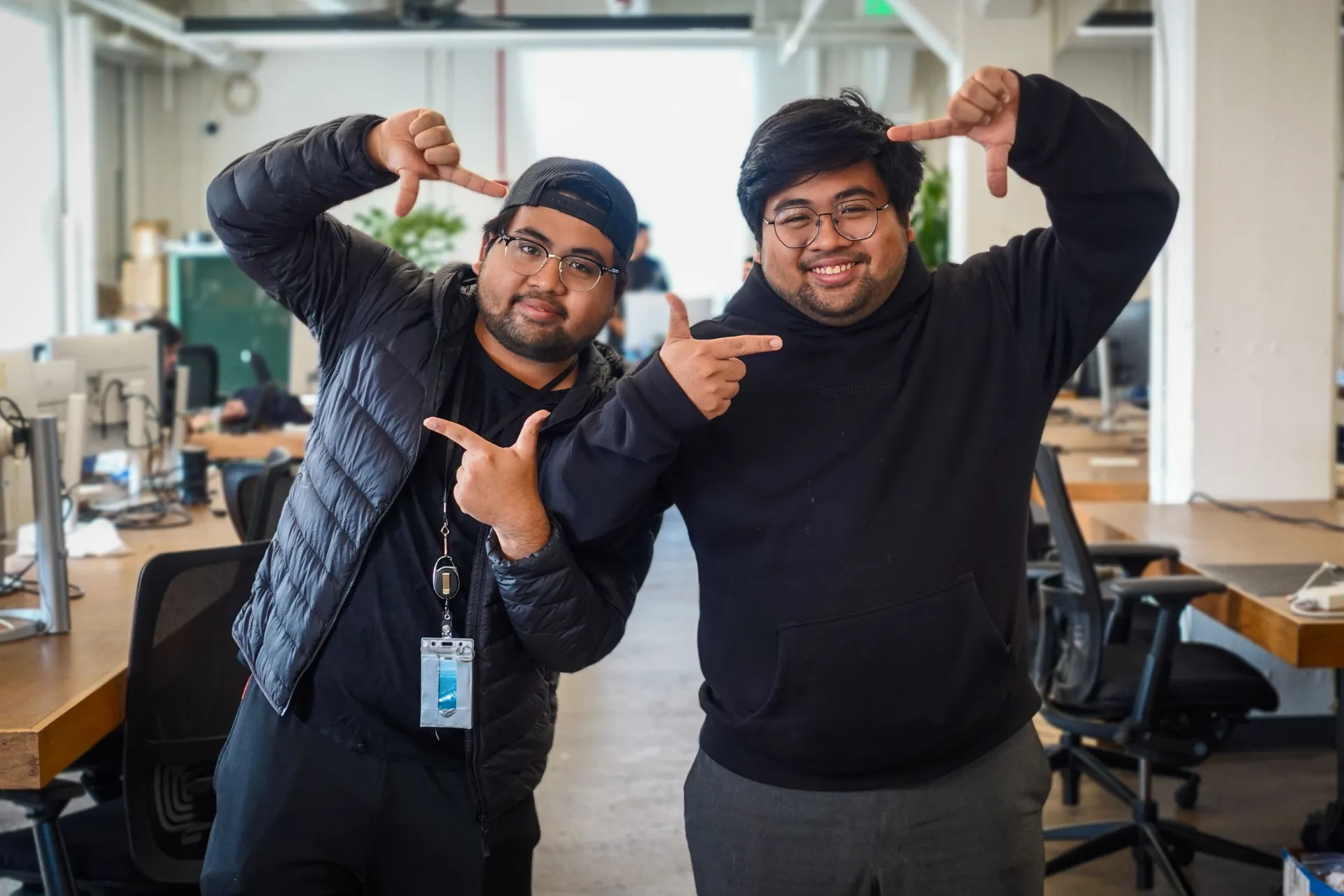
Dalton and Dale Ng are Singaporean twins behind Polygres, an AI retrieval platform built on Postgres. Three weeks into Y Combinator, they launched a second product out of it, WonderSearch, which makes a company's data searchable by AI without embedding it first. Earlier this year, one VC told them their market was too small. So the twins flew to Thailand with exactly one meeting booked. There, they found the pitch that actually worked. Along the way, they doubled down on a ritual they still swear by: get the heck off localhost, and stay obsessed with talking to customers, no matter what role you hold in the company.
Dalton and Dale are among the few teams Founders, Inc. chose to fund directly, followed by an invitation to join Y Combinator's Fall 2026 batch. I visited them to hear the twins' full journey, from Singapore to Thailand to San Francisco.
Launched to Crickets
Before Polygres, there was Master, an AI edutech company the twins started as teenagers. It launched to crickets, and it taught them to distrust their own assumptions.
Q: What made you want to start a company in the first place?
Dalton: When I was 14, I went to SF on a school trip, and it felt like an awakening. Before that, I never considered that I could start a company. But in SF, I saw people quit their jobs and drop out of school to build companies. When I came back to Singapore, I immediately started a software dev company, and I've been building companies ever since. I'd started coding even earlier, at 11, building Minecraft mods on the family laptop we all shared. Dale joined me when we were 16, and by 17 or 18 we'd properly started a company together.
Dalton taking a selfie with Tim Cook during his visit to SF.Courtesy of WonderSearch.
Q: What was the first thing you two built, and why didn't it work?
Dalton: The company we started was an AI edutech company called Master. We were 17 or 18, so the products we could come up with were close to home, built for students and sold through our own network. It never got enough traction, so we shut it down a year or two later.
The biggest lesson was that you need to talk to your customers a lot more than you think, because it's easy to make assumptions. The buyer and the user were two different people, and we didn't spend time talking to either. We had an idea we thought was really good, built it, and launched it to crickets. We'd looked at likes and wait-list signups, and those didn't convert. That's why we now focus so much on avoiding fake signals.
The second lesson was that there's no such thing as a part-time founder. We built Master part time. If you're not spending 24 hours a day obsessed with your company at early stage, you can't compete with everybody else, because you're competing with someone who is.
Dale: Startups are a brutal competition. Maybe only the top 1% to 5% of people who contemplate starting a company actually survive. The day I quit to go full time, it was a massive difference. YC said it best. If you aim to be an average startup, you will fail.
Q: Dale, what got you into growth and marketing?
Dale: My interest in growth marketing isn't really about producing content. It's about understanding how people interact with trends. It started when I was very young. I loved trading CS:GO (a multiplayer shooter game) items, and you learn a lot about marketing from trading virtual items, because the entire item economy is built on it. My first internship was at a fintech company. Within the first month, they promoted me to head of international community, managing about eight people.
One mindset has worked for us: you need to make your customer your muse. You almost need to fall in love with your customer, feel the same pain you're trying to solve for them. If you build a product purely to sell, you don't get the same result as one built with deep understanding and love.
Burn Your Bridges, Burn Your Boats
At the end of last year, the twins started building an AI-native OS for companies. Dalton went at it with the lesson his previous startup had taught him: go all in, and leave no way back.
Q: How did the idea for Polygres start?
Dalton: We started the company a couple of days after Christmas last year, building an AI-native OS for companies. At that point, AI was still mostly being deployed by engineers. For most people, it was limited to using ChatGPT or Gemini. We wanted ours to be as easy to set up as Shopify. The current AI stack is more like setting up WooCommerce and WordPress yourself.
When I believe in something, I go all in, and I mean really all in. I sold my car, my guitars, my amps, and told the team I wanted everyone to quit their jobs. We did, and had no traction for about three months, so we spent a week talking to users. Burn your bridges, burn your boats. If you don't give yourself a second option, you're forced to succeed, forced to do things you don't want to do. In my case, I had to call users and negotiate contracts, which I hated. We started closing customers, but it took a lot of effort, which to me was a signal we were doing something wrong. Good products are easy to sell.
Q: After a Singapore VC told you your market was too small, why Thailand, and how did that trip go?
Dalton: We already had contacts there. We were building the AI-native OS for service companies like dental practices and salons, and Thailand has a huge beauty tourism industry. We landed with exactly one meeting booked. The plan was to get an intro to another company from that meeting and keep stacking introductions.
We ended up meeting four huge companies alongside a bunch of smaller ones. For the smaller ones, I'd walk straight into salon and beauty shop HQs and say at the door that I had a meeting. They'd wave me in, someone would check who my meeting was with, and I'd talk my way into one anyway. It doesn't work in Singapore, which is much more conservative. But in other parts of Asia, walking in and talking to people works pretty well.
We'd only built the backend, since the front end was still in progress. When we sat in front of the enterprise companies, they told us straight up they wouldn't buy our front end, but they would buy our backend. That's how we closed our first enterprise POC on that trip. Two hours after that meeting, we pulled the feedback together and decided to pivot to selling the backend. That backend became Polygres's retrieval platform. We built a new pitch that same day and tested it the next day on a different company. It landed like a world apart. They called in all their engineers to listen.
Dale: We didn't lose conviction in the product. We realized the customer wanted something different. The obsession is solving the problem for the customer. You do it until you hit product-market fit, or die.
Signing a memorandum of understanding with True Digital Park in Bangkok.Courtesy of WonderSearch.
Q: What's the biggest argument you two have had building Polygres?
Dalton: When we were building our pitch deck, we disagreed on our messaging. We concluded that both of us were wrong, and that we should talk to 100 users. So we did. It was a crazy experience. Back-to-back 15-minute calls, 5 to 10 minutes apart, over a couple of days. One insight came straight out of those calls. At a specific point, users leave a traditional database like Postgres and add dedicated databases for vector and graph work. Even with extensions like pgvector, that point was usually around 1 million vectors. We call it the "great migration," and most of the users we talked to brought it up themselves.
Q: What happened after Thailand, and how did you find your first users?
Dalton: We started posting on X, and that's when we decided to go all in again. Our first launch wasn't even a product. It was an open-source repo called pgGraph, and it eventually went viral. So did pgContext, which followed. Imagine writing a full-length article by hand every day while running a company. That's what Dale was doing. He woke at 6 a.m., wrote an article, and posted it at 8. Then he went back to sleep, woke again at 2 p.m., and stayed up until 6 a.m.
Dale: You have to post around 8 a.m. US time, when people open their phones on the way to work. That's when Twitter peaks.
Dalton: Our first users were all senior data engineers at enterprise companies. Most had been trying to push a graph database internally, but graphs are expensive and require migration, so procurement usually says no. We need to sell the outcome, not the technology, which is why we now position ourselves as an internal search engine for AI.
When we came back to Singapore, we started pitching to VCs. One of them said he wouldn't fund us, but that we needed to go to the US, like Supabase had. So we took the leap.
A One-Star Motel and a Suitcase Desk
Getting to Founders, Inc. wasn't as clean as it sounds. It started with a rejected application to a previous batch. What got them noticed instead was a habit of posting in public, and rules they'd already started following before anyone at Founders, Inc. had told them to.
Q: How did you find your way to Founders, Inc.?
Dale: I'd known about Founders, Inc. for a while through its Canopy program. We applied late, since we were in Thailand doing enterprise meetings, and got rejected. After that, we posted a lot on X, launching our open-source repos instead of just talking about shipping, until they took notice and let us into the program.
Q: What happened during the flight and launch to San Francisco?
Dalton: We launched the first version of Polygres, which was bad, slow, and ugly, from a plane to San Francisco. We'd set it deploying at the airport. With no Starlink, we could barely send a WhatsApp message to monitor it. It was the most stressful flight ever, but we landed with a couple hundred users from the product's first public launch. Growth compounded weekly across the six-week Founders, Inc. program after that, 10% week-on-week, then 20%, then 30%, then 50%. By the last week, we were at 100%.
Dale and Dalton checking in for their flight to San Francisco.Courtesy of WonderSearch.
Q: What was it like living inside the Founders, Inc. community?
Dale: Founders, Inc. embodies the original Silicon Valley hacker culture. I sat at a table where the person next to me was building an underwater autonomous drone. The team behind me was building military simulation technology, and there was a strawberry-picking robot a few tables over. It's a place where you don't need permission to build whatever you want. We give brutal feedback and don't mince words, but it comes from pure respect. Polite feedback isn't real feedback.
Dalton: On day one, they told us their two rules, which we'd already been living by before coming here. The first is get the heck off localhost. The second is keep launching. So we try to launch something new, or relaunch the same product, every day or every other day if we can.
Q: Where did you live when you got here?
Dalton: When we got here, we couldn't find affordable housing. The first week, we stayed in the worst motel imaginable. One star, the stairs literally under construction, and the shower took about 10 hours to drain after each use, so we had to take turns. We found a place to rent the same way we found customers, by negotiating. The landlord said he couldn't lower the rent because California water prices are high. So we offered to take one shower a day, and eventually he agreed to chop the price. You've got to hustle to get customers, and you've got to hustle to find a place to stay.
Dale and Dalton sharing a pot of ramen in the Founders, Inc. kitchen. To save money, they live on ramen and Safeway's Friday deals.Photo by EO.
Q: Dale, how did you learn to hustle for customers as an introvert?
Dale: You don't wake up one day and you're good at sales. If you've never done it before, your goal shouldn't be 100 customers by tomorrow. It should be, how do I close one customer this week. I'm introverted by nature. I took a promoter job in school specifically to force myself to talk to people. Sales is a numbers game at the end of the day, so you shouldn't be scared of rejection. To close your first customer, you'll probably be rejected something like 99 times.
Q: Was there a moment that felt especially brutal, doing sales calls here?
Dale: It was a weekend of back-to-back 15-minute calls, in that first motel room. There were two of us with two different calendars but only one table, so Dalton was at the table and I was on the bed with a suitcase in front of me as my table. It was tiring and a lot of work, but it helped shape the product massively.
Compress Your Learning Cycle
By the time I sat down with them, Dale and Dalton had spent months practicing what they now hand out as advice. None of it sounds new. All of it, they've paid for once already.
Dale's profile on X, where the twins build in public.Source: X.
Q: You post constantly on X. What does building in public look like, day to day?
Dale: A lot of people want to build in public but only want to show the good moments. People don't necessarily resonate with success; a lot of the time they resonate with failure. So when you build in public, you need to be willing to call yourself out and talk about the process. It's scary. But you have to be willing to deal with that.
Nobody's good at this from day one either. When we first started posting on X, the first two weeks got us seven views and two comments total. One of our highest-converting pieces of content ended up being a song parody explaining our database. Our first launch post, we relaunched around 30 times over a month before it caught on. Most people only ever saw the version that worked and assume that's just how it went.
Q: Regarding fundraising in the US, how does it differ from fundraising in Asia?
Dalton: It comes down to liquidity and exit. VCs need to return capital to their LPs, and US and Asian LPs expect different exits. In the US, liquidity is high enough to IPO as a unicorn. In Asia, it isn't, so VCs look for other exits, like an acquisition by a PE firm or a corporate VC. Asia is also fragmented. You have a lot of big economies, but they're separated by cultures and languages, so you either dominate one country or find a way to sell to all of them at once. That's part of why a lot of VCs prefer you focus on the US first. For a startup, I'm still convinced nowhere is better than SF. It's the only place on earth where what feels impossible back home feels like something you can actually do.
Q: Is coming here with this mindset common among Singaporean founders?
Dalton: A lot of the people I know back home don't have the desire to move anywhere else. Singaporeans are quite comfortable in their home country, so moving to another country feels scary.
Q: For Singaporean founders who do want to come, what's your advice?
Dalton: Stop dreaming and start doing. Singapore can create a false sense of security, but you have to be prepared to risk everything. In the US, you have to be willing to uproot your life and build for about 10 years before you have a real shot. But I wouldn't be scared to pitch to US VCs and onboard US customers while still in Singapore.
SF is the one place in the world where I feel people value ideas and conviction more than where you came from. People rarely ask where I'm from except out of curiosity, and it never comes across as a qualifier. They ask what you're working on and what you believe in.
Dale: Talk to people in the US even before you've touched down. I built out an entire network of people in SF before I even reached the country. Be on Twitter a lot more, and post on US timing.
Dalton (left) and Dale (right) at Y Combinator, where they're in the Fall 2026 batch.Courtesy of WonderSearch.
Q: After being funded by Founders, Inc., you're now in YC's Fall 2026 batch. Why YC, and why now?
Dalton: We didn't see YC as a fundraising badge or something every startup has to do. The real question was whether YC would change Polygres' trajectory. We already had conviction about the problem. What we wanted from YC was pressure. Pressure to move faster and talk to more users. Pressure to simplify the story, so a technically ambitious product becomes something people urgently want and quickly understand.
Dale: Our biggest internal debate was timing. Infrastructure companies can always convince themselves they need another feature or benchmark before they're ready. We had to choose between perfecting the technology in isolation and putting ourselves somewhere that would force tighter feedback loops. Getting in felt less like a finish line and more like agreeing to run even faster.
Q: What was your first few weeks at YC like?
Dale: The vibe is intense, in an energizing way. On Day 2 we joked that 48 hours in, we'd already unlearned half of what we thought we knew about growth. We came in after months deep in infrastructure work. Then at YC the questions get brutally simple again. Who desperately needs this? How did they find you? Why did they come back? What can you change before you talk to the next 10 users?
Q: Three weeks into YC, you launched a second product, WonderSearch. Where did it come from?
Dale: It was spawned from a personal hatred of setting up RAG databases. AI search today is kind of stupid. You have to embed everything and set up pipelines. Semantic search meant embedding every document, every row and every chunk up front, and paying for it before anyone ran a single search. We flipped that. You connect your data, choose what's searchable, and search it by meaning, and you pay only when you actually search. The world's data should just be AI-native.
Dale's WonderSearch launch post on X, Sep 28, 2026. It drew 131K impressions.Source: X.
Q: What do you want to get out of your time at YC?
Dalton: Our biggest goal is to use YC to get sharper on who we're building for, which of their problems are most urgent, and how to explain what we do more simply. Most of that comes from conversations. We're already confident in the technology. YC is where we pressure-test the commercial side.
Q: Any last advice for founders just starting out?
Dalton: Your co-founding team is very important. Your skill sets need to be complementary, and you need to be close, family close. You don't have to work with your actual brother, but you should feel close enough to your co-founders that you could trust them with your life.
Dale: Everybody on your founding team needs to be willing to do the dirty work, and should be racing to be the first one to do it. If nobody wants to do the dirty work, it never gets done.
Dalton: Another successful founder in SF gave me this advice. As a founder, you'll complain about dealing with shitty things. But the number one thing you have to do is eat shit every day, as much of it as possible.
Dale and Dalton at Founders, Inc.Photo by EO.
Learn more about WonderSearch
- Dalton Ng — CEO & Co-founder
- Dale Ng — CTO & Co-founder
- Homepage | wondersearch.ai
- Video | Introducing Polygres (Founders, Inc., Jul 31, 2026)
- Launch Post | Today we're launching WonderSearch (YC F26) (Sep 28, 2026)