At a Glance
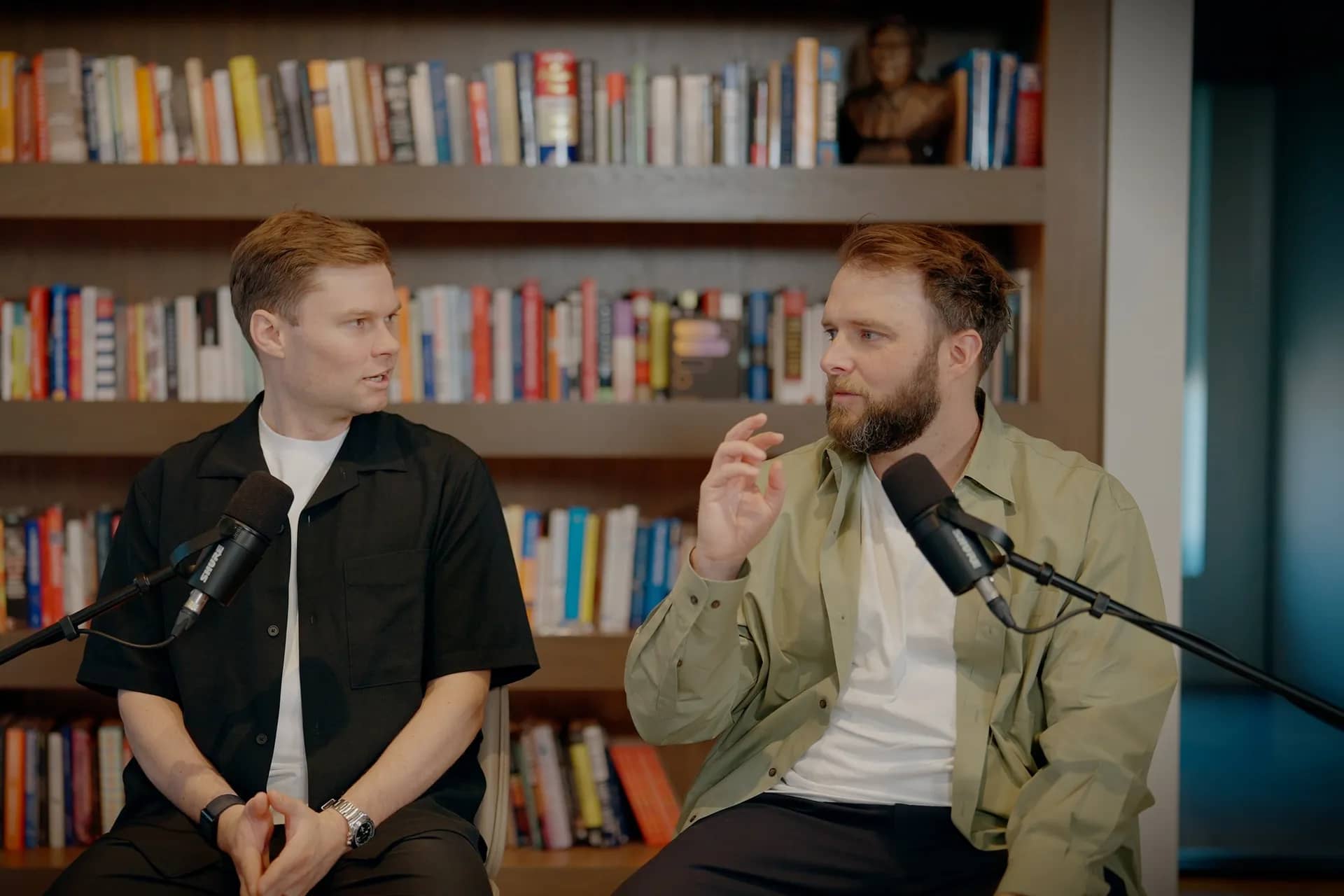
- Who: Matt Herbert and Connor Archbold, co-founders and co-CEOs of Tracksuit, who met eight years ago as colleagues at a previous startup where Herbert was the first SDR and Archbold served as COO
- What: Tracksuit is a brand tracking platform that makes top-of-funnel marketing measurement affordable through daily consumer surveys, replacing $200,000 enterprise market research reports with a real-time dashboard tracking brand perception
- Traction: Tracking 7,000 brands globally across four offices in Auckland, Sydney, New York, and London with 100 employees
In this interview, Matt Herbert and Connor Archbold reveal how Tracksuit makes brand tracking accessible for the 95% of consumers that marketers have overlooked, why they redraft their co-CEO job descriptions every six months, and how New Zealand's constraints produced a beta nation of globally efficient startups.
Key Takeaways
Brand building is about the 95%, not the 5%
Herbert explains that while marketing has spent the last 15 years perfecting measurement for the 5% of buyers ready to purchase, the real opportunity lies in the 95% who will enter the category later. Tracksuit measures how well brands connect with these future buyers through daily consumer surveys, making research that once cost $200,000 accessible to any company.
The co-CEO relationship must be designed, not accidental
Archbold emphasizes that a co-CEO arrangement requires intentional design of roles, communication patterns, and interaction norms. Herbert and Archbold redraft their job descriptions every six months and completed team behavior profiling in their very first weeks together, giving them a framework for navigating differences.
Team profiling builds self-aware organizations
Herbert describes how he and Archbold did personal and team behavior profiling when they started Tracksuit, mapping strengths, weaknesses, and friction points. They have since rolled this exercise out to all 100 employees, so everyone knows their role in any team situation and when it is their turn to step in.
Customer demand should pull you into new markets
Herbert explains that Tracksuit expanded from New Zealand to Australia, the US, and the UK because existing customers asked for coverage in those markets. Rather than racing to go global, they validated product-market fit first and only scaled when pulled by customer demand, now operating from four offices worldwide.
New Zealand is a beta nation for globally efficient startups
Archbold describes New Zealand as a beta nation: a small, highly engaged population where founders build efficient companies with limited capital. Companies emerging from this environment tend to have strong product-market fit, and Archbold credits New Zealand's constraints for producing startups that can scale globally.
Below is the complete transcription of the interview. Minor edits have been made for clarity and readability.
The 95% Marketing Forgot
Q. Tae(Partner @Altos Ventures): Maybe start with this. Could you please introduce yourselves?
Matt Herbert (co-founder and co-CEO of Tracksuit): Yeah, I'm Matthew Herbert, co-founder and co-CEO of Tracksuit.
Connor Archbold (co-founder and co-CEO of Tracksuit): And I'm Connor Archbold, co-founder and co-CEO of Tracksuit.
Q. Tae: Tell us a little bit about Tracksuit. What does it do? What problem is it solving?
Matt: Tracksuit is a brand tracking platform, the best way to measure top-of-funnel marketing. The problem that we're solving in marketing and brand building is that there are two jobs to be done: the 95% and the 5%. In any category, there are about 5% of people who are ready to buy from you right now. That's one job: go and get those people to buy your product and your brand.
But at the same time, there's 95% of people who will come into the category, aren't ready to buy from you right now. What are you doing to build your familiarity and emotional closeness and make people fall in love with your company and your brand so that when they are ready to buy, they're going to come and buy from your business?
Over the last 15 years or so, the world of marketing has been so focused and successful at measuring 5% of people, or the bottom of the funnel, the sales, the conversions, at the expense of the 95%. What we're doing at Tracksuit is building the best way to measure how well you're building your brand with the 95% of people that will come into the category and they're going to choose your brand.
Connor: Essentially, at Tracksuit we do surveys of humans to find out what they think and feel about brands. That's novel because any company in the world hasn't been able to afford this. It's only been available for enterprise companies who have $200,000 to pay for market research reports that end up sitting on a desk gathering dust. We've created a beautiful dashboard. We're collecting surveys every single day for 7,000 brands now globally. We help those marketers understand what people think and feel about those brands.
A Grizzly Bear and a Border Collie
Q. How did you two meet?
Connor: We met at a previous startup. We started on the same day when we were much younger. Matt was the first SDR, ended up looking after all of APAC. I started as the sweep-the-floors generalist guy, ended up as COO based out of New York. We both moved back to New Zealand many years later, and Tracksuit was started off the back of a weekly coffee when we were figuring out what was next for both of us.
Matt: This goes back eight years. Colleagues, friends, and now co-founders, having another go with Tracksuit. Bring on all the learnings from our experience to build a company that we really wanted to do. Eight-year journey and a few more to come.
Q. One thing I wanted to ask is, how would you describe each other? You can describe each other as friends but also as co-founders, colleagues, however you want to go about this.
Connor: Who's going first? [laugh]
Matt: All right, I'll start. Connor and I have known each other for eight years now. Colleagues, friends, business partners, founders and so. The way I describe Connor as a person, as a leader, is a little bit like a big grizzly bear. What I mean by big grizzly bear is that he's the first one to come over and give everybody a big hug, but every now and then he can show a little bit of teeth and a little bit of raw.
He's the best at driving forward. That's a big part of where we came together. Complimentary. I know exactly what Connor's going to say, so that's why I wanted to get in first. He's like a big grizzly bear. He looks tough and scary, but he's a big softy. When he needs to drive, he can drive really well.
Tae: There's a reason the beard is.
Connor: Just growing it out more and more. I'll go with spirit animal as well. Matt, I think he's the perfect cross of a border collie and a golden retriever. [laugh] Stick with me here. He will make your day every day in the office. You are stoked to run into Matt in the hallway. Matt is stoked to run into you in the hallway. Everyone appreciates Matt's energy and what he brings.
But he is also in every meeting, like, okay, what are the next steps? What are we doing? He's keeping us on task, he's keeping us focused, and it's a really nice combination. We work really well together. He makes sure the team is focused. If he sees a ball bouncing somewhere, he runs really quickly. He's super kind and always has a smile, but he keeps you on task, keeps you focused, and keeps you moving.
Matt: I think one thing worth touching on here, and why this is working, why I love working and leading Tracksuit with Connor, is that it's so complementary. In one of the very first couple of weeks as we were coming in to start Tracksuit, what we did was we did not only personal behavior profiling but team profiling. This is where you say, who do I think I am as a person, but what do my teammates and what do my old colleagues perceive me as. You get this really objective view around not only what I think, but what does my team think.
We went through this exercise where Connor and I both did this, and it comes out to say, what is Connor, what is Matt, where are our strengths, where are our weaknesses. But more so, what are the things to watch out for. Where's Connor going to go, and this is where Connor's driving and really good and complements me. And where are some areas where I'm leaning into my superpowers, but knowing where we might cause tension, where we might see the world in different ways.
Having that as a framework about who we are, how we operate, how we build and operate in teams together has had a really impactful and huge impact on who we are as leaders, as friends, as colleagues, but also the type of culture and teams that we're building at Tracksuit.
Connor: You know what your role is in any given team situation, which is quite fascinating. If you know that you're the strongest creative problem solver or the strongest driver, you know that when you see people struggling with a problem, it's your turn to step in. Or when you see people deliberating for too long, it's your turn to step in and drive it forward and make a call.
Once you understand how you fit in with the team, you are able to embody that trait at the right time. It was fascinating to do that, and it has helped. We've done it for every single person. We're now at 100 employees. Everyone knows what their roles are and how they should and can interact with the team. Super helpful.
Why did they decide to become co-CEOs
Q. And then you also decided to become co-CEOs. That must have also been a very intentional decision as co-founders, so maybe help us understand how that decision was made.
Connor: When we started Tracksuit, we both were doing everything. Because we were bootstrapped, half the time you're doing demos. If you close customers, they're your customers, and you run it. We're both thinking about product and iterating. It kind of naturally started that way, where we were both doing it all and talking about the opportunity.
Then as we started bringing on team members, you look at what we were doing and it's like, this is perfect the way it is, let's not upset the apple cart. I think co-CEOs, it's a really interesting thing that you have to be intentional with. We redraft our JDs almost every six months where the company's changing really fast, so we need to adapt and change really fast.
That relationship has updated. What we focus on at any given time has changed. The main thing is that we have to be really good at communicating, just maintain that solid connection ourselves. It's worked so far, and we can hire better people into a CPO position or a COO position who've been there and done that. There's almost a bit of a hack in that Matt can be in London being a CEO and I can be in New Zealand being a CEO. It's like 24/7 coverage.
Tae: 24/7 coverage.
Connor: Yeah, it's double trouble.
Matt: I've heard a couple times that if you're a CEO or a founder CEO, you're the one that gets the least amount of feedback in the business until you're really intentional about that. To be able to do that together, give each other feedback, take on each other's feedback, and have that ongoing dialogue is so important so that we really align and are clear on what we're trying to do here at Tracksuit.
We also see the world in slightly different ways and complement each other. It's that ongoing communication. I don't know how founder CEOs go around building and maintaining a rapidly growing business as well as you're going down and raising investment. When we went through that, that's two full-time roles.
That was a great example of when we decided to go and raise capital. A lot of Connor's time was spent on doing that, the upwards stakeholder management, investor relations, while I was able to lean into keeping the business going and maintaining the momentum that we needed. Being able to split the roles we needed with what the company needs to do, leaning into our strengths, but being able to do it together is fantastic. Highly recommend.
Connor: As long as you're good communicators and you don't let your egos get in the way. I reckon that's the main thing that gets in the way of co-CEOs over time. Someone gets a little bit offended that some call was made or they're like, you stepped on my toes. But everyone's doing their best at any given time and we're both aligned with that long-term vision. Keep pushing, keep moving and make it work.
Q. Tae: You've made the co-CEO format work quite well so far, and so if you were to give advice to other founders on the structure, like, how would you recommend, what advice would you have on this co-CEO idea?
Matt: Basically, would I recommend it? Yes, I would recommend it. Recommend it with a couple of flags. We also knew each other, we've known each other for eight years. When we first came into this, we did that teaming exercise. Who are we as people, how do we operate in teams, how are we going to work dynamically so that I know exactly where Connor's going off somewhere. Great, I'm going to let Connor go there. When I'm starting to really lean in or fight for something, Connor knows that there's a reason why Matt's going into that area. Knowing who you are and how you operate together is really important.
We're seeing in New Zealand that the multi-CEO is a thing. We looked at Sharesies, an investment platform. They've got a three-CEO. Sharesies in New Zealand have a three-CEO structure. There are examples of where it worked. If we weren't really honest with each other, if we didn't really know who each other were deeply, it probably would fall over. So, recommend it, but go into it with caution. Just because it works for us doesn't mean it's going to work for everybody else. But what we do want to do is prove that we can build an incredibly successful business but be really well respected in how we grow and what Tracksuit is as a place of work and the impact that we can have.
Connor: Everything you jump into in business, in life, there's going to be an outcome and it's either going to be accidental or it's going to be designed. The co-CEO relationship is not something you can go into and be open to an accidental outcome. You have to intentionally design the relationship, what your roles are, how you interact. Otherwise, I don't think it would end well.
People aren't very good at doing that when things are busy and when they're hectic. People forget that, they leave it for too long. So if you think you're that way inclined, don't do the co-CEO thing. If you're willing to put in the time and the effort, go ahead.
New Zealand, a Beta Nation
Q. Tae: Maybe even rewinding further, if you go to your personal backgrounds, a little bit of your upbringing, and also what some of the singular moments were that you think led you to getting attracted to this world of startups and technology?
Connor: I actually started my career as a corporate lawyer of all things. Wasn't inspired by that so much, which is probably easy to imagine. I ended up raising a fund and almost going into the VC route first because I started Auckland, New Zealand's first accelerator program. That was my risk-free way of understanding everything I could about startups. Jumped into one of the startups that came through that program, and that's when I met Matt.
My wife and I ended up running a surf and yoga retreat in Nicaragua at some point. We spent a year there. I'm attracted by trying new things. I've always been a first-principles thinker, and I think that naturally lends itself to being in a startup and maybe being a founder in particular. I was always going to end up here and have had a nice meandering path getting here.
Matt: I also studied law and science. I never went and practiced law. My first role in the world of tech was being part of the Uber team that launched Uber in New Zealand. That was big tech, big brand coming across the other side of the world and being involved in that in startup mode, but the backing of what Uber was in 2015, 2016. That was the introduction to tech. I said great, let's keep going in the startup world.
Had the opportunity to move to Sydney. That's where Connor and I met on the first day. Connor was off to New York, I was going off to Sydney. That company was a company called Mish Guru. It was looking after the Snapchat management platform. We were working heavily with leading agencies and brands to unlock Snapchat as a new channel. That was the real toe into martech, helping modern brands use new channels. Were there for five years or so.
Then ended up back in New Zealand, linked up with Connor. Have always loved brands, have always loved an entrepreneurial spirit. Growing up, I ran landscaping businesses and pool cleaning and car washing around the neighborhood. I don't know whether that's where my entrepreneurial spirit came from. But then tech, martech, and now Tracksuit. I always like to get Connor's perspective on this. Connor brings the best of the American and the best of the New Zealand together.
Q. Tae: Tell us a little bit about New Zealand. What is it like to grow up as a kiwi, what is the tech scene?
Matt: It's a great question. I always like to get Connor's perspective on this. Connor brings. The base of the American and the base of the New Zealand take in, so.
Connor: I was born in California and moved to New Zealand when I was 11, so I kind of have a bit of both. Matt likes to think I can dial up one or the other depending on what we need at Tracksuit at any given time. Do we need wild ambition, optimism and chasing those dreams and drive? Or you can turn on the cool, chill Kiwi charm. That's the other side.
Growing up in New Zealand is amazing. I always like to tell my American friends that my first week of school in New Zealand, I got in trouble for wearing shoes. That's New Zealand culture. It's so relaxed, it's a wonderful place to grow up.
The tech scene, I think it's an exciting place. If you talk to investors around the world, a lot of them are starting to look at New Zealand and Australia because we've had a lot of success recently with the likes of Canva and some big companies coming out of that part of the world. We're starting to see second-time, third-time operators or founders coming through.
We're known for being highly efficient. That's because we haven't had a lot of capital previously. You're seeing these companies come out that are highly efficient. It's a great place to test and learn. It's a bit of a beta nation because you've got a highly engaged small population. The things that are coming out tend to have good product-market fit, they're highly efficient, and then they can take the world by storm relatively quickly.
Tae: I visited New Zealand a few years ago and I learned that there are more sheep than humans.
Matt: Who told you that? [laugh]
Tae: Everyone.
Matt: I think cows are actually the most now.
Connor: There is a big agritech sector in New Zealand. We have rockets, we have agritech, and now we have Tracksuit.
Pulled Into New Markets, Not Pushed
Q. Tae: Does that impact the way you thought of or think of the way you build a company? In other words, do most entrepreneurs think about going global from day one because it's a relatively small market, or are there people still focused mostly on the domestic Market?
Matt: The global from day one, I think, there are so many different ways to build a business, and what the aspirations are, and where you want to take things. At some point, if you do have international intentions, you need to leave New Zealand. There's five and a half million people in New Zealand, there's 25 million people in Australia. It's the same size as California.
Depending on what you're doing and where you're trying to go, people look offshore. You can still build big business across Australia and New Zealand. For us, for Connor and I with Tracksuit, we were so intentional about the way that we wanted to grow Tracksuit. A few scars and burns about trying to go global too fast and product-market fit and that type of thing.
With Tracksuit, right from the start we said, hey, look at the back end of the technology that we're doing needs to be in a position that we can turn on any market in the world when we're ready. But we wanted to be super intentional about the way that we built. Do we have product-market fit? Are people paying us? Are we solving real problems? Are we building a great team? Are we building great brands that then enable us to go and scale?
We started in New Zealand. Our New Zealand customers said, can you do this in Australia? Great, we moved into Australia. We started working with incredible Australian brands like Culture Kings and Bondi Sands.
Then those businesses said, the US, we've got a whole lot of revenue in the US, we're trying to figure out how to position what our competitors are doing, where we should be spending our marketing dollars. We went into the US off the back of our customers, the same into the UK. We've been pulled into the markets, which has allowed us to scale a team with our customers, with product-market fit. But always from the start, absolutely global from day one, but not turning it on straight away.
Connor: Being from New Zealand and how intentional we are with our company, Matt and I when we started, we wanted to spend 50% of our energy on what we were building and creating a great product, but we also wanted to spend 50% of our energy on how we were building and taking a great culture in our company and then taking that culture to the world.
We have four global offices now. We've got Sydney, New York and London on top of our New Zealand Auckland head office. We've been putting some of our key members of our early team into those offices. We try to bring that New Zealand and that Tracksuit culture to the world while making a good amount of room and setting space for that local flavor to be a part of that in each office as well.
Q. Tae: Allright. We'll end on, uh, can you share the story of hanging out with Sam Altman in Auckland? [laugh]
Connor: I was launching Auckland's first accelerator program. Sam Altman was visiting New Zealand, I think on a holiday, not to do anything official. I bothered him in his Twitter DMs for a long time. Hey, you want to go, you're from California, do you like surfing, do you want to go? No answer. Do you want to do something? I don't know. Eventually he said, oh that'd be great, when I said something like, oh I can maybe get an investor to provide a big boat and we could do a tour of the harbor.
First of all, I didn't have a boat. But he said, oh that'd be great, I'd love to meet some New Zealand startups. So I went and found a 70-foot boat from some investor in New Zealand and we all went out on it. But the investor was a fishing guy. He wanted to go fishing, and he wanted to show these American visitors the great fish you can catch in New Zealand harbors. Sam was vegan at the time.
I got this boat but the only way we could use it is if the guy could take us fishing. It was like, oh I'm sorry man, we're hauling up all these poor fish and you're sitting there chilling in the inside of the boat talking to a few startups. That was my interaction with Sam Altman 15 years ago. He was running Y Combinator and I was trying to launch New Zealand's first accelerator program.
Tae: And here we are.