Nov 11, 2024
Big Tech is NOT the Only Answer to Win
Interview with Jacob Bank, Founder of Relay.app
Founder Focused

0:00 / 0:00
💡
At a Glance
- Who: Jacob Bank is speaking about the work behind Relay.app. The discussion connects Jacob Bank's background to company-building choices, focusing on the problem being solved, the people served, and the evidence guiding decisions as the organization develops.
- What: He walks through why he left a six-year product leadership role at Google to found Relay.app, betting that the biggest unsolved productivity problem lives in the cross-tool workflows between apps rather than inside any single one of them.
- Traction: Relay.app has passed the early traction bar Jacob Bank cares about: a core group of users who love the product, paying customers who found Relay on their own with no prior connection to the team, and usage and revenue that have both grown week over week.
In this interview, Jacob Bank, founder and CEO of Relay.app, traces his path from a Stanford AI PhD dropout to a six-year product leadership run at Google to founding a workflow automation startup built around the cross-tool problems he saw others ignoring. He reflects on the skills he had to unlearn from operating at Google's scale, the year of scattered AI experiments before Relay's real opportunity became clear, and why he measures progress, not hours, as the thing that actually staves off burnout.
Watch the full interview now on EO's YouTube channel! Below is the complete transcription of the interview. Minor edits have been made for clarity and readability.
Key Takeaways
Relay Connects Repetitive Work Across Multiple Tools
The purpose of Relay.app is to automate repetitive work across tools, such as turning customer emails into spreadsheet updates. The product reflects his observation that workplace workflows often cross product boundaries, creating an opportunity for a system that connects tools instead of optimizing only one.
Product Skills Transfer Differently From Google
At Google, Jacob Bank learned how to operate with billions of users, scrutiny, and a steady flow of requests. Leaving for Relay.app required unlearning those habits because an early startup has no river of users, only a few people whose names and needs the founder knows.
Startups Turn Inertia Into Intellectual Honesty
Jacob Bank values startups because small teams can change direction immediately when evidence changes. Unlike Google, where hundreds of people create inertia and require careful planning, Relay.app can admit a path is not working and adapt without pretending the original plan was right.
Experiments Reveal the Shape of the Opportunity
Relay.app spent its first year running five or six AI product experiments before the workflow opportunity became clear. Jacob Bank learned that repeated work often mixes automatable steps with human judgment, so the strongest product removes the mechanical parts while supporting the creative ones.
Traction Means Love, Payment, and Growth
Jacob Bank measures early traction through users who love Relay.app, unaffiliated customers who pay, and week-over-week growth in usage and revenue. Together, those signals show more than attention: they demonstrate that people discover the product, adopt it, pay for it, and keep expanding their use.
Progress Through Hard Problems Prevents Burnout
A startup burnout is less about hours than about stalled progress. Difficult work becomes energizing when a customer loves the result or the business advances, so solving one problem can restore the motivation needed to face the next.
Introduction
My name is Jacob Bank and I'm currently the founder and CEO of Relay.app. Relay.app is a workflow automation tool that saves people time by automating the repetitive and mundane things they have to do every day, usually connecting one tool to another tool. So, for example, let's say every time you get an email from a customer, you want to update a spreadsheet. You could use relay to automate that.
I was pursuing a PhD in the AI lab at Stanford when I ended up dropping out in 2013 to start my first company, Timeful, which was an AI powered digital calendar.
Timeful ended up being acquired by Google in 2015, where I spent six years as a product leader responsible for Gmail, Google Calendar and a few other products, mostly in the area of productivity, and I left Google in 2021 to found relay, and I've been doing that for the last two and a half years.
Chapter 1. From Stanford PhD Dropout to Startup CEO

I got into AI first. I would say I had a couple of amazing professors in my undergraduate education, all big in various aspects of AI, whether it was computer vision or network analysis or kind of core machine learning algorithms. And that's how I developed sort of my initial skill set and understanding, sort of like the basic AI technologies and capabilities.
At the time, I actually really wanted to be a professor and really wanted to do academic research, but I just wasn't that good at it.
But I was pretty good at the combination of AI, software engineering, team building, product thinking, talking to customers, and then project we were working on was an AI powered digital calendar, and it was way better suited to being a startup company and a product than to being an academic research project.
So even though this was not my plan at all in life, it was like in fact very, very jarring to make this change. It became immediately clear after one month of leaving Stanford to work on Timeful that it was the right choice, and I never looked back from there. We launched Timeful in July of 2014. We were featured in the App Store. We were kind of a hot product in the productivity space.
There were a few other well-known email and calendar clients at the time, Acompli and Sunrise and Wunderlist ended up getting acquired by Microsoft. We got acquired by Google, so we ended up joining Google on May 4th, 2015.
So when I first joined Google, my primary role was to integrate the Timeful acquisition, and that meant working on a few features that were inspired by Timeful and that we could build into Google Calendar. So we worked on tasks in Google Calendar.
We worked on a feature called Goals in Google Calendar, and then after that initial integration period, which was between 6 and 9 months, Google had to figure out, okay, what are we actually going to do with these people?
And the most natural place to put me and to put the Timeful team would have been in Google Calendar, but we were all based in California, and the Google Calendar team was based in Switzerland. But Google Calendars partner team Gmail was based here in California, and so I and most of the other members of the Timeful team ended up shifting from working on smart Features and calendar to smart features in Gmail.
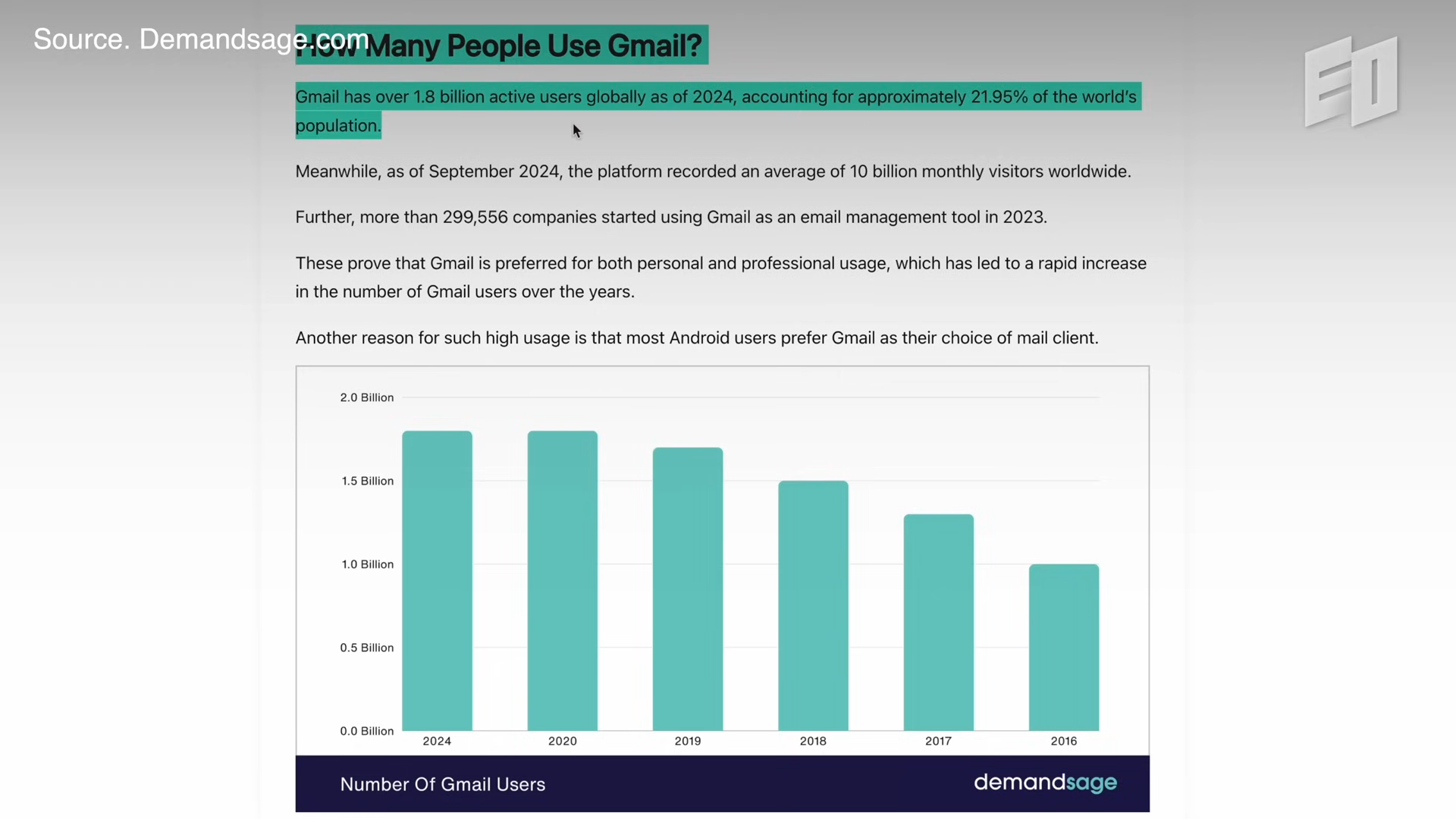
And then after becoming responsible for Gmail as a whole, I became responsible for a broader set of products, which at one point included calendar and our developer platform, Google Chat, and a few others. And so sort of an incremental steps over time, that kind of key thing that happened was joining the Gmail team, which I did in 2016, because Gmail became sort of the core of my identity at Google, so to speak.
Chapter 2. Why I Had to Unlearn Everything from Google
One of the things I learned most at Google is how high the bar is to ship a piece of software. When you have 2 billion users and you have the level of scrutiny on you that Google has, and I think it's important to recognize that when you're Google, you have a lot of advantages in terms of data, in terms of hardware, in terms of algorithms.
But you also have a lot of disadvantages in terms of press scrutiny, regulatory scrutiny, user scrutiny, internal dynamics and bureaucracies. And so it's I can see why it's hard. And I ran into many of those frictions myself. That's not to say that I think any of those limitations or areas of caution were the wrong approach. I think it's just a reality that comes from being at Google scale.
And so first I left Google for two reasons. One was a personal reason, which is I wanted to learn and grow in a different way. I had been six years at Google. I loved my time at Google, but by the end of my time at Google, I had kind of settled into a routine and I wanted to push myself to learn and grow in new ways.
And I knew from my previous experience that starting the company is the best way to push yourself to learn and grow new skills. And the second was I saw an opportunity, and the opportunity was and this is what led to relay is that most of my time at Google, I worked on Gmail on calendar, and I observed that in most of the productivity and collaboration ecosystem, people are really focused on building individual tools that are better.
But when we saw in practice is that to actually get something done at a company or in your work, the cross product workflows are often just as a within product workflow. So the workflow for example of like composing within an email, within Gmail may not be as important as getting that email into your CRM tool effectively.
And I knew that to build a product that was really, really good at these cross tool workflows, it would be hard to do it from within the context of an existing company, where you're incentivized to work on the products that existing company already has. And so those were kind of the the personal motivation and then the mission market product motivation, which is like, I want to learn new things.
I want to try something new. There's this really exciting problem of cross product workflows I want to work on. I think it has to be worked on outside of Google to really solve it. And so all of that combined to say it's the right time to start a new company at Google, I built up an amazing talent network of incredible engineers, designers and product people that I would love to work with again.
I learned a lot about productivity tools in the market. I learned a lot about how to operate at scale. I also had to unlearn a bunch of stuff because at Google there's this inertia. Like every day there will be lots of new users signing up for Gmail, and your job is to take those new users who already know Gmail already have some expectation over it and just make them happy and successful.
And that is totally different from trying to create something totally new that no one has heard of, that no one is going to sign up for unless you get them to sign up for it. And so many of the things I learned at Google were about how to take this flood of revenue, this flood of users, this flood of interest and feature requests and support tickets and figure out how to redirect them in the most appropriate way.
At Google, you learn a lot about how to redirect this flowing river, whereas at relay there's no river. Like when you start a company, there's no river. You have to figure out, like, how do I make the first little drops of water come out of the spring? And it turns out those skills are totally different. So Google, you know, Gmail I think has something like 2 billion monthly active users.
So at Google, I feel like this sort of like societal, I'm working on this thing that's really, really important to lots and lots of people, but I don't know any of those people individually. Whereas at relay, our first 100 users who really love the product, I know their name, I know their business, I know what they're trying to achieve. I know why they love relay and how it helps them.
And so I almost feel more connected to the 100 really, really passionate relay users. Then I feel to the 2 billion Gmail users because it becomes so much more personal and and intense. And that's something I love about the early stage startup. People are not just numbers on a dashboard, but they're real humans trying to get something done that you're helping.
The big difference between a startup and a big company is that it's way easier to make a decision, change a decision, and then adapt flexibly. Because at Google, once you've marshaled teams of hundreds of people and they're all pointed in one direction, it can be really hard to change those directions because there's so much inertia. So that's why you have to plan really, really carefully. And then once you're on a path, you kind of have to keep going.
Whereas in a startup there's a few people, everyone's very nimble, there's no inertia, and you can immediately change your mind to do anything. And that creates positives, but also some negatives. So the positive is you can be totally intellectually honest when you see something's not working. You don't have to pretend that it's working and just keep going according to plan. You change your mind and you adapt to the new information.
And so that's the huge advantage of a startup and that's the reason why startups often take new markets. So if someone wants to start a company, spending time at a big company is valuable in other ways.
But you'll have to unlearn just as many of the skills you learned at a company like Google to be a successful startup founder, as you can take advantage of the skills that you did learn at Google. Another thing that people talk about a lot is like, should you join a big company? Should you join a growth stage startup? Should you join an early stage startup? Should you start your own company?
And I don't believe there's one right answer to that. So if you really want to learn how to build a 0 to 1 product from scratch, don't go to Google. Go to an early stage startup. If you want to learn how to hyper scale a product, go to a growth stage company. If you want to learn how to operate when you already have a billion users, go to Google.
If you want to develop a talent network, you know, maybe go to a slightly larger company that gives you more people you can interact with. If you want to build a peer founder network, probably start your own company because then you'll be in touch with many other founders.
Just naturally, I would just encourage people to be very deliberate about when you take a job, what skills do you want to learn and in what way do you want to grow in that job and make sure you've chosen a company that will best give you the opportunity to learn and grow in that way.
So over the first year of relay, we built 5 or 6 different product experiments, all using AI and somehow in some way to connect a workflow across them. And then it was only after a year of all these experiments that the real opportunity sort of crystallized in front of us.
Most of those repeated things at work involve multiple tools and multiple people, and most of those repeated things at work involve some things that can be automated, and some things that we need to do ourselves with judgment and with intuition and with creativity.
And so that's what led to final idea of relay, which is like, we're going to build a workflow tool that helps you save time on things you do over and over again, by automating the parts that can be automated and make it easier for people to do the rest.
We have initial traction in the sense that there's a few different definitions, like there's the Y combinator definition of do you have ten people or 100 people that love your product? We have that. There's another definition I like from Jason Lemkin of SaaStr which says, do you have ten unaffiliated customers, meaning ten people you've never met before.
You have no idea how they found you, they just found you and they're paying for your product. We have that too. So we have the people who love us. We have customers coming and finding us through the ether and signing up, self-serve and paying us money. We have a product that's growing week over week and revenue that's growing week over week.
So every Monday we get a metrics report and we have more users and more revenue and more usage than we had before. Those are all the things that are good.
Chapter 3. Advice for Future Founders
I think already way easier to start a company now than it was ten years ago. Even ignoring AI, the tooling is way better. And so, like back in the olden days, if you had to incorporate, you'd have to like figure out what state to incorporate in and figure out how to write all the legal documents and engage a law firm. And now you have Clerks and Stripe Atlas.
And in the old days, you'd have to figure out, well, how am I going to get health insurance for all my employees as a startup? And I have to go to all these brokers, and now you just sign up for gusto or rippling.
So there's a bunch of things that have happened to make it easier to create startups that allow you to do more with a smaller team, you can very quickly scale up resource that you need. And so what keeps me motivated? Two things. One is the mission and vision of what I think we can create. I think we can create something really, really cool that's also going to be a successful business.
And the other thing keeping me going is that each thing that's hard that we go through teaches me some new skill that I wouldn't have gained any other way. So what's hard about starting a company? You have to convince people to work on it with you. You have to convince someone potentially to give you money, either customers or investors.
You have to figure out what problem to solve, figure out what product to build, figure out if that product can even be built. Figure out if that product actually solves the user's problem. Figure out how you're going to find anyone who cares that you've solved this problem.
Figure out how you're going to get customers at scale trying to figure out, you know, have some employment regulation in France is going to affect one of your employees, like there's no shortage of challenges, and every day brings a different challenge. I think the existential ones are are you solving a real problem? Has your product actually solved that problem?
And can you figure out a way to scalably get more users who have that problem to try your product? Those are like the big three challenges that underlie all of it. But even on the way to solving those big three challenges, there are a whole bunch of related difficult things, whether it's in hiring or finance or marketing or sales that you have to learn learn along the way.
And so I think, it's definitely hard, but one thing that gives me comfort is it's kind of related to the topic of burnout, which is people talk about a lot about burnout these days. And for me at least, I don't really think for other people either. Burnout is a function of how many hours you work. Burnout is a feature of are you making progress?
There's nothing more demoralizing than working for 50 hours on something and then not having it go anywhere. That can burn you out pretty fast. But if you work really hard on something and a customer loves it and the business is doing well, I've never actually seen anyone get burnt out by that. I've only seen people get more motivated and more excited by that.
And so that's kind of similar to how I think about the challenges in, in a startup, like challenges really get you down if you don't solve them. But as soon as you solve that one, you know, as soon as you solve each incremental problem, it gives you so much more energy and motivation to solve the next one.