Nov 21, 2025
Everyone’s Misunderstanding AI’s True Potential
Interview with Joseph Kraus, Co-founder of Radical AI
Founder Focused

0:00 / 0:00
💡
At a Glance
- Who: Joseph Kraus is the co-founder and CEO of Radical AI, which is building artificial general intelligence for scientific discovery, starting with materials science. Before founding the company, he served in the National Guard, did materials research at the Army Research Lab while earning his graduate degree at Rice, and later worked as an investor at AlleyCorp.
- What: The interview traces Kraus's path from military service and materials research toward founding Radical AI. He explains why materials discovery, often a 10-plus-year process, is the kind of large, slow-moving problem AI and autonomous experimentation can compress, and lays out the company's "51% rule" for making decisions before full certainty arrives.
- Traction: Radical AI's AI agents are built to index millions of scientific publications and operate at roughly 370 times the speed of a human scientist. The company closed its entire preseed round with a single investor, Kevin Ryan, in about 45 minutes, after Kraus and his co-founders built the case for materials science as an AI opportunity during a leave of absence and internship at AlleyCorp.
In this interview, Joseph Kraus, co-founder and CEO of Radical AI, traces his path from National Guard service and materials research at the Army Research Lab toward founding a company built to compress materials discovery, a process that often takes more than a decade, using AI and autonomous experimentation. He explains the moment a co-founder asked why no one was using AI to solve genuinely hard problems instead of easy ones, and how that question led the founding team to materials science and their eventual third co-founder's autonomous lab work at Lawrence Berkeley National Lab.
Key Takeaways
Choose Work Where You Can Make Real Impact
Joseph Kraus learned to evaluate work by whether it matched his strengths, love, and potential impact. That standard guided his move from military service and scientific research toward commercializing science, making the mission and its consequences more important than a familiar professional label.
Mission-Driven Teams Teach People To Put Purpose First
Basic training showed Kraus what happens when people from different backgrounds align around one mission. He learned to remove himself from the equation and put the team's purpose first, a lesson he later carried into the culture he wanted Radical AI to build.
Bias To Action Turns Strategy Into Learning
Kraus learned from Kevin Ryan that strategy without action can become a dead end. Startups get easier when teams act with more information, a distinct thesis, and a willingness to watch results unfold, then use those results to continue the process.
Scientific AI Should Accelerate Novel Discovery, Not Minor Gains
Radical AI focuses on materials science because discovery can take more than 10 years and affects major industries. Kraus sees AI and autonomy indexing millions of publications, simulations, and experiments so researchers can pursue novel materials and harder problems instead of optimizing small improvements.
Fifty-One Percent Confidence Can Keep Teams Moving
Radical AI's 51% rule asks teams to decide once they have enough confidence, while weighing the decision's size and the downside of being wrong. The rule is not speed for its own sake; it moves decisions earlier and treats imperfect outcomes as learning.
Build For A Future That Outlives Its Founders
Kraus believes Radical AI could last 100 or 200 years because removing materials as a blocker would reshape what people can build. His closing perspective treats the company as a long-lived mission and technology, not a project whose horizon ends with its founders.
Watch the full interview now on EO's YouTube channel! Below is the complete transcription of the interview. Minor edits have been made for clarity and readability.
Introduction
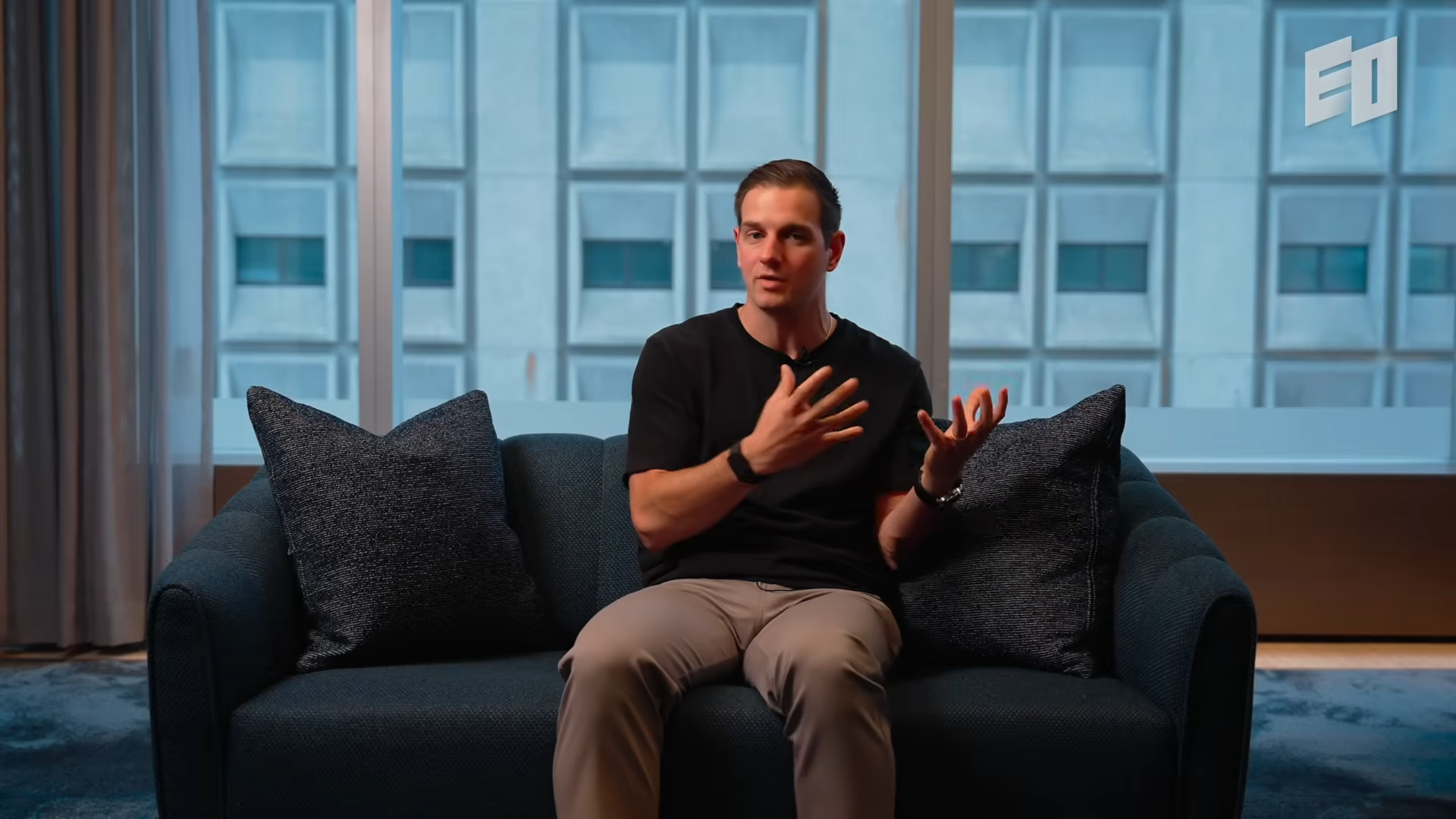
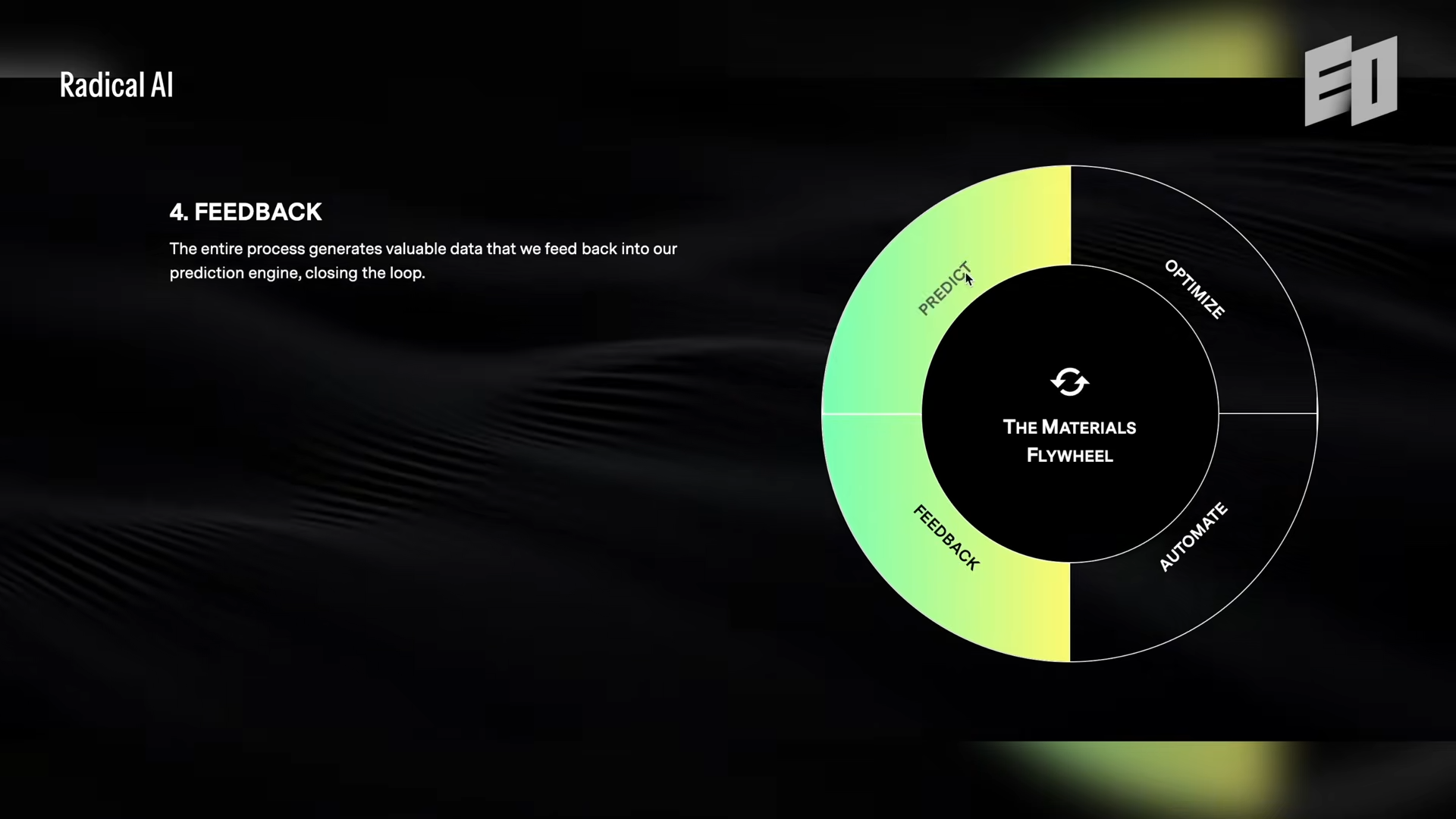
My name is Joseph Kraus. I'm the co-founder and CEO of Radical AI. At Radical AI, we are building artificial general intelligence for scientific discovery starting in material science. The material discovery process is challenging today. Processes in materials just take an incredibly long time, typically 10 plus years. Our AI agents will index millions of scientific publications and learn what a field has done already. And so this process can happen at an incredible speed in comparison to a human scientist, about 370 times the speed we operate as a human scientist today.
Chapter 1: The One Mission That Shaped My Life
I just always was taught and really wanted to be like my dad in pursuing something that I knew I was the best in the world at and that I truly love to do. My father, he always instilled that not just about being happy about what you're doing, but much more engaged in what you're doing. Find the thing that you can be better at anyone else in the world, and where can I make an impact?
That for me has always been this guiding light into what I want to do and how I want to do it. And so when I was an undergraduate, I actually bumped into someone who was serving part-time in the National Guard. I really wanted to go to a military academy in the United States.

They're incredibly prestigious. You have the opportunity to serve the country. So I thought that this would be for me. And the US National Guard is a reserve component both of the Army and the Air Force. You pretty much go to drill one weekend a month and then you do two weeks in the summer of training to actually make sure you're up to code with your military training, and if you ever get deployed down range. I was like, well, this is amazing. I can continue to study, but I can also serve in the military in my free time is the way I looked at it. So, I enlisted in the military my junior year of college.
Basic training is an amazing experience, right? Because you're with a bunch of people you've never met in your life.
Meeting people from so many different walks of life. I met people from New York, Pennsylvania, Georgia, Maine, and the East Coast through to the Midwestern or western states all the way through to California coming from San Diego or Silicon Valley. And everyone was there for the same mission. They were there for the same goal of building a stronger military to protect and defend the freedoms that America likes to propagate throughout the world.
That was not only inspirational but was the first time I was forced to remove myself from the equation and put the mission of the team which was the battery that I was serving in before yourself. And that was an incredibly insightful lesson and so went away to basic training and then came back and finished my senior year and then went away to training again before starting graduate school at Rice.
So for Rice there was one specific reason. I had went to this undergraduate research symposium which I presented my work on and I won that symposium and in winning the symposium the best presentation I got to sit with a bunch of both graduate students and professors inside the program and ask them about their research and what they were working on and there was a concurrent theme through that.
They were all working on problems that could have a big impact, actual things that they were trying to transition at one point or another. I interviewed at a lot of graduate programs when I was thinking about where to go to school and none had felt as strong as I did when I met the faculty and students at Rice and this kind of focus on the future and what they were trying to build. So, I was doing them concurrently in graduate school and in the military at the same time, but I didn't know what I wanted to do after graduate school. I didn't know if I wanted to be a professional scientist. I had thought about fields like law, patent law. So in graduate school, I did this deep dive in understanding where could I make an impact.
While I was serving in the National Guard, I was also not together a scientist at the Army Research Lab. It is this corporate research lab that the US Army has a bunch of scientists working in to try to push novel research up to higher technology readiness levels or make that science more approachable for the Army. We used to have these commanders who would come through and tour the facility. We would have to tell them why the work we were doing was relevant to the Army and their relevance was not the same relevance to us. They were thinking about future conflict about how to bolster the force or make it stronger. We were thinking around electrons and hydrogen atoms and thinking about making new novel 2D materials for different technologies.
And so there was this disconnect between leadership at the Army and the scientific perspective that we were driving. And there was this day where I had to actually explain why what we were doing in the lab could eventually impact future of warfare or future technology that the Army would want to use. And that's when I realized that that is exactly what I wanted to do. I wanted to transition from this fundamental area of research driving our understanding of science to actually commercialize science. Science that could actually go into products and make a difference. And that was where things started to come together that the only way to really do this is to actually push technology in a novel way in which case startups are the best in my opinion the best place to do that today.
I know one day I want to build a company, but I have no idea how to build it. And so I said, let me find entrepreneurs and investors who have built a company in the past and now are investing in the companies of the future. And so I looked up a bunch of venture capitalists, entrepreneurs, and really wanted to be in New York. Actually, I tailored my search to New York and I bumped into Kevin Ryan. Kevin Ryan is a prolific entrepreneur in New York City.
He built and ran DoubleClick before taking that company public. And then he came out of that and started AlleyCorp, which is both an incubation studio as well as an early stage investment firm.
And when I talked to Kevin, I had told him, if you're not investing in materials, you're not going to invest in the future. And he said, "That's a big, that's a big bet. Why don't you come prove that out?" And so I took a leave of absence. I moved to New York a week later, and I had a six-month internship to see if this was the field for me, if this was the career for me. Kevin had taught me early part of my career that you have to have a bias to action and just get things done.
Strategy can be effective but most of the time will also lead to a dead end with no action involved. The best entrepreneurs have an immense bias to action. They just get things done and in doing so watch the results unfold in front of them as they do that, and then they continue to go through their process. Startups are already hard enough and the way to make them easier is to do more than anyone in your space will do with more information than anyone in your space has with a thesis that no one else has been able to come up with.
That is truly what can drive good value and I think a bias to action is the most important lesson I've learned from him.
Chapter 2: Stop Using AI To Solve Tiny Problems
One of my other co-founders and I were both investors at AlleyCorp, and Jorge was looking into AI technology as every good investor was, but really at a fundamental level. He was reading the publications coming out on novel architectures and novel approaches to machine learning and really what the impact of the technology was. And he came over to me one day. We sat next to each other in the office and said, "You know, AI is so incredible. I am actually convinced this technology is going to change the world. What I don't understand is why everyone is picking low-hanging fruit and solving small problems. Why is no one using AI to cure cancer?" was the question he asked me.
And I said, "Well, I don't know about curing cancer, but that's a really good opportunity." And so we spent the next month and a half reading hundreds of research papers on all the different fields that we think AI could be put into. And finally it dawned on me that well material science problems with fragmentation, slow-moving ability, you know, lack of progress over short timelines. This might be a great area for AI to be implemented in. And so we took another deep dive and we read every publication we could find at the intersection of material science, AI, and, as we found out, robotics. And that led us to our third co-founder, Herd Cedar, who had built an autonomous scientific lab at Lawrence Berkeley National Lab. And together with him, us three really saw and came up with this vision for where science is going to go, where AI and autonomy are going to build a new paradigm of scientific discovery, driving us from a human-driven to an AI and autonomy-driven process.
And we were all aligned that whether we started Radical AI or not, this is the way science was going to go. And it had to be us who were going to build this company. And so all three of us agreed, and that was the formation story for Radical AI. The most important areas are the most challenging. I think those are the things people should work on. I think if you look at technology today, we don't struggle with what we call optimization problems at Radical AI, driving one, two, or 5% improvements in a current system.
We're actually quite good at that. What is incredibly challenging is novel discovery. And that's where most hard problems lie. And when us three wanted to form the company and we're going to build Radical AI, we had this opinion that if you want to impact the most important industries in the world, automotive and aerospace, manufacturing and defense, climate, energy, semiconductors, all of them are a direct result from materials R&D. But these processes in materials just take an incredibly long time, typically 10 plus years and an exorbitant amount of cost to go from a novel discovery to a scale material system.
And this was the exact place that we could make a massive impact. We think AI and autonomy are going to drive change in the process and in doing so can actually unlock and remove materials as our biggest barrier to some of our most important industries. And I think if you are aligned on that mission, then the problems that you want to solve are naturally going to be hard because if you succeed, you will fundamentally reshape human trajectory.
And that is an incredibly impactful thing to be able to do and also incredibly important to the future of the world.
Chapter 3: How I Raised $55M in 45 Mins
We're going to leave AlleyCorp and we're going to raise money, of course, to start the company. And AlleyCorp, as I mentioned, likes to incubate companies, and we were incubating this company inside the AlleyCorp umbrella. So we knew Kevin had told us they are going to put some money in in this incubation setting, and then we'll roll out from there, and we knew we needed a lot of capital.
Material science is a hard business to build in, and we are building a full stack solution which requires a lot of capital. So we knew we wanted to raise a fairly large preseed round. And so we went to Kevin and said, look, we're going to start this company, put together a whole 100-page pitch deck on why we think the opportunity is now, where the technology is today, why interdisciplinary approach is incredibly important to solving the problem.
The reason AI is so impactful in this space is its ability to index information. The best example that we always like to give is AlphaGo. It was this AI that was built by the Google team, and it played with the best player in the world, the game of Go. And the best part of the story is this infamous move it makes where everyone watching thinks the AI makes a mistake, and in reality it has indexed so many games of Go. It made a move the human brain has never thought of before.
When we take that to science, all of our limitations in science come from the human brain. How many papers can we read? How many things can we simulate? How many experiments can we run, and then how do we tie all those together to make a new hypothesis on what we want to build? But if you bring AI and autonomy to the center of that, you unlock this indexing problem that a human scientist feels.
You can read millions of publications, simulate billions of materials, and test thousands of them, connecting all this information in real time. And so if you can do that, the world that we think we can really build is one that is what we call inversely designed, where we are no longer making materials and then looking for a solution to solve. We are actually taking our hardest problems and inversely designing material from that.
And human scientists can't do that today, or if they can, do so in only very, very long time frames, whereas AI and autonomy can do that incredibly fast and incredibly efficient. What we actually think AI can do is not replace that scientist but rather give them the tools and the capabilities to index across a multitude of different experimental processes.
So they are spending their time thinking around what next material to build or what next problem to solve, and not on going through the monotonous process of fundamental research. That is really where we see the impact on AI for science and how we are building the future of the scientific process. And to Kevin's credit, he said, you're not going to raise money anywhere else. I want to give you all of it. And so he was the only investor. We raised our preseed round in about 45 minutes, which was great. And we were able to get started and start building, and us three started recruiting from that time on and built the company that we have today.
Chapter 4: Just Make a Decision When You're 51% Confident
We are incredibly passionate about the culture that we built at the company. Every single person that we hire into Radical AI, we ask the same question. If you are looking for a job, this is not the place for you. You're incredibly intelligent.
You can go get employed other places. If you are looking for a mission then you should come work here. Every person that comes to Radical AI deeply, deeply believes in the mission that we are going after. And the way that we keep that alignment is through culture.
We are never afraid to fail. We actually know failure is a part of the discovery and learning process. And so we will push aggressively, relentlessly to drive technology to rethink from first principles and to build a connected system that can truly discover novel materials. So we adopted a rule very early on in the company. I believe SpaceX started it, called the 51% rule, where when you are at 51% confidence on a decision, you just make that decision.
And the reason why is you will actually cause more time and less efficacy across the company by debating on decisions that you could otherwise quickly decide on and see what the result of that decision is going to be. When it comes to 51%, two different things that we think about: first, how big is the decision, and second, what are the risks if the decision is wrong. And those two together allow us to actually identify when we are at 51% or not.
Of course, we do a bunch of research and have a bunch of conversations and debate around getting to that confidence interval of 51%. But when it is a decision in day-to-day, for example, it's not year defining or really decade defining and what we're trying to go after, well, then we can have confidence to make it quickly.
And when we think about what the other side of that decision is, what is the worst case scenario that happens, that usually alerts you to you are already at 51% or you are nowhere near 51%. And that is a great checkpoint that we ask ourselves and everyone in the company, and constantly pushing towards getting at quick decision-making but effective decision-making as well.
You know, 51% is not about just making decisions fast for fast's sake. 51% is making decisions that you are already going to make, just making them earlier and then dealing with the effect of not always being 100% correct. Because no matter if you think about a decision for 2 weeks or 2 years, there's still a likelihood that you're not going to be correct. And because we operate the company that way, failure is inherent.
You will automatically fail if you come work at Radical AI in something that you do. We don't view someone as failing or a project as failing. We view it as learning and an opportunity to recreate the process that we just thought that we should build. And so for us, I actually think we go deeper into the essence of asking why and first principles.
And we don't view things as failure. It is just normal to try things that don't work, learn from them, and try again at Radical AI. One of my favorite quotes in the world is, you know, Steve Jobs' connecting the dots. You can never connect the dots looking forward. You can only connect them looking backwards.
This is an exact moment where I didn't know where this dot was going to lead.
But now when I look back, it was imperative that I went through that experience and lived through the frustrations of materials research today. You need dots to be able to connect. And while you might not know where this dot is going to make an impact, you never know where it is going to or how it is going to impact what comes next. And so I didn't care that I didn't know what was coming next.
I didn't care if it was going to work or not. I didn't care if I was going to be a scientist or not. In the real retrospect, what I cared about was continuing to push forward and searching for the answer. And I think that's truly how I ended up getting to the answer.
So, I just reminded myself every day that this will lead to something. You have to never ever give up no matter the scenario. We want to remove materials as the blocker to those innovations. And that's why we don't think there's an end to the company. We think this company will be 100, 200 years old. It will way outlive myself and the two co-founders. This is a company and a technology that when it succeeds will truly be able to create a world not today thought possible.