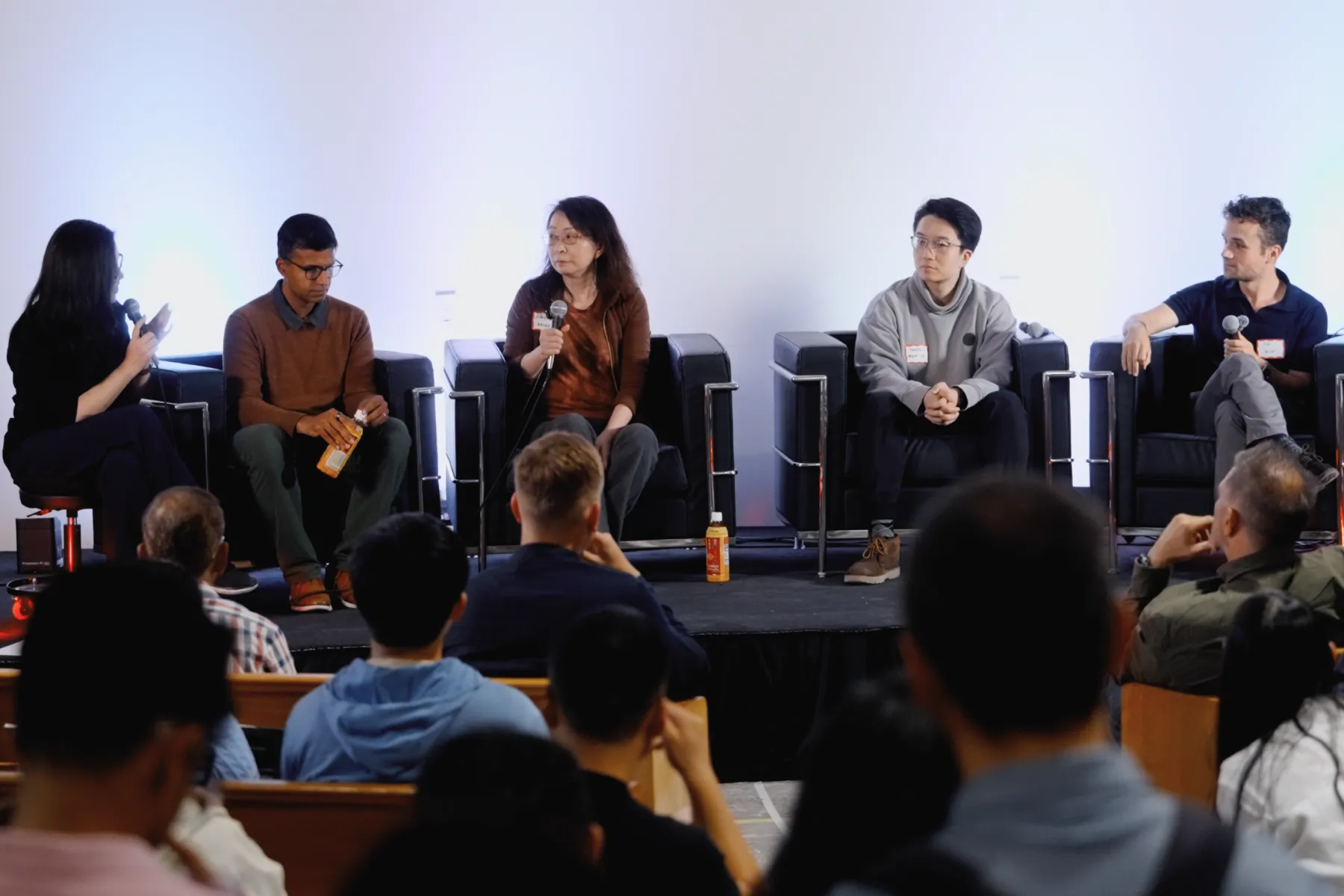
"What's the most overhyped claim in physical AI right now?"Lukas PankauCo-founder of Industrial Next
Lukas Pankau, the co-founder of Industrial Next (IN), saved it for the last panel of the night. He called it "one somewhat spicy question."
Franz Tschimben, CEO of ALLSIDES, went first. "I didn't prepare for this," he said. The room laughed. That was the mood of the night. Researchers, founders, and factory people were talking about what still doesn't work in physical AI.
Attendees fill the Real2Sim2Real Arena launch in San FranciscoPhoto by EO
The event launched IN's Real2Sim2Real Arena, a robot testing space inside the company's 10,000-square-foot headquarters in San Francisco, during SF Tech Week. About 16 robots were on the floor, with plans for more than 50. IN also introduced sim2world.ai, an open benchmark where labs and companies can bring their own tasks, train in simulation, and run them on IN's robots.
Gilwoo Lee moderates the first panelPhoto by EO
The pitch, from CTO Gilwoo Lee's opening remarks: the gap between simulation and the real world is too big for one company to close alone.
Where the Gap Shows Up
"Just like there is a sim-to-real gap, there's also a demo-to-real gap. Lots of demos, not that much real."Siddhartha SrinivasaProfessor at the University of Washington
Siddhartha Srinivasa speaks on the first panelPhoto by EO
Siddhartha Srinivasa named the gap. He founded Berkshire Grey and led robotics initiatives at Amazon. The rest of the panel showed where the gap is.
Jingyi Jin speaks on the first panelPhoto by EO
Jingyi Jin is a principal engineer on NVIDIA's Cosmos team. Lee asked whether world models can learn physics from human-labeled videos or whether they need a physics engine to check them.
"If you do the simulation right, the physics comes for free from the simulator."Jingyi JinPrincipal Engineer at NVIDIA
Her open problem is a different one: finding what the foundation model still doesn't know and pulling that out of the simulator.
One way is to switch physics on and off inside the simulator to make clean examples of success and failure, then train on both. Another is to map the holes in the training data. She said those holes tend to be rare cases that are hard and expensive to capture in real life.
Yunzhu Li speaks on the first panelPhoto by EO
Lee turned to Yunzhu Li of World Labs, co-founder of SceniX, which World Labs acquired in July, and author of a widely discussed blog post published right after. She asked what mattered most in closing the gap.
Li said what you need from a simulator depends on what you use it for. If you are testing a robot's policy, looks matter more. If you are training one, physics matters more because the model will find any flaw and exploit it. Everything else, you randomize.
"Anything you forget to randomize during training will come back and bite you."Yunzhu LiWorld Labs and Columbia University
Li's advice for cheaper hardware followed the same logic. Don't look for one set of numbers that makes the sim match the real world. Measure the range the real robot moves in, and randomize across it.
Xavier Puig speaks on the first panelPhoto by EO
Xavier Puig, CTO of Versor, builds digital copies of factories to train robots. He was blunt about where the industry actually stands.
"It's very different having scenes that look okay and make amazing videos for slides, versus things that will be useful for learning behaviors."Xavier PuigCTO of Versor
Who Owns the Risk
Allen Pan moderates the fireside chatPhoto by EO
Between the two panels, a fireside chat looked at the gap between Tesla and the US government. Once a technology works, who decides to take it on?
The first question from Allen Pan, IN's other co-founder: What kills promising technology in big manufacturing? Is the product not ready, or does nobody want to take responsibility?
Olivia Barr speaks at the fireside chatPhoto by EO
Olivia Barr, who leads capital equipment sourcing and procurement at Tesla, didn't hesitate.
"Not having someone own the risk is definitely the biggest killer."Olivia BarrCapital Equipment Sourcing and Procurement at Tesla
Find a champion, she said, and an unfinished product isn't a problem. Thomas Shedd, who spent eight years at Tesla before joining the Trump administration in 2025 to lead the GSA's Technology Transformation Services alongside DOGE, said government works the same way, only slower. Someone inside vouches for it, or it dies.
Who gets to say no? At Tesla, Barr said, it depends on the objection. If it is technical, engineering has to show why the risk is acceptable. If it is cost or supply, finance or supply chain makes the case. Either way, it should be someone with a stake in the outcome.
Shedd gave a more specific answer. In DC, he said, it is the political appointee who holds the budget. He had been that person himself.
Thomas Shedd speaks at the fireside chatPhoto by EO
Allen asked what Shedd would bring back from DC to a factory.
He said, "The system has been put in place such that it's very difficult to make the wrong decision because it's very difficult to make any decision." That is fine for nuclear weapons, he said. It is fatal for a car company.
"If you take how DC operates and apply it to what we saw at Tesla, we would have never reached profitability."Thomas SheddFormer Director of Technology Transformation Services at the GSA
His example was software. Agentic coding tools changed how most engineers in the room work, he said. Most federal software teams still write code by hand because deploying a new tool means one person has to sign off and carry the risk.
The last question was the hard one. Manufacturing gets more successful and creates fewer jobs. Is that progress?
Barr counted the whole ecosystem: fewer jobs on the line, but more engineers, more technicians, and more suppliers coming to the US. Shedd went further. There are not enough people to produce even what Tesla is trying to produce in the Bay Area or Austin, he said. Without automation, “we will lose.”
"The primary concern should be how do we accelerate, and not how do we save jobs."Thomas SheddFormer Director of Technology Transformation Services at the GSA
Someone Has to Answer the Phone
Lukas Pankau moderates the final panelPhoto by EO
The last session brought in voices from the floor: what happens once a robot is actually inside a factory. Pankau put the "demo-to-real gap" from the first session back on the table.
"There still remains a lot of work to make a robot actually useful on a production line. One of our previous panels called it a demo-to-real gap. So what is it that takes the most time to make it really useful for the production end?"
Takehiro Ishiguro speaks on the final panelPhoto by EO
Takehiro Ishiguro of Mitsubishi Electric answered, "I can split that into three pieces."
First, get to a working demo. Second, move it into the real factory, which is "not simply just plug and play." Lighting changes. Dimensions need checking. Third, the part that never ends. After deployment, the environment drifts.
"The system integrators will get a phone call saying one day something happens and it's not doing the correct job."Takehiro IshiguroMitsubishi Electric
Adrian Macneil speaks on the final panelPhoto by EO
So when a robot stops, what should the team have recorded? Adrian Macneil of Foxglove answered as if it were obvious. "You should record everything!"
Then the practical version. Keep two kinds of data. Light telemetry that streams all the time: where the robot is, what it is doing. And the heavy raw data, every sensor frame, kept on the robot like a black box and deleted after 24 hours unless something went wrong.
Why? Because of how the complaint arrives.
"Quite often the customer comes and they're like, 'Hey, yesterday afternoon it was not working very well.'"Adrian MacneilFoxglove
In the end, a robot that leaves the lab has to pay for itself on the floor. Ishiguro's answer to what startups get wrong about factories was the most practical line of the night: "It boils down to ROI."
Factories care about payback period, efficiency, and how many people a robot replaces. Startups rush in to show performance, which he said is fine.
But then they have to follow up: what the customer actually needs and how far the system has to go before the customer is satisfied.
Three Answers
Near the end of the last session, Pankau put the question to his panelists: "What's the most overhyped claim in physical AI right now?" It caught them a little off guard. Then they gave candid answers.
Franz Tschimben speaks on the final panelPhoto by EO
For Tschimben, it is the belief that you can generate unlimited data for simulation instead of measuring real objects. You might be able to generate it, he said, but in a factory, good enough is not enough. "The last 20% is what matters."
For Ishiguro, it is the claim that robots can easily pick up new tasks: swap in a model, add a little training, and the robot does something new. In practice, he said, adding one task still takes "a tremendous effort in data training."
For Macneil, it is the story, often from investors, that a few companies will build the "brain" for every robot, the way a few labs came to lead AI chatbots. Robots will end up doing everything humans do today, he said, and no single model can be deployed to every customer in every industry. He expects thousands of robot companies instead.
The three answers had one thing in common. Each named a claim that holds up in a demo and breaks after it: data that looks right, a new task that seems one fine-tune away, a single model that could run anywhere.
A robot demo at the Real2Sim2Real Arena launchPhoto by EO
That stretch is what Srinivasa called the demo-to-real gap on the first panel. Ishiguro described who ends up dealing with it: the integrator who gets the call when something stops working. Barr described who decides whether a company takes it on at all: someone willing to own the risk.
Three sessions that started from different questions ended up pointing at the same one. As it happens, that is also the case IN makes for the Arena: the gap is too big for any one company, so robots should fail, get measured, and try again in a shared space.
"We're not here to watch movies about robots. We're here to get robots to actually do stuff."Siddhartha SrinivasaProfessor at the University of Washington