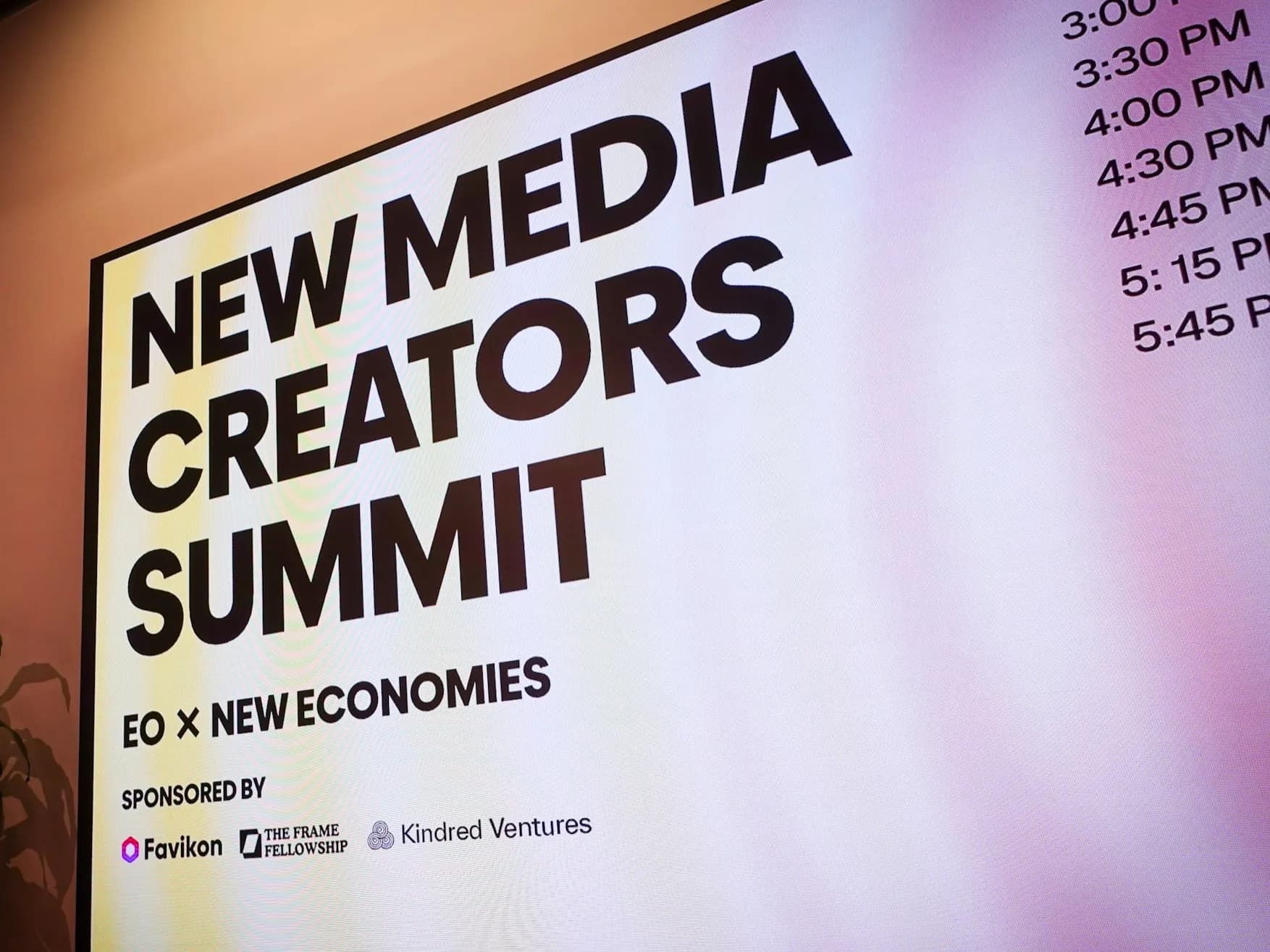
"Where is this new media space going, and how can we adapt as creators in this exciting new era?"New Media Creators Summit
We all know that the time of new media and creator economy is here. Yet becoming a creator is still hard. So is making money as one in the new media era, and so is turning a channel into a company.
On October 8, Ollie Forsyth (New Economies) and Taeyong Kim (EO Studio) co-hosted the New Media Creators Summit at Kindred Ventures in San Francisco, part of SF Tech Week. The speakers included a former product manager turned full-time AI creator, a Berkeley student who interviews Silicon Valley founders on the street, Corgi's head of community, who reaches a million people a week, the CTOs of WordPress VIP and MIT Technology Review, the founder of a club for the top 1% of creators, and HubSpot's head of creator partnerships. Across four sessions, they took on three questions:
How do you build big channels? How do you make money? How do you stay relevant?
The stage at Kindred Ventures before the New Media Creators SummitPhoto by EO
Session 1: Staying Relevant as a Creator
Speakers
- Peter Yang: Founder at Behind the Craft
- Viraj Ala: Founder at Viraj Ala Media
- Brooke LeBlanc: Head of Community at Corgi
The first session asked what it takes to become a creator today, and how to stay relevant while platforms and formats keep shifting.
Peter Yang, Viraj Ala, and Brooke LeBlanc on stage for the first sessionPhoto by EO
Q: What does new media mean to creators today?
For Peter, the shift comes down to who is speaking. Old media meant newspapers, brands, and TV.
"New media, I think, is like the individual is the brand, and people value authenticity from the individual."Peter YangFounder at Behind the Craft
Peter spent years at big tech companies, where every message went through comms for PR approval. Audiences hate that, especially on X. The founders and creators who break through speak their minds, for better or for worse.
Viraj sees new media as a way of democratizing media. Anyone can follow anyone on Instagram, but building a culture around yourself has never been this easy. He calls it a fast track to ownership, one that puts people with no access to Silicon Valley in the headlines. He counts himself among them.
Brooke minored in new media at the University of Georgia and graduated in 2018. Back then her classes taught students to code personal websites, something a paid Lovable subscription now does in less than a day. Her definition of new media keeps evolving, and she thinks creators should too. Her advice is to diversify across platforms, because your audience is probably on several of them already. Recognition earned on one platform transfers to the next, so the job is to stay nimble as new platforms and tools appear.
Q: Should creators post everywhere, or pick one platform?
The old advice was to grow one platform at a time. Peter thinks AI has changed that. Every platform needs its own tweak of format, and AI can now make those tweaks automatically when you post everywhere at once.
Posting everywhere doesn't mean winning everywhere. Peter still hasn't cracked Instagram or TikTok, and the shorts he cuts from his podcast get almost no views. His advice is to pick a platform you actually enjoy making content for. For Peter, that's long form and articles.
Viraj's own channel shows how a format can grow. He started in college, stopping students on campus to ask how to land a job at McKinsey or Goldman Sachs. Then he moved to student founders and how to get into YC. Now he interviews the most cracked founders in Silicon Valley.
Each step stayed close to the last, and Viraj thinks that is the rule. He has watched friends jump from lifestyle content to videos about breaking into VC, and their followers may not connect the two. He pictures it as a Venn diagram. His audience already follows people in venture, so venture content is a natural next step.
Viraj applies the same thinking to in-person events, where a physical space gives creators something to post about. The creator CatGPT runs Cat Labs, an IRL community in Los Angeles where creators make content about the community itself. Corgi does it with the Corgi Cafe, which people post about constantly. Viraj calls it in-event UGC, with short form and long form feeding a physical space.
Q: Does being a creator help or hurt your day job?
Brooke rejects the idea that being a creator distracts from a real career. In her view, it works the other way around.
"Being a creator gives you access to anyone in the world, and you can use that to your advantage if you're smart and you have a container to convert them through a funnel."Brooke LeBlancHead of Community at Corgi
At Corgi, Brooke is that funnel. She filters leads for hiring, sales, and marketing all day and makes intros across the company. As a shareholder, every useful intro grows the value of her equity. Startups whose employees stay quiet online, she argues, are leaving money on the table.
She coaches Corgi's large sales team the same way, starting with one question: what's your story? Even the office dogs count. Corgi keeps one in every office, and a photo of one takes two seconds to post. If it reaches 10 small business owners who need insurance and converts two, that's sales on top of the cold calling.
Whether you're an employee or a business owner, Brooke's case for content is the same. An audience compounds over time.
Q: Where does a creator's money actually come from?
Peter's revenue is 80% sponsorships and 20% paid newsletter subscriptions. AI companies are throwing money around, and a paid post from him now runs anywhere from a few thousand dollars to $10,000. He keeps raising the price, but he knows the limit. Too many paid tweets hurt his authenticity, and people stop listening.
Having been a PM for most of his career, Peter wants to build a product of his own. SaaS is hard to sell now that anyone can build the code themselves. For now, what people pay for is community and relationships, and creators are good at both.
Viraj started with ad revenue, the sponsored posts every creator begins with. Then he noticed that the founders he interviewed wanted help with their own media, so he built a company to give it to them. He took leave from UC Berkeley to run it full time, and his street interviews now bring in its clients.
His other channel is venture investing. YC Demo Day, Speedrun Demo Day, and Neo Scholars give him another way to work with founders.
"So I think of it as: in what different ways do I have access to certain things, and how can I help monetize them?"Viraj AlaFounder at Viraj Ala Media
For new creators, Viraj still calls ad revenue the benchmark. Some brands have paid him just to put a logo on a video. His advice is to get revenue in first and reinvest it in hiring, which has been his biggest upside.
Brooke never needed sponsorships, because she makes content as an employee. She learned what content could do three years ago, when she raised $5,000 for her first marathon in Berlin through posts on X. She has since raised tens of thousands of dollars for charity the same way. That was when she knew content marketing could lead to real sales.
She turned that into a job at Corgi, joining the week its cafe launched. Her goal is to be the most profitable employee at any company she works for. Sales and social media appeal to her because they scale, reaching people even while she sleeps.
"Back in my old sales job, I had a KPI where I had to meet 80 new people a week. Now, through content, just off X and LinkedIn, I reach a million people a week."Brooke LeBlancHead of Community at Corgi
That reach now brings Corgi revenue. Brands like General Legal partner with the cafe, and Brooke wants any future video work to be profitable the same way. She insists on the word partnership, never sponsorship. She doesn't want to take a brand's money and give nothing back.
Q: What's the hardest part of playing the algorithm?
Each speaker had a different complaint.
For Peter, the content he wants to make isn't the content that gets views. Calling a new model insane gets attention, but he isn't sure it's valuable. So he makes some hype to stay relevant and mixes in his own workflows and opinions. He left his job to do work that gives him energy, not to chase views.
Viraj's problem is his format. Few founders have the time or energy for a street interview with a stranger, and nobody else in the Valley does them. That makes him unique, and it also makes him a hard sell. Founders ask why they should show off about the billions they've made, so he sells the value of the videos and the audience behind them.
His other problem is time, and how to split each day between content and the business. Viraj maps it onto Maslow's hierarchy.
First you go viral and monetize. Then you stop working only on the business and build a life outside content. At the top sits the hardest question, whether to keep going at all or leave for Bali.
Brooke's frustration is that she never feels she's posting enough. Her answer is volume, because quantity begets quality. There's no shortcut, only reps.
Brooke LeBlanc speaks during the first session alongside Peter Yang and Viraj AlaPhoto by EO
Q: Should creators build a media company to sell, like TBPN?
OpenAI bought TBPN, the daily live tech show, in April for a reported low hundreds of millions of dollars. It had no outside investors and was already profitable, proof that a creator-led show can become a company worth acquiring.
Peter isn't chasing it. He went independent to spend more time with his kids. Selling online courses could probably grow his revenue tenfold, but he doesn't want to sit on Zoom all day.
Viraj suspects his next opportunity may not come from his media company at all. Job offers have made him ask whether people want his expertise or his audience.
"If you build up an audience and have the ownership, that's more important than just getting a bunch of views."Viraj AlaFounder at Viraj Ala Media
His early gaming videos taught him the difference. They got views, but nobody cared. A niche audience that values your expertise is worth far more, and Viraj thinks anyone can build one.
Brooke's bet is her equity. She expects her piece of Corgi to be worth more than anything she could earn on her own.
"Not a lot of people can prove they can be a great operator at a fast-growing company and make content."Brooke LeBlancHead of Community at Corgi
Q: How do creators keep coming up with new ideas?
Peter has a Grok bot that scans X and YouTube every day for trending AI topics and hands him a list.
Viraj treats each video as research for the next one. One morning every other week, he spends two to three hours studying nothing but his hooks, the opening lines that decide whether a viewer stays. He also tracks the exact moments where viewers stop to rewatch and the moments they share.
The comments fill in the rest. Viewers quote his guests back to him, like "I love what she said about this." So he asks new guests the same types of questions to elicit the same responses and the same types of emotions, then edits around those moments.
Brooke trusts the numbers. She believes algorithms are as efficient as markets so good content gets seen even from an account with no followers. She calls it the TikTok-ification of every platform. Her own topics rarely change: running, reading, and tech. For Brooke, that repetition is the method.
Q: Who should a small media company hire first?
Viraj's best hire was a sales lead. As the face of a positive channel, he doesn't want to be the one turning deals down. A videographer is his other pick.
Brooke would hire customer support. You close the deals, and a friendly face nurtures the relationship while you chase new business.
Session 2: The Technical Side of New Media
Speakers
- Brian Alvey: CTO at WordPress VIP
- Drake Martinet: CTO at MIT Technology Review
The second session turned to the tools behind new media, and to what changes for creators when anyone can build software with AI.
Drake Martinet and Brian Alvey during the second sessionPhoto by EO
Q: What is new media today, and where is it heading?
Brian finds the question a little funny. Twenty years ago, he sold two new media companies for millions of dollars. Now he's the old one.
Every five or 10 years, the game changes. Media has been dying, he joked, since a week after newspapers were invented. Today it's apps and newsletters, Substack and AI.
"I say it's probably never been harder to build a 100-person or 1,000-person media company. It's never been easier to build a one-person media company."Brian AlveyCTO at WordPress VIP
Drake thinks everything old is new again. His own companies counted as new media because they put video on social platforms for the first time. To Drake, the audience defines what new media is. When people want something they aren't getting, whatever gets made for them becomes new media.
That's the opening for creators. Find an audience, find the platform it wants to be reached on, and make something for it. Drake told the room not to feel any kind of way about the people who have done this for decades. Learn from them instead, and skip the mistakes everyone repeats.
"Connecting with folks at a distance is what media's about, and new media is whatever every audience makes of it."Drake MartinetCTO at MIT Technology Review
Q: Does WordPress still matter when anyone can vibe code a website?
Brian didn't create WordPress. He built 25 other content management systems, and then one person made WordPress and gave it away for free. It's hard to compete with free, and AI agents know free too. Ask an agent to build something, and it reaches for WordPress.
Brian now works on the enterprise side. Clients like NASA and News Corp sign six- to eight-figure deals. When anyone can vibe code software, he expects the bottom of the market to fall out. The $3-a-month consumer tools go away first.
The top end stays. A brand like Nike or Sephora will pay a vendor a cut of every sale to keep its store running through Super Bowl ads and Black Friday. Thousand-person newsrooms need the same reliability. Vibe coding can compete with a lot, Brian said, but not yet with the most extreme software.
Q: What changes for creators when anyone can build software?
Drake and Brian share one trait with the creators in the room, an orientation toward making things. Now the barrier keeps dropping, and you can make more in your spare time, faster than ever.
Brian thinks most people outside the AI bubble haven't noticed that software has changed for good. You can now build disposable software for a single user, use it once, and throw it away. For his clients, what they make and who they make it for stay the same. Everything around them speeds up.
He has lived through every shift from open source and the web to the cloud and mobile. AI, he says, is the ultimate accelerant. Creators can post more, in more places, than ever.
"But so can everybody else. They all have the exact same magic wand, the exact same robot army."Brian AlveyCTO at WordPress VIP
Drake finds hope in that. Anyone could copy what you make, but most people won't.
"Most people are not creators by nature. They're not driven by something inside them to go make shit."Drake MartinetCTO at MIT Technology Review
The room, Drake added, is a bubble. Most of the world will still buy its milk at the store rather than bring a cow home. That leaves plenty of space for creators to find an audience, a life, and a business.
Q: What's the next AI opportunity creators should look at?
The models will keep getting stranger, Brian expects. The business underneath won't. What matters is a direct connection with your audience and making a living from it. That's why newsletters, email, and video stay powerful.
Brian has mentored hundreds of companies over 20 years, and almost all of them said they needed a technical co-founder. He always told them they needed a sales co-founder instead. That's the person who sells the product and makes sure the company can eat next week.
His old blog network ran on that split. Writers brought the talent, and the company handled the rest. A creator today doesn't need Brian for the software, because Claude handles that for $3 or $30. You still need that sales co-founder.
This week at Tech Week, Brian heard creators describe feeling dirty after promising a company something or taking money for a tweet. Splitting the creator from the seller solves that.
For Drake, AI makes it more important to know yourself and to know your audience. Most of his own business mistakes came from not seeing the distortion in his own view of a problem. Your customers can be very different from the people you wish they were.
His canonical example is a company that spent heavily on Facebook marketing early on. It went in with an English-language website and came out with a mostly Spanish-speaking audience. Nobody knew what to do about it.
So Drake starts with two questions. Who am I, and what do I want to make?
Q: Which creators do builders admire, and why?
Brian thought back to people he has built for, including TMZ's Harvey Levin and Jason Calacanis. People who amass huge audiences, from Howard Stern down, often have something broken in them. That drive to connect and be visible comes from somewhere. Everyone has a YouTube channel and a 3D printer now, but almost nobody makes the thing.
Drake respects people who know what they're about. Steve Jobs was deeply flawed, he said, but knew exactly what he was there to do. It doesn't have to be aggressive or mean. Drake also watches a YouTuber who does deep cuts on cooking from history and nothing else.
Watching someone love a thing that much, Drake said, is like watching someone play music or do magic. That's his bar.
Drake Martinet speaks during the second sessionPhoto by EO
Q: Should a company really post content every hour?
Brian's answer was no. It can't be healthy, and it can't be good for the world. Anything worth gaming gets gamed, the way Spotify flooded with generated songs.
LinkedIn added a "Seems like AI slop" button in July, and more than a million people used it in under three weeks. The company says the button cut the visibility of AI slop in feeds by 40%. Humans, in other words, did the cleanup.
Human slop came first, Brian said. One of the most searched articles from a London publisher that WordPress VIP works with is "What time does Tesco open?", a page that exists only because the grocery chain keeps changing its hours. Brian prefers quality over quantity.
Drake doesn't think anyone who lives inside an algorithm believes it's better. MIT Technology Review still prints a paper magazine, and readers his age and younger love it as an antidote. He doesn't separate AI slop from human slop. It's all slop, like fast fashion copied 11 billion times until most of it ends up in a landfill.
For Drake, the biggest problem is that it's hard to see the landfill we are accumulating with slop content, because it doesn't have mass. It still harms our intellectual environment and the institutions we rely on. He has no solution, so he builds tools for people who still do real journalism.
Q: How do creators stay consistent enough to keep posting?
Brian's answer starts with Claude. It has never been easier to get a personal coach for consistency. His old blog network ran 50 or 60 blogs, and a dashboard tracked who posted. Bloggers who went quiet for a few days were locked out and had to re-interview to get paid again.
On Engadget, 10 stories a day brought a certain amount of traffic. Twenty doubled it, and 30 tripled it, until there weren't enough stories to cover. The one who shows up wins, Brian said, and a site that skipped a day fell off the earth.
Drake once worked for Kara Swisher, whom he calls unavoidable for comment. Some creators are wired like her and can't keep the content inside. If you're not that person, you still have something to contribute. Drake runs a cron job where Claude preps the work on a schedule and brings him only the key decision, the human part he cares about.
His second tip is to be honest about the parts of the work that feel uncomfortable. If a tool can't do them, run straight into the fire. Every creative job has a part that pays the rent and a part you get to keep. Do the rent part first, so you can take your time with the work you care about.
Session 3: Creators, Brand Deals, and Community
Speakers
- Elena Freeman: Head of Partnerships at Favikon
The third session moved from making content to the business around it, from brand deals to building a community that lasts.
Elena Freeman speaks during the third sessionPhoto by EO
Q: How does a would-be diplomat end up in the creator economy?
Elena grew up in small-town South Dakota and set out to become a diplomat, working at embassies and earning a master's in diplomacy. Then she joined a YC startup, and tech hooked her. In Paris, where she knew nobody, she started hosting events. You can't not be invited to your own event, she joked.
Those events grew into a community of artists and creators, and then into a job as Favikon's head of partnerships. She built out its LinkedIn partner program. When the co-founder asked how to make Favikon cool, Elena pitched events and community. That became Le Centile, a creator club she started in January 2026 under Favikon.
"I fell in love with the creativity of creators. I see them as entrepreneurs, and I see them as the future, changing the marketing industry, advertising, and even consulting."Elena FreemanHead of Partnerships at Favikon
To Elena, creators are entrepreneurs. They build stories that millions of people connect with, and nobody hands them a guidebook. In many ways, they're the new consultants.
Q: Does the world need more new media, or better filters?
Elena agreed with the earlier sessions that there is too much AI slop. The attention economy isn't going away, and people should keep making and watching content. We do need to filter what we consume, though. We now know it shapes how we think and talk.
That is why she partnered with Gist, a new social app from AppLovin built around substance. Favikon works on the same problem. It ranks creators on engagement and real watch time against follower count, plus an authenticity score for how much is AI and how much is the creator's own voice. Elena thinks we're entering an era where people consume smarter.
Q: How have creators changed in the last two years?
When Elena joined Favikon two years ago, the company focused on LinkedIn creators. LinkedIn is built for business relationships, so a follower easily turns into a coffee and then a working relationship. She assumed that pipeline was unique to LinkedIn.
Meeting the top 1% across every platform changed her mind. There is a business pipeline on every social platform. Brands have long rented creators' audiences or paid for what they know. Now creators are asking why they rent that audience out instead of building something of their own. Others are choosing long-term partnerships over one-off posts. Either way, creators are becoming founders. They're launching courses, building products, and putting their audiences to work for themselves.
Q: Why do brand deals fall flat, and how can creators stand out?
Landing brand money is hard, even for established media companies. Elena has seen the problem from both sides.
Brands can now find a creator in any niche with an AI search tool. What the search doesn't show is how that creator talks about the topic, or which part of their story the audience follows.
The usual mistake comes next. The brand hands over a script with exact keywords and no room to move, and the post gets 20 likes. A boss who just paid $5,000 for the reel then asks the obvious question.
"Why are you using a creator if you're gonna try to create the content for them?"Elena FreemanHead of Partnerships at Favikon
For creators, Elena's advice is to see yourself as a business. Many creators now launch courses and products of their own, assuming fans will buy. That works at first, then fades fast. A creator needs a reason for people to buy, not just a reason to like them.
With brands, Elena echoed Brooke from the first session. It's a partnership, not a sponsorship. Pitch a full campaign or a year as the brand's ambassador, get to know the team, and learn the business side. Many creators never worked a nine-to-five, and brands still expect that professionalism.
Q: What makes a creator top 1%, if not follower count?
Numbers matter, Elena said, but niche matters too. A creator who posts about corgis can reach the top 1% of that niche with 50,000 followers. Engagement counts, and so does whether you're still active. A creator with a million followers who stopped posting to start a company may not make the cut.
Le Centile is built on Favikon's rankings. Reach the top 1% there, and you get an invite. The club brings together people who made it without a rule book, so they can talk about what comes next.
Elena's main worry is that creators work alone. Being a creator is a one-person show, and creators need peers. Her dinners mix niches on purpose, a habit from her diplomacy days. Innovation happens when we connect dots that don't seem like they should go together.
Q: How should creators price a brand deal?
Favikon estimates a market rate for every creator, but Elena thinks price should be a conversation. A creator might take less cash in exchange for new skills or a long-term deal.
"There are multiple ways we can look at brand partnerships, and I don't think we should be looking at it as a one-off post where you just get paid anymore. I think that's going away."Elena FreemanHead of Partnerships at Favikon
She described a model she's seeing more often. A brand hires a creator to make three trial reels and keeps the one that lands. The creator then earns a commission tied to that post's engagement, agreed in advance. Brands can spend more without getting fired when a post flops, and creators get room to experiment.
Q: How do you build a community people come back to?
Community is almost every creator's dream, because it skips the algorithm. Elena called it the hardest thing to scale.
She leans on in-person events. Le Centile's dinners seat 25 to 30 people in a different city each time. Making people feel seen is what brings them back. She treats a community like a startup. Know your ideal member, interview them, and keep adapting to what they say.
Her one "don't" is about saying no.
"Don't be afraid to say no. Don't be afraid to exclude people. I know that's kind of taboo nowadays. But in order to feel like it's specifically for me, I need to know who it's specifically not for."Elena FreemanHead of Partnerships at Favikon
Q: Should creators pick a niche or post everything?
Elena is in the niche-first camp. People need to understand what they get when they land on your page. Find your story and the one takeaway you want people to remember, then say it in as many forms as you can, from a meme to a deep dive. You'd be surprised how many times you have to say the same thing before someone gets it.
Different parts of an audience want different things. Some want every step of a how-to, and others just want to laugh at your memes. Build the niche and the why first. Then slowly bring the rest of your life into it.
The audience at the New Media Creators SummitPhoto by EO
Q: Why do online communities go quiet, and how do you fix it?
Plenty of creators have tried to build an audience community. Slack, Discord, and WhatsApp groups often buzz for a week and then go silent.
Elena has failed at it herself. Her LinkedIn partner community had 300 members and a full weekly schedule of challenges, discussions, and coffee chats. Her goal was everyone in the chat every day. Instead she got odd AI posts and memes. The members had little in common beyond being LinkedIn creators.
She let go of daily chatter as the measure, because it didn't move anyone forward. Every conversation has a purpose, so she asked what her members wanted to achieve. She found the seven most common goals among her 300 members, like earning a YouTube plaque by year's end, and built a channel for each.
Members now know exactly why they're engaging and who to talk to. A blank forum that asks people to introduce themselves does the opposite. A few loud voices answer, and everyone else stays silent.
Session 4: How HubSpot Built a Media Business
Speakers
- Alanah Joseph: Head of Creator Partnerships at HubSpot
The final session looked at new media from the buyer's side, and at why a software company keeps buying creator brands.
Alanah Joseph on stage for the final sessionPhoto by EO
Q: What does HubSpot's creator team actually do?
In that role, Alanah runs HubSpot's in-house influencer marketing agency. Inside it sit four creator networks across YouTube and LinkedIn, newsletters and podcasts. Her team works with about 300 to 400 creators a year and runs about 200 sponsored posts a month.
Q: How does a creator partnership turn into an acquisition?
HubSpot owns a growing roster of creator brands. It bought The Hustle, home of the My First Million podcast, in 2021. This year it added Starter Story and Futurepedia.
Alanah works with creators from a 30-day test all the way to acquisition, and none of those deals happened overnight. Every acquisition started as a partnership, usually a small experiment to see how a creator's audience responds to HubSpot. The team also asks a simpler question. Is this someone they want as a colleague?
The price comes from the same history. After a year of working together, HubSpot has granular data on impressions and demand, plus the revenue each creator brings in. That data projects future revenue, and the math gives HubSpot a price it can back up.
Q: Why would a software company buy media at all?
OpenAI's purchase of TBPN suggested the game is now distribution and attention. Alanah traced HubSpot's version back to its roots. HubSpot started inbound marketing and was among the first to tell businesses to build blogs. Seen from there, buying creator media in 2026 is the next step.
Her leaders believe in the work, and the team is well funded. HubSpot wants to be a first adopter in the creator economy, the same way it was in marketing.
Q: Why do creator brands keep growing after HubSpot buys them?
Media channels often lose steam after an acquisition. My First Million and Starter Story did the opposite.
Alanah's answer starts before any deal. HubSpot never hands a creator a script.
"We already like that creator. We already like their content. So when we work with a creator, we're not trying to make them more HubSpot."Alanah JosephHead of Creator Partnerships at HubSpot
The brand should fit into their content so naturally that it leads to sales.
An acquisition keeps that relationship. The logos stay, and the content stays. What changes is the support. A creator business that ran on 10 or 30 people with one data analyst suddenly has a team of 50 analysts studying its audience.
There's no secret playbook, Alanah said, only more resources. That can mean money, more producers, or a studio. The resources come from her own staff, split into four teams. Brand and demand partnerships cover the top and bottom of the funnel, operations runs the data and contracts, and creator success gets creators onto stages and into events.
Growth doesn't require an acquisition. In 2021, HubSpot launched a podcast network of about seven licensed shows, then built a community around them and grew them 40%. When a partner grows, more people see HubSpot's ads, so helping creators grow is in HubSpot's own interest.
Q: How does HubSpot decide which formats to bet on?
Some people expect newsletters to fade, while live streaming and clips are having their moment. Alanah isn't in the camp that thinks newsletters will go away. HubSpot is testing live streaming now, and her job is to fund her team's experiments and see what lands.
"In order to be good at this job in the creator economy, you have to be in a constant state of innovation and experimentation. If you are not experimenting, you are going to be left behind."Alanah JosephHead of Creator Partnerships at HubSpot
She is wary of anyone who claims to know what will blow up in a year. Her approach is to keep a toe in every emerging pond, run five experiments at once, and scale the one that works. That's how HubSpot has launched a new network every year since 2021, including a LinkedIn network this January. Asked what comes next, she told the room to check back in January 2027.
Q: Who would HubSpot acquire next, if audience size isn't the test?
As marketers, Alanah's team cares less about audience size than most brands do. HubSpot can help a creator grow an audience, but it won't change their voice.
HubSpot looks for new voices with different points of view. Around 2023, it noticed how few women sales creators there were in its categories. So it launched an accelerator that found micro-creators and invested in them.
Q: What will change most in new media over the next year?
When Alanah started, B2B creators weren't really a thing. LinkedIn creators and entrepreneurship creators got no respect. That has changed. In consumer media, generalists who simply show their lives are having a tough time.
"People really want experts. We've talked a lot about slop. Well, if you're talking about the opposite of that, you would be talking about the B2B creator economy."Alanah JosephHead of Creator Partnerships at HubSpot
B2B creators have the degrees and the experience, and they share tactical advice that helps people at work. Over the next 12 months, she expects more respect and more investment for B2B creators.
Q: What business model works for a niche creator?
Alanah told B2B creators to think less about being niche and more about being an expert. Plenty of creators in the sales category aren't good salespeople, and she can tell.
Real expertise comes through in the content. It draws people looking for tactical advice, and that audience with high intent is more profitable than an audience of everybody. Her example is creators who collect Bratz dolls. If she ran the Bratz team, she'd sponsor them, because the conversion on a new doll would be enormous.
She doesn't call that a niche. She calls it a curated audience with high intent, and it can be big or small. It starts with knowing your stuff, and as she put it, you "can't fake the funk."
Alanah Joseph speaks during the final sessionPhoto by EO
Q: How do creators get to experiment with a brand behind them?
Testing is hard for creators. A podcaster can't easily start making shorts or 10-minute videos. Yet Starter Story's founder, Pat Walls, rarely appeared on camera before HubSpot and now shows his face far more often.
HubSpot rarely pushes creators into experiments, Alanah said. Creators bring the ideas to HubSpot. Its creator success team checks in with partners, and after a year together a creator might ask for help building a course.
HubSpot often says yes, because two or three years of data on a creator make the idea easier to judge. Even an interview while bungee jumping might get approved. After an acquisition, more becomes possible. With a studio and a wardrobe budget behind them, creators may finally want more time on camera.
Q: How do you pick a creator, and win over executives who don't get TikTok?
First, HubSpot needs to know a person is actually a creator. Alanah has a few thousand LinkedIn followers herself, but she doesn't call herself a creator. A large enough audience shows consistency and commitment, and that's the quantitative floor. Beyond that floor, HubSpot looks at point of view and production, and at how a creator stands out in the market.
For executives, start with experimentation again. Leaders may not know the creator economy, but they know influencers are a big market and that their competitors are already in it. Show what competitors are doing, and you don't have to prove the value yourself.
Then start small. Ask for $5,000 or $10,000 to test an idea, and make it work. Come back with triple the return on ad spend, and the conversation turns from proving value to scaling it.
Q: How can a brand hit its KPIs without hurting a creator's brand?
Alanah is on Team Creator. No company should tell creators what content to make. A brand that does wastes the reason it hired them and pays for content that performs worse. Creators know their audience best, so they should tell the brand how to fit in.
"I'm not purchasing inventory, I'm purchasing trust. And if I mess up the trust between you and your audience, I'm getting in the way of my own success."Alanah JosephHead of Creator Partnerships at HubSpot
The deal runs both ways. Creators have to know their audience well enough to show the brand, with examples, which formats outperform. Someone earlier in the day called creators the CEOs of their own media companies, and Alanah agreed. Speak the language of the brand, she said, even if it takes a Marketing 101 course to learn the difference between an impression KPI and a conversion KPI.
Ollie Forsyth and Taeyong Kim open the summit with the first session's speakersPhoto by EO