Mar 12, 2024
Secrets of an AI Chatbot Loved by 200+ Enterprises
Interview with Irzan Raditya, Co-founder of Kata
Founder Focused

0:00 / 0:00
💡
At a Glance
- Who: Irzan Raditya is the co-founder and former CEO of Kata.ai, Indonesia's pioneer conversational AI platform, which has served over 200 enterprise customers and processed more than 2 billion conversations. Before Kata.ai, he ran a string of scrappy side businesses, from a Ragnarok Online gaming bot to a Twitter growth tool for musicians, while playing bass in a touring German band.
- What: The interview traces Kata.ai's origin from Raditya's childhood hustles through YesBoss, a human-staffed virtual assistant company he had to painfully pivot into a B2B AI chatbot business, letting go of 90 staff members along the way. He also covers what he looks for in teammates, why customer problems should drive technology choices, and how partnerships with consulting firms became Kata.ai's go-to-market engine.
- Traction: Kata.ai has processed over 2 billion conversations for more than 200 enterprise customers in Indonesia, and its first B2B chatbot deployment reached 2 million users within a year. That early win, alongside the earlier YesBoss-to-Kata.ai pivot that required letting go of 90 staff, set the trajectory Raditya says let the company survive and then double in size year over year.
In this interview, Irzan Raditya, co-founder of Kata.ai, traces his path from childhood side hustles to building Indonesia's pioneering conversational AI platform. He describes the painful pivot from YesBoss, a people-powered virtual assistant, into a B2B AI chatbot business, including the decision to let go of 90 staff members to make the company survive. He closes with what he looks for in teammates, why customer problems should come before technology, and why hyperlocal data is the edge local AI companies can build on.
Key Takeaways
Hyperlocal Data Gives Regional AI Companies Leverage
Irzan Raditya says local AI companies can compete by solving problems with data that is specific to their markets and unavailable on the public internet. The advantage is not simply access to an algorithm, but access to knowledge embedded in local industries and communities.
Side Hustles Taught Irzan Practical Entrepreneurship
Raditya’s early businesses included game bots, music services, and a tool for musicians, combining programming with an instinct to solve problems people would pay to remove. His reflection is that one person can start the work, but a durable company needs a broader team.
A Painful Pivot Saved Kata’s Future
YesBoss began as a people-powered virtual assistant, but fifty agents made the model difficult to scale. Moving from consumer service to B2B AI required Raditya to let go of ninety staff, a painful decision that ultimately allowed the company to survive and grow.
Shared Mission, Growth Mindset, And Humility Matter
Raditya identifies three traits for startup teammates: belief in the mission, willingness to learn, and humility that makes coaching possible. Since founders and teams will make mistakes, the ability to learn from others becomes a practical cultural advantage.
Customer Problems Should Lead Technology Decisions
Raditya warns entrepreneurs against falling in love with a technical solution before understanding the customer’s pain. Kata’s chatbot work starts with the problem, quantifies outcomes such as cost savings or revenue, and then builds technology around a measurable business result.
Partnerships Turn Enterprise Technology Into Distribution
After customizing solutions for individual customers, Kata built developer tools that consulting firms could use to create chatbots with its NLP technology. Raditya says these partnerships mattered because established relationships and measurable results make enterprise adoption easier for a new technology.
Watch the full interview now on EO's YouTube channel! Below is the complete transcription of the interview. Minor edits have been made for clarity and readability.
Introduction
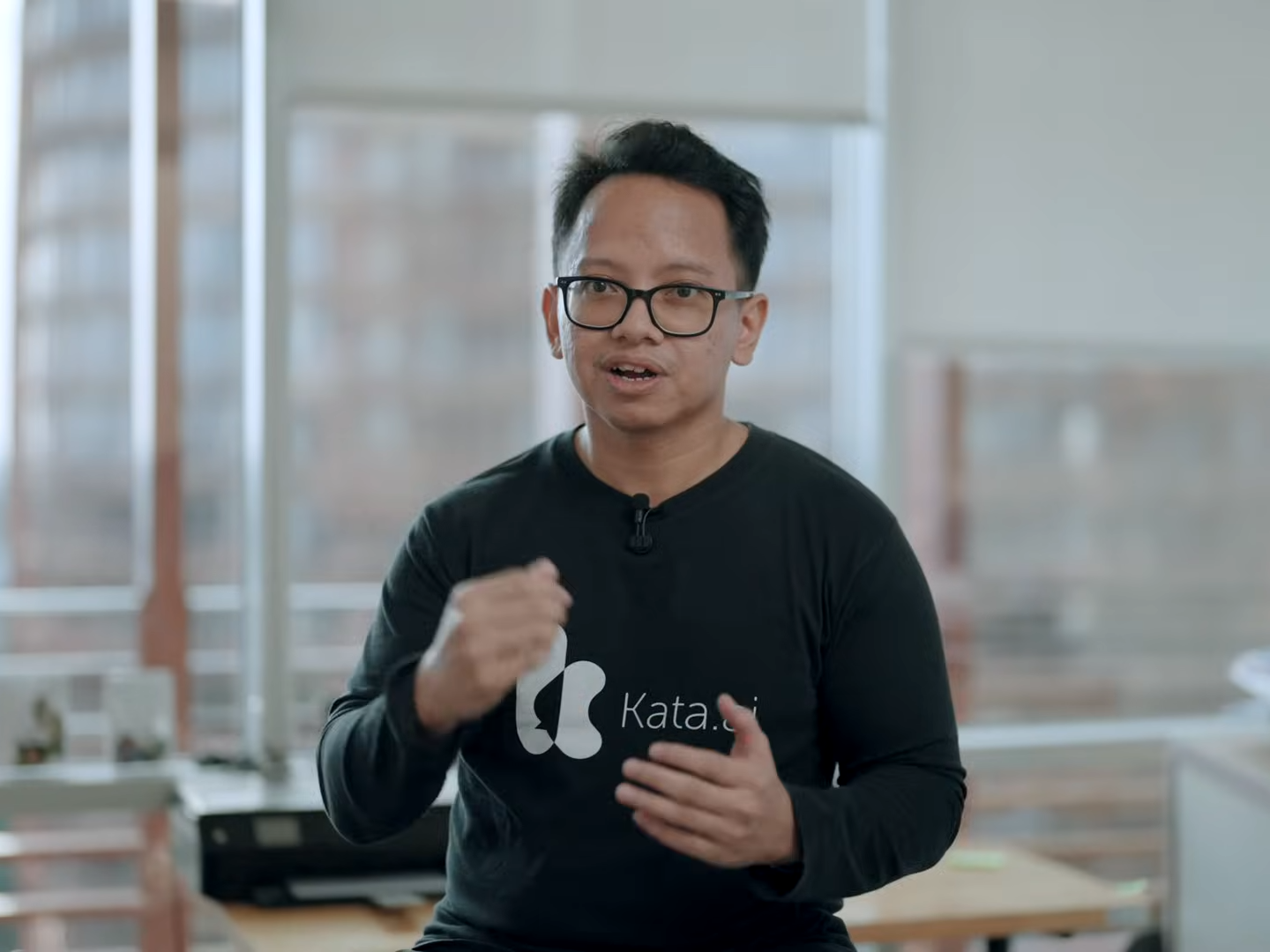
Hi, my name is Irzan. I'm the co-founder and CEO of Kata.ai. What we do here Kata.ai is the pioneer of conversational artificial intelligence platform. We help businesses to improve their customer engagement through the likes of messaging apps such as WhatsApp, Instagram, Telegram, Line and many more.
We provide a platform where businesses and developers could build their own AI powered chatbots through our natural language processing algorithm, especially to understand Indonesian language. The first pronoun in English, be it informal or casual, it's only I, right? But in Indonesian texting language, you can find 13 types of ways people are expressing the first person pronoun, all the abbreviations, the slangs. And it's just crazy.
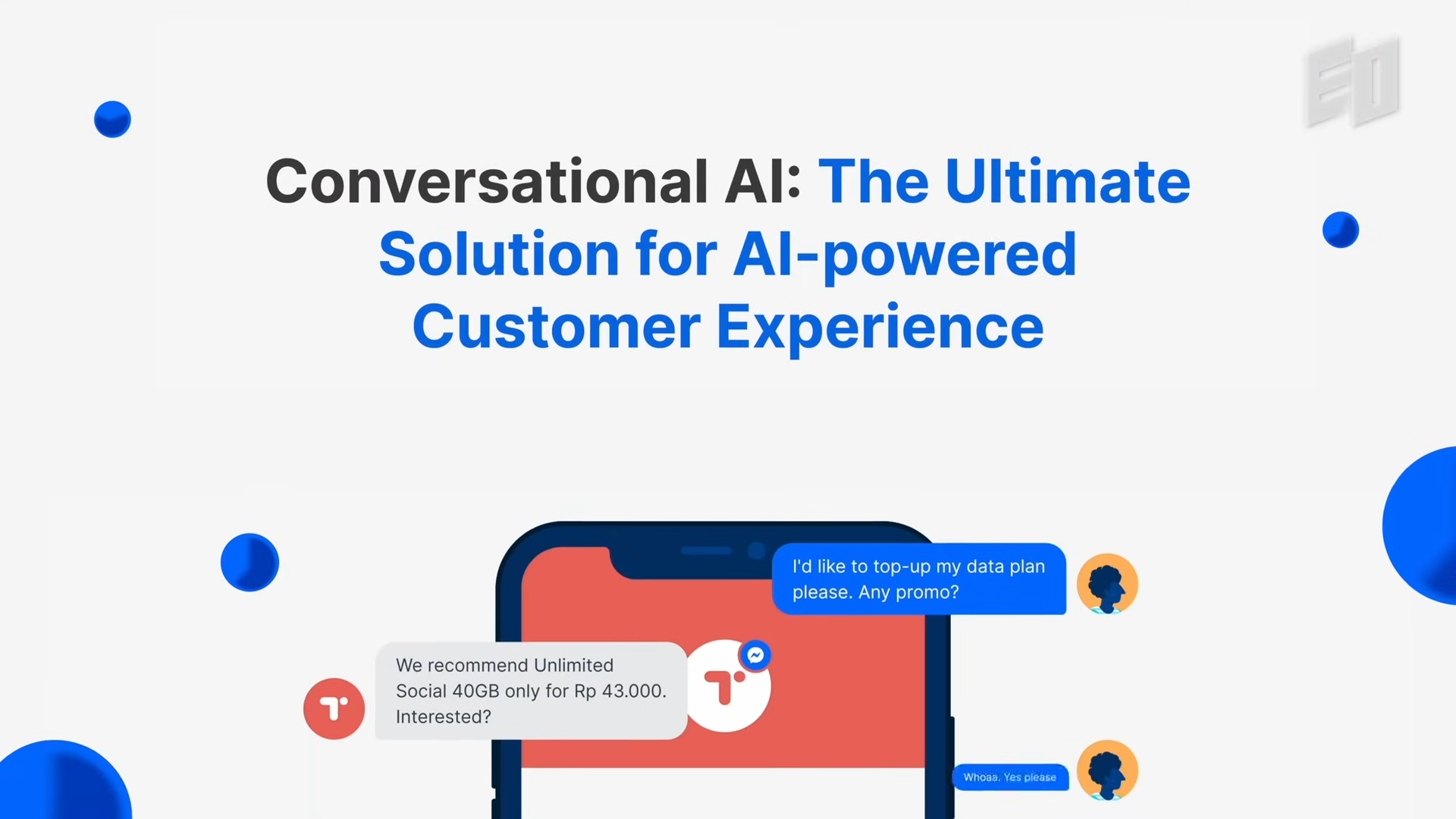
We collect 3 million messages as an initial training model for our AI to understand the language here. We do like annual subscription, in which the customer has to pay some license based on their traffic size, based on the conversations number they are serving every year. Our key focus industries ranging from telecommunication providers. And then we also support customers in financial services.
So we have helped over 200 enterprise customers in Indonesia and processed over 2 billion conversations to date.
Chapter 1: From Making A Living To Giving An Impact
When I was eight years old, in elementary school, I was selling a caricature of pictures of my friends, and they could pay me like 500 rupiah and I could use the money as a pocket money. And during my middle school years to high school years, I was being drawn to an online game called Ragnarok Online.
But I was not only using the game and the internet access I had, but I was thinking how I could make money out of it. So those who are playing the games, I built a bot. So I did programming since I was in elementary school, so I built a bot for them in which their characters could run and hunt like monsters, and then they pay me in exchange for that for the service.
Not only that, there was like this pirated, let's say, music download services right back then. The original CDs for some bands' music are very expensive. A lot of my friends are asking, hey, Irzan, could you please help me burn the CD? I want to give it to my girlfriend.
So I did that and it became like a pocket money when I was in middle to high school, and I have always been very happy with it. At the same time, I have like two hobbies which are not really quite normal for kids who are into IT, like computers and also into music. So I played bass guitar in a band.
I used the money that I made from this side job, so to speak, side hustles to purchase some gears and equipment for my music. So when I moved to Germany for my bachelor's degree, so I get my computer science there. So aside of focusing on my study, I was a professional musician. I was in a band. I was the only like Indonesian or Asian kid in a band.
The rest are Germans. We toured around Europe. I went to Indonesia and I learned a lot, being in a band, because I learned about digital marketing, because I designed the band's MySpace back then, the website. So that's why I did some coding on the HTML and JavaScript design. Not only that, I talked to a lot of sponsors for our touring.
That exactly helped me to shift to where I am today, because when I talk to sponsors, I have to give like value proposition. It's just the same when you're an entrepreneur, you have to pitch to investors. I think my first foray into my entrepreneurial journey was building a website called Amplitweet. So back then I think it was 2011 and Twitter was very huge at that time. I think they're the largest social media after Facebook.
So I found a problem with my band and my other fellow musicians and artist friends that they are struggling to get like new followers on Twitter, like to build fan base so to speak. By building this tool, I made it possible that their fans, when they download their music, their single, their album, they have to tweet and follow the artists and bands.
I think I managed to sign up like eight musicians and even one from a major label, but I learned a lot because, back when I was in Germany, it was a side hustle. I didn't have enough dedicated time to do that, and I was alone. So yeah, I think the lesson learned is, well, you can start as Superman, but if you want to build a business, you've gotta be the Justice League.
I look back to when I was a kid that I loved to make a living from my creation, and I love to make an impact because my parents always tell me that the best human being and mankind are the ones who can make positive impact to our lives. It resonates in my brain every time, every day. So I took multiple chances to become an entrepreneur.
I failed many times, but this time, yeah, I started with YesBoss in 2015 before it became Kata.ai as it is today.
Chapter 2: The Biggest Lose From Pivot
Before I started Kata.ai, it was called YesBoss. It is the same company, by the way, but we changed the business. We pivoted from B2C to B2B when we started YesBoss. It was a virtual assistant company in which we believe that people in Indonesia, they love to get served, they love services. So through YesBoss a customer could chat to an assistant, which is not AI actually.
They could ask anything, hey, I want to book a movie for Star Wars for for two people in X cinema for tomorrow, for example, and our assistant, they use other services to book the tickets, and then customers made the payment and they provide the information and the digital ticket, for example. And then it can do anything.
But all in all, we had like 50 customer service agents that we employed internally. But from day one we understood that this wouldn't be scalable and it required this AI technology. We did that, but it was not easy because we had to collect the data, clean the data, build the model, test this and that.
And then after one and a half years, we came to a point that, yes, the AI model is there. And I think we are at a point that we're very proud of. But at the same time, as a startup, we are constrained with resources, with cash, for example, and then with time, with energy.
So we had to pick a battle because it was a transition from B2C to B2B, from YesBoss to Kata.ai.
It was the toughest three months of my life because I had never been an entrepreneur running a business full-time, and then I was very, I was very upset that I had to let go 90 of my staffs back then because maybe, like, they're part of a family, they have to make a living for their family, for their spouse, for their kids, right? For their parents. So I also was in their shoes, right?
We tried our best in order to help them. We helped them to find jobs. We helped them to create a LinkedIn profile, to write a CV, for example. So we had to explain why the changes and the business has to survive. And we see also AI is the future. So it's not easy definitely for me and for everyone who was involved there. But we are thankful that we could survive. And not only that, we managed to thrive.
We grew two times from the previous year, and I think this requires tight collaboration between all team members, and culture is key, that glues everything. To have a strong team, there are three traits that an entrepreneur should look for: having the same mission and why.
The why has to be clear. You're an organization as a startup, and you find people who believe in your idea, your vision, and once the people buy into your why, the rest is limitless. And then the second one is having this growth mindset, the willingness to learn. As long as the people have this growth mindset, they are willing to learn and they could learn fast. And the third one is having humility and coachability, because we will fail.
I made a lot of mistakes and my team will also make mistakes. Having humility is helping us to be coachable. How we can learn from ourselves, from others, and from our superiors and others.
Chapter 3: Customers First! Technology Second
An entrepreneur shouldn't be falling in love with the technology or the solution. You should fall in love with the problem. Focus on your customers, their pain points and their problems and build your solution around it. So it's not technology first, but your customers first. When it comes to the problem, it's a market of billions of dollars. Imagine, as your business grows as a consumer business, and you have to add more headcounts. Let's say there were some problems with service or product, it has to be handled by a human.
And those people who work in the call centers and customer service contact centers, they are serving a stressful job because 80% of the questions which are coming to them are the same within one industry. That's one thing. The second, the turnover rate is very, very high: three out of ten people resign from a contact center agency every year because of the stressfulness in doing the job.
And the third one, the cost per call. By using human agent and the tools around it, it will cost like 3 USD per call. At the time we started YesBoss, we always envisioned that AI is the future. So that's what we convey to the media, to our investors, and thankfully our investors, they all agree and they support our vision. There's one guy who used our YesBoss service.
He loved the service, and at the same time, there's an opportunity coming from the largest consumer goods brand in Indonesia. They want to build the first virtual female best friend in partnership with the messaging application Line in Indonesia. So they brought the idea from other markets, from other countries. And we're looking for a partner in Indonesia to do that. I think we were lucky and we met this guy.
He was the managing director of Line back then. And we discussed, I want to see our technology. And then we ran the POC that we did with our early NLP technology. And I think unanimously the customers and the partners are impressed. And that became our first foray into B2B, building AI powered chatbots. And the result was amazing. Within a year, we, our chatbots managed to talk with 2 million users.
And not only that, for the business itself, they were happy because out of this 2 million users, 40% of them, or 800,000, they can converse with the chatbot and provide their information so they could retarget for remarketing, so to speak. We saw a turning point, and it became a snowball effect because it was like one of the prominent consumer goods brands, and everybody in the B2B scene saw that opportunity.
Oh, I also wanted that. I also wanted that kind of chatbots. And yeah, we talked to multiple companies. And I think when it comes to B2B, having like the social proof and credentials being trusted by major brands is very important for you to acquire more customers, building like what we call a brand moat. I think I wouldn't deny that there were some challenges, especially with chatbots. And it answers, sorry, I don't understand what you are trying to say, right?
What we believe in. Yes, the AI algorithm, the NLP has to be strong. You have to understand the colloquial language, the slang languages and various of inquiries, especially the ones that matters to the business. That's one thing. Second, give a way out for the end users or the consumers in which we believe there should be like human in the loop.
So that's why every chatbot we deploy for our customers, they should work hand in hand with an agent on the back office. So if the chatbot, for any reason couldn't be able to serve the customers, it will pass over to the human agent. So I think that's our idea. And from the human agents we see, like, what are the inquiries that the agents were taking and use that knowledge to train back the chatbot?
So next time there were similar inquiries coming to the chatbot, it already understood without passing over to the human agent. When I found that one customer, we operated just like a software house. We had to customize everything. And then we came to the second point that we get this opportunity to work with, I think, a major technology consulting firm, to serve this telecommunication provider client.
At that point, we had to think twice how we can support the software engineers of this technology consulting company so they can use our product and technology. We had to build a platform, a developer tool that can be utilized by their software engineers to build an AI powered chatbots using our NLP technology.
Kudos to my co-founder ex CTO back then who put a lot of efforts there along with his team back then. Now we don't have to customize everything on our own. We can replicate the model and build relationship and partnership with other consulting firms with other software houses. And that became our go to market model.
Working together with these software houses IT technology consulting firms, where they can use and leverage our technology to build AI powered chatbots for their customers. Because we believe when it comes to B2B, it's not always about the technology, but the relationship matters a lot. And a lot of these relationships have been established for many, many years or even decades. And it's something that you cannot just disrupt as a new player in the town.
When you try to bring a fresh new technology and innovation to the space, there's a cycle of customer adoption. What you have to find is the innovators or early adopters. Typically, they are the first mover, typically they are the market leader, and they always want to stay ahead and have an edge against their competitors. You have to talk to them.
I believe relationships will go hand in hand with results, because relationship is something that you build socially, that you can nurture it. But results, when you leverage your solution, you have to leverage the promise, whatever the technology that you're leveraging. In my opinion, the best result has the best return on investment. It has to be quantified, especially when you serve B2B customers, how does it impact their bottom line?
Whether you manage to save your costs or even you are able to drive new avenue of growth through sales, revenue and transactions.
Chapter 4: Small AI vs Giant AI
I think the opportunity for local AI companies like in Indonesia, in Southeast Asia as a whole, is to solve hyperlocal problems. So now the algorithm is out there everywhere and it's becoming more accessible. And that's great, right? But the algorithm, it only works when you have hyperlocal data, data that are not easily accessible by the public on the internet, data that is not being owned by OpenAI, for example.
And that's your edge. It could be in various areas. It could be in agriculture, for example. It could be in supply chain, in healthcare, in financial services. So if these entrepreneurs could leverage AI to solve local problems with hyperlocal data, that's a winning game.
We are glad that Kata.ai has been trusted by a lot of corporations in empowering their customer service operations to be more powerful and robust and becoming more productive, so to speak, and the future that we're looking with the rise of generative AI with ChatGPT and others, I believe the future of conversational commerce.
So how we can enable a human like conversations on a messaging, messaging apps to help consumers to interact with businesses, to pay for services to transact, to buy their products, to purchase and make it easy and seamless. So I think that's the future and focus that we'll be heading this year and moving forward. Well, I think my dream is that I want Kata.ai to create a long lasting impact.
Even I'm not part of the company anymore. Maybe I'm not here anymore, but I wish the impact will still last on how we can leverage impact with AI to people and improving their happiness, their productivity, and create the best customer experience.