Interview with Miki and Anantika, co-founders of FoundHer

The last morning in Glen Park
On the morning of August 23, 2025, Anantika Mannby woke up early to drive back to Los Angeles. It was the last day of FoundHer, a hacker house for women. Her best friend sent her a photograph of a newspaper lying on the front step of a country club, and the faces on it were hers and her housemates'.
Copies of the August 26, 2025 print edition of The New York Times.Courtesy of FoundHer House.
The New York Times had put their house on the front of its business section. Mannby went room to room, waking everyone up.
"The house was full of screaming and excited commotion that day. That was literally the last day of the first cohort, so it felt like really full circle."Anantika MannbyCo-founder of FoundHer House
Back then, the house was just three months old. Eight women had arrived at a rented house in Glen Park and spent their first day assembling four beds together from a manual. No long history, no playbook, no name anyone recognized. Then the stories kept landing, before and after the New York Times cover, one outlet after another.
The bigger surprise was the money. That summer the residents raised more than $7 million for their own companies. FoundHer started as a conversation between two USC (University of Southern California) freshmen about where to spend the summer.
That's not the ratio you want to be in
Mannby and her co-founder, Miki Safronov-Yamamoto, first met at USC's admitted students day. Their friendship began that fall in an entrepreneurship club called SCP (Structured Curriculum Program).
Both had entered the Iovine and Young Academy, a small program at the intersection of art, technology, and business, and both were already building companies. Mannby remembers their first encounter as meeting "a very similar soul," and the two quickly became best friends.
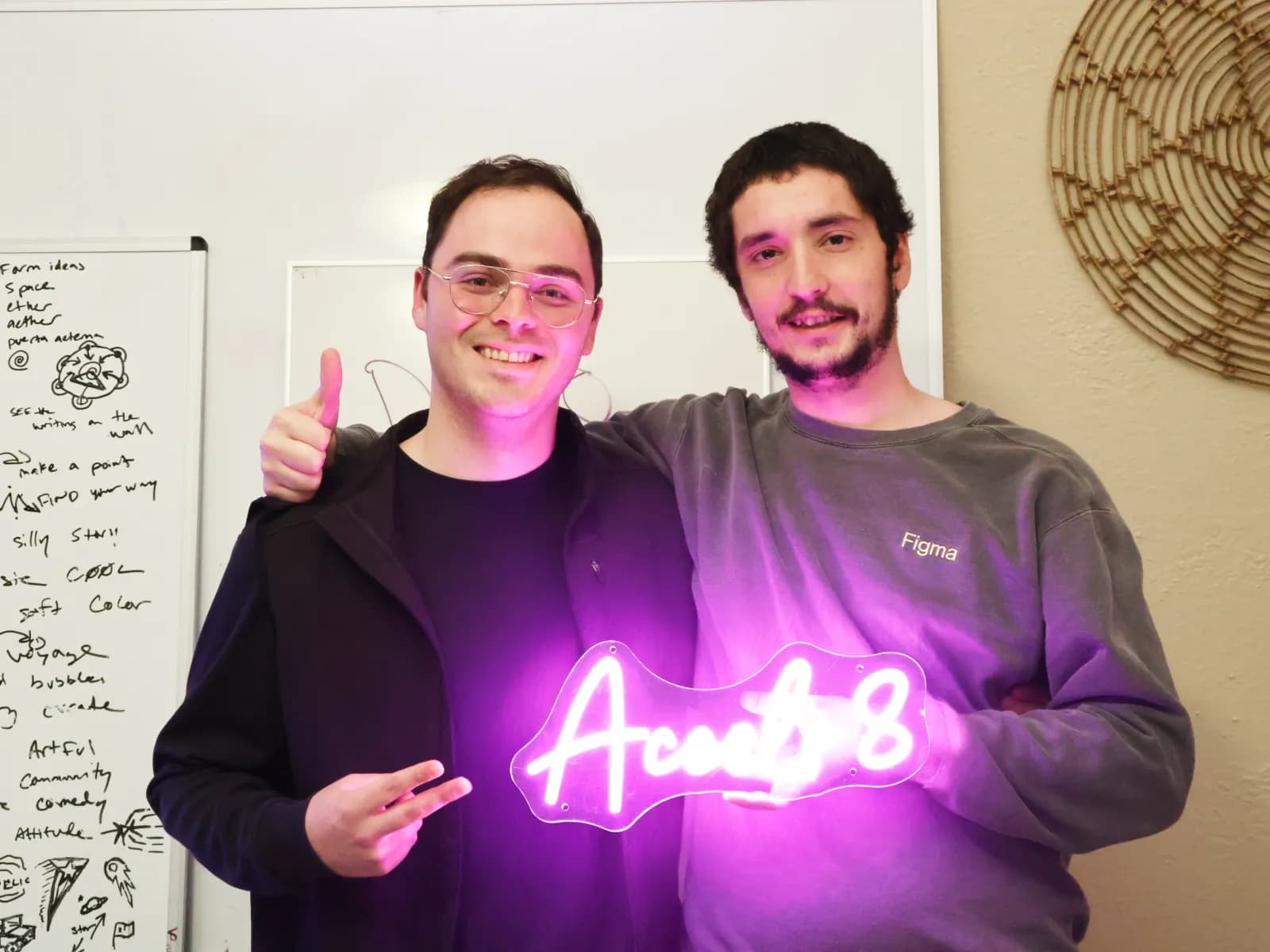
Anantika Mannby, right, and Miki Safronov-Yamamoto, who met at USC and founded FoundHer House as freshmen.Courtesy of FoundHer House.
By the end of their first semester, the conversation kept returning to the same question. Where did they want to be for the summer? The answer was San Francisco, building their companies in a hacker house.
"We just really wanted that hacker house experience. It's just fun, all morning to night, grinding on laptops. I have two friends who dropped out. They live in a hacker house, and they were talking about how much fun it was."Miki Safronov-YamamotoCo-founder of FoundHer House
When they went looking, the houses that existed had a problem: the ratio.
"We don't need to live in a four-story house where we're the only girls," Mannby said. "That's not the ratio you want to be in."
They realized co-ed houses have a mixed reputation and aren't always the best community for women. So they decided to build one themselves.
A women-only house draws its own objection, and Safronov-Yamamoto has heard it enough to have a short answer.
"People say, 'oh really, a female hacker house?' I'm like, yeah, well, there's male hacker houses all over SF. It's just nice to have a touch point where it's all women building the same thing. It's really not that deep. We're not trying to exclude people. It's just one place where people feel comfortable."Miki Safronov-YamamotoCo-founder of FoundHer House
But building it was a chicken-and-egg problem. They couldn't get money without people in the house, and they couldn't get people without a house to promise.
They decided to start with the people. Safronov-Yamamoto started dialing. There was a person who ran a hacker house himself; he was one of the first people she called, and he introduced her to founders and to other operators without asking for anything. At one point she was on three calls a day with founders she had never spoken to, ending each one with the same request: "Can you guys introduce me to the most cracked, insane, talented female founder?"
Three months later, and she figured she had spoken to every female founder she knew of, and every female founder they knew of. The result way exceeded their expectations. An application went up online, and a LinkedIn post went viral. Almost 100 women applied to live in a hacker house, which for all anyone knew, was just a random website.
"Every single girl we talked to said, this is so incredible what you're doing. I realized very quickly that this is needed."Miki Safronov-YamamotoCo-founder of FoundHer House
Safronov-Yamamoto remembers how easily people introduced her that summer. "I really just appreciated everyone's willingness to connect us to the right people," she said.
Dozens of no’s and one three-minute yes
The investors were a different story. Meetings produced offers of dinners and event invites but almost no money, because FoundHer was a nonprofit, and the only return on a check was goodwill and connections. She met dozens of investors before the first check.
"It was demoralizing," Mannby said. "You get on a call, and people were really excited, but then there was no follow-through. Everyone says yes, but how many people will actually send you the money?"
Tina Sharkey, their USC professor and mentor, sent a blast to some 200 people in her network. As Safronov-Yamamoto remembers it, the note said little more than that a student named Miki was building a hacker house, and that Sharkey would connect anyone interested in donating. And Brad Feld, the Techstars co-founder and a friend of Sharkey's for more than a decade, answered in three minutes.
"He said, 'I'm in for 10k,' and that was the whole email. We cried. We were so happy. We were so happy. I think I might have been more happy than I was finding out about The NYY story. Finding that first person to bet on you is so hard. As soon as one person bets on you, it's so easy to join the bandwagon. But it's so hard to get that first person to believe."Anantika MannbyCo-founder of FoundHer House
Brad Feld, second from left, at a breakfast in SF with FoundHer residents.Courtesy of FoundHer House.
When they later asked Feld why, Mannby remembers a simple answer:
"He said, 'A lot of investors give support, but they don't give the money. I'll always give the money. I'll always give you that first bump to get you there.'"Anantika MannbyCo-founder of FoundHer House
Feld's bet and his introductions helped the two founders secure further support. By then, they had also gotten better at pitching FoundHer to investors, learning to frame it as a donation. Although FoundHer offers its backers no financial return with every dollar going toward operating the house, the nonprofit charges founders only $1,000 per month, a striking bargain by SF and NY standards.
On why investors back a model that offers no equity in return, Safronov-Yamamoto explains:
"We're a donation model. You give us a donation, and we'll give you access to 16 incredible female founders now. Everybody wants to get in on their rounds. So the accessibility itself is our reward. We also host large events so they can connect with the best talent in each city. And basically, I think FoundHer's brand becomes their brand as well."Miki Safronov-YamamotoCo-founder of FoundHer House
In the end, a small, tightly curated community of top female founders was what made the model work. FoundHer launched its first house on roughly $15,000 in donations.
The first cohort at FoundHer's demo day.Courtesy of FoundHer House.
The first summer, and what came after
FoundHer's start in June 2025 looked as chaotic as any hacker house's. Safronov-Yamamoto recalls that they weren't following any kind of playbook, so they genuinely didn't know what they were doing, and it was hard. Mannby shared a few of the more comical stories from those early days.
"We showed up and built four beds on the first day we were there, all of us with a manual, trying to figure out how to build the beds and shove them in the rooms so that they all fit. Also, there was an event where we did a hibachi dinner with Kleiner Perkins, and we didn't have a table. It was an hour before the event. We had to drive to Walmart and buy a table. We kept the tags on it so we could return it."Anantika MannbyCo-founder of FoundHer House
That first cohort ran on little more than a handful of simple rules: dishes done within twenty-four hours, a chore chart, and a Sunday dinner at 8 pm where everyone talked through their goals and how to help each other reach them. The residency itself is three months, and Safronov-Yamamoto says that is deliberate.
"A lot of times these are people who are young, but they really want to take the leap. They're like, I just need three months to grind, to raise my round, to go all in. I mean, why is YC not a whole year?"Miki Safronov-YamamotoCo-founder of FoundHer House
Even so, the results were striking. Together, the members of FoundHer's first cohort raised $7 million. One resident closed a round of more than $1 million during the summer. Another landed contracts with AI companies.
The New York Times ran its FoundHer story online on 2025.Source: The New York Times.
The New York Times had found them at a ping pong event in San Francisco. Mannby wasn't there. The rest of the house went, seven women walking into a venue of almost all men.
"I think we instantly get noticed. Because we show up in mobs."Anantika MannbyCo-founder of FoundHer House
Someone introduced them to Natallie Rocha, a New York Times reporter, and a few days later she came by the house and talked to all of them, Mannby included.
"I didn't even realize she was gonna write something on us. I thought we were just hanging out."Anantika MannbyCo-founder of FoundHer House
Mannby had gone home to Seattle when Safronov-Yamamoto called, saying that it wasn't a casual meeting. They were being featured in the NYT. She told her to come back to SF because the photographer's coming tomorrow. Mannby booked a flight to San Francisco for the photos and flew home again.
USA Today had reached out separately through Instagram after seeing the house's social videos. Its story ran on the front page first, and the Times followed the next day. Then the inbox broke open.
"We had our emails flooded. So many reporters reaching out on email, Twitter. We realized we had momentum. We were like, okay, let's lock in on this."Miki Safronov-YamamotoCo-founder of FoundHer House
Residents of the first cohort at an evening event in San Francisco.Courtesy of FoundHer House.
Both founders said the coverage made a real difference in conversations with investors and in recruiting residents. By 2026, applications to FoundHer had grown to around 200, and funding had risen tenfold over the previous year. Josh Kopelman of First Round Capital joined as a new backer, and Marina Girgis of Precursor Ventures, who had supported the first house, increased her donation.
That growth let the second cohort run a house in New York alongside the one in San Francisco. In August 2026, FoundHer expanded its demo day into a full "Summit," held at OpenAI's offices. Looking back, Safronov-Yamamoto called the Summit "the culmination of all of hard work."
"The FoundHer Summit was a chance to bring everyone together, celebrate how far the founders had come, and showcase the companies they had spent the summer building. What stood out most was how much progress every single person made in just three months of going all in on their startups. The cohort included founders at very different stages from people closing their first few customers to companies that had just raised a $6M seed round."Miki Safronov-YamamotoCo-founder of FoundHer House
A panel talk at FoundHer Summit, held at OpenAI's headquarters.Photo by EO.
Other Girls Who Are Just Like Me
Two summers later, FoundHer is a hacker house backed by the founder of Techstars, featured on the cover of the New York Times, and co-hosting events with OpenAI.
What makes this remarkable is that the co-founders built all of it while running their own startups. Safronov-Yamamoto runs Northstar, a robotics data and deployment infrastructure company that has raised a pre-seed round led by Genius Ventures. Mannby relaunched Treffa as Perfit, a fashion tech platform that reached more than 100,000 users and over half a billion organic views.
When asked whether running the house alongside a company is hard, both said operating the house helped their company.
Mannby, left, and Safronov-Yamamoto being photographed.Courtesy of FoundHer House.
"We joke there is no such thing as balance in a startup. Some days all I'm doing is making sure FoundHer House is running smoothly. Some weeks I am 100% focused on my startup," Mannby said. "The girls in the house have helped me so much with meeting investors, talking about product, and most importantly in inspiring me to be brave and take big swings."
FoundHer House was where Safronov-Yamamoto met the VCs who eventually invested in her company, and some of the people she met in the house became customers of her company. "Working on my startup and running the house are in parallel," she said. "It's all in the same direction."
The load is also lighter than it looks, because the residents run much of the house by themselves. Since the second cohort, applicants now apply to a specific job: events, budgeting, social media and branding, logistics. Every resident arrives with a role attached. Mannby ran the New York house this summer, Safronov-Yamamoto ran the one in San Francisco.
Safronov-Yamamoto, right, at one of the house's evening gatherings with investors and founders.Courtesy of FoundHer.
Ask Mannby what the house gave her, and she does not start with the $7 million. She talks about the ordinary days instead.
"I remember I had a really bad day, and I was sitting on the couch. One of the girls ordered me like a matcha and brought me snacks. We did a little surprise birthday party for one of the girls who normally doesn't celebrate her birthday ever. People say founding is lonely, and everyone will celebrate your raise. But who's going to be there in the smaller moments? That's really what the house gave."Anantika MannbyCo-founder of FoundHer House
The other thing she wants FoundHer to do is let women watch other women build, in person and up close. Before the house, Safronov-Yamamoto was the only other woman Mannby knew at USC who was seriously building a company. Walking into the house for the first time, she said, her reaction was "Wow, there are other girls living this life who are just like me."
"It's not what women are capable of. It's not talent. That's not the issue. It's what you believe is possible, and the only way you can believe it's possible to raise tens of millions of dollars and build billion dollar companies is if you see it with your own eyes."Anantika MannbyCo-founder of FoundHer House