May 30, 2025
How I Built a $3.3B Blockchain Business Against All Odds
Interview with Konstantin Richter, Founder of Blockdaemon
Founder Focused


0:00 / 0:00
💡
At a Glance
- Who: Konstantin Richter is the founder and CEO of Blockdaemon, the leading institutional gateway connecting banks and financial institutions to blockchain networks. JPMorgan, Goldman Sachs, and Citibank are both investors in and customers of the company, which he built after seeing how unstable and poorly supported Ethereum node infrastructure was for institutions.
- What: The interview covers why Richter built infrastructure rather than a token-dependent business, betting early that institutions would eventually need reliable access to blockchain nodes when almost no one believed that demand existed.
- Traction: Blockdaemon now runs 250,000 nodes and roughly 10% of global institutional node volume, serving 70% of the top 500 active crypto companies. The company has raised about $430 million at a last valuation of $3.3 billion, up from Richter's 2017-2018 prediction, widely mocked at the time, that institutions would run 100,000 nodes by 2020.
In this interview, Konstantin Richter, founder and CEO of Blockdaemon, explains why he built infrastructure for institutions to run blockchain nodes at a time when almost nobody believed banks would want that. He describes surviving two crypto winters, one where he subsidized payroll to keep the company alive and another where growth plans collapsed and he had to cut staff and resize the business, and how inviting customers like JPMorgan and Goldman Sachs onto Blockdaemon's board built the trust needed to win institutional business.
Key Takeaways
Blockdaemon Builds Institutional Gateways For Blockchain Networks
Konstantin Richter describes Blockdaemon as infrastructure that runs the ledger nodes institutions need to connect with blockchains. The company serves major financial institutions, supports 70% of the top 500 active crypto companies, and frames blockchain infrastructure as a gateway layer.
Belief Turns A Blockchain Gap Into A Company
Richter was drawn to Bitcoin's transparent, community-controlled origin and its promise of accessible money. When he found that running Ethereum nodes was unstable and poorly supported, he connected that infrastructure gap to a company that could serve institutions without depending on token momentum.
Founders Must Lead Through Markets That Stop Cooperating
During the first crypto winter, Richter subsidized payroll and kept searching for a believable path forward while resources disappeared. His operating lesson is that founders must find resources others cannot, motivate teams through bleak periods, and lead visibly when confidence is scarce.
Survival Requires Conviction, Team Integrity, And Adaptation
Richter's second crypto winter forced Blockdaemon to resize after plans for a larger product suite met a collapsed market. He describes the work as accepting the problem, changing strategy, protecting operational efficiency, and relying on a team whose integrity helps decisions hold together.
Institutional Trust Grows When Customers Share Governance
Blockdaemon took three years to attract institutions, then invited customers such as JP Morgan and Goldman Sachs into governance. Richter says board participation gave them visibility and influence, turning outside customers into contributors who could question choices and share responsibility.
Transparency Makes Crypto's Next Chapter Worth Pursuing
Richter sees transparency and efficiency as requirements for fair governance rather than luxuries. Having watched crypto move from an underdog position toward a standard, he wants to remain involved long enough to see the system's institutional future develop.
Watch the full interview now on EO's YouTube channel! Below is the complete transcription of the interview. Minor edits have been made for clarity and readability.
Introduction
I'm Konstantin Richter. I'm the founder and CEO of Blockdaemon. Blockdaemon is the leading institutional gateway for institutions to connect to really blockchains and the web 3 ecosystem. And so we're one of the market leaders and staples of the crypto industry that it has JP Morgan, Goldman Sachs, and Citibank as investors and customers. Out of the top 500 companies active in crypto, 70% are customers of Blockdaemon for infrastructure. Ultimately, what we do is the purest form of infrastructure we run in a decentralized network.
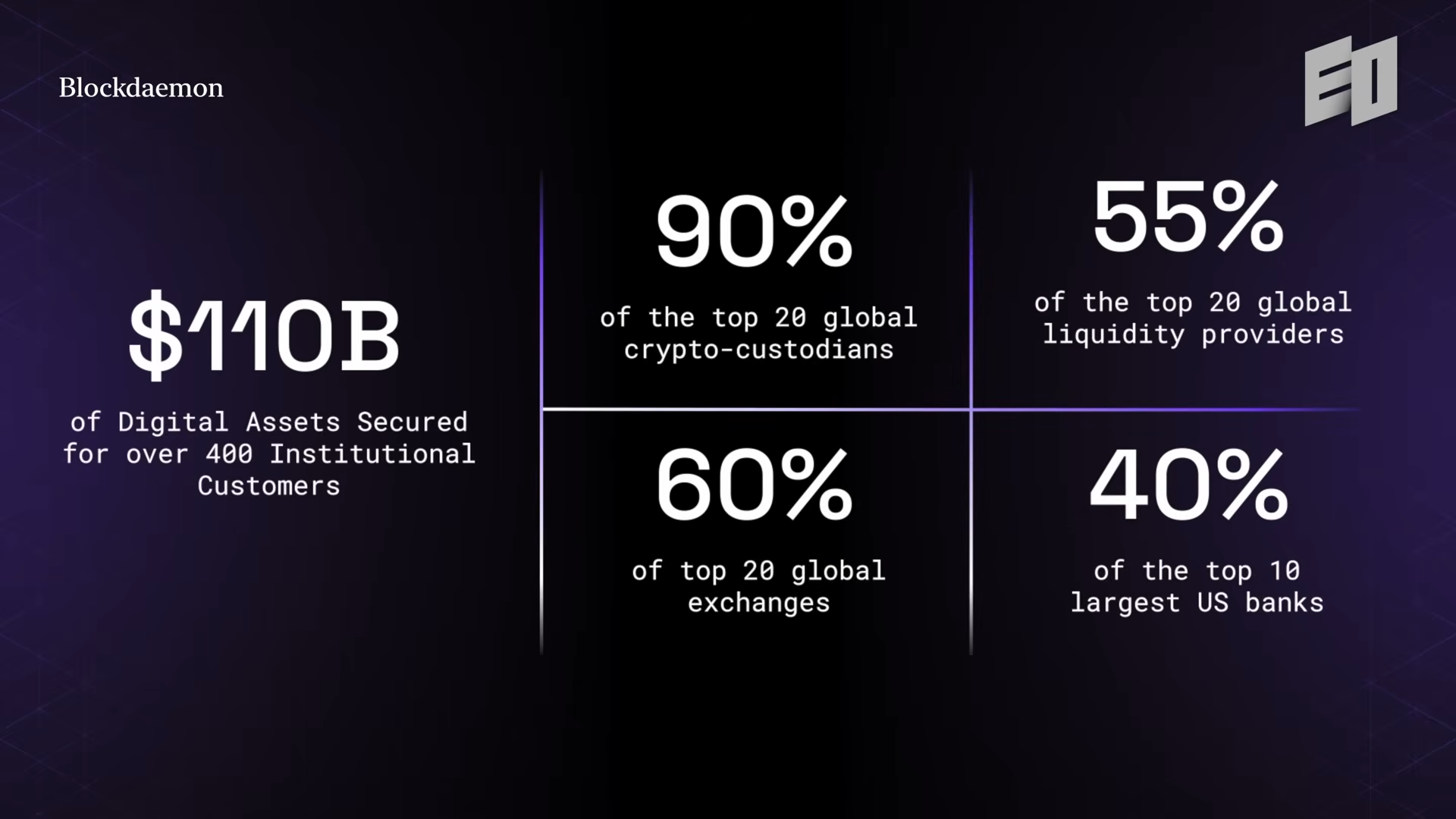
One easy way to think about it is that the internet ultimately functions via different gateways and so do blockchains. And so one way I used to describe blockchains to people was you have ultimately nodes. Nodes are the different members of the network that contain a copy of the ledger. Nodes are actually like cell towers. It's these groupings of individual ledgers that make a blockchain. And Blockdaemon manages the individual ledgers.
We basically run these cell towers for blockchains for institutions. We assume that we run around 10% of the global institutional volume of nodes around the world. Blockdaemon has raised around $430 million. The last valuation we've had was $3.3 billion.
Chapter 1: From Cold War Walls To Crypto Belief
One memory I always have is when the wall came down in Germany. I was a teenager at the time. I remember the Cold War ending when the world somehow got a lot closer and also in the context of the history of Germany from the Second World War being very aware that it's important to have systems that are incorruptible in order to establish truth. And so I remember that time as a really important moment to think about how do we become closer as humanity? How do we communicate and then how do we ensure that the forms of communications are incorruptible.
What I found really exciting about Bitcoin specifically was one the immaculate conception story of Satoshi ultimately a value system that basically gets birthed by itself and then the people who can control it vanish in the background and leave it for the community. And I like the encryption and a little bit the sort of hackery nature of it. I did like that it was a currency of the underdog. Bitcoin was started as a result of the financial crisis in 2008.
The whole idea was to basically take control of money away from banks into a system that's transparent and fair and accessible to anyone. And that excited me and I felt I can actually contribute to it because I know how to build and scale software companies and I know how to corral capital together to work on succinct problems and belief is important. I believed Bitcoin is one way to make the world better, but you also have to be an active part in creating that world. I didn't just want to make money. I also wanted to change the world a little bit.
I understand there's also lots of concerns and some of it might be bad, some of it might be good, but the system in itself I really hold very dearly. And so I was thinking what company in cryptocurrency can you build that is part of it but not so susceptible to the short-term velocity of tokens.
Chapter 2: Keep Believing, Even When No One Else Does
When I was working on the proof of existence protocol where we worked with an Ethereum node and saw that the physical node and infrastructure was very unstable and there weren't any tools available.
When I started researching that subject and talking to my friends about it, I saw an opportunity and I got really excited about it. You know, it feels so great when you see a gap in the current product landscape. What was very apparent was like you couldn't go anywhere online and say, "Hey, is there a tool that helps me to run an Ethereum node really efficiently? Okay, if this is hard for us people who are really passionate about crypto and blockchain, how are institutions and banks going to engage in this if there's no tooling, nothing available?"
What I saw is a world in which institutions would want to run these Ethereum nodes. And when I told other people about it, they didn't believe it at all. They were telling me we won't do that. But the more I learned about the structure of transactions, the cost of transactions, the more I saw the future in which blockchains become an integral part of this. I knew one thing for certain that if I hold on and deliver this, it'll be a massive win. I believed in the vision of the company to a point where nobody else believed it because obviously you're working on a problem that nobody else sees.
I think that's the resilient part is then to continue to work on it while people are telling you this is not a problem. Why are you working on this? I remember raising money in 2017, 2018. I told people that I believe in a world where there will be 100,000 nodes that will be run by institutions by 2020. That's what I said, and people were laughing at me.
And then Blockdaemon itself now runs 250,000 nodes. You need to be stupid enough to also hold on to an idea that most smart people around you will tell you is a very bad idea.
Chapter 3: The Mindset That Survived Two Crypto Winters
Within 6 months of starting the company, the markets of crypto fell down a cliff which we call the crypto winter which is like when the tokens that drive a lot of the momentum in blockchain suddenly devalue by like 80, 90%. Everybody stopped investing. Banks started exploding. We had two banks at the time.
One bank went bankrupt and so a lot of the inherent growth for the business dried up right when I started the company. You know, quite frankly, at that point in time, everything was so bad. We ran out of money a few times.
I had to subsidize payroll, for example. The only way for Blockdaemon to survive is if I put in everything I have without a clear promise of a better market environment, and I just have to make it last as long as I can with as much output as I can. And so there were a lot of moments where it felt like, wow, I don't really have a believable path forward, but still I have to convince people that there is one. As an entrepreneur, that's your job. Ultimately, you have to find resources where other people can't. You have to keep people motivated and inspired when it looks very bleak, and you just have to keep on leading by example.
The first one was Blockdaemon was very small. I think the second time around was unique because at that point we raised a lot of money. So we had a lot of capital. What was difficult is that we started 2022 by raising a lot of money buying companies to build a sort of really cohesive product suite that we thought we could sell within the year to institutions. And what happened is that market just died.
There was suddenly a lot of pressure on ultimately scaling down the projects we worked on that created operational pressure on the company to how do we rightsize the company? How do we losing money in developing products that currently have no market? It was a lot harder because we had to make the hard choice to also let go of a lot of Blockdaemons and people that worked with us in order to ultimately be operationally efficient.
Changing strategies and letting go of people in order to adjust for a longer period of time without any growth of a more mature company. And so I'd say that crypto winter felt harder to me because obviously losing people from your team because of that is really, really hard. The way I describe it to people, it actually just felt like another Wednesday. You just take it on the chin and they're like, "Okay, now I need to solve this problem." So you have to maintain an illusion of competence and vision where it's like, hey, this is not a problem.
This is just a little bump on the road.
I know exactly how we're going to solve it. It's challenging because as a founder you know that a lot of the plans and thoughts I had very early on are assumptions. I don't know if they're right or wrong but I have to pretend I do. But you know I mean like anything else you just try to not tell yourself it's so bad and you just keep moving.
And we found solutions for it. Having a really strong team and people who have good integrity is really important in moments like that.
And I'm very lucky that I do have a great team and people who stuck it out with me basically.
Chapter 4: Survival Belongs to the Trusted
In a world where it's so hard for us to develop consensus between human beings when news and social media and everything is so polarized and it's hard to know what's true and what's not that systems that are, I want to air quote, infallible and always true are really important.
When the internet was created, people scammed people on the internet. I never thought the internet shouldn't exist. I thought there should be regulation and rules and education to protect people from scammers, but that the benefit of the technology of open access and trade outweighs the downside.
If done correctly, crypto is the antithesis to scamming. It's fully transparent. It's traceable. You can see every wallet that's active on the network. And so it's actually the most scam resilient system at its core. I think it took us 3 years before institutions started engaging with us in order to engage with institutions. I think we also made the decision at the time that the only way institutions are going to engage with us is if they also own part of Blockdaemon or part of the governance of Blockdaemon. And so JP Morgan and Goldman Sachs, for example, participate in the board of Blockdaemon. So they're basically also my bosses, which means that they get to see the inside of the company. They get to question my choices.
They're not just outside customers. They're also part of creating the company. And so I think that gave them a lot of confidence, right? And so that was an important initial step for the first customers. And the US has started to look very, very different than it did in 2024. We see a huge shift that's materializing very quickly. The landscape of crypto will look really, really different in the US, with a lot more enterprises and institutions actively launching services for their respective customers around crypto. I think in a complicated, convoluted world that we live in, transparency and efficiency are really, really important.
Is This the Golden Era of Crypto?
They're not a luxury. They're a requirement for fair governance and efficiency. And so I think it is indeed a golden age for cryptocurrencies. Yes, I've seen it from it being the underdog to now becoming basically the, not the main dog, but the standard, right? And so I think we're halfway there, and it's so exciting to be a fundamental part of something that I want to see it through.