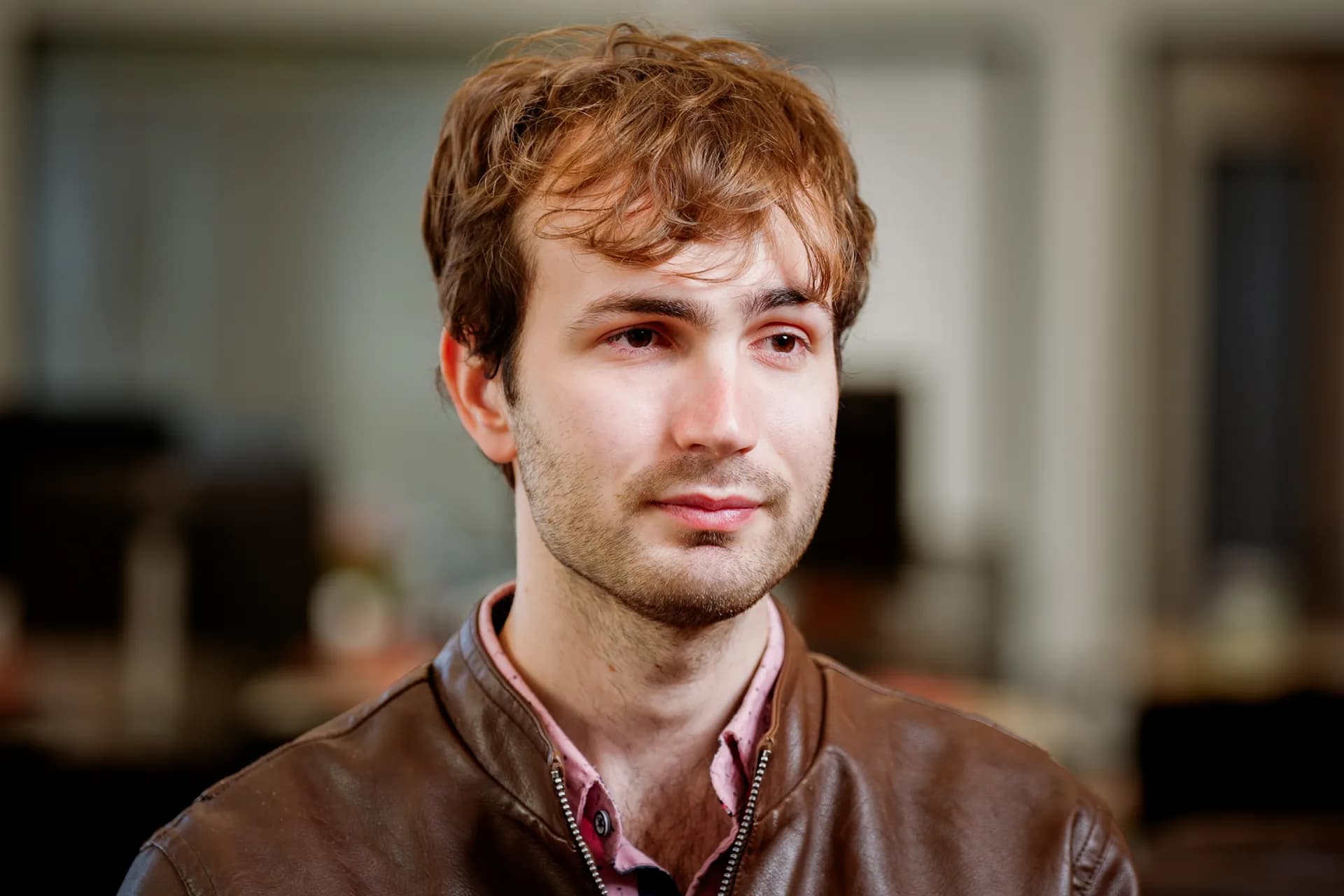
Based on a documentary interview with LayerZero's co-founders
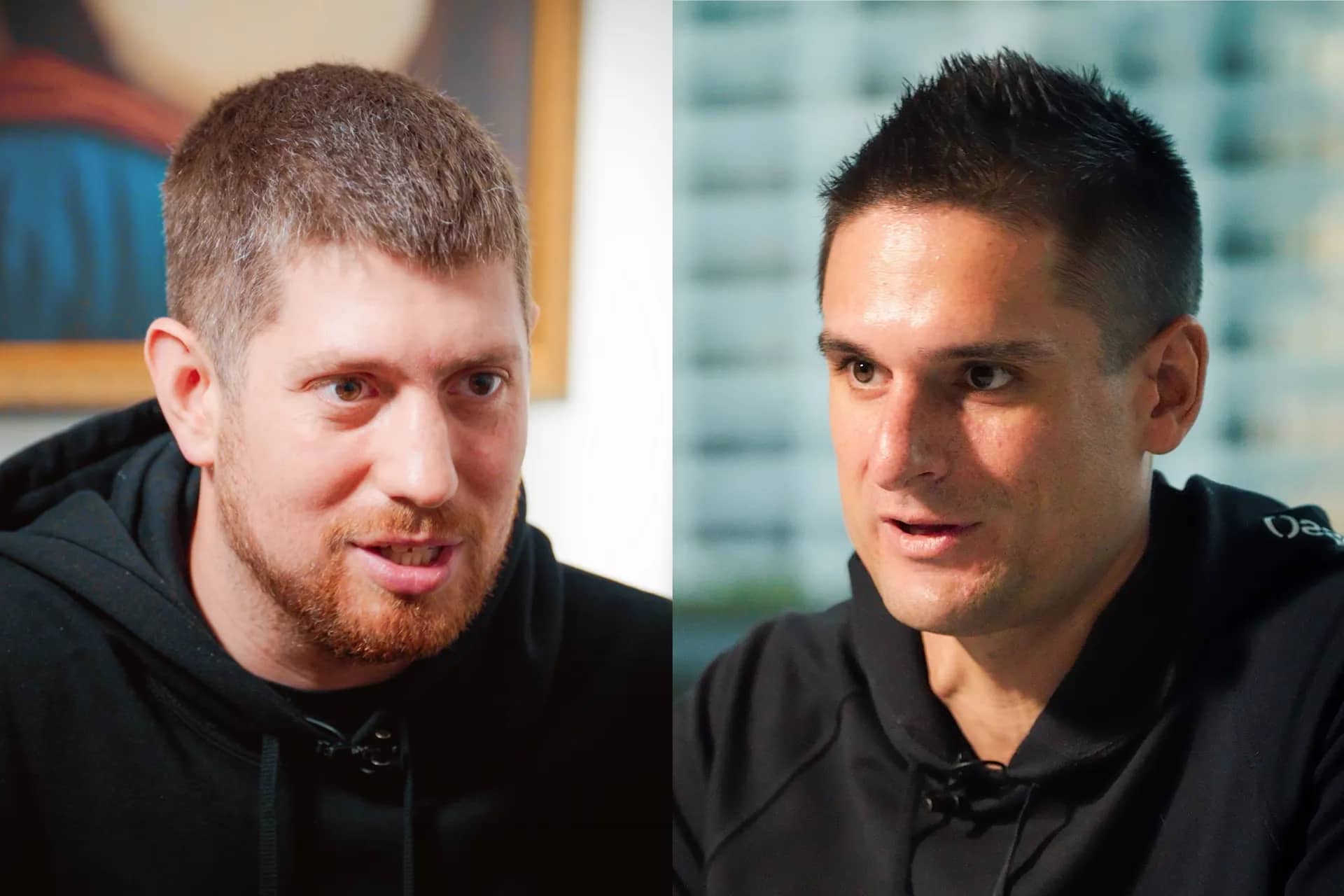
LayerZero: The Last Blockchain That'll Ever Be Built
"Vitalik said the trilemma is broken, but he means theoretically. We actually broke it. There were no more bottlenecks."Ryan ZarickCTO of LayerZero
"Reset everything. Think completely from first principles. How can I break it? How can I break it?"Bryan PellegrinoCEO of LayerZero
Blockchain has one supposedly unsolvable problem: achieving speed, security, and decentralization simultaneously. Vitalik Buterin named it the "trilemma." A founder from a town of 900 people and his college roommate from a state school claim they actually broke it. On February 10, 2026, they took the stage to prove it.
That day, Bryan Pellegrino and Ryan Zarick stood in front of a live audience in New York and made a claim nobody in the industry had made before: that they could prove Ethereum's entire history in real time, verifying a million transactions per second at 110 bits of security. Not on a slide deck. Not in a white paper. Running, live, in front of everyone.
But this is not really a story about technology alone. It is a story about a poker player who woke up one morning to find his entire career erased by three letters on a screen. About a CTO who taught himself GPU programming from 2 to 7 a.m., every single day for six months, pacing his co-founder's living room with a baby strapped to his chest. Neither went to Stanford. Neither had connections in Silicon Valley.
Yet they went on to become the first founders in history to have Andreessen Horowitz and Sequoia co-lead the same round. And now they say they are building the last blockchain that will ever need to be built.
The Day Everything Disappeared
April 15, 2011. Bryan Pellegrino sat down at his computer in Austin, Texas, the same way he had every morning for years. He was one of the best heads-up poker players in the world. He played or studied 70 hours a week. He had just bought a house. Poker was not his hobby. It was his entire life.
"I started up my computer, and there was a big seal of the Department of Justice on the website. And what had happened was that overnight, they had banned all online poker within the United States."Bryan PellegrinoCEO of LayerZero
"All of the websites are down. All of the payment processors are down. You can no longer move money between accounts or do anything. And it was just overnight, just like that, the industry was gone."Bryan PellegrinoCEO of LayerZero
He had no job. He could not access his money. Everything he had built over years of obsessive, grinding work vanished while he slept.
"I woke up and immediately saw that I had no job. I couldn't access any of my money. All of my funds that were on the site were frozen, just immediately."Bryan PellegrinoLayerZero
It was not the first time the government had disrupted his life. He had already been forced to leave New Hampshire after a tax law change made poker there financially impossible. He moved to Texas. Then Texas fell too.
"Those were the first times when you said okay, you saw the reach of policy and government impacting you in your real life. When you're a kid, you don't think about it too much."
"When you're a young adult, you don't think about it. But this is the first time: I need to literally move where I live. My entire life and career just got taken away from me."Bryan PellegrinoLayerZero
For the first day, he did nothing but sit with it. That was natural. Your career is gone, your money is frozen, and you don't know what comes next. But the day after, Bryan woke up and started looking at what was in front of him.
"The next day I woke up, and I saw that the world was changing very quickly."Bryan PellegrinoLayerZero
"All of the main poker sites were now gone, but there were a bunch of smaller, kind of shady poker sites that still existed, and everybody was going to sign up on those because they needed to continue to make a living."
"And I knew all of the highest stakes poker players in the world."Bryan PellegrinoLayerZero
He created an affiliate business. Signed up every top player he knew. Negotiated the best deals he could find. Within a couple of weeks, he was making $20,000 to $30,000 a month.
This is the pattern that would define Bryan Pellegrino's career: a landscape reshuffles, and he sees the opening before anyone else. Not because he is lucky, but because he never stops looking.
Three People Against an Industry
Two things happened in the aftermath of Black Friday that changed the trajectory of Bryan's life.
First, all of poker's payment processors were shut down, but Bitcoin survived as the only way to deposit on the remaining sites. Every serious poker player in the United States found Bitcoin in 2011. Bryan was one of them.
Second, a loophole in the same bill that killed poker created a new industry. The legislation had banned online gambling but specifically protected fantasy football leagues. That carve-out opened the door for daily fantasy sports, the industry that would become DraftKings and FanDuel, now worth tens of billions.
Bryan reached out to a company working on that loophole.
"I went to them and said, can I just work for free? Just let me do some affiliate stuff, I want to learn. Let me just see how it is. And they said, 'Sure, great.'"
"And then the board of the company said, 'We actually want you to become CEO in a couple of months and run the company.'"Bryan PellegrinoCEO of LayerZero
It was only after he took the offer that he realized how bad things were. The company had raised just $150,000 and had already spent $135,000 on an external development firm. That left $15,000 in the bank and no product. It was the worst possible situation, but he chose to keep going.
"I actually took my two co-founders here that I started LayerZero with, and I brought them in, and we rebuilt the whole product over the next year. Finally, we grew to being third overall in revenue."Bryan PellegrinoCEO of LayerZero
There were eleven companies in the daily fantasy sports space. The next smallest had raised $2.5 million. The biggest had raised $50 to $100 million. They had no business surviving that competition. But they did.
"It was a hard time. I think that was the first time we felt real hardship. A year and a half, maybe two years of zero income. Me working 80-hour weeks."
"Every day I was on, because it was just us maintaining a site that had tens of thousands of users with real money playing on our site. It was like three of us when every other place was a real company with hundreds of employees."Ryan ZarickCTO of LayerZero
Three people running a platform with real money against companies with hundreds of employees. And Bryan called at 3 a.m. about a button.
"He'd called me and said, 'Raz, it's a disaster.' I'm like, what's a disaster? He said, 'You've got to get your computer right now.' I get to my computer, and he's like, 'Can you fix this button?'"
"That is not a disaster. But it was to him."Ryan ZarickCTO of LayerZero
They were paying out of pocket to keep things alive. Ryan was using his wife's salary. Bryan was doing the same. An acquisition offer came in. It was not great. Bryan wanted to keep going. Ryan could not.
"I said, I have to take it. We have to take it. I just need to tap out at this point. I can't do it. It was the first time I ever tapped out."Ryan ZarickCTO of LayerZero
They sold. Six months later, the industry consolidated, and companies smaller than theirs sold for $50 to $100 million.
The Promise
But the man who tapped out didn't stay gone.
"Ryan actually came back to me later and said,"
"'I really, really believe that we can build something incredible. And I promise you, the next time that we do something, I will run my life into the ground. I'll go all the way to maximum suffering and everything, and we won't kind of give up early.'"Bryan PellegrinoCEO of LayerZero
Bryan went on to build machine learning models that caught the attention of MIT PhDs and led him to Billy Beane of Moneyball fame. They sold models to pro baseball teams. He started another company in the Valley. It got acquired.
What came next arrived with Ethereum. It was a trustworthy foundation, a layer you could build value on, but it was slow, and building complex applications on it was nearly impossible.
Bryan called Ryan two days after Christmas.
"I said, 'I know you said the next time we did something, we would really do it. I think now is the time.'"Bryan PellegrinoCEO of LayerZero
Within ten days, Ryan had sold his house, packed up his life, taken his four-month-old daughter, and flown across the world to Vancouver. He was true to his word.
"My daughter didn't sleep well. She would be up all the time. It was actually the worst time to take a shot and do these things. That's where I learned GPU. The first thing I did was walk around Bryan's house."Ryan ZarickCTO of LayerZero
"Every morning at two, I would strap my daughter in, and I'd walk around Bryan's downstairs living room. I would read the docs and everything Nvidia had on how to GPU program. Read textbooks."
"Without doing the work, because I didn't have a computer. So I was just doing it in my head. From two in the morning to seven in the morning, every single day, for six months."Ryan ZarickCTO of LayerZero
Six months of learning to code on a GPU entirely in his head. No computer. Just a baby, the dark, and Nvidia documentation.
"And then I sat down and just started coding the GPU. It was the worst time to go, which is the best time for me, because that means that, like, everything's on the line, uh, finances, stress, time. And that's when I have to hit my shot."Ryan ZarickLayerZero
Then something strange caught their eye. Binance Smart Chain had higher volume and more users than Ethereum, yet they could not send a single message between them.
They built a bridge. And the bridge became LayerZero.
"All of this stuff that we had done prior brought us to that. We realized, hey, this is like a real thing. This is more than just a toy project."
"Early on, we're sending $100,000. $1 million would go across the network, and we'd all be like, Oh my God, I can't believe you know it's being used."Bryan PellegrinoCEO of LayerZero
"And the other day, we sent almost $1 billion in a single transaction, and now we're sending hundreds of billions of dollars across the network."Bryan PellegrinoCEO of LayerZero
The Internet Between Blockchains
Bryan has an analogy he likes.
"A long time ago, the internet wasn't the internet. It was just groups of computers. You would have a group at Stanford and a group at DARPA and a group here, and they each ran in their own cluster."
"But they couldn't talk to each other. And so if I had some data, I would have to take my disk of data, fly to Stanford, plug it in, run it on their program, and then I would fly back with the results."
"And then we invented the internet."Bryan PellegrinoLayerZero
Replace "groups of computers" with "blockchains," and you have the problem LayerZero solves. Ethereum, Solana, Binance Smart Chain, and the ledgers of every bank in the world. None of them could talk to each other. LayerZero is the internet between them. Any message, any asset, any digital ledger.
"You can think about LayerZero as the internet between any digital ledger. Early on, this felt like fantasy land craziness."
"But now, 15 years later, every major institution in the world is figuring out how to actually leverage this."Bryan PellegrinoCEO of LayerZero
The scale of what they have built is staggering. In November 2025, LayerZero processed $38 billion in cross-chain volume. That is 5.5 times what Western Union does in a month.
Their largest single transaction was nearly $1 billion, processed for $0.81 in fees. They now support more than 150 blockchains, compared to Wormhole's roughly 40 and Chainlink CCIP's 20. Cumulative volume through 2025 exceeded $133 billion.
The real-world impact is most visible through Tether, the company behind USDT, the world's most widely used stablecoin. Tether uses LayerZero's OFT (Omnichain Fungible Token) standard for USDT0, its omnichain version of the dollar. Instead of managing separate deployments on every blockchain, Tether deploys once and connects everywhere through LayerZero.
Bryan sees this as the most important use case in the entire industry:
"Tether went and said, 'We're going to offer access to the US dollar to all the places that don't have easy access.'"
"Egypt, Nigeria, and Argentina are places where their currency is inflating at hundreds of percent a year, where the institutions aren't trusted, and the central banks aren't trusted."Bryan PellegrinoCEO of LayerZero
"They really made arguably one of the best businesses in the entire world out of that. Hundreds of billions of dollars of assets. 15th largest holder of sovereign debt in the world."
"All of that was just by giving the average person access to the dollar. No yield, no anything special. Just access. I think that is as powerful a change as the world is going to see in a really long time."Bryan PellegrinoCEO of LayerZero
The stablecoin market grew 49% in 2025, reaching $306 billion. BlackRock, PayPal, and Ondo Finance have all adopted similar omnichain strategies. The infrastructure is invisible. End users never see LayerZero. They just see that their dollar works everywhere.
Like TCP/IP: nobody knows it exists, but nothing on the internet works without it.
The Impossible Problem
Ryan Zarick is the one who explains the impossible problem.
"Every blockchain has to do the same thing. They're all in a network, all communicating with each other, taking turns building blocks."
"A block is a series of transactions. Every single validator has downloaded, executed, agreed on the outcome, and then come to a consensus."
"Now, since everybody's taking turns doing this, they all need to have the same hardware."Ryan ZarickCTO of LayerZero
Here is where the tradeoff becomes physical:
"The faster I want my blockchain to be, the bigger the device. And the bigger the device, the fewer people who can run it, because it's more expensive, and it's less accessible."
"So if you want somebody in a third-world country participating and helping decentralize the network, they can't if it's a $40,000-a-month server that you have to pay through AWS."Ryan ZarickCTO of LayerZero
Ethereum chose maximum decentralization and gave up performance. Solana chose performance and gave up maximum decentralization. Nobody got both.
"It's the holy grail. The impossible thing. An impossible problem."
"My favorite."Ryan ZarickCTO of LayerZero
Then, Ethereum made a decision that Ryan calls the "noble lie." Unable to scale, Ethereum told its community to build on Layer 2 rollups that would "inherit" Ethereum's security. Ryan saw this as a surrender.
"That lie struck a nerve with me. It made me feel like no one is left to do this thing. And we're going to build a centralized internet that will be captured by the governments, and it was all for nothing."Ryan ZarickCTO of LayerZero
"This experiment will die. We'll just have a more redundant financial system, but not a freer one."
"It felt like the last samurai putting their sword down and saying, 'This cause is over.' I felt like I had to pick it up. I felt like I had to do it because I thought no one else would."Ryan ZarickCTO of LayerZero
So LayerZero Labs built what they call "Zero": a blockchain designed to break the trilemma physically, not just theoretically.
They started with the database. Their paper QMDB, published on arXiv in January 2025, achieved 2.28 million state updates per second at 15 billion entries. That is more than 10 times Ethereum's entire 2024 state size. The authenticated data structure bottleneck that capped every other blockchain at roughly 33,000 TPS was eliminated.
Then compute. Their scheduling algorithm, described in the FAFO paper published in July 2025, achieved over 1.1 million transactions per second for ETH transfers on a 96-core ARM processor. For non-EVM workloads, they hit 2 million TPS.
The result: a blockchain where a device with the computing power of a wristwatch can verify millions of transactions per second, with requirements far below Ethereum's, while maintaining Ethereum-level decentralization.
"Vitalik said the trilemma is broken, but he means theoretically. We solved it physically. We did it. It's not just on paper. In practice, we did it."CRyan ZarickCTO of LayerZero
Delete Everything or Don't Ship
After QMDB succeeded, the pressure came fast. LayerZero had something that could outperform Solana. The obvious move was to ship it: launch a centralized, high-performance blockchain, capture market share, make money. Ryan didn't see it that way.
"We had the success of QMDB, and we realized that ZK wasn't there yet. It was like, hey, we have a faster and better Solana, let's just go to market."
"Why don't we just make a more centralized blockchain like them? And the answer is: why? Is it just about making money?"Ryan ZarickCTO of LayerZero
"I don't need more money. I want impact. I want a certain outcome for the world. We will not build this blockchain, period."
"If that's the blockchain we're going to build, if this is the point we say, 'Hey, we can't innovate any further, we can't make it decentralized,' then 'rm -rf', we're done."
"Because we're not going to put a blockchain out that isn't built on the principles that we care about."Ryan ZarickCTO of LayerZero
rm -rf. The Unix command that deletes everything. He would rather destroy the entire project than compromise.
This is not posturing. Ryan's conviction is grounded in something specific. While living in Canada, he watched the government freeze the bank accounts of citizens who donated to the trucker convoy protests.
"Whether you believe in the cause or not, you should be outraged at the fact that donating to a cause that they didn't like, they seized your bank accounts and turned off the money you worked for, you earned."
"You can't pay rent. You can't buy groceries today. Because it's not your money."Ryan ZarickCTO of LayerZero
"Imagine an internet that can't be censored. Imagine an internet where truth is not tailored to tell you what your government wants you to think. That's an internet I believed in, and I wanted to see through."Ryan ZarickCTO of LayerZero
Bryan brings a different frame to the same conviction. His hero is Demis Hassabis, the co-founder of DeepMind.
"Demis is my all-time personal hero. He's never changed his story in 20 years. The industry blew up in 2014, then it died, then it came back. And he's the whole time, pretty intellectually honest."
"'Here is what is useful, here is what is not. We're really focused on protein folding and solving real problems.' He's just never wavered. And he stayed at the very top of the field throughout the entire time."
"That kind of person is inspirational. Ten out of ten. You want to bet on them every single time."Bryan PellegrinoCEO of LayerZero
That conviction is what drew the investors. People are drawn to passion, Bryan says. Even when he was a college dropout poker player, MIT PhDs found his work on their own and introduced him to Billy Beane. He talked to Mark Cuban. None of them cared about his pedigree. They cared that he was certain.
They became the first company in history to have Andreessen Horowitz and Sequoia co-lead the same round. Two college nobodies from the University of New Hampshire.
"They're normally Stanford grads who did a PhD, who worked in a lab. We went to the University of New Hampshire. Dropped out of school."
"But we were completely convinced of the thing that we were doing. We didn't care. We didn't need them to write a check. They wanted to be involved because they saw that we were driven in a direction."Bryan PellegrinoCEO of LayerZero
In the days surrounding the February 10 announcement, LayerZero's ZRO token surged over 40% against a declining broader market. A leaked video, institutional rumors, and the announcement itself all compressed into a single week of frenzy.
"On February 10th, we're going to stand on stage. We're going to prove Ethereum's history in real time, verifying it, a million transactions per second at 110 bits of security."
"Nobody has ever done even remotely close to that. Talk is cheap. So we're going to go out there and do it."Bryan PellegrinoCEO of LayerZero
The Good Old Days Are Today
Near the end of the interview, the two founders looked back at everything that had led them here. The poker ban, the fantasy sports grind, the sold company, the promise, Vancouver, the bridge, the trilemma. After all of it, they were asked what mattered most. Both said the same thing: each other.
"Building a company is unbelievably hard. It's a thankless, miserable job most of the time. But you're doing something that you think matters."
"I could have never done it without Raz. With no question, there is zero doubt in my mind."Bryan PellegrinoLayerZero
"It's destiny. That's what it feels like. Almost like everything that's happened, it feels like it was meant to happen. Like it was preordained."
"I know it sounds crazy and probably cringey, but it does. The right people show up at the right time for us. I think about the first time I met you fairly regularly."
"Bryan was meant to pop over the fence and say, 'Hey, I'm Brian.' I could not do this with anybody else."Ryan ZarickLayerZero
Bryan admits he's never heard some of this before. An awkward laugh passes between them. Then Ryan keeps going.
"This is the best time of your life. You are healthy. You get to work with your best friends, and you get to work on something cool. Whether or not we had succeeded with LayerZero, before LayerZero, we were not succeeding financially, but I was happy."Ryan ZarickLayerZero
"I kept asking myself, what is my goal? Because money's not really driving me. And I realized: it's doing the thing. The goal is right now. The purpose of now is to live in the now and enjoy the good old days, because the good old days are today."Ryan ZarickLayerZero
Bryan takes the final word. He is no longer talking about LayerZero. He is talking about something larger.
"There's only one thing I'd have people remember. In order to truly change things, in order to build something great, you must have conviction."Bryan PellegrinoLayerZero
"It's very easy to think that technology just progresses automatically. The Egyptians had the pyramids, and the technology was lost. The Romans had the aqueducts and all this stuff, lost in the Dark Ages."
"Technology is not guaranteed to move forward. The world is not guaranteed to move in a positive direction."Bryan PellegrinoCEO of LayerZero
"Technology advances, and the world changes, because a group of people who are really passionate work really hard to make that thing happen."
"That conviction, that passion, that hard work should not be taken for granted. It's not expected. And it deserves the utmost respect."
"But it is a prerequisite."Bryan PellegrinoCEO of LayerZero