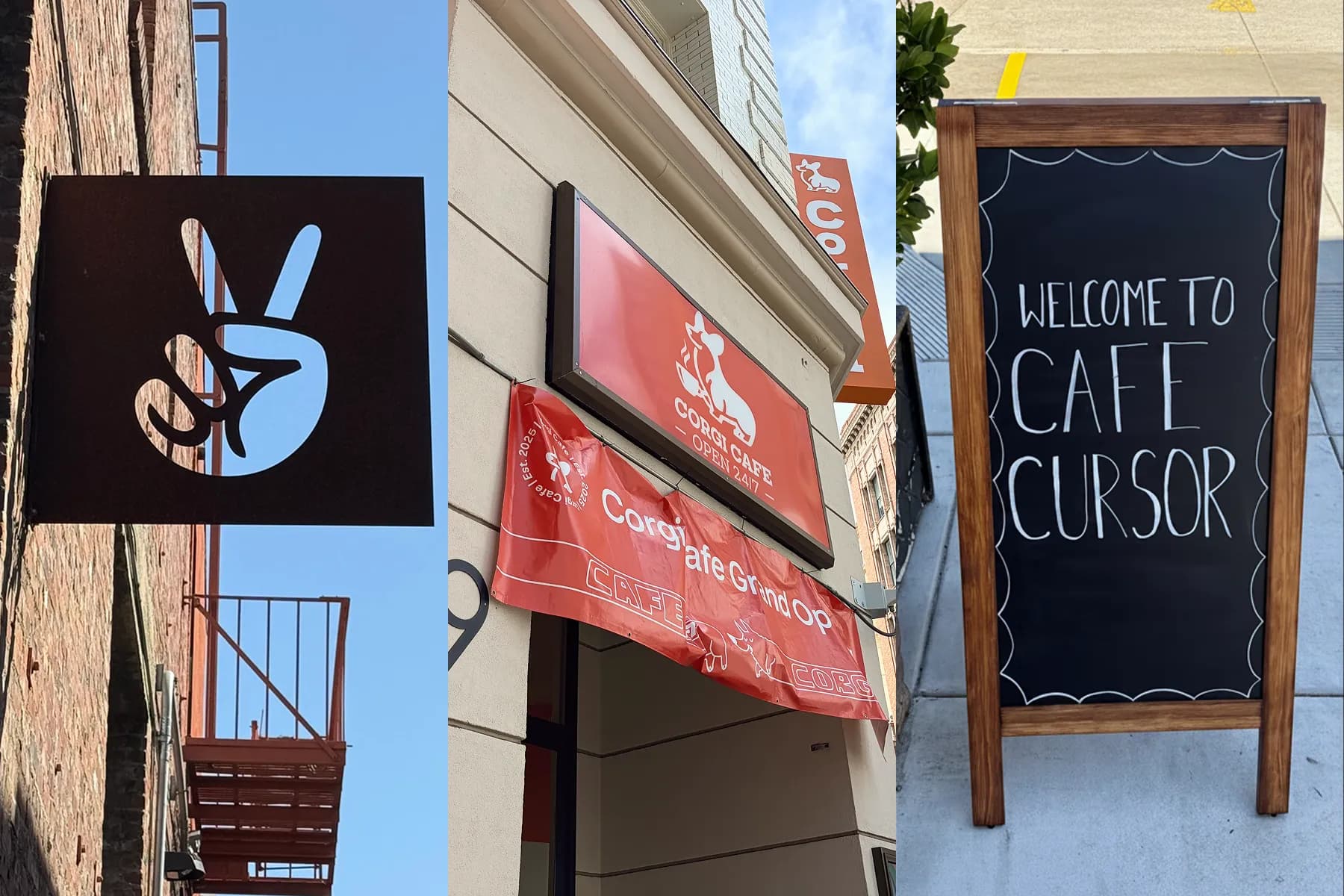
None of them is a coffee company
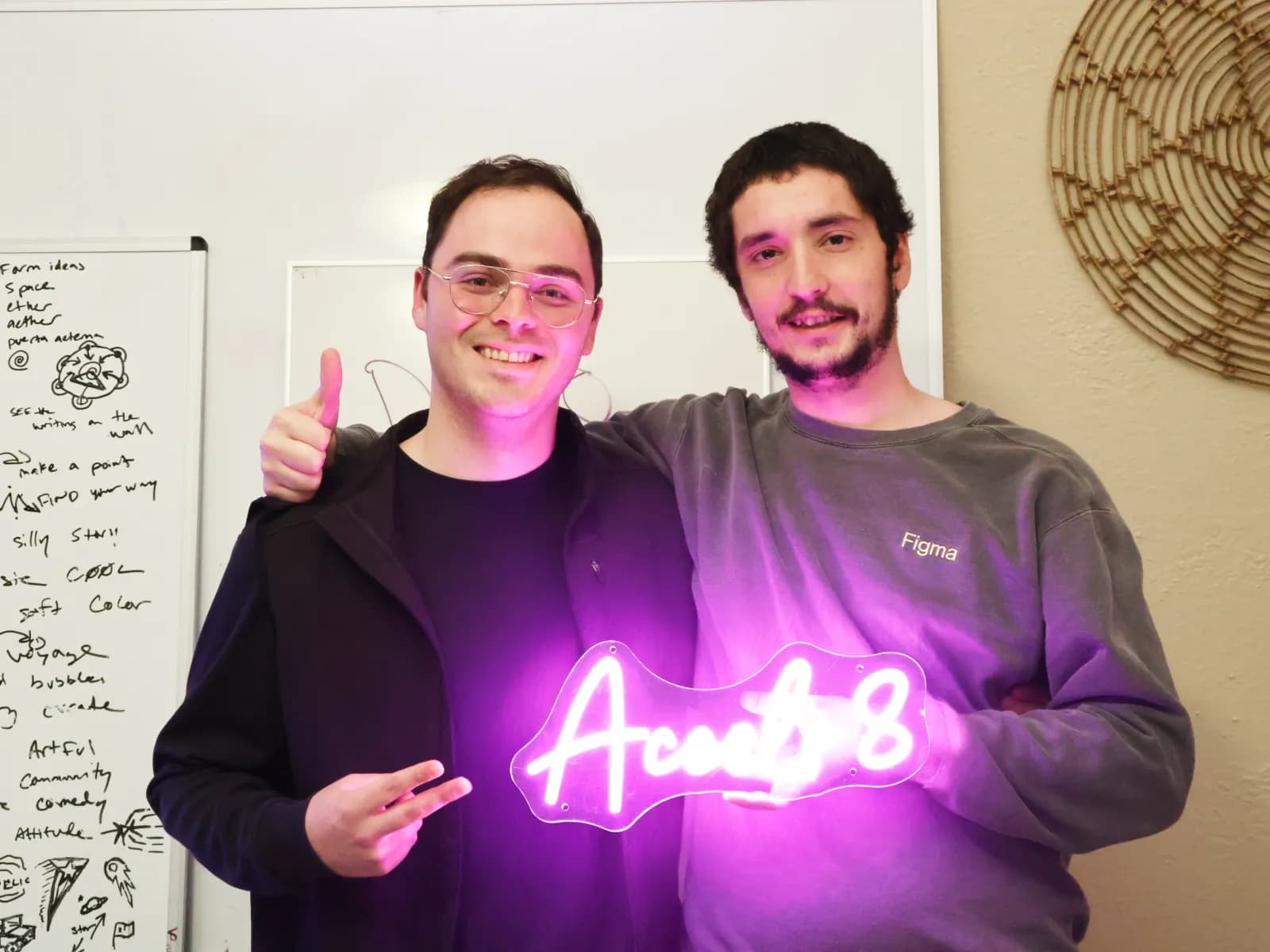
Corgi Cafe's grand opening.Source: @nico_laqua on X.
The hottest cafe in San Francisco right now is run by an insurance company.
If you want to visit Corgi Cafe, be prepared to find it full. Walk in on a weekday afternoon and every table is already taken by builders hammering at their keyboards, some perched on chairs with laptops balanced on their knees, most of them slipping naturally into conversations about each other’s products. “Founder heaven,” as one recent visitor put it, is less hype than plain description.
Here is the strange part. Corgi does not sell coffee for a living. It is an AI insurance carrier valued at $2.6 billion, and the cafe, open only since February 2026, never closes.
Cursor's community events page.Source: Cursor website.
Corgi is not alone, either. Over the past several months, Cursor has been throwing one-day cafe pop-ups around the world in what looks like a relay race. What began in September 2025 as renting the cafe next to its SF office for a single day has grown to 176 takeovers across more than 130 cities. When Cafe Cursor returned to San Francisco in June, 2,000 people signed up, and the line stretched around the block before it opened. For a day, my entire feed was Cafe Cursor.
Avlok Kohli's poll that started Founders Cafe.Source: @avlok on X.
Around the same time those pop-ups began, in September 2025, another cafe started with a tweet. Avlok Kohli, CEO of AngelList, posted a poll asking whether the company should turn the open ground floor of its San Francisco office into an actual cafe for founders. Two weeks later, Founders Cafe existed. Not everyone can get in, but everyone in the scene knows it.
An insurance carrier, a code editor, an investment platform. None of them sell coffee for a living, yet all three now run “cafes.” But when I asked the people who run these spaces how they measure the payoff, the answers were not the ones a CMO would expect. I sat down with all three to find out why and how the spaces actually run.
Why a cafe, of all things
Ask each operator why the space exists, and before anything else, you get the same diagnosis three times. San Francisco is full of builders and strangely short of places where they can comfortably be around each other.
Victoria Olaogun, who leads community and partnerships at Founders Cafe and is a former founder herself, described hunting for somewhere to work in the city and finding cafes without Wi-Fi, spaces that close early, and members’ clubs with fees and gatekeeping. "It’s a very lonely industry," she told me.
Erika Lee, Corgi’s Head of Brand, frames it around the clock: San Francisco simply runs out of open doors at night, so a room that never closes fills up on its own. And Ben Lang, who works on community at Cursor, frames it as appetite. People are starved for in-person connection, he said, and they want it without an agenda.
Founders gathered at Founders Cafe.Courtesy of AngelList.
Why now is the fair follow-up, and the answers stack. Victoria points at AI: building has gotten easier, which frees founders to leave their desks, and distribution has gotten harder, which forces them to. Erika points to fatigue: after years of everything going digital, people miss analog, physical, real experiences. And beneath both sits the fact every marketer already knows, that paid digital channels no longer convert attention into affection the way they used to.
So why a cafe, and not a lounge, a club, or an event series? Victoria’s answer was disarmingly practical.
"We all survive on coffee. That’s where people typically go when they’re working remotely and need a place to get work done."Victoria OlaogunCommunity & Partnerships Lead at AngelList
A cafe is the one format that needs no explaining and no membership card; walking into one is among the lowest-commitment acts in urban life. It is also, not coincidentally, the format that feels least like being marketed to.
The idea has theory behind it if you want theory: investor and writer Balaji Srinivasan has argued that “popups are the new startups,” physical spaces as the next expression of internet communities, and Avlok Kohli has cited that thinking around Founders Cafe. But you do not need the theory to see the logic. Coffee is the excuse. The room is the product.
Cafe Cursor in Buenos Aires.Courtesy of Cursor.
The more delicate question comes next: how does a room like this create value for the company paying for it?
At Founders Cafe, the answer is relationships. The route to them is one of the space’s core rules: nobody sells anything to anybody. The rule does not mean AngelList expects nothing back. It is how the value gets made. In a room with no pitch, trust builds. Inside that trust, relationships form between founders, investors, and the AngelList team.
And relationships, given time, turn into hires, partnerships, and closed deals for AngelList. AngelList employees get a place to work next to the founders they serve, the company meets talented people who may become future hires, and prospective venture fund clients get hosted in a room that proves how close AngelList sits to founders.
"We don’t want people to feel like there is an ulterior motive when they walk in. The experience has to be valuable on its own. But when you create a trusted environment for founders, investors, and our team to spend time together, relationships naturally develop."Victoria OlaogunCommunity & Partnerships Lead at AngelList
At Corgi, the answer is a funnel, and Erika is open about it: the cafe and the insurance business feed each other. People discover the cafe first and the insurance second, and she considers that the point. Her founder is blunter still: Nico Laqua has posted that the point of the cafe is that it is "the only place where I am 100% certain that there are billion-dollar companies being founded, probably several per month.".
The menu and insurance QR codes behind Corgi Cafe's counter.Photo by EO.
I saw that balance in the space itself. Behind the counter, a QR code for the menu hangs next to a QR code for insurance sign-ups. In all my time there, I never heard a barista mention insurance first.
And at Cursor, the answer is the community itself. Ben named the motive without any hedging when I asked: brand awareness, bringing power users together to meet each other, and collecting feedback in person when the team shows up. "Community is what makes products sticky," he told me. In his framing, community is not something adjacent to marketing. It is the marketing and the most durable kind.
Trust, funnel, fandom: three different routes from the same kind of room back to the business that pays for it. Yet all three converge on one operating conclusion, and it is the closest thing this trend has to a law. The moment a space feels like marketing, it stops working as marketing. The playbook that follows is how the three of them actually run these rooms. Read it with that law in mind; it sits behind more of the decisions than it first appears.
The playbook
The three models differ. Founders Cafe is permanent and invite-only. Corgi Cafe is permanent and open to anyone, 24 hours a day. Cafe Cursor is a distributed one-day format that borrows from local cafes. But talk to the operators long enough, and the decisions they had to make line up in the same order.
The Tech Company Cafe Playbook. Table by EO.
(1) Who gets in
Founders Cafe treats curation as the entire product. Victoria and Irin Son, AngelList’s Head of People, decide who joins from a long waitlist. The question Victoria says she hears most often is also the simplest one: "How do I get in?”
Founders Cafe's application page.Source: Founders Cafe website.
There is no fixed rubric. They look at what a person is building, whether they show their work publicly, and whether they can give as much as they take. The community holds roughly 75 to 100 people cycling through per month, kept deliberately tight, at about an 80/20 ratio of founders to VCs.
Cursor applies the same filter one level up: it curates not attendees but hosts. More than 300 ambassadors run Cafe Cursor pop-ups worldwide, selected from thousands of applicants. Corgi is the outlier that curates nobody and compensates with the next decision instead.
(2) Where and when
Corgi’s differentiation is hours. Pop-up cafes come and go, Erika notes, so being the space that never closes is itself the brand. "There’s just nowhere else to go sometimes at night, so you just come here."
Cursor’s differentiation is a place. The team insists on real neighborhood cafes, never offices or event venues, chosen to feel like Cursor’s own space: sunlight, plants, cozy shelves. Convincing an owner to close to the public for a day is the hard part. Most cafes simply do not offer private rentals. What breaks the resistance is who does the asking: a local ambassador who knows the neighborhood’s culture, reaching out to a friend, or a friend of a friend.
The line outside Cafe Cursor.Courtesy of Cursor.
(3) What makes people talk
None of the three spaces advertises in any conventional sense. Instead, each engineered conditions where word of mouth does the work.
Victoria’s tool is events nobody else would think of: the space’s first event was mind-controlled drone racing, and her current favorite format is a game show where founders and VCs answer questions while vibe coding on stage.
A Founders Cafe event.Courtesy of AngelList.
Corgi’s tool is the space’s own openness. Because anyone can walk in at any hour, the cafe generates its own stream of tweets, photos, and "you have to go" recommendations without a single nudge from the company. The Corgi Times, an actual physical newspaper the company prints, extends the same instinct: give people something analog and unexpected, and they will do the posting for you.
At Cafe Cursor, the branding effect comes from continuity and scale. The pop-ups run as a rolling series across more than 130 cities worldwide, sometimes circling back to a city that already had one, and that rhythm gives builders something to anticipate. Visit one, and you might get coffee or a hat, but the giveaways are closer to a side note.
(4) How the money works
They may all be called cafes, but most of them are not actually in the coffee business, so what they spend varies wildly. AngelList takes in no revenue at all, by design. Costs shift with each event, and Victoria treats the absence of any transaction as the product itself. Cursor likewise manages each pop-up as a bounded, one-off spend.
Corgi Cafe's sponsored drinks.Source: @UseCorgi on X.
Corgi, running a true 24-hour cafe, is the heaviest operation in money terms. It actually sells coffee to paying customers, which means real labor, ingredients, and operating costs. To support that cost structure, Corgi created sponsored drinks for startups, and the slots are popular enough to be sold out until September.
After founder Nico Laqua described the cafe as money-losing in one interview, plenty of people voiced doubts, but Erika told me the cafe has since swung fully into the black. Corgi has opened its Atlanta location, and the goal is 100 locations worldwide.
(5) How many people it takes
Fewer than you would guess. Founders Cafe runs two to three events a week on a core team of two, plus office helpers and TaskRabbit hands for setup. Cafe Cursor’s 176 pop-ups are supported by roughly three people at HQ, with ambassadors carrying the rest through a shared guide and a Loom video.
Corgi, the only one operating true retail around the clock, is the heavy one: around ten baristas, four to five people dedicated to cafe expansion, and new QSR hires brought in for the expansion. The cafe expansion lead, Trevor, shows what hiring for a project this odd looks like. Erika had known him for years from her crypto days, when he was a GP at a crypto fund and had run his own cafe in Puerto Rico: a rare resume that reads startup on one line and espresso on the next. People like that surface through networks, not job boards.
(6) What not to do
Corgi Cafe Atlanta.Source: @UseCorgi on X.
Here the veterans converge. Brooke LeBlanc, who traveled to open Corgi’s Atlanta location, named the most common misconception directly: “if you build it, they will come.”
"You must start with the end customer in mind. Customer first, brick-and-mortar second."Brooke LeBlancHead of Community at Corgi
Victoria’s version of the same warning holds two ideas in deliberate tension: be clear about what you are trying to accomplish, and make sure the people in the space never feel it. “It should be enjoyable first. People should have a good time while they’re there and not think that you’re just trying to sell them something all the time.”
What they measure instead
If you brought this strategy to your CMO, the first question would be about ROI. Here is the honest answer from all three companies: the returns arrive first as demand and stories, not as conversions. Part of the reason is structural. The work these rooms do is awareness, the very front of the funnel, about as far from a purchase as marketing gets. A conversion dashboard is the last place that work would show up.
Cafe Cursor in San Francisco.Photo by EO.
Cursor keeps close tabs on its pop-ups. Ben told me the team monitors NPS and "the basic things that people would track" after every pop-up, though he kept the details general. The reach numbers, on the other hand, are actively public: Cursor has shared running totals of 176 takeovers and 37,000 signups, and the signal Ben clearly savors most is people publicly asking when the next pop-up is coming to their city.
Notice who those people are. Every one of those 37,000 signups is a developer, which is to say a current or future Cursor user. Demand for the cafe is a direct proxy for demand for the product.
Corgi, it turns out, runs the cafe by the numbers.
"Our cafe team is actively tracking orders and foot traffic to measure how effectively they convert into sales."Brooke LeBlancHead of Community at Corgi
The same discipline extends to the menu: the team tracks headcount, footprint, and sales to relay feedback to the startups behind each sponsored drink. But all of that counting stays behind the counter; nothing about it reaches the guest. The insurance returns, meanwhile, show up one level deeper. Laqua has said that more than 20 people told him they submitted their YC application or signed a term sheet inside the cafe.
Read that the way an insurance executive would: companies being founded inside your cafe are your sales pipeline, captured at the exact moment they start needing coverage. Keeping a room open to builders 24 hours a day is, at bottom, a bet on being there when your future customers begin.
An event at Founders Cafe.Photo by EO.
Victoria of AngelList says the returns on Founders Cafe lie in relationships and business outcomes that no immediate conversion metric would capture. Founders who met their co-founders in the room. A first check written after an event. A member who got into YC. Potential hires who built relationships with the AngelList team, and prospective fund clients who were brought into a space that reflects the community the company serves. And the tell, easy to miss in that list: funds closed on AngelList by people who work out of the room.
The regulars of Founders Cafe are, precisely, the customers of AngelList’s platform. Victoria calls it "relationship infrastructure." Add the 30 to 50 inbound event and partnership requests Victoria fields every month, and "there is a very clear return on investment that is happening," as she puts it, a return measured in relationships and deals rather than a single dashboard.
This is the part to internalize before you pitch a cafe internally. The honest version of that pitch is not a conversion forecast. It is a short list of leading indicators tied to your own customer base, things like signups, repeat visits, testimonials, and deals your customers strike with each other, plus a timeframe you are willing to wait.
Conversion data, when it arrives, is the receipt, not the steering wheel. And if your organization cannot defend a budget line without quarterly attribution, this is not your channel yet.
So, should you copy it?
That the trend is real is not in question anymore. "It’s definitely becoming a trend," Victoria told me, pointing out that fashion and consumer brands proved decades ago that real-life activations outperform selling online.
Erika’s answer to the same question was one word: "Absolutely," before rattling off a list that ran from Cursor to a16z Speedrun to prediction markets opening pop-up grocery stores.
And the demand side is obvious to anyone who has spent a week in San Francisco, a city where everything is being automated and a warm introduction is still the most valuable currency. Meetings are gold there, and these cafes mint them.
"I think people are craving in-person connection."Ben LangCommunity at Cursor
Networking at Cafe Cursor.Photo by EO.
But wanting the results is not the same as being able to copy the method, and the bluntest thing anyone said to me in three interviews was Ben’s warning about exactly that. Cursor’s pop-ups work because Cursor has fans, a product people already talk about, and a brand people want to wear on a hat. Take away those preconditions, and the format is just an expensive coffee tab.
"I wouldn’t say hey, just take this and copy it. I don’t think it would be that effective for many companies."Ben LangCommunity at Cursor
His advice for companies that want what Cursor has: skip the cafe and go earlier in the chain. Spend time with your users, look for signals, and let things happen organically rather than top-down. Erika’s advice is to find the one thing that makes yours unique before signing a lease. Victoria’s is an open invitation: figure out what you actually want from the space, and, she added with a laugh, call her.
Put their answers together, and the headline question resolves into something simpler than a trend. Tech companies keep opening cafes because in-person serendipity became the scarcest resource in the industry, and a room of your own is how you own some of it. But every operator in this story had the same thing before they had a room: people who already wanted to be in it. The community came first. The cafe is where it finally got to sit down.