
"I don't like it. Do you have a different product?"Hubert ThieblotGeneral Partner, Founders Inc.
It was 3 a.m. on January 1st, inside an AI hacker house in Korea. Everyone else in the house was still awake, celebrating the New Year. David and Chase, on the other hand, had slipped down to the basement. They were preparing for an interview with Hubert, general partner at Founders Inc.
Chase and David in the basement for a Founders Inc. interview.Courtesy of Sume Labs.
5 minutes into the interview, Hubert cut them off: "I don't like it. Do you have a different product?"
At that moment, David felt the pitch couldn't be about the product anymore. It had to be about who they were. He knew they needed to shed the "smart-but-generic Asian nerds" label.
David started framing himself as the next Roy Lee. He mentioned gathering 200k users for his old time-sync tool, built to beat K-pop concert ticket scalpers. Chase followed, pitching his own credentials as a product guy: an international science award, and that he'd gone to "the Korean MIT." A few exchanges later, Hubert's tone had changed, and he offered them a spot in the Artifact batch.
David's X post about getting accepted to Founders Inc.Source: @davidim on X.
Weeks later, that pitch became the batch's top performer, one of the few Founders Inc. actually funded.
I asked David and Chase whether it was San Francisco itself, the density, the proximity, the talent everyone talks about, that made the difference. They didn't agree. San Francisco wasn't what changed them. It was just a launchpad for a practice they'd been doing for years.
They had their own name for it: going Beast Mode. I sat down with Sume Labs' co-founders to find out what that means.
"We call this Beast Mode: once you understand the customer, even imperfectly, you trust your gut to pick what they'll like most, and just ship it immediately. We set our sprint length at three days. Ship a product, and if it doesn't work, change direction, and if that doesn't work, change again, until one catches."David ImCo-founder of Sume Labs
"We're not good at numbers-driven, top-down, consulting-style reasoning. But we're the best at reading the audience, creating virality, shipping products fast, and trusting our Beast Mode instinct over process."Chase HuhCo-founder of Sume Labs
Thin Startup Mockery
Ironically, the Beast Mode they now speak of so confidently didn't start out sounding like a compliment. For years, it looked like a flaw, one that even got them mocked.
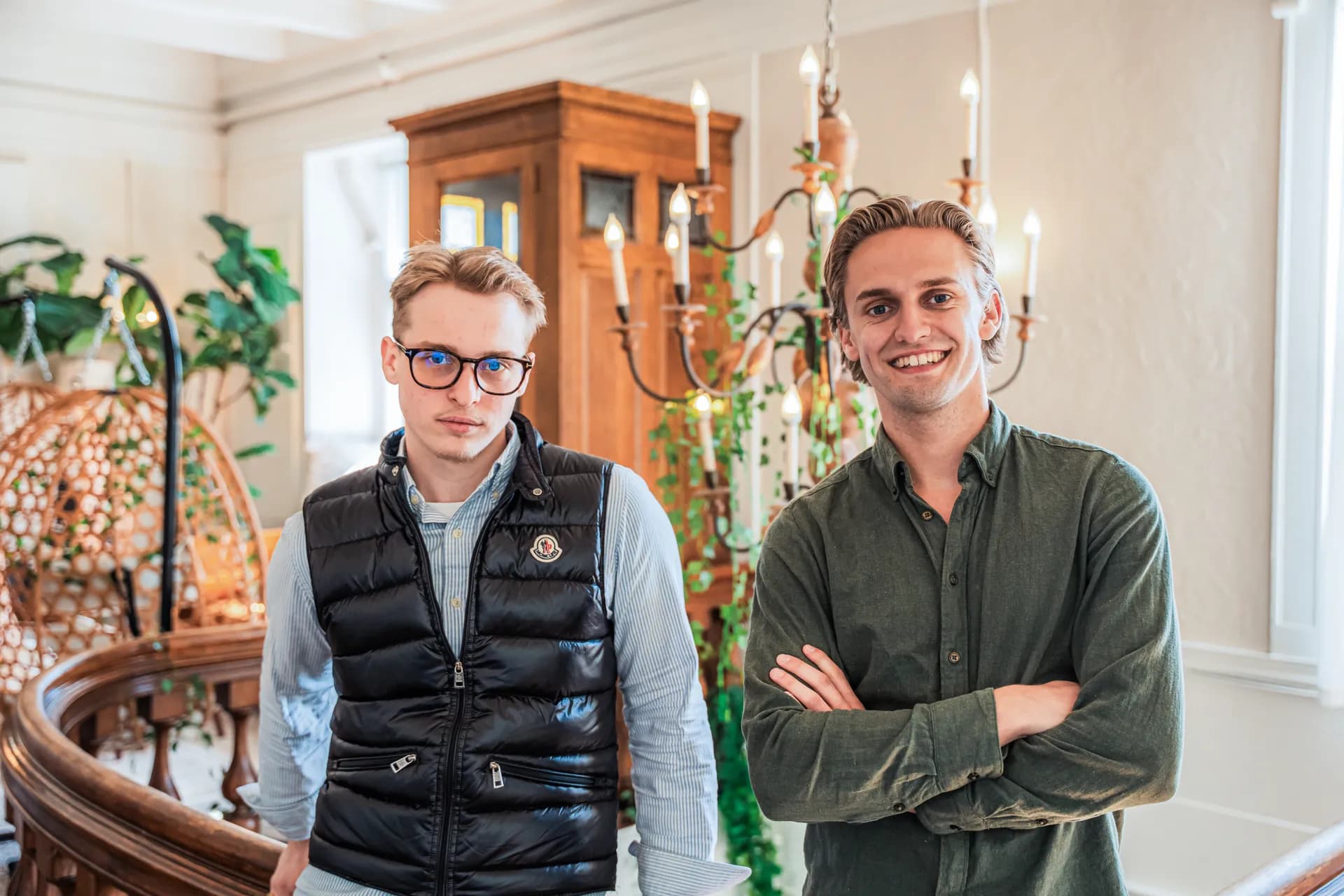
David and Chase.Courtesy of Sume Labs.
Chase's Story
His father was a programmer, so Chase had been coding since elementary school. In middle school, he opened a Minecraft server that made him roughly $2,200. Although it shut down a few months in, he kept building other products throughout his youth.
"By that time, I saw an Israeli startup that got acquired by Walmart, its founder becoming a multi-billionaire. I thought, if I can make that kind of money doing something I'm capable of, why not do it too? That's when I first wanted to start a company. And also, it's just cool."Chase Huh
To get real work experience first before starting his own company, he joined Dalpha, one of the top startups in Korea at the time. Even while working there, launching his own business was always in the back of his mind. He would spend his time after work having coffee chats and meeting with VCs, until one VC principal called him out:
"You are pitching abstract concepts with zero users or even a product. What are you doing here?"VC principal
Slapped in the face, Chase left Dalpha and went straight back to building, determined this time to find users. But it wasn't as easy as he thought.
"I'd build something, but scrub it just before launching it because I felt like nobody was going to like it. I'd build something else, but end up doing the same thing over and over. I did get to ship about three products, but no users ever came."Chase Huh
Chase says it was the darkest time of his life. He barely left his room. He saw no one. He just built. At the time, he saw that directionless building speed as a flaw.
David's Story
For David, a two-week family trip to the US in his first year of middle school was what eventually got him into the world of startups; he loved how open American culture felt.
"Korean adults would tell me, 'David, life is hard, you have to get a good job.' People at Apple would say, 'David, you can achieve your dreams. What's your dream?'"David Im
Since then, he'd deliberately fed himself American content. He only followed and subscribed to American tech and meme accounts, consuming anything that might help him understand the culture he was aiming for.
"I figured I was going to end up living in the US anyway, so why bother watching Korean content?"David Im
He was also plotting a realistic path to crack into the US. A top Korean university first, then a US PhD to make a living. He approached this plan with obsession: cold-emailing American PhDs for advice, studying with such intensity that he'd cut through the lunch line and sprint to the library for extra time to study.
He did get into a top Korean university and joined their reinforcement learning lab. But just three months before he'd planned to apply to grad school, his advisor pulled the research out from under him. His advisor had found out David planned to pursue his PhD in the States. He wasn't going to bet the lab's output on someone already halfway out the door.
But even with his original plan scrubbed, he still wanted to crack into the States as much as ever. He decided startups were his alternative ticket. All along, while still doing research, he'd noticed how far research theory sat from actual engineering, and he'd been suppressing the urge to start a company right along with it. He moved into an AI hacker house and started launching products.
David fell into the same restless pattern Chase had: build fast, ship faster, and scrubbing it. A tutoring platform, a dating app, a concert ticketing tool, a composer's music tool. He dumped a new idea on Reddit almost daily. Other hacker house residents mocked him for it.
"They said I was doing a thin startup instead of a lean startup, since I kept changing my product every three days without going in depth."David Im
He did it for five months, roughly ten pivots a month, with nothing to show for it. By winter, he was a month away from being kicked out of the house. He was at his lowest when Chase reached out for a coffee chat.
The Merge
David and Chase talking in an hacker house.Photo by EO.
From the moment they met, the two had already decided to start a company in the US. They started building products together again.
"David's more the reading the audience and visionary side. I'm more the technical execution."Chase Huh
That's when they found Founders Inc.'s Artifact batch, its deadline closing in a matter of hours. They didn't have a decent product, but they also had nothing to lose, so they prepared a fake product. An hour and a half went into the application, 30 minutes into a demo video, and they submitted it.
"To be honest with you, we didn't actually have a product back then. We just prepared a fake one and trusted our instinct."David Im
Everything moved fast after that. Their acceptance letter landed on January 1st, and they had to be in the US by the 9th. Chase rushed back to his hometown to grab his things, breaking the news to his parents on the train ride down. David sold off all his Nvidia stock to help cover the trip.
The Beast Unleashed
Chase and David arriving in SF.Photo by EO.
Once they got into Founders Inc., Beast Mode kicked into gear.
"David was sure that just posting what we'd gotten into Founders Inc. would go viral. I doubted it, but I went along with it anyway. It ended up being our actual starting point."Chase Huh
The Founders Inc. post went viral, and people started calling David the next Roy Lee. Determined not to waste the momentum, the team shipped an AI avatar of Steve Jobs and Roy Lee that gave real business advice. They built it and shipped it in two days.
"Things got crazy. It spread on Twitter, and we got 10,000 users. Investors and founders reached out. Half of the people of Artifact already knew us because they saw us on Twitter."David Im
Sume Lab's appearance on the TWiST podcast.Source: @twistartups on X.
All of this happened before the Artifact batch had even started. But the team wasn't satisfied. They wanted something bigger, always chasing the next wave of momentum. Around then, the OpenClaw phenomenon took off. OpenClaw could hold a conversation across every channel someone used, remembering everything said before, close enough to feel like an actual person. That was what drew them in. They asked themselves how far they could push that feeling.
Sume's answer was Clawra: the world's first OpenClaw agent with its own face and its own personality. It benchmarked "Samantha" from the movie Her.
"Clawra got 1M X impressions, 10k users, and 1k GitHub stars in a single day. The product was picked up by This Week in Startups, shared by top influencers on TikTok and Instagram, and covered in press across the US, Europe, and Asia."David Im
Clip from the movie 'Her' and Sume's Clawra.Courtesy of Sume Labs.
The Beast Mode instinct wasn't just about building products and distribution. It showed up at the term sheet table too. At a Founders Inc. group fireside chat with Hubert, David found his opening. In a room like that, it's usually hard to get a word in. Everyone mostly just listens to Hubert talk. He was looking for a way in when Hubert, almost as an aside, asked the room a single question: "Is there anyone with bad news?" David didn't have any bad news. But he knew this was his chance.
"Yeah, I have bad news. We got 10,000 users in three weeks, but retention isn't great."David Im
David remembers Hubert being stunned. The fireside chat turned into an instant investor meeting on the spot. Hubert asked about the product and how they'd pulled in those users. The next day, Sume got their investment from Founders Inc., even before demo day happened.
"I had that Beast Mode feeling. I just knew he was going to invest in us right then. Looking back, that valuation is crazy: we hadn't found real product-market fit yet, we'd only started a week earlier, and our user base wasn't even fully ours, it ran on an open-source base. But we followed that Beast Mode anyway, and we were confident we could keep creating virality."David Im
Just a few months after moving to the US, Sume was one of the few teams Founders Inc. funded. They'd also secured pre-seed funding from other VCs.
Sume Labs during Founders Inc. demo day.Photo by EO.
How Beast Mode Works, and How Far It Can Go
All of it was possible for one reason: Beast Mode. But how exactly does that instinct work? What David and Chase point to is simple. Moving faster than anyone else.
"This is hard to articulate, but I believe winning in B2C ultimately comes down to virality and shipping fast. It's a naive answer, but that's exactly what Beast Mode is: following our instincts and acting with high agency. No one has more of it than we do. We're the best at going viral and shipping products fast."Chase Huh
Speed is easy to claim. Sume calls their version of it the "-1 to 0" phase, the earliest stretch before a product has found anything real. The rule there is blunt. Keep the iteration window shorter than the typical time a product deserves before being judged.
"The key is not running too long down a path that's already failing. It's an advantage to keep that iteration shorter than most people think a product deserves before you judge it."Chase Huh
That same discipline didn't stop at the product itself. It applied just as much to creating virality. Before Founders Inc. ever entered the picture, they cycled through various distribution approaches the same way they cycled through products — test fast, drop what doesn't work, try again.
"We dug up 30 Reddit accounts. All 30 got blocked. We got IP-blocked, and even the public wifi at a café got blocked too."Chase Huh
Apart from speed, another core of Beast Mode is the nerve.
"It comes down to a kind of shameless boldness, bordering on recklessness. I've never seen someone succeed by staying self-conscious and betting everything on pure product strength alone."Chase Huh
David is the textbook example. Even with nothing to offer, he'd gravitate toward whoever was winning in the room and force his way in. David locates that nerve somewhere else entirely. Not culture. Instinct.
"It was more an internalized Beast Mode instinct. I understood, on some level, how people connect and start a conversation, so I could just do it without hesitating."David Im
Chase and David sharing their experience.Photo by EO.
Beast Mode is what got Sume this far. But instinct like that doesn't scale on its own forever. Every startup that survives its earliest scramble eventually has to reinforce that same instinct rather than just ride it. For Sume, that started with a new member. He came in with an indie hacker's instincts: customer obsession over vision decks, revenue over fundraising, bottom-up thinking over top-down conviction.
"Whenever a meeting drifts into abstract vision talk, he's the one who flags it and pushes us back to bottom-up thinking. Vision still matters, but in the end, a business is about making money, and fundraising is secondary."Chase Huh
David sees the same evolution from a different angle. Not a new influence, but Beast Mode maturing on its own terms. Until now, that instinct ran wild. No boundary. No fixed target. Just jumping across products and domains, chasing whatever looked promising next. What changed is the fence Sume built around it: one domain to hunt inside instead of every direction at once. Inside that fence, Beast Mode doesn't slow down. It runs denser.
"Leaning purely on instinct is still our strength, but we've realized that having boundaries to run Beast Mode with high density could bring more advantages. Right now, our boundary is the AI video domain. We search for products from inside that frame instead of chasing anything and everything."David Im
Discussion between Chase and David.Photo by EO.
Beast's Next Move
After the pre-seed round closed, Sume moved on from Clawra. They tried a few other products next. One topped $10,000 in revenue, another cleared a couple thousand dollars a month, but none of them held onto users.
A sync call with their VC's growth-advising team is what changed the search: Sume's Beast Mode was a real strength, but one that needed some constraint around it.
They kept hunting for Beast Mode's boundary, and settled on the AI video domain.
"AI video right now is in about the same state LLMs were in 2023. Not especially useful yet, expensive, still awkward. But within a year, it would follow the same arc LLMs did. Practical, cheap, everywhere."David Im
That domain served people who couldn't afford to shoot real ad footage, giving them an easy way to generate AI ad videos instead. Most competitors there amounted to little more than a subset of what Higgsfield could already do. What they quickly built was Sume Avatar: a video API that generates consistent-face UGC ads at scale, no actor, no camera, no reshoots. It uses multi-model orchestration to match the performance of Omni and Seedance.
Sume Avatar.Courtesy of Sume Labs.
"If you look at AI UGC generator platforms like Arcads and Creatify, their product sucks. Yet it's still hitting over $10 million ARR. If something that bad can do that, we can do better."Chase Huh
Their Beast Mode worked again: Sume hit 20,000 users in eight weeks, with 95% of them arriving through organic content on Instagram and TikTok.
Sume Labs hit 20K users in 8 weeks.Source: @davidim on X.
David and Chase emphasized that every founder who lands in San Francisco starts as an underdog by default, no matter what they built back home. They just didn't see that as a disadvantage. Winning from there isn't luck. In their eyes, it's a practice that can be done even before setting foot in the city.
"Wherever we've come from, no matter how impressive a track record we built before, coming to the US means starting over as an underdog. We were underdogs before, and we managed to win, so why not do it again here?"David Im & Chase Huh
Learn more about Sume Labs
- David Im — Co-founder
- Chase Huh — Co-founder
- Sume.com
- Try Sume Avator, the most credit-efficient video agent
- Media Coverage | This Week In Startups episode (Jul 21, 2026)
- Previous products | Clawra.dev & abgcmo.com