At a Glance
- Who: Mikita Mikado is the CEO and co-founder of PandaDoc, a document automation platform, who grew up in Belarus before immigrating to the US.
- What: The interview traces PandaDoc's 22-year path: building small paid software add-ons as a broke exchange student in Hawaii, growing a bootstrapped business in Belarus with Microsoft as a client, selling that business off to fund a self-funded pivot into SaaS, surviving a failed first product, and navigating a government crackdown that took employees hostage and the war in Ukraine, all on the way to $100 million in ARR.
- Traction: PandaDoc crossed $100 million in ARR and became a unicorn-valued company serving hundreds of thousands of users, growing from a single $650,000 seed round.
In this interview, Mikita Mikado, CEO and co-founder of PandaDoc, traces the company's 22-year path: building small paid software add-ons as a broke exchange student in Hawaii, growing a bootstrapped business in Belarus with Microsoft as a client, selling that business off to fund a self-funded pivot into SaaS, and surviving a failed first product, a government crackdown that took employees hostage, and the war in Ukraine, all on the way to $100 million in ARR.
Key Takeaways
He built his first paying customers almost by accident, as a broke exchange student
At 19, Mikita came to the US on a summer exchange program, flipping burgers and cleaning toilets for $7.25 an hour. While studying in Hawaii, he and former classmates built a $9.99 website add-on that sold thousands of copies without him lifting a finger after launch, his first real taste of software economics.
He moved back to Belarus because he didn't know venture capital existed
With no path he could see to funded software growth, he returned home to bootstrap with cheap local talent instead, building a 35-person, $700,000-a-year business run out of a two-bedroom apartment, one that improbably landed Microsoft as a client.
He sold his first company for $40,000 to chase independence instead
When a hired CEO turned a profitable business unprofitable, the original team gave Mikita and his co-founder an ultimatum. Rather than fight to keep the company, they sold it to their own friends and former classmates and used the break to pursue a self-funded SaaS business instead, no outside investors, just a credit card swipe form.
The first version of what became PandaDoc nearly failed
They spent months building in isolation, assuming customers would show up and pay once billing went live. Of 3,000 free users, only six ever paid. Mikita calls the failure soul-wrecking, but says it forced them to check their egos and actually talk to customers before building further.
PandaDoc survived two literal wars on the way to $100 million ARR
During the 2020 Belarusian government crackdown, the company's office was raided and four employees were taken hostage, one held for 11 months. Mikita had to evacuate 220 employees to Ukraine, then relocate over 300 people again to Poland and Portugal when war broke out there, all while the business kept growing toward its $100 million ARR milestone.
Watch the full interview now on EO's YouTube channel! Below is the complete transcription of the interview. Minor edits have been made for clarity and readability.
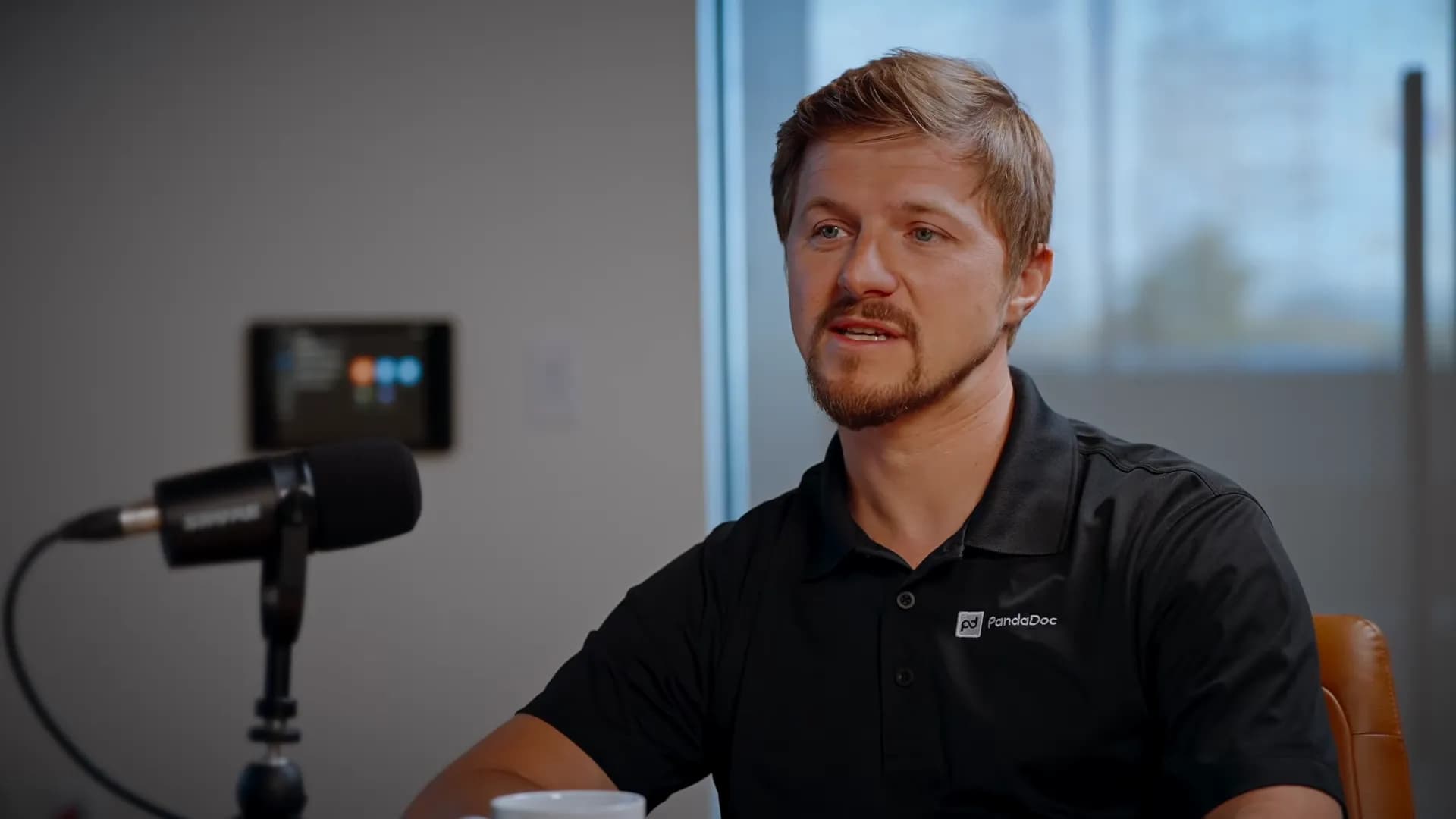
Introducing Mikita Mikado, partner of PandaDoc
Mikita: Is working out, I'm so happy in my life. But that changed dramatically with the revolution, we had a raid in our office, government took four people hostage. How did I navigate that?
Tae: So you recently crossed 100 million in ARR, how did that feel when you noticed that actually happening?
Mikita: There's a brand value of the 100 million, brand value of becoming a unicorn company, yeah, you feel good.
Tae: But, my name is Tae, I'm a partner at Altto Ventures, we are very excited to have Mikita here with us today, such a pleasure to have you here and to hear your story, so thank you for being here.
Mikita: Thank you, Tae.
Tae: Maybe just a quick introduction of yourself and PandaDoc.
Mikita: My name is Mikita Mikado, I'm the CEO and co-founder of PandaDoc. PandaDoc helps dozens of thousands of companies streamline their work with contracts, quotes, proposals, forms, get those documents sent to customers, signed electronically, hundreds of thousands of people use our product.
Tae: Mikita, tell us the story of starting PandaDoc, it wasn't even called PandaDoc in the beginning, when was it, what were your observations, why did you decide to start the company?
Mikita: PandaDoc is a step function of a web design business I've run, landing in America, something like, oh my God, it's been such a long time, 22 years ago. It started as a very simple tool to address an internal need, transformed into something bigger as we learned along the way.
Tae: So let's just start with the very early days, actually even before the 22-year journey of PandaDoc, you're from Eastern Europe, where were you born, what was your upbringing like?
Mikita: I was born and raised in Belarus, which is a small country between Poland and Russia. I always wanted to have an opportunity to use my passion, energy, to try to build something. Belarus is a totalitarian state, I wanted to be free, I wanted to be able to unleash my energy, maybe my creativity. At the age of 19, I got an opportunity to enroll into a student exchange program, and I came to the US to flip burgers at Han airport, that was the first place where I landed, to do a variety of random jobs. I also learned to design and build websites, that was my first small business in America. That small business helped to pay for college here in the US, it also funded what later became our first software service company, and then kedu.
Tae: Wow, so much to unpack there, you said you wanted to be free, was that something that was unique in your yearning, that even your friends or your families noticed, where they were like, huh, Mikita is a little different than most people in Belarus, or was that a common sentiment in your community?
Mikita: I think most teenagers just want to be free, so therefore it's not unique, maybe what was unique and different is timeline of circumstances that happened in my life, the people that I met along the way that helped me to believe that the sky is the limit, anything is possible. So I wouldn't say there's something way different in my character, there are likely certain things that helped me to make the move, give me that energy, give me the belief that anything's possible, but there's also a lot of luck and a lot of circumstances that led my path the way it did.
Tae: Yeah, were some of those examples?
Mikita: Let's say, when I was 15 years old, for a long time I'd been getting really sick, and my mom decided to send me to Crimea so that I could get exposed to the sun and hopefully not be sick anymore. A guy who was her colleague, he was an intern at the place where she worked, was actually going to Crimea, she asked whether I could tag along. The guy worked in IT, it was his first job, he was an intern, he, over the course of the month being there in Crimea, became my role model. I loved computers my entire childhood, he pushed me to learn to code, try to become a software engineer. The pitch that worked with me at the time was, if you get that job you will be free, you can go anywhere and you'll be in demand, and you can get a job anywhere in the world, you can get out of Belarus, you won't be dependent on rules of the country, who your parents are, or who your relatives are.
Tae: And you were looking to get free.
Mikita: I was looking to get free, so that worked, that totally worked.
Tae: How old was this person?
Mikita: He was 19 at that time, maybe 20 at that time, something like that, I was 15 turning 16, we went to Crimea.
Tae: Did you live together with him?
Mikita: Yes, we were roommates, most importantly, I'd seen a role model who was just a few years ahead of me, was already able to pay his own bills and travel and be free, that's what I was looking for, so that was one turning point.
Tae: Yeah, why was he going there?
Mikita: Oh, just to have a good time, vacation, it was total happenstance. Yeah, then I think the next turning point was when I got a US visa and was able to come here for a summer, it was a mind-blowing experience, the program allowed a lot of Eastern European kids to come to America, work for a summer, and see what America is all about. Maybe some of the propaganda I'd seen on Belarusian TV, it just showed a different side of America, not Hollywood but hardworking and earnest, down to earth, the side of it that I really, really liked.
Tae: Do you remember how you heard of the program?
Mikita: Yes, it was a big deal in Belarus, all the friends of my friends who I thought are really cool, they all either wanted to get into the program or have gone through the program, but yeah, a lot of kids participated, a lot of people went to the US, so yeah, I'd seen how big America is compared to Belarus, how much opportunity is here. The second pivotal meeting at the time for me was meeting my first landlord in America, this Japanese guy, he rented his house to two, three students per room, we were all cramped in that place, but it was a wonderful time, 14, 16 hours a day, but somehow we also found time to see the US, the place where we worked, and have a good time. He was the first guy who said, look, if you somehow stay in this country you will be very successful, you will become a millionaire. At the time it all felt like a bit of BS 'cause I was flipping burgers and cleaning toilets, and I was making $7.25 an hour. His whole rationale was, as long as you work as hard as you do, you will be successful in this country, he just kept repeating and repeating and repeating, and at some point I started believing it, I think that was the second big pivot.
Tae: And he was saying this to everybody, or just to you, in a side conversation?
Mikita: To all the exchange students that did work 14, 16 hours a day.
Tae: Got it, so he saw something in some of the folks there who were working really hard.
Mikita: Maybe he was able to relate, grew up on a farm, he worked really hard growing up, maybe there was something else, but yeah, there were a few folks whom he kept repeating this to, who he helped. I remember there were many, many times when someone got sick, he took us to a pharmacy, or he drove us to work, but he was helping here and there, and yeah, that was the only support system we had coming here.
Tae: So that was for a full summer?
Mikita: Yeah, that was the first summer, and then the second summer I came with a goal to transition from an exchange student to a student. Through the summer I made enough money to pay for a community college, it was $3,500, and I stayed, I went to school on Oahu in Hawaii.
Tae: Okay, so this is back in Hawaii.
Mikita: I was back in Hawaii, I studied for about a year, I learned to actually speak English versus just read, and then I started building websites, I connected with a few of my former classmates from Belarus, we built little software products, we put them online, and people started buying those little things. At that point I thought, okay, we built five or 10 of them, what if we build hundreds of them, I packed my things, moved back to Belarus.
Tae: So you go back to Belarus, you have this initial idea that was kind of like a side project, but it was working, do you remember, like, how many sales you made or how many products you had, like, what was the scale of that quote-unquote business that gave you the lightbulb of, oh, this could maybe work?
Mikita: It's a very small business, the first little add-on we built, that was back in Hawaii, cost was 10 bucks, $9.99, to be a genius marketer, we sold thousands of copies of this thing, but the peculiar thing for us at the time was that we didn't have to do anything for this thing to sell and generate revenue. Prior to that, I built websites, it was a service, I was paid on an hourly basis, therefore in order to earn money I had to put in the time, now we built something and it just sold, it was crazy, was unbelievable. Yeah, today we live in this app economy, software economy, this is not a novel type of thing, but for a kid from Belarus that doesn't really know much about business, that was a mind-blowing experience. We sold thousands of those copies of the software, then we
Key lessons from the conversation
Mikita: built another thing, and another thing, that was like, okay, I'm getting a passive income of $5,000 a month, maybe $10,000 a month, that was more than enough to fly back to Belarus, rent a studio, sleep in that studio, and wake up, make my bed, and then transform it into an office, which was frequented by my former classmate who we partnered with to build more of those little software pieces, little add-ons. We were employing some 35 people, and the business was generating $700,000 per year, which again is not much for the US, but it was a lot of money back in Belarus.
Tae: Why did you decide to go back to Belarus to do this, rather than stay in Oahu?
Mikita: Talent, I would be able to hire engineers in the US to do this for like $220,000 a year, those were too expensive.
Tae: So you rationally thought it was better to go back to Belarus, did you have any personal reasons that you wanted to go back to your home country at that time?
Mikita: Primary reason was, I didn't see a path towards building a software business, I had no idea how this whole venture ecosystem operates and works, I didn't know venture funds exist, so in order to build a software company that sells online, which is amazing, yeah, I thought, I have to go back, try to hire my friends, that's what I did.
Tae: Wow, what was the best-selling or the most-used app in that initial software, like, what was the actual software supposed to do?
Advice for building and growing a company
Mikita: I can tell you what the first thing did.
Tae: Yeah, what was the first one?
Mikita: It was an extension for a web content management system, exported data. What I mean by web content management system, imagine something that sits behind a website and then updates content. They just didn't build something that was needed by a lot of other web designers or users, we created a little extension, little add-on, it exported data into CSV format. The idea was, on the surface, it was not something incredibly smart, kind of like plumbing with that CMS system, then we created a bunch of designs for it so that you can install a new design into your website, then we created a bunch of little add-ons that integrate things like Twitter that just came out, or Facebook that at the time just came out, and yada yada, we didn't really have an overnight success or a brilliant idea, little software product that got us rich fast, everything was like a little step function, little stairs, so there's not much to brag about, it's just a big, boring business.
Tae: So you're back in Belarus, 700K revenue per year, 35 people, life is pretty good.
Mikita: Oh yeah, life was wonderful.
Tae: And what year was this?
Mikita: We started this business in 2007, we operated it for 3 and a half years, so that's through the financial crisis, anything that happened there, we serviced very low end of the market with very cheap product, although we did have Microsoft as a client.
Tae: Wow, you got lucky with that, tell us about that.
Mikita: Somebody within Microsoft bought one of those little extensions, wanted a customization, they came to us, I tried my best to present ourselves as something bigger than we really were, we were 15 people, two-bedroom apartment turned into an office, that's what it was, if they knew that, they'd never do any business with us. Yeah, we powered part of microsoft.com.
Tae: Did they also pay $9.99 a month?
Mikita: We charged them maybe $10,000.
Tae: Wow, so 2010 you have Microsoft as a client, 700K, 35 people, and then what happened?
Mikita: Whenever vendors of that content management system we built for changed something without thinking things through, our software broke, our extensions broke, clients thought it's our fault, so we were getting pages in the middle of the night, whenever that happened, that just started to become, at least once a couple of months we had that surge, we had to wake up, try to fix things. At the time there was a blog by one of the pioneers of a software-as-a-service company called 37signals, which built software that was standalone and had a credit card swipe form, and my co-founder was like, oh my God, it would be so wonderful not to be dependent on anyone, just be dependent on ourselves, so that whenever our stuff goes down, it's on us versus it's because of someone else, that never happened because, you know, we're hosting AWS now, and at the time that was a good enough idea, and we wanted to build a tool where a user can swipe their credit card, use software online, and we get paid, that sounded like a dream. Again, we had no idea that software as a service is going to explode, we didn't think we're going to be able to raise money at any point in the future, we had no idea this little thing is going to progress into PandaDoc as it is today, but we decided to pursue that path of independence, we got really, really lucky.
Tae: So there's this existing business though, so how did you balance this new initiative with what was already generating?
Mikita: Oh, poorly. We hired a CEO who's a former client, a highly profitable business within a year became a highly unprofitable one, with a lot of internal turmoil and conflict, at some point we were bleeding cash in this first business, and then we were bleeding cash in what later became PandaDoc, it was a really stressful time. The original team in this first business, which consisted of our friends, former classmates, folks that we were in the trenches with, they were fed up with the new management, our decision to step aside and start this new thing, they put an ultimatum in front of us saying, look, if you guys are going to keep the new management, you're not going to fix this thing, we're out. When a company is like 35 employees and your core team, like five, seven people, exits, then the company's done. We asked, like, okay, do you know how to fix it? They said, yes, we do. We asked whether they want to run it, they said, yes, we do. We asked whether they want to buy it, they said, we don't have money to buy it, and we asked, what if you were to make that money over the course of next however many years? We settled on a price of $40,000 for that business, which is not much, but it was bleeding cash, and those were our friends, and they turned it around, and turned this company into a successful operation with, at this point, more than 100 employees.
Tae: So it's still going?
Mikita: It's still going, yeah, it has a different name, but it is still going, this founding team who we worked with at the time has done really well for themselves, we're still friends.
Tae: The story had a happy ending, so you decide to start QuoteRoller, effectively sold or handed off the original business to your other colleagues, tell us about the origin of that idea, like, what did you see in the market, why that specific problem?
Mikita: We had a few ideas running actually in parallel, me and my co-founder, and I've got to mention, you asked me what were the pivotal moments in the journey, I think pivotal moment was actually starting to work with my co-founder, we are very different people, but I got really lucky meeting this guy, we met back in university in Belarus, played in the same band, he was a drummer, I was bass. Over the journey of going to the US and coming down, he was the brightest of all my friends, not just one of those very smart engineers, but also a very empathetic person, very down to earth, and very level, very balanced. The third pivotal moment was actually meeting him and persuading him to go into business with me, he had a great career at a large company, I was able to convince him to go into starting a company with me.
Tae: So he wasn't involved in the first?
Mikita: Oh, he was, he started the first company.
Tae: Oh, okay, so he was already involved.
Mikita: He was part of the 35.
Tae: Yeah, the two of you took the lead of, hey, we got to try this new thing.
Mikita: We were looking at a bunch of different ideas, some of the ideas were my ideas, some of the ideas were his ideas, there were a few things we were trying to tickle with, QuoteRoller, which later became PandaDoc, was among all probably the most feasible to execute, it just made the most sense. Everything else we tried to pursue, we tried to build Airbnb for Eastern Europe, Airbnb, I want to say, at the time was launching, it was a really tough business, we tried to build a scheduling system for small businesses like brick-and-mortar businesses, it was a good business, but my co-founder didn't like the code base there, and he just trashed it, was trying to do a project management system, and I trashed that one because at the time there were just too many other options, felt it's a red-ocean type of market and we shouldn't do that. And then there was a summer I had to go to the US, he had to stay in Belarus and hold the fort, got him into sales because he needed to build sales proposals and he hated how much time that process takes. Originally QuoteRoller was his idea, and later I translated it into PandaDoc, we expanded it beyond sales proposals into all kinds of standard bureaucratic documents that we can automate, that idea kind of just kept at it.
Tae: What was the existing process that he and most people in this field took?
Mikita: Take a boilerplate agreement, copy paste back and forth forever, and then send it out, never knowing whether it gets opened, the recipient really cares and really spends time on that document, that was the process that preceded creation of QuoteRoller, and some of the pains that we experienced in that sales process, we tried to solve.
Tae: So it was really built for his own use case, and then there must have been a moment where you and he were like, we should productize this or sell this to others.
Mikita: We were looking for something to productize from the get-go, therefore we've been sort of looking inwards at problems that existed in our business, at the time this was one of the problems, and we were building it as a product, and the way we were building it, it's the wrong way to do things, we know everything, we're going to build it, they're going to come and they'll pay us a lot of money, that was wrong. We spent countless hours arguing about the colors of the buttons, or where this tab goes, or whatever, some nonsense, I remember spending all of our money, draining all of our savings to launch this thing, then see how people that come to the application end up paying, that was soul-wrecking, but it helped us to learn that we know nothing about the market, the problem, the pain points, have to check our egos, go talk to the market, go talk to customers, tell them their ideas and their pains and then their thoughts. I think that first failure in this particular product was very impactful, very helpful towards building the bigger vision.
Tae: The way it was set up was similar to your prior version, where people could just come in, sign up, download, get access to it, and just start using, with the credit cards?
Mikita: It was first just a free tool, and we thought, okay, the moment we're going to attach billing to it, people are going to pay us, that was not the case. We had, okay, some 3,000 premium users, only six ended up paying, some like 9 or 18 bucks a month, which considering the money we spent to build this thing, was nothing.
Tae: How are they even finding out about this though, like the 3,000, do you remember how they even came?
Mikita: A myriad of different techniques that were the result of the natural anxiety I had at the time, I was in a constant fear, and I was trying to run different experiments and get the word out.
Tae: Was this targeted to the Belarusian community, or was it global from day one?
Mikita: It was global from day one, in fact, we were building a tool for sales proposals, it wasn't applicable to the Belarusian market in any way, we didn't build it in native language, it was English from day one.
Tae: Got it, and so no real funding yet, right?
Tae: You were self-funding it at that point?
Mikita: I didn't know that funding existed, I only later learned that it exists. We went to a meetup that we randomly read about online and we decided to show up.
Tae: Oh, where was it?
Mikita: It was in Belarus, it was in Minsk, I remember that a bunch of people told us that what we're working on is BS, but there were people called investors at this thing, and I was like, oh wow, that's how things could work, but it's been at least a year between that and our first financing.
Tae: When was that?
Mikita: Our first financing happened 11 and a half years ago.
Tae: Do you remember the moment you decided that you should raise? I presume there was some inkling of the idea from meetups like that, but then from a business standpoint you probably wanted to get to a certain point before tapping that opportunity.
Mikita: We needed the money, we were on a ramen diet for sure, I've been trying to fundraise for at least a year, we're talking like hundreds of conversations, hundreds of leads, hundreds of investors, dozens of trips to here or there, because Belarus doesn't have any venture scene, it all kind of came together, I had a baby on the way, I really wanted my daughter to have a passport of a free country, so I really wanted to make a move here, I really wanted to be able to start learning the Bay Area and growing the business here, the business was on a path to hit break-even, so all of this happened sort of at the same time. But first I made a move, I had to sell everything in Belarus so that the baby can be born here, it was very stressful, short period of time, but there was a happy ending, eight investors chipped in a little bit, which amounted to $650,000, which at the time I thought, they're crazy, you can't even touch it, some piece of software a bunch of kids in a third-world country put together.
Mikita: It's somewhere out there in the cloud, it can break, it can be hacked, so many things can go wrong, why would they do this? I didn't misrepresent anything, but you tell some facts, but then in the back of your mind, my mind was still not really exposed to everything that's possible, the world of software in Silicon Valley, I was still a Belarusian kid that didn't know much.
Tae: So 650K, do you remember the pre-money, post-money?
Mikita: I do remember the post-money, what was it, valuation cap, it was 3 and a half million.
Tae: Do you remember how big the company was at that time, both from a P&L financial standpoint as well as personnel-wise?
Mikita: We were making 20 grand a month, we were growing fast, and we were a team of, I want to say 10 people at the time, maybe seven people at the time, but definitely less than 20.
Tae: Got it, all in Belarus?
Mikita: Still somewhere outside of Belarus, those were remote contractor types that were with the company.
Tae: So it seems like you already knew that you wanted to build a global company.
Mikita: Building business in Belarus, I don't think it's feasible in the software or high-tech sphere, Belarus is kind of like Estonia or Israel, internal market is tiny, there's so much bureaucracy and so much corruption, there was a lot of talent, but there's not much market, therefore if you want to build a software business you have to do something globally.
Tae: So you had that, and then from an employee standpoint there was some concentration in Belarus, but you already employing people from outside, how did you manage that, because that's a very intentional decision to have a remote workforce even at that stage of a company?
Mikita: Well, we didn't have money to rent an office, didn't have know-how to run a payroll, again, didn't have money and brand to recruit very top talent, so we had to be hacky and figure out how do we find good people that for whatever reason ended up being in a place where can't get a full-time job at a great software company employing full-time, and we found them.
Tae: Wow, so you moved to San Francisco, where's your co-founder at this time?
Mikita: Belarus.
Tae: So he stayed, yeah, is he still there?
Mikita: He moved 2 years after me.
Tae: Okay, so he followed suit. So you both come to San Francisco, and then share with us the journey from there, so what is the QuoteRoller journey, and then when does the PandaDoc name come into play?
Mikita: Started, our first office was a townhouse I rented in San Francisco.
Tae: Okay.
Mikita: Pretty much the same as the way we started our earlier business in Belarus, during the night that's where we slept, during the day that was where we worked, our first sales guy was trying to pursue customers that called in.
Tae: That's not the baby crying in the background, is it, something.
Mikita: Oh, 'cause you had a baby? Yeah, that was the case, the baby was crying in the background, and then we were sitting in the living room trying to be the manager or write some code, then that progressed into a small office in the middle of nowhere, then it progressed into a small office San Francisco, one of those live-work apartments, townhouse, then that progressed to a tiny office on Kearny Street, then AG Gro.
Tae: So you're starting to have some center of gravity in San Francisco, was that intentional, you were hiring here and you have a separate team in Belarus and you wanted this to be the center?
Mikita: I read a lot of TechCrunch, and they said that's where software companies go, in retrospect I think that was another good decision, because it put me into environment where I was able to learn so much, so quickly, from so many people that had experience that I didn't have, or had know-how never exposed to, it was so much easier to surround myself with people smarter than I am here in the Bay Area compared to Belarus. I stayed here, however we kept hiring people all around the United States, we had Americans living in Europe who worked for us, we tried to scramble and figure out all kinds of hacky solutions towards talent.
Tae: As you're scaling, you have a global team, and you've had some very interesting and tricky situations to navigate, wars are involved, tell us about some of those big struggles or challenges that you faced over the years.
Mikita: I think the first struggle is, what am I supposed to do in my role, it was rough trying to hire people here in America, it was rough trying to lead people, I made so many mistakes, if I was to go back I would do a lot of things differently.
Tae: What is one thing you would do differently, the biggest mistake you probably made?
Mikita: I micromanaged so many times, and I'd leave you with this too, I think lack of patience is a lot of mistakes, a lot of challenges came from, maybe at times, some hard-headedness, I know how to do better, closed-mindedness, there's a lot I got to learn, and I have to learn while doing, while keeping an open mind, that helped quite a bit. There are some challenges outside of our domain, our control, there was COVID, which happened to everyone, but then during COVID there was a revolution in Belarus, we sided with the democratic side of it, a video that I posted in response to violence the government induced on people got way more abuse than I expected. We had a raid in our office, a way to retaliate, the government took four people hostage, the last one was released after 11 months in prison, that was a really, really hard time, we had to exit Belarus, we survived, and the team there has shown so much resilience.
Tae: How many people in Belarus at the time?
Mikita: At the time we had 220 people in Belarus.
Tae: Wow, what are you actually doing to get them out?
Mikita: We had to employ lobbyists here in the US, that was hard, that was a process, it was really tough.
Tae: So they leave, where did they go?
Mikita: Ukraine, we scaled operations out of Ukraine, and then the war in Ukraine breaks out, and for another year and a half we become a migration company, which enables people to migrate to Poland, Portugal, and Belarus and Ukraine completely changed our P&L, we had to do a lot of catch-up, it's been a tough year and a half, but we migrated over 300 people out of sight of dictators, out of sight of the war.
Tae: How do you balance perspectives on life, you're running a software company, it's growing well, things are going well, and you have all these people, hundreds of employees contributing to that, and you're very grateful for their contributions, and then you're also faced with this situation where you're the leader of hundreds of people who are going through a war, actually in this case two separate types of wars, how do you navigate that, it feels like a very tricky balance.
Mikita: In the summer of 2020, at the time I was here in the US, and I was, for the first time, visiting Yellowstone, and as I walked into a lake with kids, I'm thinking, oh my God, life is so wonderful, I am so lucky, everything is working out, I'm so happy in my life, and that changed dramatically with the revolution. About 2 weeks after that, I started doing therapy, but it was a pretty rough time.
Tae: Yes, one last question, so you recently crossed 100 million in ARR, how did that feel when you noticed that actually happening?
Mikita: It did feel good, it was not something that kind of blew my mind, PandaDoc is a very repeatable and predictable business, so we knew when we're going to hit that milestone, there's a brand value of this, like, 100 million ARR, there's a brand value of the unicorn company, but it's a, you know, it's a short dopamine hit, yeah, you feel good, but for a much longer period of time is having a positive impact on people that surround me, be that customers, or customers try your product and use it and they love it and they say thank you, that has more impact, milestones are milestones, they feel good.
Tae: What's your next big milestone that you're looking forward to?
Mikita: Millions of people to use our product and love it, that's what I really, really want, we've been at it for like 14 years at this point with this business, and we've built so much, I want more people to use it, to like it. There is a recent research we've done on how many trees we save, because paperless with PandaDoc, they get to sign electronically or notarized documents electronically, we discovered there like dozens of thousands of acres of forest that are saved thanks to that.
Tae: That's cool.
Mikita: You know, imagine 10x-ing that, that's wonderful, but what feels even better is millions of people using the thing and benefiting from the thing and enjoying the product.
Tae: That's great, thank you Mikita, really appreciate it.