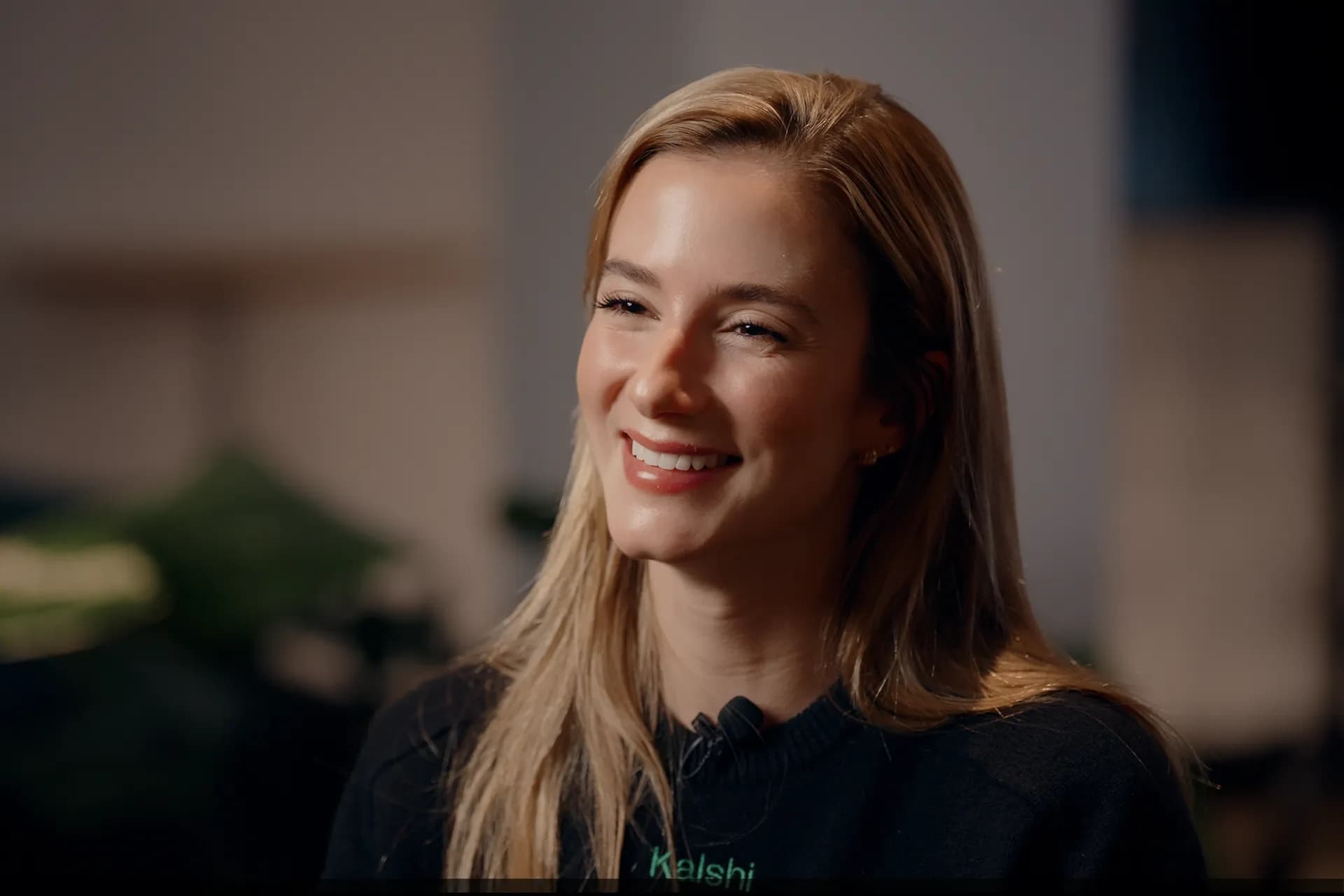
At a Glance
- Who: Luana Lopes Lara and Tarek Mansour are the co-founders of Kalshi, a prediction market platform they began building after meeting as interns at trading firms Five Rings and Citadel and spending four years pursuing regulatory approval before launching.
- What: Kalshi is a federally regulated prediction market where people trade on the outcome of real-world events, from elections and interest rates to award shows and hurricanes, with prices reflecting the market's aggregated forecast.
- Traction: As stated in the documentary, Kalshi's $1 billion Series F round valued the company at $22 billion as of May 2026, double the $11 billion valuation it reached five months earlier after a prior $1 billion round; Lopes Lara says the platform added over 2 million customers and processed more than $2 billion in trading volume within two weeks of launching its 2024 election market.
In this documentary, Kalshi co-founders Luana Lopes Lara and Tarek Mansour reveal how 60 to 65 lawyers told them their idea wasn't possible, why they chose to sue their own regulator instead of launching offshore like competitors, and how a four-year regulatory fight turned into four weeks that took the company from a small niche website to a $1 billion Series F round valuing Kalshi at $22 billion as of May 2026.
Key Takeaways
Regulatory-first is not just compliance, it's the whole strategy
Mansour and Lopes Lara built Kalshi around a single unbending principle: nothing would launch until it was fully regulated. Mansour says the two spent four years talking to regulators and writing legal documents while competitors 'were shipping products, acquiring new users, and growing every week,' choosing stagnation over the offshore, unlicensed path some rivals took.
When the regulator says no, sue the regulator
After more than 60 lawyers and years of resistance from their own regulator, Mansour and Lopes Lara concluded they were right on the law and sued to win the right to list election markets. Mansour calls it 'a very difficult decision' for a small startup to sue the government body that oversees it, but every judge who heard the case ruled in Kalshi's favor.
Four years of fighting bought four weeks to prove it
The lawsuit win came about two months before the 2024 election, leaving Kalshi roughly a month to scale from a niche website into an election-tracking platform, according to Lopes Lara. The team also had to migrate its entire clearinghouse over a single weekend after a third-party partner blocked the election market, a move Mansour says usually takes six months to plan.
Money is the signal, not the noise
Lopes Lara argues that prediction markets beat surveys and social media because they force people to back their opinions with cash: when people are putting money behind their convictions, that is what produces the best forecast. Investor Immerman frames it the same way, describing prediction markets as turning social media's 'qualitative opinion' into 'quantitative conviction.'
The real growth is outside sports
Immerman says non-sports prediction markets already generate $300 to $400 million in weekly volume, translating to $15 to $20 billion annualized, and are growing 5x year over year even as sports markets remain about 10 times larger. Categories like interest rates, elections, and awards shows are where Kalshi expects its next wave of growth to come from.
Retail traders are already finding an edge
Independent traders like Holsinger, who built a database of historical Trump speeches to trade 'mention markets,' and Fean, a schoolteacher who made $150,000 partly by reading publicly visible website source code, show how individuals are treating Kalshi as an inefficient market ripe for research-driven edges rather than a betting site.
Below is the complete transcription of the interview. Minor edits have been made for clarity and readability.
From Ballet to Building a $22B Startup
Luana Lopes Lara(Co-founder of Kalshi): When I was very young, around two, I think, I started doing ballet classes. That was my first big passion, and I started doing it more and more and more and more, up until I was doing it professionally. My days were very full, so I would wake up at maybe six in the morning, eat a little bit, and then go to normal technical school to study math and science and all those things from 7 to 12:30. Then I would drive to the ballet school, which started around one and went until 9pm.
Then I would go back home around 9:30, and then I would actually start studying for whatever exams I had in school, or SATs, and all those things I had to do. So it was three years that I was sleeping, I think, four hours a night. My parents today make the joke that they don't know how I grew to be a normal height, because in Brazil you say you have to sleep a lot to be able to grow, and they're like, you're not sleeping for three years, how did that work out?
Since I was very little, I was always very disciplined and worked very, very hard. I feel like I get a lot of pleasure from working hard, and it makes me feel like I'm doing something with my life. And that's always been true since I was very little. I remember that on the discipline side. And the other side is this delayed gratification side: I liked doing things that were hard and painful in a lot of ways, because I thought there was going to be a big reward, or something that I really was looking forward to, in the end.
And that's why ballet is very, very good, because you rehearse for a year to have one hour on stage. So those things, in a lot of ways, my personality matched the kind of challenge I was setting myself up for. It's a lot easier for me if I have a very clear goal. I wanted to figure out how to both excel in normal school and in ballet, and I wanted to do that, and I knew it was around three years ahead, so it was kind of an eye on the target type of thing, but definitely not typical teenager.
I remember multiple weekends thinking, wow, I don't have exams next week, I can just sleep eight hours, and my friends would be going to parties and all that stuff, and it was definitely not me.
I only decided I wanted to come study in the US. I ended up picking MIT because I thought it was the school that was going to take me most out of my comfort zone. But it was a very hard transition, first of all, because I used to train a lot every day, and it was a very important thing in my head.
When I went to school, the first Saturday I was there at MIT, I remember going to the Boston Ballet and trying to take one class, and I looked at myself in the mirror and I was like, oh my God, I'm losing my form, my arm looks bad, and all those things. And I thought it was better to just completely stop it, so I could remember myself being very good. So that was very hard, to go from eight hours a day doing something to not, even though I think it was the right decision.
Conviction: 65 Lawyers Said No
Tarek Mansour(Co-founder of Kalshi): So I'm a big math nerd. I grew up loving math. That was my biggest passion. And I think one of the things that happens when you grow up in a country like Lebanon, there's a lot of similar countries that have similar issues, is that everything is very dynamic. Anything could change at any given day. You have to adapt. You become very adaptable, basically, because one day there's war, one day there's civil war, one day there's bombs, one day the country is doing okay.
Lebanese people in general are very adaptable. They can change their entire life pretty quickly to adapt to something new that gets thrown at them. And two, they always smile at life, like they got so used to bad things happening that they don't take them too seriously. So you could have a bomb happen during the day, and then Lebanese people would party at night. They would not cancel their social plans or anything like that, which is, I think, very cool.
But I think that definitely has come with me in my founder journey, which is: you're going to get hit hard, and there's going to be new things. As an entrepreneur, there's always new things that get thrown at you every week, every month. And you're going to have to adapt, and then not complain too much about it. Don't take it too, too seriously. You just kind of have to change the way you're approaching things, and then hope that over a long period of time, if you're doing the right thing, it's going to work out.
I was an intern at Goldman Sachs in 2016, and I was very young at the time. I was discovering financial markets and learning about how they work. Two things really surprised me that summer. The first thing was institutions and investors: what they really cared about was not the price of a stock, or the price of Treasury bonds, or other complicated assets.
And at the time, there wasn't a very good way for them to get that exposure. It was basically shorting the S&P on the week of the election. This was really one of those moments where they made us think, maybe there's a better way.
Maybe you could build a financial market that essentially answers these yes or no questions about whether important events are going to happen or not. Because if you could build that market, it would be a much more precise and direct way for people to get the exposure that they really wanted, which is whether an event was going to happen. And that was the initial idea for the company.
The first time we actually fully talked about it was when we were both working at this prop shop called Five Rings. We were interning there together, and there was this market making game that you basically made markets on all day. You'd be like, what's the market on? We started connecting a lot of different ideas and different things we've seen at this internship, but also previous ones. And I was like, well, when I was at Bridgewater, this was happening with this other event, and at Five Rings, this was happening there.
And that's kind of when we started connecting the dots of all these different kinds of Kalshi behavior we were seeing and thinking about. It's insane that there isn't a legalized, great, big prediction market in the US that's liquid and you can trade on everything. And that's really the first time that we thought about it. It was the winter of maybe 2017 or 2018 that we put everything together into really the Kalshi idea.
In the start, there was a single day that we called, I think, 60 or 65 lawyers, and we just had a spreadsheet, and we're like, well, let's see, let's see, maybe the lawyers will add some clarity here. We had a list of 60 lawyers, and we were like, Tarek, Luana, Tarek, Luana, Tarek, Luana, who is going to call who? And we called everyone. And then when we finished the list, we were like, wow, none of them said this was possible.
Then Luana, through multiple contacts, got to Jeff. The first call we had with Jeff, he didn't say no, but he said all the reasons why this wouldn't work and how hard it is to get a regulated exchange and then a regulated clearinghouse, and all the difficulties that would be ahead of us. And then he also explained that there are rules: there are 23 core principles that you have to prove you are satisfying to become a regulated exchange, and they're very hard to do, and it takes a long time.
We took those rules, and we didn't have much context, but it was a Thursday night, and then by Monday we had a full analysis. Luana and I did it, the two of us, by ourselves, on how we would create this entire system that would abide by those 23 rules. And I think when Jeff got that, he realized we were very serious about this.
He was like, these people, yes, they want to build product and are committed to it, but they understand that there's a long regulatory journey they're going to have to take, and they're probably going to be able to balance those two things together. And so he got excited about joining and helping us make this happen. And I think that was a very big early win for us.
Legitmacy: Four Years to Earn the Right to Launch
Luana: We started talking more about whether we should actually try to do this, whether we should actually build this company. It was in the summer when we were both working at Citadel, and one of our first things was, well, why don't we just try to go to this Y Combinator hackathon? It's where these massive companies like Airbnb and whatever, they always go there. So let's try.
We presented, and we had this very janky demo that was kind of stablecoin based at the time, and it did move place A to place B, but it was only that, in a very simple user interface. And the first thing he said was, that's illegal. And then we're like, well, but maybe we can figure this out. And he's like, well, then why haven't other people done it? And we didn't really have a good answer for any of that.
Tarek: Yeah, I definitely remember the moment when we were first really deciding whether to start a company and how to start it. This moment was very foundational, because this was the time when, as a company, we decided to define one of the most important principles of the company, which is: we're going to do everything regulatory first.
We're not going to launch, we're not going to market, we're not going to build product, we're not going to do anything, up until we figure out the most important thing for the company to exist, which is how do we legalize and regulate this, and how do we create an ecosystem that is safe and transparent for customers. And that has informed everything we have done at Kalshi till today.
Luana: And I think that YC, Michael Seibel actually says this to this day, he's like, this sounds insane, but these two kids from MIT sound really motivated, and we should give them a try. When we were in YC, every other group in our batch had week over week metric growth, where they were like, well, we grew 20%, we're making this amount in revenue, we're getting new users, and building this product.
And our entire journey was, we talked to these lawyers, and the next week we talked to these other lawyers, and the other week it's like, we filed this document, and all of that. So it was a very different YC experience.
Tarek: We were stagnating. There was no real progress, because we were just talking to regulators and writing legal documents and figuring out policies and procedures, all the stuff that entrepreneurs usually don't want to deal with. It's kind of the unsexy part of building a company. And it was even more hard because some of our competitors launched and did it offshore, without the license, without really this regulatory structure that we were seeking. And I would say that was the hardest part of the path.
It's not necessarily the period of time or the work itself, it's just the fact that you cannot make real, tangible progress. But we were very committed to it. We did not want to launch unless this was 100% regulated. It goes back to how we started the company: we were not necessarily looking for ideas to start a company, we started the company because of this idea. We were a bit different. There are sometimes teams that start and they pivot and look for a bunch of different ideas to decide which one is the best one to work on.
We were committed to this idea from the start. And so my answer here is that we really wanted prediction markets to exist. We love markets. We love this idea that markets can bring more truth and more objective conversation to a lot of our most important questions. And we really wanted this to exist, to go mainstream, for people to see its power and start utilizing it. And this was essentially the guiding light that in the hardest times kept us going and kept us trying.
Luana: Nowadays, it's very hard to find very good and reliable data sources for what's actually true and happening in the world. It's very hard to know what I'm seeing on Twitter, is it writers, is it bots, who is writing this? What prediction markets do is they kind of take away the noise, and you can really look at a forecast that's come from millions of people putting money on the line and putting money where their mouth is, to really see: I believe this is going to happen, I have a lot of conviction.
And kind of aggregating all of that to see the future. So even if people are not trading in the markets, actually the most important part of these markets is the single point of data, the price that comes from these markets, which can benefit anyone. And I think that's the most important thing. If there's one thing people know about prediction markets, I really hope they know that if they want to know anything about the future, it is the best way to get a correct, unbiased forecast.
Payoff: Four Years of Fighting. Four Weeks to Scale 100x.
Alex Immerman(GP at a16z): I take hundreds of meetings a year. My first meeting with Tarek really stands out. We were in Cafe Lyria, which is this hipster coffee shop in New York City. It was really crowded, we could barely get a seat, we were surrounded by people. I'm thinking to myself, no one around us has any interest in this conversation. I meet Tarek for the first time. Forget product market fit, he doesn't have regulatory market fit. Part of the reason that meeting stood out so much was he's telling me the story of how he's suing his regulator.
We love to back ambitious founders, bold founders. There's probably nothing more bold, more ambitious than suing your regulator.
Luana: They blocked it a lot of times. So we tried to engage with them for over two years on the usual process that we have for new markets. And we talked to them about the use case of this market. We actually had a public comment period where 200 people, including very big academics, like the head of the Council of Economic Advisers, all of these folks wrote in saying these markets are very important, you should allow these markets to operate here and just regulate them so that they're safe.
Tarek: And then we realized that working with the regulators, or trying to convince them, wasn't going to work. But we didn't decide to list it like competitors. We stayed committed to the regulatory first principle. So as a company, the only choice we had, if we believe that we were right on the law, if we believe that this should exist in society, is to sue our own regulator, which is what we did. It was a very difficult decision.
It's very hard for a company, especially a startup, a small company, to sue the part of the government that oversees you, because they have all the power over you. But we decided to make this decision regardless, because we really believe that these markets should exist.
Luana: And it was a very hard decision, because it took four years for us to get regulated, and we were kind of putting that in jeopardy in a way by suing them. Because we're basically fighting, very officially fighting in court at that time. But it was two things that really mattered to us. One, these markets are the holy grail of prediction markets, they should be legal, they should be regulated, they should be in the US, they're very important.
And the other side is, we knew we were right on the law. We ended up winning: every judge that looked into our case ruled in our favor, on the district court and then the appeals court. For two weeks, and then when we won, it was amazing. The next day, the government's like, we're going to appeal this, we are extremely against it, we think this decision is wrong. And then the stress all came back up: okay, so now we have to go through the entire appeals court process, is it going to be done in time?
Because at that time, we were two months before the election, and maybe there was a chance we would run out the clock and lose the 2024 election even if we won the lawsuit. So then it was one month of, we had this one big hearing on the appeals court, in the state pending appeal, and I remember it was both Tarek and I, we listened to the court hearing at the time, and we were just pretty much only listening to this one recording of the court and trying to get the company to keep moving and building things, in case we won.
But in our heads, we were like, this is the most important thing ever. We weren't able to focus on anything else, sleep or eat or anything like that. But after we won, I think it was at 1pm, and we were extremely happy. It was like, okay, but the next day we have to launch this market.
And then we're going for actually the most intense period ever, because it's four weeks for us to go from a small niche website that not a lot of people know about, to hopefully one of the most important things in the 2024 election, and one of the most important data sources.
Tarek: We won. We won, we won, we won. These moments are great, because it's part of what a lot of entrepreneurship is about. You get frustration after frustration and disappointment after disappointment. But then all of these are counterbalanced by these very short moments where you get big wins, and those big wins make the whole experience totally worth it, because you put so much effort and you see results. I think it's important to try to celebrate them, but it's also important for us that we don't try to celebrate them for too long.
We celebrate them for a bit, and then we go back to work, because then you have the next milestone. We're lucky enough that we got this win. We have to now make it count, and we have to figure out how to scale the product, bring in the customers, make the election market count. And we only had a month to do that. So we celebrated for a few hours, and then we got back to work.
Luana: One of the very tricky things about Kalshi is that a lot of our story is tied to very external factors that we don't have control over. It's the government, it's a lawsuit, it's this and that. But this was one of the first times that it was actually fully in our hands how big it was going to be, and if we were going to win or not.
Tarek: We felt like we had fought so hard for years to get to that, to get the chance to be able to do these markets. We felt like it was our shot, we cannot mess up that shot, we have to deliver. So we decided that for this whole month, our entire team, and it's not just Tarek and Luana, we oftentimes get disproportionate credit because a lot of the real work was basically the team: the engineers, product, marketing, everyone.
For four weeks, they put their life on pause. They were close to 24/7 in the office, in the weekends, just completely committed to making this thing work. It was really hard, because we scaled 100x overnight, and that's not easy for systems to sustain, or a team to sustain. But we had a very small team that made that happen.
Luana: It was insane. We got over 2 million customers, and I think in two weeks we did over 2 billion in volume. It was crazy. Everything, engineering wise, was kind of breaking. We've never gotten that many deposits, ever, in the years of the company, and everything was kind of breaking. But the result that we got in the end, we think we would have grown a lot more, but the problem was that our deposit flows and sign up flows were breaking because of the amount of people coming in, so we had to almost slow it down.
Tarek: So the hardest thing that happened is: at the time, there are two key pieces to running a financial market. There's the exchange, and then the clearinghouse. The exchange is the marketplace that matches buyers and sellers. The clearinghouse is the place that handles all the money movement, like how much money you have to put up to back this trade, where does the money go, how do you keep it safe. We at the time had the Kalshi exchange, and we were using a third party clearinghouse.
We had just gotten approval for our own clearinghouse, so we could stop using the third party, but we were not ready to use our own clearinghouse at the time. The issue is, when we won the lawsuit, and this was really unfortunate, the third party clearinghouse decided to block the election market, they did not want to let us list it. And so the hardest thing we had to do that weekend, and we knew we had only four weeks left, so we had to do it really fast, was basically move all of our business from the old clearinghouse to the new clearinghouse.
Usually you do this over the span of a six month window, you plan it, there's a lot of different things that go into that movement, it's very complicated, it's a very big migration. And we had to do it over a weekend, because otherwise we wouldn't be able to do the election market. So it was a very disappointing situation, but we made the most out of it. And honestly, the engineers had done an incredible job navigating that. But that was definitely the hardest part of the month, that was very, very difficult.
Alex: If you look at the 2024 election, Kalshi was able to call the results before the media. You were able to see live probabilities throughout the night, and so long before it was declared that Donald Trump was the 2024 winner on mainstream media.
Signal: Not a Casino. A Market for Truth
Tarek: The question of whether prediction markets are betting or gambling is very similar to the question of whether financial derivatives are gambling or betting. And that has always been a question, historically, that has happened in financial markets. And the reason this question exists is because there is speculation in financial markets, and speculation can look, in some cases, like a bet: you're putting money to make more money on something you don't control. But there are key differences.
One is, are you participating in something that is a natural risk, that exists in the real world, that is tangible, that people care about, versus rolling a dice that has no, it's an artificial thing that you're creating for the purpose of betting. The second core pillar of this is the market structure. In gambling, the market structure is you walk into a casino or a house, and the house's revenue is equal to the customer losses. There's an inherent conflict of interest in the business model, because the company benefits when their customers lose.
Prediction markets, just like traditional financial markets, like the New York Stock Exchange or other places, yes, the underlying is different, what you're trading on is different, but how you're trading, or how you're participating, is the same. It's an open marketplace, it's fair, and people are trading against each other. So the market is neutral, the market doesn't make more or less money if their customers lose. It's more of a fair and transparent place for people to participate. And that's why it makes it a financial market, and places it in a very different way than traditional betting or gambling.
Luana: I disagree that without money you can get the same level of accuracy. A lot of the research, of course, my background is in academia, so a lot of the research is always in very controlled environments: you're getting a very small set of people and you're testing specific things. But when you actually take this into the real world, you're talking about millions of people.
Incentives really matter, and that's why when people are putting money where their mouth is, they're actually putting money behind their convictions, that's why we get the best forecast, because people, at the end of the day, are incentivized to make money. And you see a lot of it is like the decrease of polarization. If you ask someone who they think is going to win an election, there's a lot of research that says people go, oh, of course this person, the other person is stupid, this person's not going to win.
But when you ask them, okay, would you put money behind it, then they take a step back and they're like, well, I'm not really sure, because maybe inflation is going to make a lot of people vote this other side, or maybe COVID is going to make people change. So it kind of decreases polarization. But it's the whole point about money being the incentive to bring truth and information to markets, which you can't have if you don't have it.
Alex: Prediction markets cut through the noise. They're the true signal of what's happening. If you think about social media, it's qualitative opinion. If you think about prediction markets, it's quantitative conviction. Talk is cheap. On prediction markets, you're able to put your money where your mouth is.
Tarek: Regulation means a lot of different things, but I usually bucket them into two main pieces. One is market integrity, which means fairness: is the market fair. And number two is customer protection, which means clarity and transparency. And if we find that people did something wrong, it's the same as the stock market: we can do a fine, or we can refer to the government for criminal prosecution. If someone commits insider trading on Kalshi, it's the same as insider trading in the stock market or other places.
All these different rules are structured so that you get a marketplace that is fair. And the customer protection piece is really all about making sure you're treating all your customers the same way, that everything is transparent. So all of our trades, we have a duty to make all of our trades and activity publicly available, so that everybody can see it, and we report to the government. We cannot have discriminatory access, we have to give the same rights and same obligations to everybody.
Which is one other thing that's very unique about financial markets, or Kalshi: you cannot, for example, block the winners and promote the losers, so that if somebody wins on your platform, you block them, like some of the gambling sites do, and if somebody loses money, you basically figure out how to get them hooked. You cannot do these types of things on a regulated exchange, because it has to be neutral.
Alex: The biggest misconception about prediction markets is that they're just around sports, it's all about sports. And sports is a meaningful portion of prediction markets, 10x, but non sports today has 300 to 400 million dollars of weekly volume. That translates to 15 to 20 billion annualized. And while everyone talks about sports, and it's growing so fast and so much of the volume, if you were to just look at non sports, it's growing really fast too, it's growing 5x year over year.
These markets cover economics, where are interest rates going, politics, who's going to be the next president, who's going to be the Fed chair, culture, who's going to win the Oscar, even the weather, how many inches is it going to snow in New York next week. But these other categories are growing really quickly, and in the next few years are going to represent meaningful portions of the volume.
Edge: Where Knowledge Becomes a Market
Joel Holsinger (Prediction Market Trader): So my name is Joel. I am a full time prediction market trader and content creator, only for the last six months, so still very new to this. I trade a variety of markets, but I'm most well known for mention markets, which are markets on what someone will say in a speech, and within that, even more so focused on Trump speeches.
Being an accountant, and following companies very closely, loving to read a 10-K or 10-Q, I realized that I can't really compete in the equities market, in terms of picking stocks or something like that, because who is my counterparty, who am I up against? It's going to be a hedge fund, or just a much more sophisticated investor. So seeing prediction markets was a huge draw to me, because I'm like, okay, here's something that I believe is very inefficient for the time being, and that's why it was a natural draw, as I felt like I could get an edge.
I made, in the past year, just over 200K trading, but since going full time back at the end of September, I've made about 170,000 in the last five months or so trading. When I'm trading, I'm doing heavy research, for Trump I'm looking at as many historical speeches that he's given, to try to gain an edge of what this guy is going to say. I'm very in tune to talking points, the administration, as new news is breaking out, how is this going to impact what he's going to talk about in his next speech.
I will watch every single one of Trump, Mamdani, or Powell, every single one of his speeches. So the intuition I've been able to build up over what he's going to talk about on a given day, and staying very in tune with what's happening around the world and how that's going to impact talking points. I have a database that I use of historical speeches for anyone that I'm trading in, so I'm not going to rewatch all of his past speeches, but anytime he's going to go live for a speech, I'm always watching it.
It started as a very quantitative thing, where you're looking at historical speeches, things like that, and it's evolved into a lot more intuition based, where I just know I can trust my intuition when it comes to someone like Trump, because I've watched hundreds of his speeches.
Brandon Fean (Teacher): I'm Brandon Fean. I'm a 25 year old in Bucks County, Pennsylvania, and I am a public school teacher. I teach sixth graders at an elementary school, and direct the school plays. So I have $150,000 that I've made from Kalshi. I just hit that milestone today. I went downstairs to my parents and said, mom, dad, I just made like $8,000. And I'd been very quiet about Kalshi beforehand, because I wasn't having success with it. Ever since I was in eighth grade, I have studied the music charts.
I have over analyzed them, I've tracked them in the little notes app on my phone. Travis Scott was selling CDs for his single 4x4, and if you copied the HTML page source and looked in the code of it, you could actually see the inventory for how much was in stock. I bought very low stakes, and it paid out $8,000. That was crazy, that just looking at the source code of a website that's public to everyone, you can just hit source code, it's right there, and I made $8,000 off one click.
Shannon Magiera (Kalshi, Operations): My name is Shannon. I work at Kalshi in Operations, and I am originally from Alabama. I started trading on Kalshi back in 2021. I went to school for meteorology, and some friends that I went to school with had said, did you know that you can trade on high temperatures? And I thought that was super interesting. My first deposit was $50. From there, it was just kind of like, let's see what happens with this. I rode out Hurricane Ivan back in 2004, Hurricane Katrina in 2005, Hurricane Michael in 2018.
I have a lot of experience with tropical storms, tropical cyclones, hurricanes, things of that nature. I think it's really important, from a climatological perspective, to utilize those weather markets in a way that is almost like insurance. Whenever I did live on the Gulf Coast, my homeowner's insurance deductible for a hurricane was over $10,000. So essentially, if a hurricane were headed to my house, the way I would hedge that is by buying yes, that a hurricane would hit.
So let's say that's at 10 cents: I take $1,000 and put that on yes, that a hurricane is going to hit. So if I bought 10,000, I get $10,000, so a $9,000 return, which I would then use to pay the homeowner's insurance deductible, to recover things from the loss from the hurricane at my house.
Scale: From Niche Market to Global Infrastructure
Tarek: Well, I think the company has grown a lot since we last spoke. I think the way that consumer marketplaces work is there's a network effect aspect to them, they compound over time, it's a bit like an exponential, and exponential things grow, but you don't really notice that growth until it starts getting to big numbers, and then an exponential basically becomes big, very big, very quickly. And I think that's what happened with Kalshi. In the last two years, I think the company has gone mainstream, we've grown a lot in size.
A significant percentage of Americans are now active on the product, whether they're trading actively or getting informed about the forecast, they use it a bit like a newsfeed. And I think we now have a globally recognizable brand. One of the places we really want to invest in is essentially defining what the brand stands for, and explaining to people who we are, who we're not, what we want to do, and what we want to achieve. And I think there's a lot of work to be put into the brand, basically explaining to people what that brand means.
We want to go international, we want to diversify our customer base, and we feel like we're in a very early inning of people using prediction markets actively. Even though the numbers have grown a lot, I think they could really grow significantly more. We get into basically every corner of the internet: if you have an interest or a passion, or you care about something, there will be a market that you can relate to, or engage with, or get informed about, because that's the whole vision.
The whole thing was, people feel like Wall Street is rigged against them. Most people don't relate to the stock market, or understand options or complicated financial instruments, but they read the news, they follow trends, they are on X, they care about politics, they care about culture, they care about sports. And this is a market where they can find a place for topics that they're passionate about, with other people that have the same passion, and debate their opinions about these things. So we have a long way to go.
Luana: We really want to go more into the institutional use case. When we started the company, it was the idea of Kalshi and how we first encountered this. This type of Kalshi behavior was in institutions: a Goldman Sachs, a Bridgewater, a Five Rings, a Citadel. And for us, it's kind of full circle, that is actually where we want to land: extremely liquid markets that everyone from retail to a massive institutional bank is trading on.
And I think that in five years, if we're very successful, prediction markets will be the size of the stock market, with a similar type of user participating, and it will just be a way more mature market. But yeah, I just hope Kalshi keeps growing even more.