Otter.ai said on October 20 that it closed $320 million in growth financing from General Catalyst's Customer Value Fund (CVF). The money is not equity. General Catalyst gets no shares, and Otter pays it back out of the revenue the money helps bring in. Before this, Otter had raised about $63 million in venture funding, the last of it a $50 million Series B in 2021, according to VentureBeat.
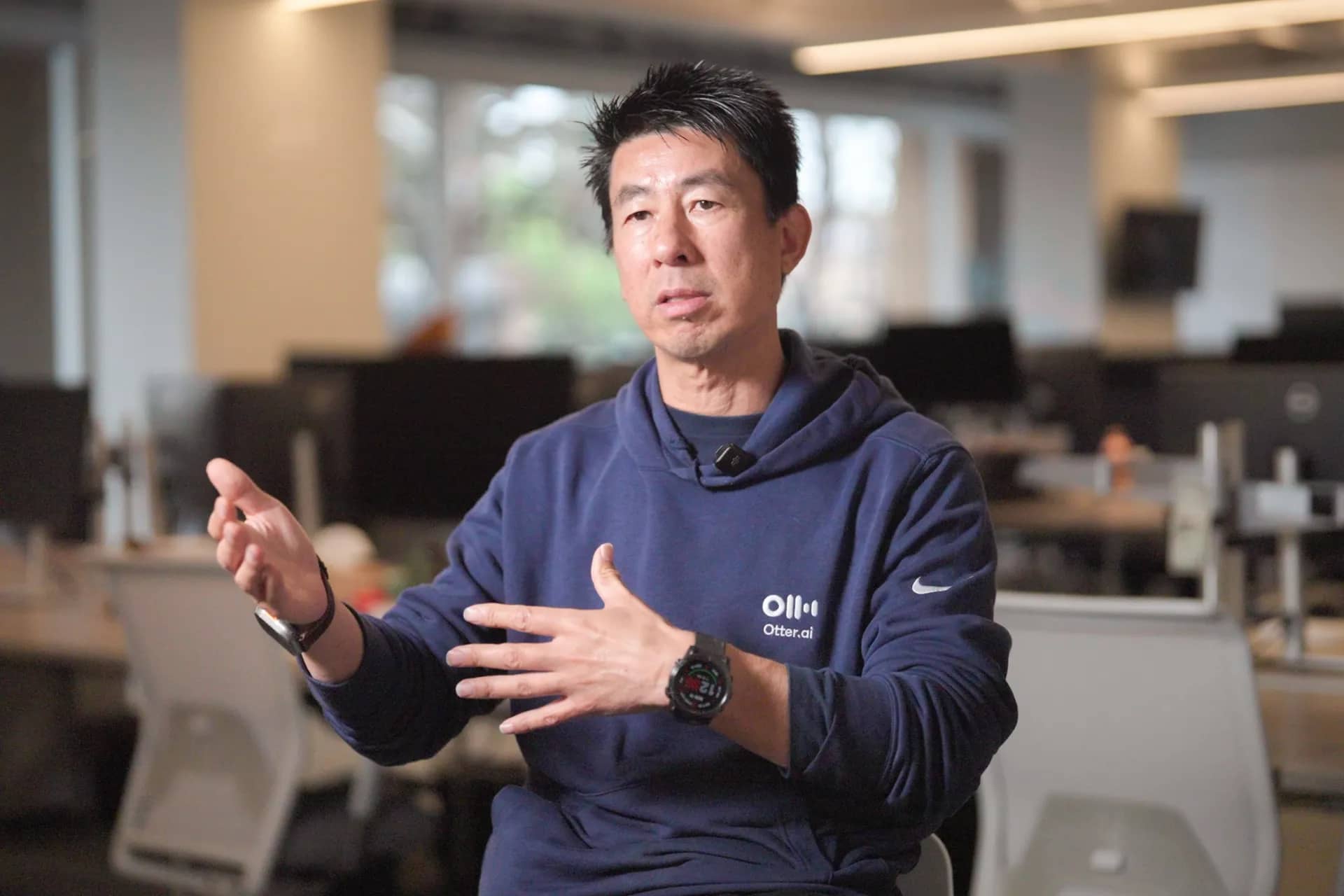
When co-founder and CEO Sam Liang sat down with EO in March, Otter had more than 35 million users and had passed $100 million in ARR. Today it says it has more than 40 million users. It did not give a new revenue figure.
Since EO's interview (Mar 2026 → Oct 2026)
- Users: 35M+ → 40M+
- ARR: $100M+ → undisclosed
- Outside capital: ~$63M in venture funding (last round 2021) → plus $320M, no equity
For most of its first decade, Otter grew mainly through people finding the product on their own. The $320 million is for going after paying customers directly, with more salespeople and more marketing.
What Kind of Money Is This?
The Customer Value Fund pays for most of a company's sales and marketing upfront, up to 80% of it, according to Axios. It is repaid only from the revenue of the customers that the spending brings in, and its return is capped. Once the cap is reached, everything those customers pay after that belongs to the company. If the spending does not bring in customers, General Catalyst takes the loss.
That makes it money for companies that already know what a marketing dollar returns. In 2024, Axios reported that companies in the program typically had $30 million to $750 million in annual revenue. Fivetran, Lemonade, and Grammarly, which took $1 billion in May 2025, have all used it.
"We do need to pay them back," Liang told Reuters, adding that Otter would repay the fund with interest as its sales and marketing spending turns into revenue. He said Otter plans to double or triple its sales and marketing budget, grow its sales team, and market more heavily outside the US.
Otter aims to at least double its enterprise revenue next year. He declined to say how large enterprise revenue is today or what share of users pay.
How Otter Got Its Users Without Paying for Them
Liang started Otter in 2016, after leading the location platform for Google Maps and selling his first startup. The idea came from his own meetings with investors, his team, and customers. "It was really hard for me to remember all the meeting content, and also hard to share that knowledge with all the team members," he told EO.
So he set out to build his own tool. Notably, he did not build it on someone else's API.
"If you want to really go big, you need deep technology roots... By owning our own technology, we can keep costs low. If you use a third-party API, you have to pay them a lot of money, which limits how much free service you can provide."Sam LiangCo-founder and CEO of Otter.ai
Free service, and notes made to be shared with colleagues, were how Otter spread.
"People who adopt early get value and benefit sooner; they become more effective and productive, and they can show that value to their colleagues and help convince other users," Liang said.
Otter now says that teams at more than 86% of Fortune 500 companies use it, and Liang told Reuters that most of that came through organic adoption. The goal is to turn those companies into paying customers. That takes salespeople, and salespeople cost money before the contracts come in. That gap is the spending CVF was built to fund.
Can 100 Other Companies Build It?
Otter is spending to sell into a market that has filled up quickly. According to TechCrunch, it competes with well-funded notetakers such as Fireflies.ai, Granola, and Read AI; newer entrants such as Calendly, Wispr, and Superhuman, which acquired Fathom; and other notetakers such as Circleback, Talat, and Quill. Granola alone raised $125 million at a $1.5 billion valuation in March, up from a $250 million valuation less than a year earlier.
When Liang spoke to EO in March, the field was already crowded, and he addressed it directly.
"Today there are a lot of APIs you can use to quickly build a meeting note taker. Any college student could do that."Sam LiangCo-founder and CEO of Otter.ai
So how does Otter plan to stay ahead?
Otter's plan has two parts. The first is to sell to companies rather than people. Liang told Reuters that enterprise customers are more likely to stick with Otter because teams use it together.
The second is the product. Otter is working on modeling how several people talk to each other in a meeting. Liang calls it "still an unsolved problem," and one that third-party APIs alone cannot solve. In the announcement, Otter describes its in-house speech recognition and speaker identification as the most accurate in the industry.
On top of that, Otter is building the same layer its competitors are. It has been testing a prebrief that sends users background from earlier conversations before a meeting, and a Live Assist feature that answers questions during one. The announcement calls the next step "enterprise agentic workflows." Liang described the same direction in March: "a meeting-centric enterprise knowledge base with agentic workflows on top of it."
The financing will test whether Otter's head start, a user base that grew mostly on its own and speech technology it built itself, turns into enterprise contracts. Liang said the fund could provide more capital once it spends the first $320 million. A fund repaid only by the customers its money brings in has little reason to add more unless those customers pay.