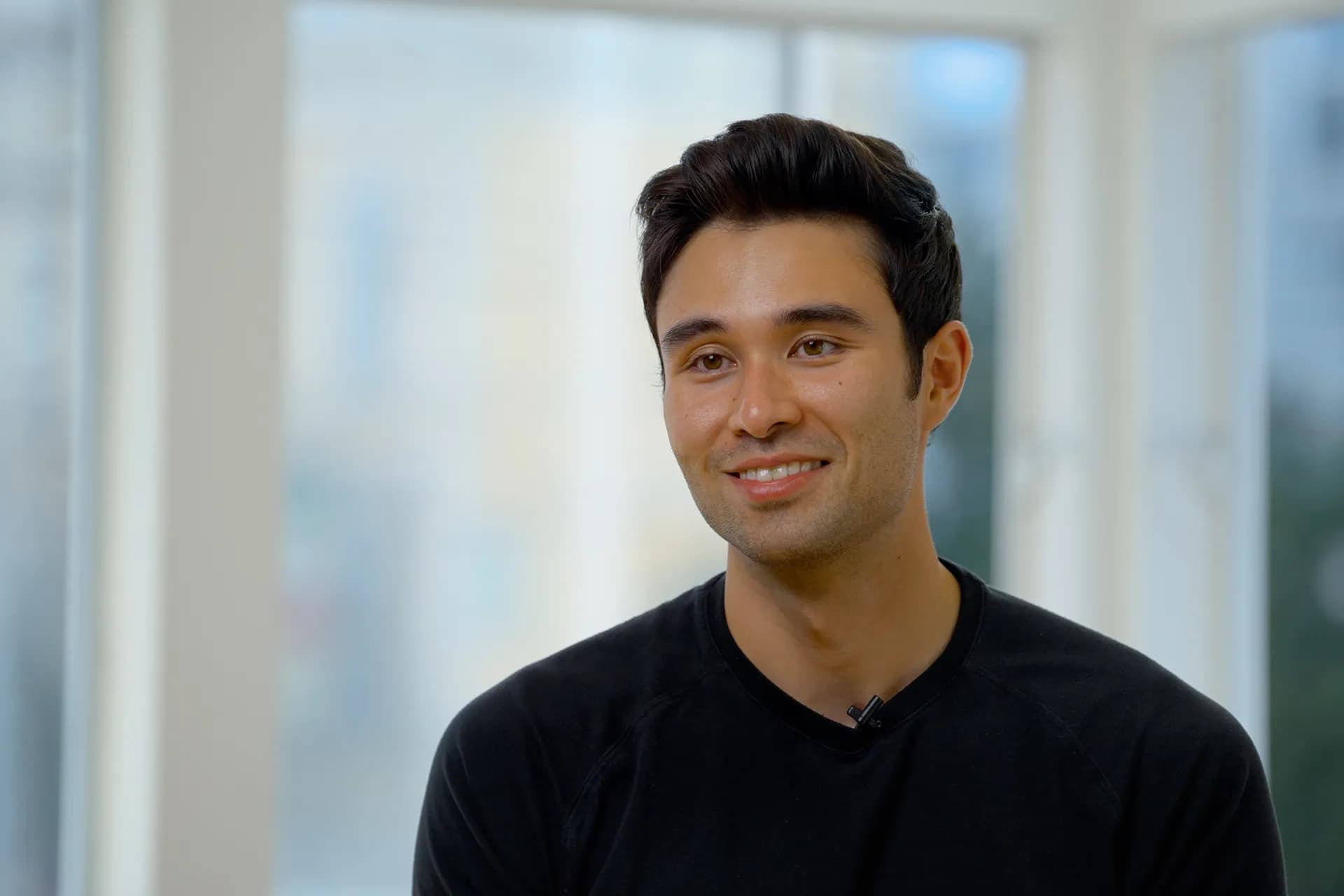
At A Glance
- Who: Rowan Cheung is a college dropout and psychology student turned AI media founder, with no journalism or media background
- What: The Rundown AI, the world's largest AI newsletter
Audience: 2 million subscribers, 50% open rate, built in just 2 years
Notable: Secured interviews with Mark Zuckerberg and Sam Altman
In this interview, Rowan reveals the counterintuitive strategies behind his meteoric rise: why he refused to use AI to write his AI newsletter, how he cloned himself to scale video content, and why the future belongs to creators who can stay radically human in an AI-generated world.
Watch the full interview now on EO's YouTube channel! Below is the complete transcription of the interview. Minor edits have been made for clarity and readability.
Key Highlights:
"When we first started, everyone was afraid of AI replacing everyone. There's a famous quote, AI won't replace you, but people who use AI will."
"We have nearly 50% open rate across all of our newsletters at over 2 million subscribers."
"Some of you were confused, like, who is this complete like zero subscriber guy who got Mark Zuckerberg for Llama 3.1? How did this guy get all the good guests? The reason why I got that interview is because I'm the newsletter guy."
"We completely steered away from AI-generated content and we actually did the opposite. We started putting our faces behind the newsletter and we said, hey, this is human generated."
"Content as a whole is gonna have two sides the Walmart and the Whole Foods. The 1% that really have the humanity are gonna have even more influence."
"Nobody's doing AI for law content. Verticalized content is blue ocean."
"We have nearly 50% open rate across all of our newsletters at over 2 million subscribers."
"Some of you were confused, like, who is this complete like zero subscriber guy who got Mark Zuckerberg for Llama 3.1? How did this guy get all the good guests? The reason why I got that interview is because I'm the newsletter guy."
"We completely steered away from AI-generated content and we actually did the opposite. We started putting our faces behind the newsletter and we said, hey, this is human generated."
"Content as a whole is gonna have two sides the Walmart and the Whole Foods. The 1% that really have the humanity are gonna have even more influence."
"Nobody's doing AI for law content. Verticalized content is blue ocean."
Chapter 1: Why Your Content Isn't Going Viral
You mentioned you were a college dropout. What was the moment you realized traditional education wasn't for you?
Rowan: I was sitting in a psychology lecture when I was still in college. My friend turned to me and asked a question about the lecture we had just heard, and I vividly remember just looking at him and asking, "You actually remember that?" He's like, "Yeah, I remember that. This is a lecture."
And that's when I realized I don't learn from these settings of someone just teaching me, and I have to remember it to sit and do an exam. I just don't learn well in that school setting.
So on the side, I was starting to teach myself things. I was learning how to code by actually building websites. I learned to design by actually creating graphics. Anytime I learned and self-taught myself through YouTube University, expanding my learning on Twitter, and that's the way I was also learning content, by just posting.
And that's when I realized I don't learn from these settings of someone just teaching me, and I have to remember it to sit and do an exam. I just don't learn well in that school setting.
So on the side, I was starting to teach myself things. I was learning how to code by actually building websites. I learned to design by actually creating graphics. Anytime I learned and self-taught myself through YouTube University, expanding my learning on Twitter, and that's the way I was also learning content, by just posting.
What was the ChatGPT moment that changed your trajectory?
Rowan: The ChatGPT moment happened, and my first thread after that—I remember I think it was a day or two after ChatGPT actually officially launched to the public—I wrote a thread like, "Hey, here's some cool things that I'm exploring in ChatGPT," and it went super viral.
From there, I decided, let's go all in on this, see what happens. I'm really curious about the space. I've been in the space for a few months already. I decided to drop out and go all in on just posting a thread every single day, and I thought the virality would die down, but it actually increased.
And then when Twitter started going super viral, I said, "Hey, how am I gonna grow a business or brand off this?" The easiest thing I thought about was just starting an email list.
From there, I decided, let's go all in on this, see what happens. I'm really curious about the space. I've been in the space for a few months already. I decided to drop out and go all in on just posting a thread every single day, and I thought the virality would die down, but it actually increased.
And then when Twitter started going super viral, I said, "Hey, how am I gonna grow a business or brand off this?" The easiest thing I thought about was just starting an email list.
The Anti-AI Strategy for an AI Newsletter
You run an AI newsletter but refuse to use AI to write it. Why take that approach when you had so many competitors using AI?
Rowan: We had so many AI newsletter competitors when we first started, and so many of them use AI to write their content, which makes sense. An AI newsletter written by AI. But we completely steered away from it, and we actually did the opposite.
We started putting our faces behind the newsletter, and we said, "Hey, this is human-generated," and we made sure that our takes were very clearly human takes. We use AI for the structuring of some parts of research, but we never do it for the human part, and there's a reason for that.
AI-generated content just has no soul, and people are smart. They will know when it's generated. The only way I see this workflow changing is if we have chips in our brains, which I don't think is gonna come in many, many years to come. So the human loop for creativity will always be there.
We started putting our faces behind the newsletter, and we said, "Hey, this is human-generated," and we made sure that our takes were very clearly human takes. We use AI for the structuring of some parts of research, but we never do it for the human part, and there's a reason for that.
AI-generated content just has no soul, and people are smart. They will know when it's generated. The only way I see this workflow changing is if we have chips in our brains, which I don't think is gonna come in many, many years to come. So the human loop for creativity will always be there.
You mentioned content will split into "Walmart" and "Whole Foods." Can you explain this analogy?
Rowan: I think content as a whole is gonna have two sides: the Walmart and the Whole Foods. The Walmart will be AI generated content, easily accessible. It's gonna be all over social media. It's gonna be funny. It's gonna be personalized. It's gonna be really addictive. It's not bad content, it's still good content.
On the other hand, some people are still gonna want Whole Foods. They're still gonna want to know the human behind things. They're still gonna want the personal takes, the person behind it.
The 1% that really have the humanity are gonna have even more influence. They're gonna have more trust, and you're gonna be able to build bigger brands and you're gonna be able to distribute your message even further. It's gonna be so much harder to be that 1%, but I think everything else in the middle dies.
So if you are a content creator right now or you're just starting content, I would highly advise you to be as human as possible.
On the other hand, some people are still gonna want Whole Foods. They're still gonna want to know the human behind things. They're still gonna want the personal takes, the person behind it.
The 1% that really have the humanity are gonna have even more influence. They're gonna have more trust, and you're gonna be able to build bigger brands and you're gonna be able to distribute your message even further. It's gonna be so much harder to be that 1%, but I think everything else in the middle dies.
So if you are a content creator right now or you're just starting content, I would highly advise you to be as human as possible.
Chapter 2: Tips for Making AI Content Go 10x More Viral
For people who prefer talking over writing, what's your workflow hack to get started in content creation?
Rowan: If you're a complete beginner and you want to start content creation, I would start by asking yourself, " Do I enjoy talking, or do I enjoy writing? I ended up being the writing archetype, so I decided to start with Twitter.
There's a little workflow hack that I tell people who aren't writers. You're gonna use a tool like Whisperflow or another AI transcription tool. You download it on your phone and you go on a walk, 2 hour walk, and you just ramble ideas into these notes. You can say "ah," you can say "um," you can do whatever you want.
Then what you're gonna do is go back home, and you're gonna have all your notes transcribed. These are raw thoughts, right? So these are your ideas, not AI-generated ideas. It all stems from your human experience, your human takes, your human insights.
Then you can go to a Claude project. I've trained the Claude project on my best tweets. I've exported my Twitter data, found the best tweets that performed the best, shoved them in there, and trained it on over 20 of my best-performing posts.
This Claude project is trained on my writing style, and I'll take those raw thoughts, sometimes they're really long and I'll just put them into Claude. That Claude project will spit out a draft that's 90% ready. This is AI-assisted writing, but it all stemmed from humanity.
There's a little workflow hack that I tell people who aren't writers. You're gonna use a tool like Whisperflow or another AI transcription tool. You download it on your phone and you go on a walk, 2 hour walk, and you just ramble ideas into these notes. You can say "ah," you can say "um," you can do whatever you want.
Then what you're gonna do is go back home, and you're gonna have all your notes transcribed. These are raw thoughts, right? So these are your ideas, not AI-generated ideas. It all stems from your human experience, your human takes, your human insights.
Then you can go to a Claude project. I've trained the Claude project on my best tweets. I've exported my Twitter data, found the best tweets that performed the best, shoved them in there, and trained it on over 20 of my best-performing posts.
This Claude project is trained on my writing style, and I'll take those raw thoughts, sometimes they're really long and I'll just put them into Claude. That Claude project will spit out a draft that's 90% ready. This is AI-assisted writing, but it all stemmed from humanity.
Cloning Yourself: The Avatar Strategy
You mentioned cloning your face and voice with AI for video content. How does that workflow actually work?
Rowan: About a year ago, all of my audience was telling me I have to do video. I agree with them, but I work 80 hours a week. I'm a founder, content creator, and I have a million other things going on, so I said, "hey, how can we turn my writing into short form video without me being there?"
We decided to clone my face and voice with AI. We still use my real writing and real takes to use it as a script, and we still edit a lot, so there's storytelling. There's a lot of research that goes into these stories that we want to cover.
But basically we take my natural writing, we put it into AI Avatar and AI voice, and then we add B-roll, we edit it together and we create a compelling story for reels and shorts. The Instagram account has grown to over 160,000 followers in the year and this is just from this avatar workflow that we did.
But there are definitely algorithm differences the hook specifically is different across platforms. Your hook for LinkedIn is two lines, your hook for Twitter is actually 3 lines, and your hook for Instagram is one line.
We decided to clone my face and voice with AI. We still use my real writing and real takes to use it as a script, and we still edit a lot, so there's storytelling. There's a lot of research that goes into these stories that we want to cover.
But basically we take my natural writing, we put it into AI Avatar and AI voice, and then we add B-roll, we edit it together and we create a compelling story for reels and shorts. The Instagram account has grown to over 160,000 followers in the year and this is just from this avatar workflow that we did.
But there are definitely algorithm differences the hook specifically is different across platforms. Your hook for LinkedIn is two lines, your hook for Twitter is actually 3 lines, and your hook for Instagram is one line.
3 Habits to Master AI
What's your framework for helping people develop AI intuition and habits?
Rowan: We believe AI is taught through habits. There's 3 ways to learn. If you do one of these, you're gonna be well off. You're gonna be a major early adopter in the space.
The first step: Ask yourself every day when you're doing something at work, "could AI do this?" If you don't know, you can literally ask ChatGPT, "could AI do this X task?" That's the prompt. Put it on a sticky note on your laptop screen, but just constantly ask yourself when you're doing tedious things, "could AI do this?" You're going to build this mindset.
The second step: when you do find something that AI can do, figure out the tool that's best for that specific problem you want to solve. Then spend a couple hours. I do it on Sundays, every single Sunday testing tools. You might fail, you might automate it, which will be amazing. If you fail, that's OK because you're gonna learn where AI can't do things yet. That's what AI intuition is knowing when and when not to use the tool.
And then the third is just sharing your learnings. The best way to learn is by sharing things. You don't have to post on social media. You can share it with your team on Slack, with your mom, your dad, or your friends. Just sharing what you're learning with others is gonna help you become the go-to AI guy around the office.
The first step: Ask yourself every day when you're doing something at work, "could AI do this?" If you don't know, you can literally ask ChatGPT, "could AI do this X task?" That's the prompt. Put it on a sticky note on your laptop screen, but just constantly ask yourself when you're doing tedious things, "could AI do this?" You're going to build this mindset.
The second step: when you do find something that AI can do, figure out the tool that's best for that specific problem you want to solve. Then spend a couple hours. I do it on Sundays, every single Sunday testing tools. You might fail, you might automate it, which will be amazing. If you fail, that's OK because you're gonna learn where AI can't do things yet. That's what AI intuition is knowing when and when not to use the tool.
And then the third is just sharing your learnings. The best way to learn is by sharing things. You don't have to post on social media. You can share it with your team on Slack, with your mom, your dad, or your friends. Just sharing what you're learning with others is gonna help you become the go-to AI guy around the office.
Chapter 3: Creators Are the Next Billionaires
You mentioned that while everyone talks about verticalized AI SaaS, no one talks about verticalized content creators. What's the opportunity there?
Rowan: Like any other business, content is the same and everyone talks about verticalized AI SaaS, right? Like AI for law, AI for accounting. These are huge startups getting all this money, but no one talks about verticalized content creators.
That's coming from someone who is a very broad content creator, but I can tell you verticalized content is blue ocean. Nobody's doing AI for law content and someone needs to be that person.
Content creators are in the best position where they have distribution, they have data and they know what the audience wants. They can survey their audience to figure out what they want, and then they can create anything.
It's harder, but it's still very blue ocean because there's so many problems that need to be solved in content.
That's coming from someone who is a very broad content creator, but I can tell you verticalized content is blue ocean. Nobody's doing AI for law content and someone needs to be that person.
Content creators are in the best position where they have distribution, they have data and they know what the audience wants. They can survey their audience to figure out what they want, and then they can create anything.
It's harder, but it's still very blue ocean because there's so many problems that need to be solved in content.
What's your advice for finding and capitalizing on those "lucky breaks" in content?
Rowan: You're gonna find lucky breaks and when you do find them, it's your job as a content creator to just go all in on it. That means you might have to spend more than 40 hours a week. That means you might have to do things that other regular jobs you wouldn't have to do.
But the momentum is everything, and once you find a lucky break, you gotta just go all in on the momentum.
I think content creators will be the next billionaires. Those creators will run the world almost. It's gonna be harder to get to that level of influence and to grow a personal brand to that level, so much harder with the rise of AI-generated content.
If he told a farmer 50 years ago that there would be this job called a content creator, they would grow a following online and they would be able to influence an election, that's insane. I think that's only gonna get crazier.
But the momentum is everything, and once you find a lucky break, you gotta just go all in on the momentum.
I think content creators will be the next billionaires. Those creators will run the world almost. It's gonna be harder to get to that level of influence and to grow a personal brand to that level, so much harder with the rise of AI-generated content.
If he told a farmer 50 years ago that there would be this job called a content creator, they would grow a following online and they would be able to influence an election, that's insane. I think that's only gonna get crazier.
The Age of the Idea
What's your biggest takeaway about this moment in time for entrepreneurs?
Rowan: We're living in this really cool period in time where it's kind of the age of the idea. If you have an interesting idea, just go build it, because things are growing really fast, capabilities are growing fast, and it's the most amazing time to be an entrepreneur.
It just brings me to this cool realization that we're living in this really cool spot where if you have an interesting idea, just go build it. That would probably be my biggest takeaway.
It just brings me to this cool realization that we're living in this really cool spot where if you have an interesting idea, just go build it. That would probably be my biggest takeaway.