Sep 20, 2024
How I Gained 5M Users In Just 7 Months
Interview with Young Zhao, Co-founder of OpusClip
Founder Focused


💡
At a Glance
- Who: Young Zhao is the co-founder and CEO of OpusClip, the number one AI video clipping tool.
- What: OpusClip turns long-form video into short, social-ready clips in one click, saving creators over 99% of the time and resources of manual video production.
- Traction: OpusClip reached 5 million users and nearly $10 million ARR within seven months of launch, after an earlier live-streaming product from the same team drew only 200 users.
In this interview, we sit down with Young Zhao, co-founder and CEO of OpusClip. OpusClip is the number one AI video clipping tool. In just seven months since its launch, it has surpassed 5 million users, achieving rapid growth and continuously releasing new features. With various functions, including an AI feature that identifies interesting highlights from long videos, it has garnered a lot of love from creators. Young Z. is the CEO and co-founder of OpusClip, an engineer with a design eye. Through several entrepreneurial ventures, he has developed a strong motivation to "make a positive impact on people." He is leading OpusClip by quickly adapting to the changing landscape of content and user needs.
Key Takeaways
The Pivot: One Small Feature Beat an Entire Product
OpusClip's live-streaming tool drew only 200 users in three months, even at $20 to $30 per session paid to keep them testing it. The only feature those users kept using was a clipping tool added almost as an afterthought, and spinning it into its own product signed up tens of thousands of users in two weeks.
Why Willingness to Pay Is the Only Real Product-Market Fit Signal
Users asked about the live-streaming tool couldn't say what they'd pay for it, but OpusClip users showed up asking to pay for queue skips, higher resolution, and more credits before payment even existed. That unprompted demand, not a survey answer, is what real product-market fit looks like.
A Cool Product and a Real Business Are Not the Same Thing
The live-streaming tool looked impressive but never saved users time or helped them make money. A product that doesn't do one of those two things stays a cool demo instead of becoming a business.
How OpusClip Splits the Work Between AI and Humans
OpusClip's AI generates a result meant to land around 80 percent right, then hands the workflow to the user to finish it. Because a business problem has to be resolved completely, the remaining 20 percent still has to be handled by human hands.
Audience Feedback: Ten to a Hundred Times Louder Than Direct Feedback
Once a user posts an OpusClip video to social media, its views, comments, and shares generate far more signal than anything gathered from direct product feedback. That audience response feeds back into training the model on what makes a good clip.
Why Authenticity Becomes the Rarer Skill as AI Content Multiplies
AI makes it easy to generate fabricated content at scale, which will make genuine authenticity rarer and more valuable over time. Creators who stay real are positioned to be seen as the most creative, not the least.
Watch the full interview now on EO's YouTube channel! Below is the complete transcription of the interview. Minor edits have been made for clarity and readability.
Introducing Young Zhao, Co-Founder and CEO of OpusClip
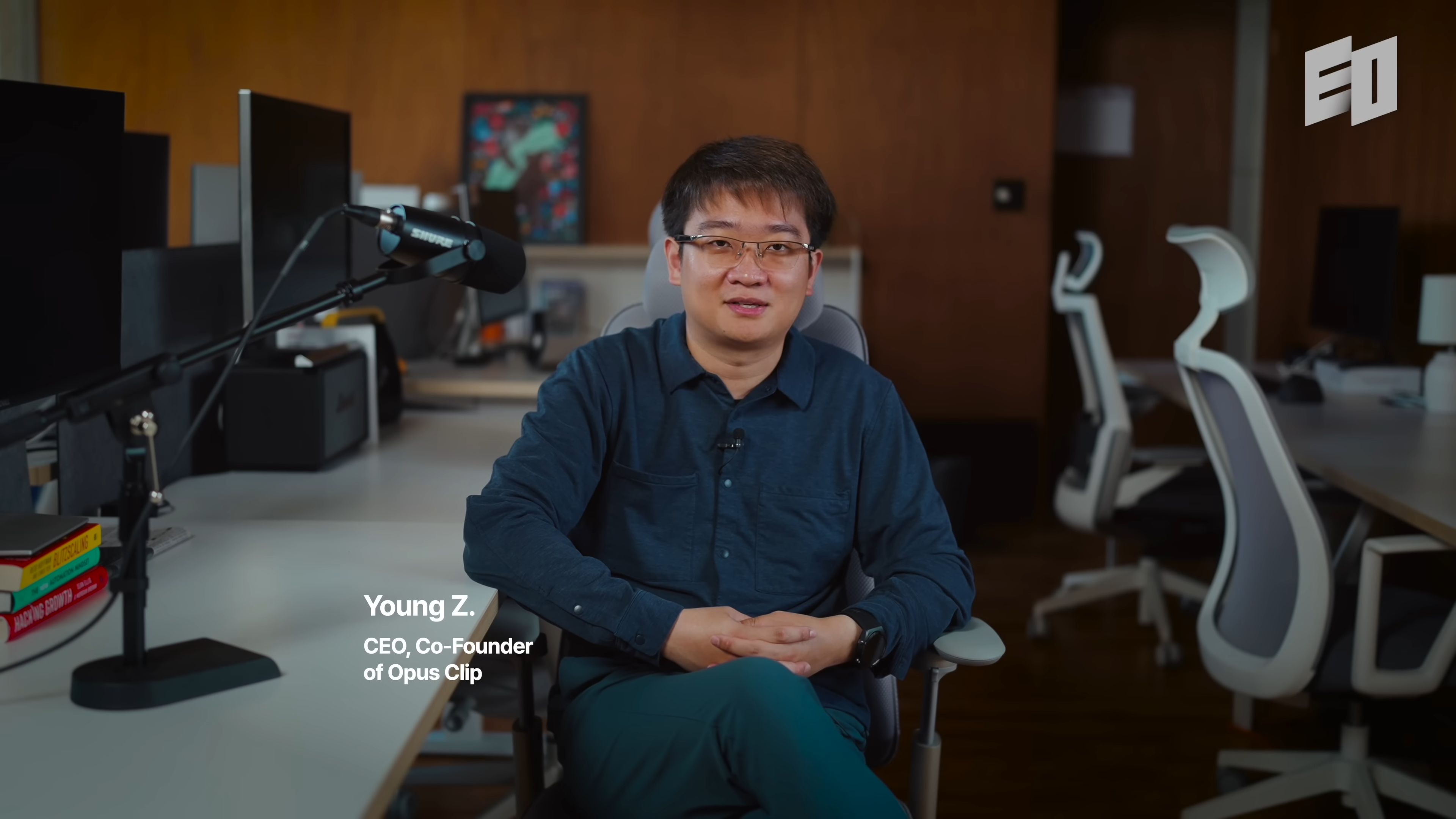
Hi, I'm Young, I'm the co-founder and the CEO at OpusClip. OpusClip turns your long form video footage into social, engaging short video clips in just one click that saves about over 99% of your time and resources and expertise of social video production. We've gathered user signups, supports and trust from over 5 million creators and businesses worldwide.
How an Introvert-Engineer Changes the World
You can probably see that people who create social apps are really introverts. They can't socialize in real life in real person, so they have to figure out another hacky way to socialize with people. Especially, I want to socialize with people when I'm not sober. I co-founded a social app company that was called Sober. So the name you can tell is that after you drink, how you want to socialize with other people.
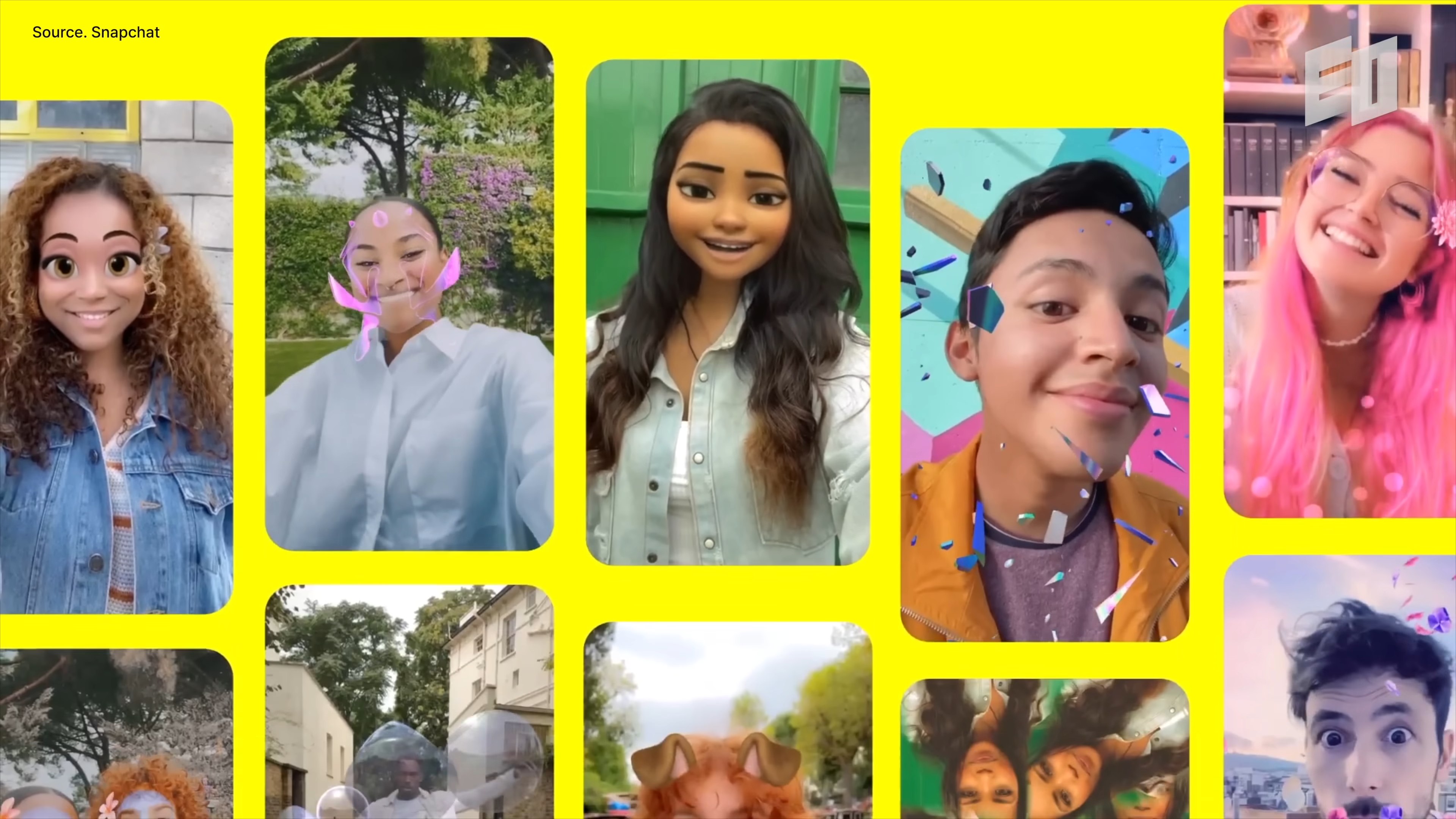
We raised about $1.5 million back in 2013. However, unluckily, that was just two months before Snapchat was launched. We shared a very similar concept that all the friendship and all the content will disappear in a few seconds or in just a day. The company definitely failed after a year. However, I really enjoyed being an entrepreneur through that experience.
In the early stage, becoming an entrepreneur is probably driven by solving your own needs and trying to expand that solution to more people. People who want to be an entrepreneur in the early days are, by nature, people who want to impact more people, impact society, and impact the world.
So back in early 2015, I went to China with a couple other friends from Silicon Valley. At that time, the popular trend was to copy the successful business models from the US to China, and we discovered a pretty cool business model from Toast that helped restaurants speed up everything all the way from POS to MarTech to HR tech. However, it didn't really turn out well because of the completely different landscape and ecosystem.
But throughout the journey that we realized, we are actually the helper for the local restaurant and we should not only build a software, but also services whenever needed. So I quickly formed a talent agency focused on Food Review, just actually four months after TikTok was launched. I know that short video can redefine how people market themselves, and we recognize the huge opportunity out there.
I spent about four years expanding that agency. We had about nearly 500 creatives in the team. After running the agency for about four years, we realized that all the top talents left us because all of them want to be a solopreneur. It is pretty easy and intuitive for a super creative person to become a solopreneur. They want to create content for themselves, not for some local restaurants.
So I thought about it. Instead of managing these creatives directly in my team, why don't I build some AI powered product that can enable all of the creators? There must be an AI solution that can automate as much as possible and remove the pain for creating contents. Because I was running the business, I know how painful it is.
All the successful entrepreneurs have some sort of altruism. They want to help others. It is pretty straightforward that they can get benefit. It's not business, but it's more spiritual benefit from helping others.
How I Gained 5M Users In Just 7 Months
So the first product idea we came about is AI powered live streaming tool. That was during the pandemic and everyone is working from home and watching live streaming content. So we founded the company back in January 2022. We spent about half a year building the live streaming product with all sorts of cool AI features like AI generated memes, AI populated interactions, and so on. We realized that it is not solving any real pain points.
So after three months of the launch, we only gathered about 200 users. So these 200 users, we actually spend a lot of effort. We want them to continuously use Opus Studio to give us feedback, but none of them is willing to do so. So we paid them like $20, $30 a session to use our product so that we can gather the feedback. But after we stopped paying for the stipend, none of them is continuously using the product.
However, the last feature we built for the AI powered live streaming product was a clipping feature, because a lot of users keep asking us that after the live streaming, we want to repurpose the content so that we can reuse for distribution. So we added a feature that during your live streaming, you can hit the button and we will add a mark. After the live streaming content is ready, we can deliver the clips for you directly. We also use some other AI to recognize the cool moments.
That was the only feature that these 200 users liked. They said all the other stuff is nonsense, it doesn't help. How can I only use this feature?
So we decided to turn the feature into a standalone product. Amazingly, in just two weeks, tens of thousands of users sign up for OpusClip. By the end of 2023, we had nearly 10 million ARR, as well as 5 million user signups. That was only seven months after we launched the product.
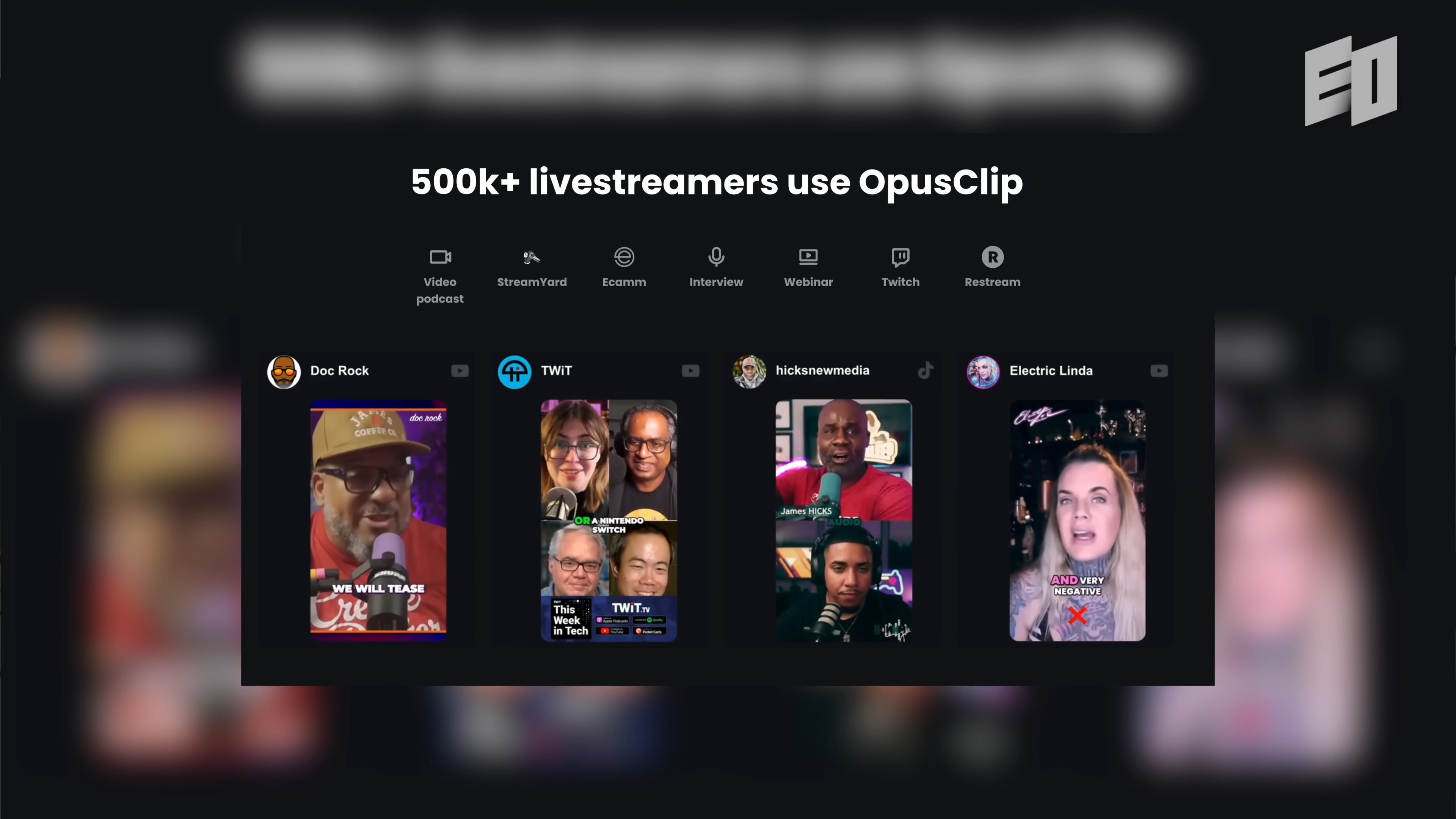
The real product market fit comes from people who are really willing to pay for it. When we launched Opus Studio, we asked the user during the interviews, like how much you want to pay for them and they're too shy to give us an answer. They were like, I will probably think about it or something like that. So you can know that they don't have any dedication or commitment to pay for the product, but for OpusClip, we see so many users saying like, I want to pay to jump over the queue. I want to pay to get a higher resolution. I want to pay for more downloads, I want to pay for more credits. We didn't have the payment setup on day one, but so many users just came in to knock on our door and email us and calling us even, because we really saved tens of hours for them.
But for the live streaming tool, we didn't save any time. We didn't really help them make more money. If you can't make more money or save time for your users, they just feel like it's a cool product. It's cool from look and feel, but not from a business perspective.
In the era of AI, there are definitely way more teams great at technologies, then teams great at building a product market fit. They believe they have a really strong technology through like a paper through academic research, but the user really want it. So definitely start with what the user wants, stay with your user, or even try to become a user. Then think about whether your technology is the best solution, whether AI is the best solution.
So many AI products can deliver over 100% quality at times, but also really underdeliver and disappoint users. So I think from a user experience perspective, how you manage your user expectations is really tricky. Once AI delivers some results, can the user touch up on that? So that's why we spend a lot of our resources building some manual features.
That comes after the AI-first approach, which means once I deliver the result, if the user thinks it's 80% perfect, they can still continue the workflow from what we generate for the user. This is going to really completely solve a user problem. Because you are building a product, you are solving a business problem that eventually has to be 100% resolved. If AI can only do 80 percent, you have to make sure the other 20 percent can be well handled by human hands.
Right now at OpusClip, we launch a new feature every single week. That is one of our culture and that is one of the trend. Users love our product. They see OpusClip as not only the current product, but as how fast we iterate on the market by launching new features every single week. Make sure you experiment extensively before launching an AI product, because AI is not so controllable nowadays, the result can be versatile, can go beyond even your expectation.
I see most of the AI features or AI products start with like a lab, start with a beta version, and after quite a few more months, when it is really stable, when the cost really came down, then it becomes part of a core product. Don't spend too much time building an AI core product. Try to launch it separately, try to launch some small experiments, and get early users' feedback before cutting down the cost, before integrating that into your main product.
Our product is also very unique in terms of user feedback: the user not only directly gives us feedback through using the product, but also once they post a video from our product to the social medias, we can gather the number of user views, the number of comments, number of favorites, and number of reshares. All these, what we call audience feedback, is actually ten times or even 100 times more than our user direct feedback. We're going to use these amount of feedback to fit into our model training, so that we can judge whether we are generating a good video clip even before the user publishes to the social media channels.
The Survivor in the AI Era
So our vision is to enable anyone to become a creator without the effort and hassle of video editing and prompting skills. We don't want an AI to remove the human authenticity. We want humans to focus and spend more time on creating an idea, create your script, film the relevant contents, and then we, OpusClip, will take over all the boring and tedious and time consuming work.
There are, in general, from a video production perspective, three major stages. The first one is pre-production, where you edit a topic, you write the scripts and you prepare the storyboard. Then it comes to the production, where you film the content, you record the screen, or you prepare the media assets. The last one is the post-production, where you edit the video, you assemble, you cut the scenes and you sequence them in order. Previously, most of the AI or technology is only focusing on a specific scene or a specific frame. But nowadays the overall story, the overall narration and the curation can be well enhanced and automated by AI.
The second thing is definitely the generative AI technologies. We can see that most of the time it's really hard to feel the content. But nowadays with Sora, with Pika, with other AI models, you can generate like a few seconds long footage or B-roll from just a few words. So I think one is the understanding, the other is the generation. These two huge advancements of AI are actually automating the whole process and also generating new footage.
I think with the advancement in these AI technologies, creators are actually shifting from creating content to being creative. They don't have to spend so much time to specifically create each piece of content. I can do this job for them, but they should spend probably ten times more time to think about how to be creative. Because everyone is being more and more creative, everyone has more time to be more creative, everyone has more resources to be more creative. The paradigm shift is how you can be tenfold more creative than before.
I think in the AI era, being authentic and being genuine is probably going to be more of a rare find, because it's easy. It's super easy to leverage AI to generate a lot of fabricated content. So my advice would be, just be yourself, be human, be real. Maybe nowadays it's easy to be like that, but think about 5 or 10 years later when AI is everywhere, when AI generated content is everywhere. Being super real, being super genuine and authentic is probably going to help you be the most creative.