Dec 09, 2023
A Story of a Mentor of Outstanding PMs in Silicon Valley Today
Interview with Mick Johnson, Product Manager of Meta
Founder Focused


💡
At a Glance
- Who: Mick Johnson, a product manager who spent 16 years moving between Facebook, Google, and Meta, and has mentored or managed over 100 product managers along the way.
- What: He ran Facebook's rotational PM program and now mentors Silicon Valley product managers on shipping quality, cross-functional leadership, and career growth, drawing on lessons from two of his own startups.
- Lesson: Johnson distills sixteen years of founding, shipping, and mentoring into one core lesson: outcomes are decided by what you choose to do, not by what you're capable of doing.
In this conversation, Mick Johnson shares his product manager story. Mick is an outstanding product manager who has mentored over a hundred of Silicon Valley's hottest PMs. We've compiled insights and narratives by weaving together the previous two episodes.
Key Takeaways:
Startups Are a Terrible Financial Bet and the Best Personal Investment You'll Make
Startups rarely make the strongest financial argument, but no other pursuit teaches you more about your own limits. Founding one puts you alone in the world with only your own resolve standing between you and the outcome.
10x or Nothing: The Bar Every Early-Stage Consumer Product Must Clear
A slightly better feature set or a nicer interface rarely moves a market. Early-stage founders, especially in consumer, need something that changes how people think about solving the problem entirely.
Why Ex-Big-Tech Founders Underinvest in Go to Market
Product people who spent their careers at Google or Facebook are used to reaching billions of users for free, so they underrate how much work distribution actually takes at a startup. Calling prospects, running ads, and chasing referrals are not extras; they are what turns a decent product into one with enough signal to become great.
Product Management's Real Skill Set: Data, Intuition, and Reading a Room
Great PMs are not the ones who dream up the perfect product alone in a room and defend it. They pull together data, gut instinct, human reaction, and visual sense as raw ingredients, then bend their own convictions the moment better information appears.
No One Remembers How Fast You Shipped. Everyone Remembers How Good It Was.
Every launch feels like a race against the clock while it's happening, but that pressure evaporates the moment the product ships. What survives in people's memory is quality, so that's the only metric worth actually protecting.
How Judging Managers on the Wrong Metric Made Them Better
Facebook stopped holding PM managers accountable for their teams' project outcomes and made them responsible only for their PMs' growth instead. Once managers were freed to focus purely on developing people, both the PMs and the business results improved.
Curate Your Life in Small Doses, Not Big Leaps
People assume burnout or fading excitement requires a dramatic move: a new job, a new team, a new career. In practice, small continual swaps, doubling what energizes you and halving what drains you, work better than any single big leap.
Watch the full interview now on EO's YouTube channel! Below is the complete transcription of the interview. Minor edits have been made for clarity and readability.
Chapter 1. Startups are a great personal investment
My name is Mick Johnson, and I've spent the last 16 years moving between large tech companies and doing a couple of small startups along the way. I was one of the first product managers on mobile for Facebook.

Australians have a little bit of wanderlust. We like to explore, we like to see the world. I've always liked travel, I've always liked exploring new things. I had a number of friends who had moved to the Bay Area, and I was at a point in my life where it felt like it was time for a change, time to try something new. When I first came, I just planned to be here for a couple of years, but I really grew to love the States. I really grew to love the Bay Area, and so I had a small startup called Gasbag, which was a way to find cheap gas around you when the iPhone App Store first came out.
I would say the first startup that I did, my co-founder and I were new to Silicon Valley. We were new to some of that culture. We ended up becoming a Y Combinator batch. We were actually there when going through YC meant you got something like $6,000 per founder. We were paying ourselves $1,500 a month or something, just trying to make ends meet, trying to make things work. We didn't really know how to raise money. We were just doing everything we could without much of a map.
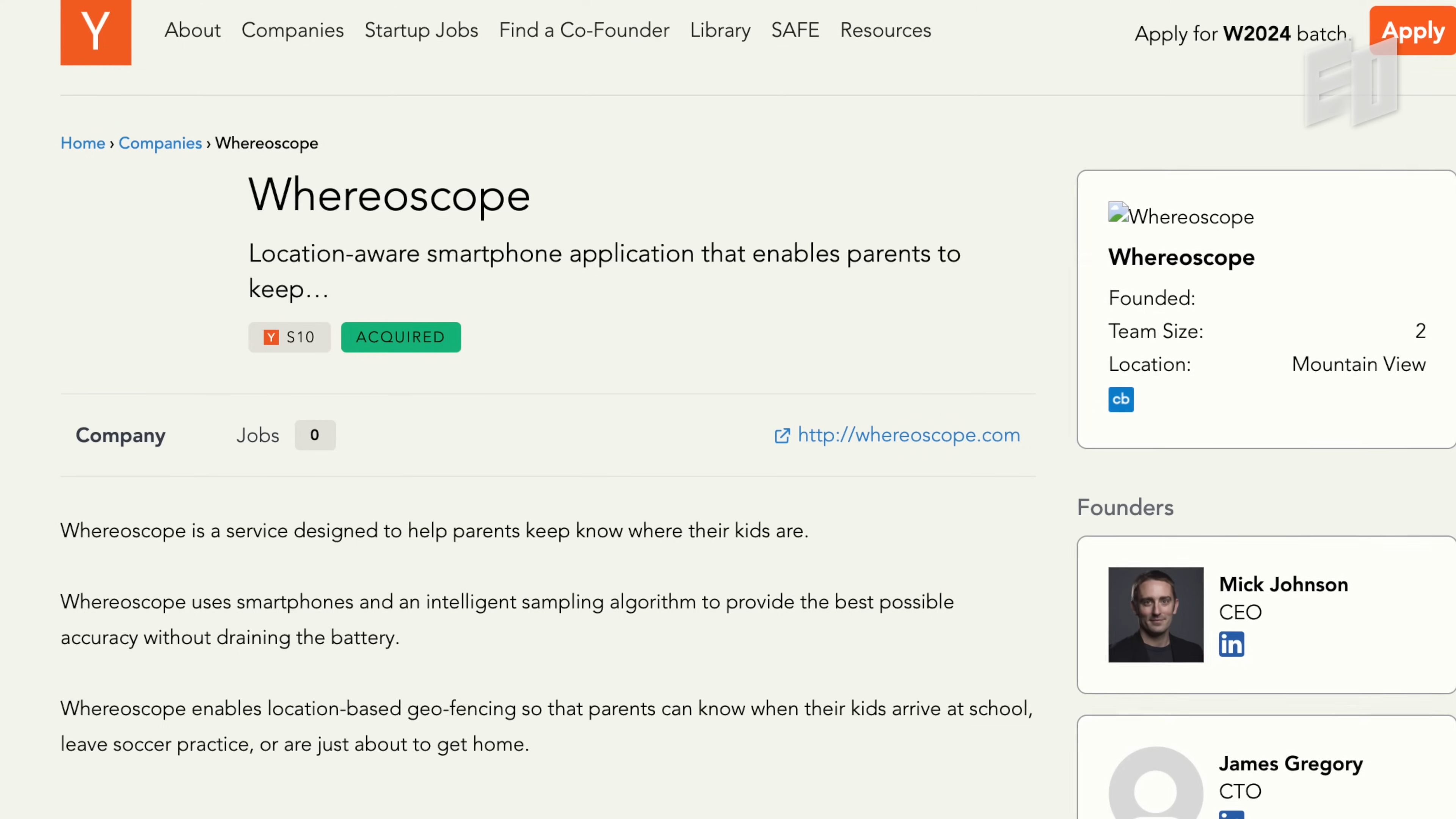
We knew we had product market fit when our servers went down and people tried to call us because they wanted our servers to work. That was when we knew we had it. You call it searching in the wilderness a little. You're trying to get to product market fit and you build thing A, and no one really responds. You build thing B and no one really responds. And when you finally build thing X and it takes off, you will know. It's hard to describe that feeling until you've had it.
I often coach people who've gone from a large tech company to being founder of a startup, and they always forget or deprioritize go to market, because if you work for Google or Facebook and you have a new feature or a new idea, you can get it in front of billions of people. That's not hard. Many early stage founders will say, well, we're planning to just build it and we'll get referrals and people will like it, and that's how we'll grow. But as an early stage founder, often your product can be pretty good. If your go to market is amazing, you will get enough signal to truly make it great. And if you can't get people using your product, it doesn't matter. This can be any combination of calling people on the phone, creating search ads, doing content marketing, doing referrals, doing whatever it takes to actually get sales and marketing. We built some really interesting things. Ultimately, it didn't scale, it didn't succeed.
That then led me to Facebook in the early days. I joined in 2011 as one of the first PMs on mobile. I spent four years at Facebook doing a whole host of fun things. I went to Google and spent some time working on maps for automotive, and then I went back to Meta to work on Facebook again.
And the main thing I learned from both of my startup ventures is that startups are a bad financial investment, but they're a great personal investment. You will learn more about what you are truly capable of by founding a startup than doing almost any other thing in the world, because you will put yourself out there into the world, and the only thing standing between you and your dream is yourself. For folks who are into self development or self learning or any form of inner learning, it's just one of the best things out there.
If you're an early stage founder, build something that's ten x better. A lot of the time you will build a thing that's a little bit better and has a few new features, or a thing that's a little bit nicer or easier to use. But you have to build something that really changes people's minds about the way to do something. If you want to truly reach scale, particularly in consumer, finding that thing that can be ten x better is really hard, but that's what you have to do.
Chapter 2. How I teach 100+ PMs in Silicon Valley
This was at a time when Facebook was growing quickly. I was one of the first rotational managers and then ended up running the program. We would have a one year program. Folks would come in with less than two years of experience. We'd put them on three rotations of four months each roughly, and by design, we would have them work in different parts of the company, so they had to do at least one consumer and at least one non-consumer.
I think I've probably mentored or managed over 100 PMs. Something I tell people who want to be a PM: product management is a learned skill, not a studied skill. The best PMs are those who can take data, intuition, human response, and visual appeal, and bring them together as ingredients.
The first thing to teach someone at the early stage of their career is that there is a tension between how quickly you ship something and how good it is. Before you ship it, everyone talks about how long it's taking, and after you ship it, everyone talks about how good it was. For the very first thing that you ship, no one will remember how long it took. It only matters how good it was. Ultimately, you need to care about and be responsible for how good the thing your team builds is.
With folks early in their career, they think too much about the product and not enough about the humans around them. So the question you will ask junior product managers frequently is: what does your engineering lead think of that? What does your designer think of that? And what I'm asking isn't just to understand what other people think, but how these leaders react to what other people think. How do they internalize other people's opinions? You often have this narrative of a PM as someone who, in a tower on their own, dreams up the perfect product, writes it out on paper, and is correct. But almost every great product comes out as a set of compromises and discussions. People who can have strong opinions but flex them as they get new information are critical.
Conversely, folks who are in the middle stage of their career might have the opposite problem. They've learned how to collaborate really effectively. They've learned how to build consensus. They've learned how to bring people along, but they haven't yet learned when they have to take that gathered credibility and spend it to have people charge up the mountain. That really matters.
A lesson I learned from a really smart woman called Molly Graham: you create process when you don't trust people. Having said that, diagnosing and solving cross-functional tension is an issue that exists whether you're a PM or not. You can solve cross-functional tension by explicitly writing out: this is your job, this is that job, if you disagree here, do it that way, let's come up with some skeleton piece. But truly high functioning teams just say you are collectively responsible for the output of this group. You need to transform yourselves from sitting across the table from each other to sitting around the table with each other. How do we solve this problem together?
When you get to really senior folks, it's often about helping the people they manage to make small mistakes, because when you're really good at something, the instinct is always to go in and fix it for them. So often the conversation that I have with more senior folks is: what small mistakes are your PMs making? Are you allowing them to make those mistakes? That's the best way for them to learn.
The really significant thing that happened: whereas managers are normally responsible for the output of the people on their teams, what we decided was that our PM manager should be responsible for the growth of the PM. They wouldn't be judged on how well those PMs' projects went. And the really interesting learning was that when we had managers whose sole job it was to manage, the PMs did way better. Turns out that at the early stage of your career, when you have managers who are really dedicated to helping you uncover and develop your skills, the business output actually increases as well.
Chapter 3. You need to know how to breathe under water
There's a story I used to always talk about with rotational PMs. They're early in their career, typically motivated, intelligent, capable, and they start this job. They can do everything they're asked to do. They read the emails, they answer all the chats, they close all the tasks, they read all the docs. Then they get more work, and they spend a bit more time. They stay a bit later at work. They read all the emails, they do all the chats, they close all the tasks, they do all the docs, and then they get more work. The amount of work they have to do is like a rising tide, water coming up their neck and then their chin, and they're struggling and fighting to keep their head above water as best they can.
Then we'd have a conversation a few months in: they need to learn to breathe underwater, and the water is the work that they will not do. There will be things they could do, things even that they should do, that they will not do, because there are more important things for them to do. This transition is going from a world where they judge themselves by what they're capable of, to a world where they judge themselves by what they choose to do.
What's amazing is once they make this transition, you can see it in their demeanor. The anxiety visibly recedes. They're like, yep, there are these tasks, but I've chosen to do this other thing, and I'm confident in it. That often leads then to the world of startups, where there are so many things you could do. You could do literally any of a billion things. But your outcomes are determined by your choices, not your capabilities.
Chapter 4. How to do things you don't want to do

Oftentimes when you're working on things, there's one thing that you have to do and you don't want to do it. There's some job that you've been putting off, and it might be talking to a coworker, or filing taxes, or letting go of an employee, and you will find any reason to do anything else as long as it seems productive. The thing that you have to do is actually eat the spike and just go straight at the hardest thing.
I had a time in my career where I was struggling to work with one of my close counterparts, and I was finding every reason in the book why that didn't matter. I'll decide which things I'm responsible for, and they can figure out which things they're responsible for, and it'll just work. I got some really clear guidance from my manager at the time: if the two of you can't figure this stuff out, none of the rest of it matters. It doesn't matter how good you are at your job if you don't solve this interpersonal dynamic.
It was quite emotionally hard for me to solve. There had been some challenges and conflicts between the two of us, but when I finally owned up to it, I thought: no, no, this relationship, and it working, is the most important thing in this job right now. I need to eat the spike and just solve it. I dedicated the next month basically to solving that. As soon as I decided to eat that spike, it got way easier.
The piece that was then professionally most important to me is that the area of greatest growth is always the thing that you will emotionally and internally shy away from. That's why there's growth there. That practice of examining the things that are most difficult for you has just been fruitful for me time and again.
Chapter 5. Tips that increase impact on life
About half of my mentoring sessions are about personal aspects of work as opposed to professional. How do I deal with burnout? How do I stay excited? How do I overcome this particular challenge internally?
Something I've learned that people don't do proactively enough is that you can curate your own life. People often think that if you are struggling with burnout, or struggling with morale, or struggling with excitement in your work, you have to make a big change: change jobs, change groups, change careers. In my experience, multiple small changes can have an enormous impact. Just sit down and think of the ten meetings I had today. Which of them were my favorite, and which ones drained me the most? For the ones that drain, you halve the frequency, and for the ones that enliven you, double it. You can continually curate the things that exhaust you in minor ways.
As a young man, I had a bit of a chip on my shoulder. I felt like I had to prove myself to the world. I had to show that I was better than other people. I had to show that I could do these things. Of course, the realization eventually was that I was really trying to prove myself to myself. It gave me a lot of drive. It gave me courage to go and do startups and take the less well-trodden path, put myself into harder to succeed situations, and sometimes come out the other side. Then, several stages along my journey, truly adopting responsibility for other people made me realize I don't need to prove myself to anyone else. I just actually have to do great work.
For many folks, particularly in the Bay Area, if you work in tech or you've done well academically, you're not really used to failure. You're used to: if I study hard on subjects that I'm good at, I'm going to do reasonably well on this test, or in this job, or something like that. But startups are where you might pitch an idea to 40 VCs, and they will all give you polite maybes. You will realize, at the end of a month of knocking on every door you can, that this is just not going to work out. You have to decide: am I going to make one more phone call? Am I going to send one more email?
I did discover, yeah, I do believe in myself enough. I am going to do this. It was just facing that form of rejection, which you can have either from investors who don't believe in you, or in a product that hasn't found product market fit yet, or from trying to hire people to join your startup when you don't yet have enough credibility. I certainly discovered a resilience I didn't know I had.