Jul 05, 2025
Built to Share: 2M Users in 18 Months
Interview with Rahul Sonwalkar, Founder of Julius AI
Founder Focused


💡
At a Glance
- Who: Rahul Sonwalkar is the founder and CEO of Julius AI, who left engineering roles at Uber and Facebook to spend a year building his own ideas full time before launching Julius.
- What: Julius AI is an AI data analyst that turns a person's own data into insights, charts, and visualizations without requiring a data science background.
- Traction: Since launching in 2023, Julius has grown to over 2 million users in 18 months, with users generating more than 10 million data visualizations and Julius producing over 4 million lines of analysis code every day.
In this interview, Rahul Sonwalkar shares the 5 essential rules every AI startup should consider. He emphasizes the importance of focusing on a single task, moving fast, and embracing failure, especially for startups. Discover why Rahul believes in these principles and how they shaped his journey by watching the full episode.
Why Focus Beats Being an All-in-One Tool
General-purpose products dilute the experience because they optimize for breadth, not depth. A startup's only real edge is picking one job and doing it better than anyone building for everyone.
Retention Beats Signups Every Time
A tool can rack up real usage and still die if the problem it solves is not one people hit daily or weekly. Solve an occasional pain point and you get a weekend project, not a company.
It Only Takes One Yes to Build a Company
Big companies need consensus up the chain, so a single no anywhere can kill an idea. Startups only need one customer to say yes, which is why speed and conviction beat internal buy-in.
Failing Fast and Cheap Instead of Slow and Expensive
Building HoopsGPT in about two weeks let Julius test a new market before the NBA season ended, so the idea could fail on a tight deadline instead of a year-long bet. The answer, that sports fans wanted betting insights more than data literacy, came back fast enough to move on immediately instead of being stuck with a slow, expensive dead end.
Never Let One Platform Own Your Growth
When OpenAI shut down the ChatGPT plugin store, Julius lost its largest source of new users overnight. Depending on someone else's distribution channel means someone else can end your growth without warning.
Build the Sharing Instinct Into the Product
People who get an insight from their data want to tell someone about it, not sit on it. Julius engineered that instinct directly into the product, turning word of mouth into a growth channel it didn't have to pay for.
Burning the Boats Forces the Risk You'd Otherwise Avoid
Comfort breeds complacency and lets founders keep telling themselves an idea will work out eventually. Removing the fallback option is what actually pushes someone to take the risk instead of sitting on it.
Watch the full interview now on EO's YouTube channel! Below is the complete transcription of the interview. Minor edits have been made for clarity and readability.
Introducing Rahul Sonwalkar, Founder and CEO of Julius AI

I'm Rahul, founder and CEO of Julius AI. Julius is an AI data analyst. If you have data on your hands, Julius will help you get insights from your data within seconds and help you make charts and data visualizations. Since launching in 2023, our users have used Julius to make over 10 million data visualizations. Every day, Julius writes over 4 million lines of analysis code. Four million lines of code is more than an army of data scientists can write every day. It took about a year and a half to get to 2 million users.
Rule No.1 Focus on only one task
For AI startups, I'll say focus. Don't build a general purpose tool. Startups win because of focus. That's the only advantage you have as a startup. ChatGPT is an all-in-one tool: making videos, making images, doing internet search, writing essays. It's an all-in-one tool, and it's not focused on data analysis, so the experience is much worse. A lot of our users start with ChatGPT, and they realize that to analyze any kind of real data and get any kind of meaningful insights, ChatGPT falls short. The quality of insights you get aren't that deep. It can't handle any kind of real data. The charts don't look good. You can't collaborate with your colleagues on the analysis. So all these problems people run into after using it for a day for analysis, and they all go to Google and look up AI data analysis. The number one search result on Google for that is Julius.
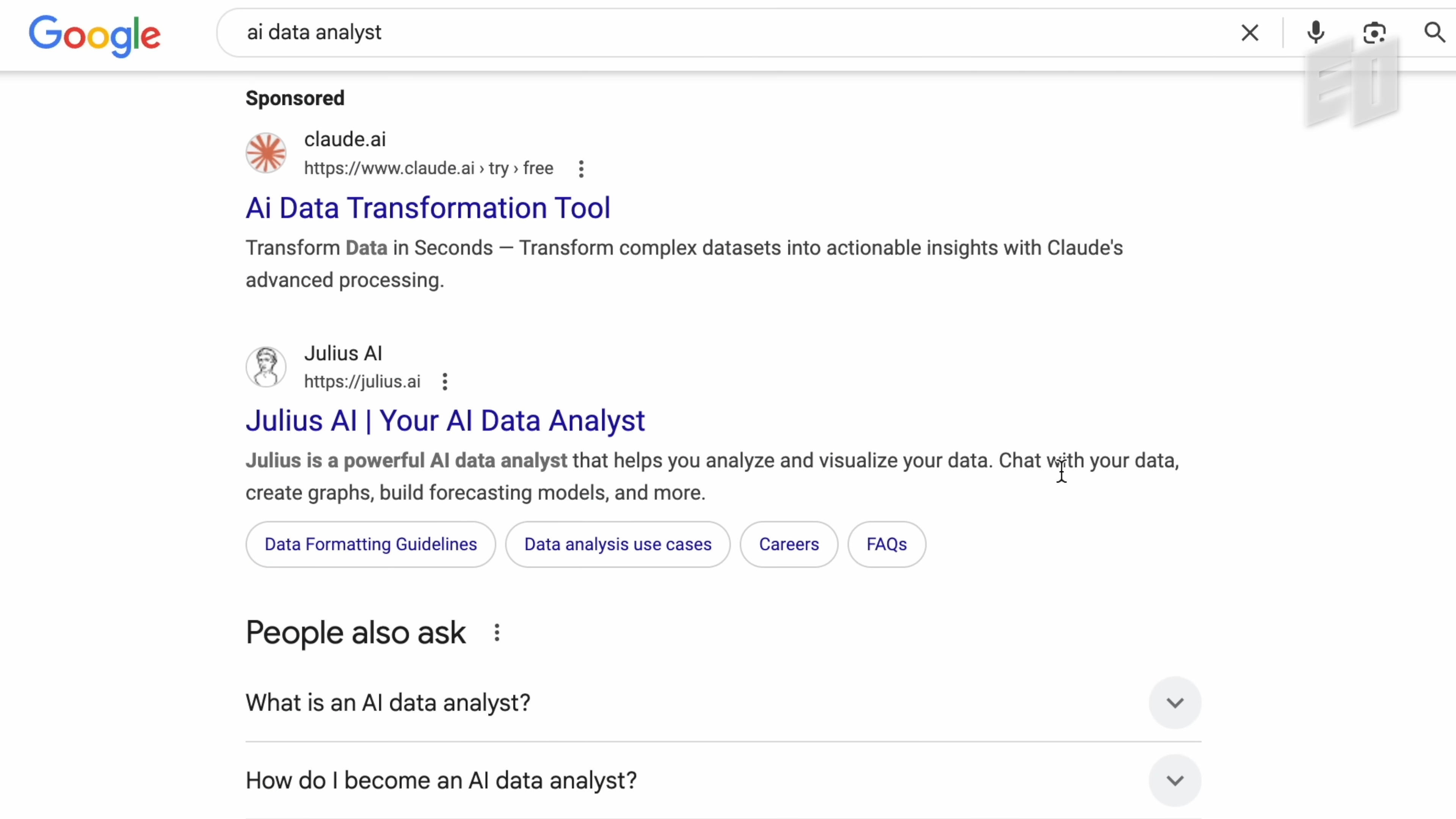
It's kind of like thinking about hiring humans. Would you want to hire one human that can do everything? You can, and that will help you get decent results. But then there comes a point where you want someone with deep expertise, someone who's really, really good at one function, like a marketer, finance person, an engineer. I think focused agents for a task have much more competitive advantage than a general purpose agent.
Rule No.2 Solve daily problems that matter
There's this conventional meme: Google just killed your startup, OpenAI just killed your startup, XYZ just killed this or that startup. I think all that is very overblown. As long as your users don't care about that stuff, it shouldn't matter. If you're building something that solves a problem for people, and you're doing a better job at that than everyone else, that's all that matters.
This goes back to college, when I got into the hackathon scene. I would go to these hackathons. The big problem I noticed is you have 48 hours to build and launch an idea, and a lot of the time people would spend it setting up a backend service and a database. I thought that was a waste of time. So Waterview was this managed service: you'd get a backend server or database out of the box that just worked. It got a lot of users. I would go to these hackathons, give it to people, and they would try it. It would save them time. But the problem was none of the people who built their hackathon projects, their weekend projects, on Waterview continued to work on those projects after that weekend. It was like a weekend thing.
The big lesson there was you can solve the right problem, you can solve a pain point for people, but if they don't have that pain point daily or weekly, they're not going to retain. They're not going to come back to the product. You have to solve a problem people have regularly. If they have it only once a year, or once every six months, or once a month, they're not going to retain to your product. That's the reason Waterview failed, and that was a very valuable lesson.
Rule No.3 One 'NO' kills an idea

I worked as an engineer at Uber and Facebook. When you're at a big company and you have an idea, one no can kill that idea. You have to get a yes from your manager, your manager's manager, your design manager, your product manager. You have to get all these yeses, and even one no can kill your idea. Innovation doesn't really happen in big companies. At a startup, it's the complete opposite. All you need is one yes. Looking for customers, you can get 50 nos, but one yes, your first customer, that's all that matters. Instead of one no killing your idea, one yes can really make your company work.
One of the problems I was trying to solve at Uber is people book Uber rides usually for things they can't drive to, like an airport, or when they're going out at night to bars or restaurants. That sporadic usage is not good for Uber. One of the things I wanted to solve for is how we could get people to use Uber on a daily and weekly basis. So I wanted to launch a commuter product at Uber, helping people use Uber's offerings, like Uber Transit, Uber X, Uber mobility, bikes and scooters, as part of a commuter package that companies could offer their employees.
I wanted to pitch the idea. I was pushing it really hard, and I got buy-in from a lot of cross-functional management, but I couldn't get buy-in from our engineering leader, and that killed the idea. But at the same time, I was building apps and different ideas on the side on the weekends, and that motivated me to quit my job and spend a year exploring my ideas full-time.
Rule No.4 Failing Fast
Every failure is good. Failing is good because you know what's not working. I talk to founders, and they're too scared to launch, too scared to tell people what their idea is. They're too scared to put the product out there. I'm the opposite. At Julius, we launch things when they're barely working, because you want to get early feedback from our users and customers. We want them to try it out. We want to learn from our users and customers what they actually want and how things should work.
I'll give you one example. We were building in data, AI, and insights, and we thought one group of people who want insights from data but don't have the expertise to do data science on their own is sports fans. We built this thing called NBA GPT, later called HoopsGPT, that could help you query NBA play-by-play data just by asking simple questions. We had to build the UI, the interface, figure out how the text-to-query engine was going to work, and ship the whole thing in about two weeks, because if we were too late, the NBA season would be over. There was no point waiting a year to try the idea again.
Turns out sports fans aren't that savvy about data. Turns out the people who really wanted it were the ones who wanted to do betting, and those really aren't the users we wanted to serve. So we learned very quickly whether something is what people want or not. We don't want to build something no one will ever want to use. I think failing is important. Failing fast is really important. Paul Graham talks about this in his essays all the time. Failing fast is super important.
Rule No.5 Build products people share

This is months after launching Julius. We had about 10,000 to 15,000 users, and most of our users at that point were actually coming from ChatGPT. ChatGPT has this plugin store where users would discover Julius, come to Julius, stay with Julius, and use it over and over. It was going great. We were growing overnight. Then OpenAI announced that the plugin store was going to get shut down, and our biggest source of users disappeared overnight. We had to scramble and figure out how we were going to get more users and where they'd come from. That was an existential moment, and it's what really got us to move fast and figure out how to get our users to become champions of Julius.
We realized that when people analyze data, they want to tell their colleagues about it. When you get an insight, you don't keep it to yourself. You want to tell your colleagues, you want to tell your team. So we built sharing into the product. If you solve a problem that people have, they will come to you, they will use your product, and they'll tell their friends about it. Word of mouth is a free way to grow your product.
If I were to start from scratch today, what would I do differently? Nothing. I think all the things I would consider missteps, things I could have avoided, those are valuable lessons. All the features we tried that didn't work out, that's really valuable data. If you only have data from successes, that's very skewed. It's really important to try a lot of things. Things that don't work are also important, because now you know what doesn't work. Honestly, I would not do anything differently.