Industrial Next trains its robots in simulation, then sends them to the factory.
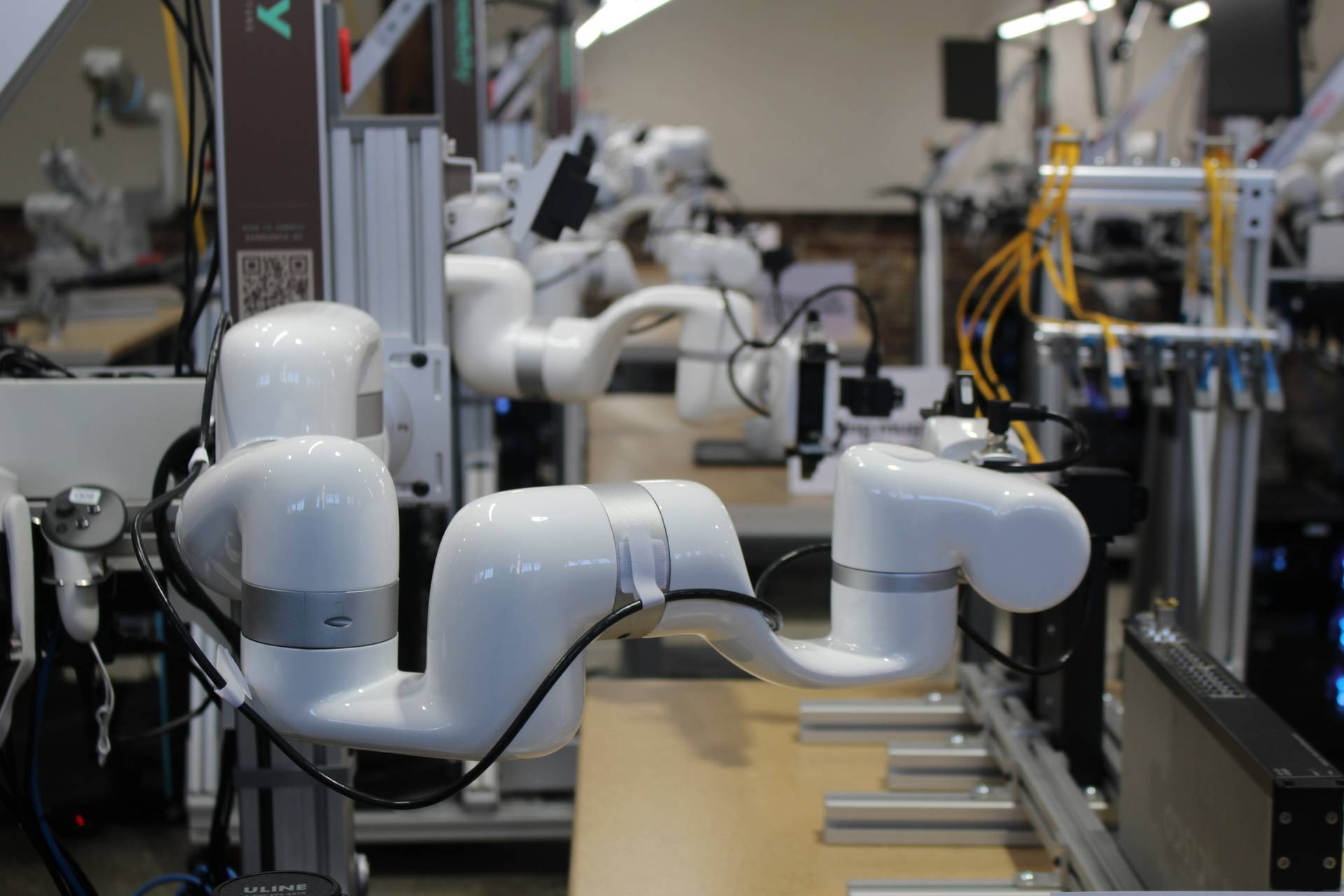
One day, one of Industrial Next's robots went offline.
It had been working on a cellphone assembly line, trained for one specific version of the phone. The customer didn't say why it had stopped, and the Industrial Next team couldn't find out. So they asked around.
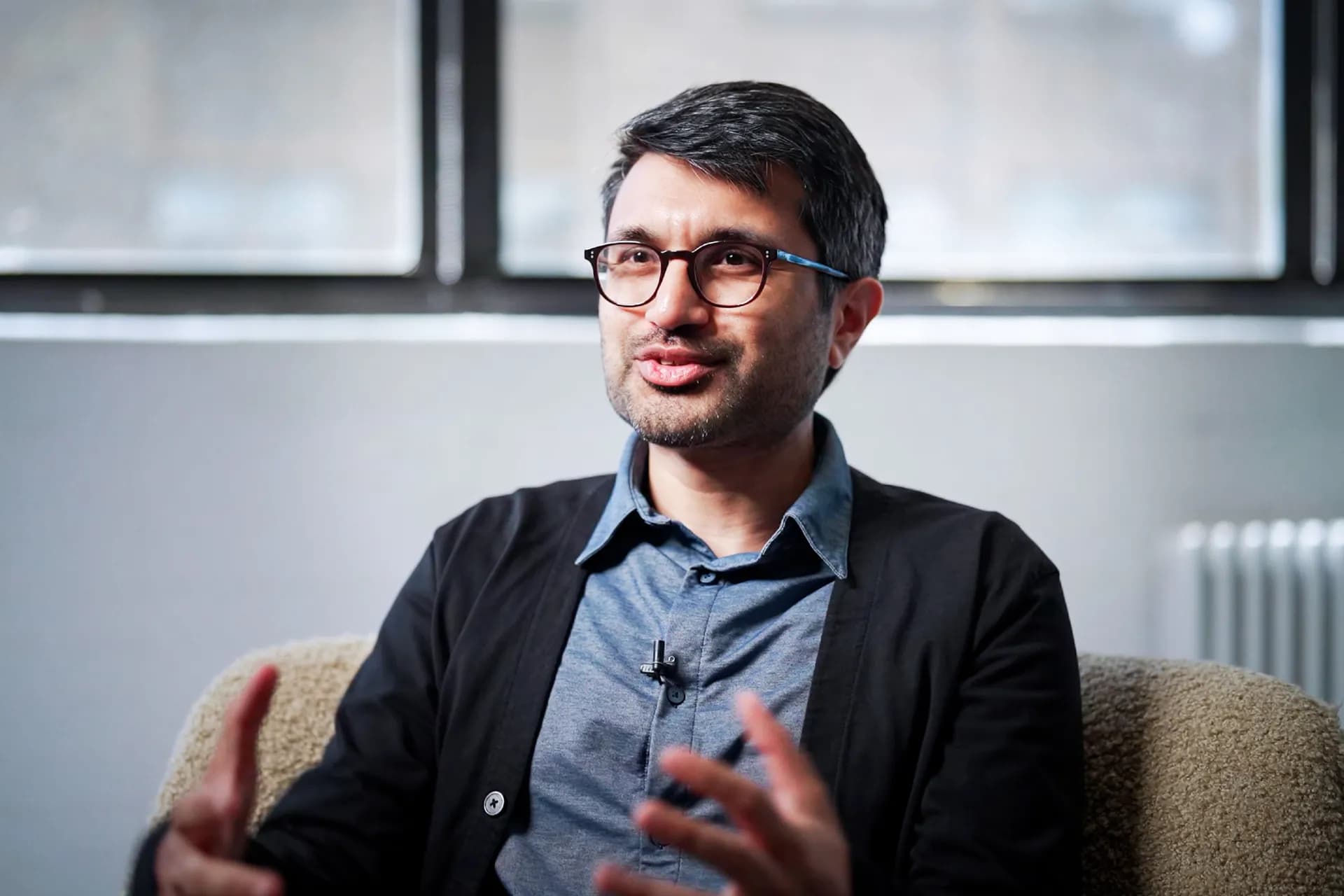
Lukas Pankau, co-founder and CEO of Industrial Next.Photo by EO.
"It turns out that our customer liked the performance enough that they just decommissioned it, moved it to a section of the factory where we didn't have any access, because this was their top secret prototype portion, and commissioned it themselves," said Lukas Pankau, Industrial Next's co-founder and CEO.
The customer set the machine up, ran the 60-second setup on its screen and turned it on. It started building the next version of the phone, one that hadn't been announced yet and that the robot had never seen.
"Even we were surprised that it just worked. It behaves more like a human than a machine."Lukas Pankauco-founder and CEO of Industrial Next
Pankau is careful not to oversell it. The new phone was still part of the same phone family. "We could generalize enough within that phone family that we can go from one to a different one that is different enough to where it's a new product, but it's not so different that the robot gets completely lost," he said.
Industrial Next's Arena in San Francisco.Photo by EO.
That one story is the shortest answer to what Industrial Next does. It builds robots that take over a single hands-on step on a factory line and keep doing it when the product changes. EO followed the three founders to hear how they got here and where they're headed. The story starts on a Tesla factory floor.
Why Factory Robots Hate Change
A modern assembly line is a row of stations along a conveyor. At each one, a worker or a machine does one small job, such as driving a screw, plugging in a cable or peeling a sticker, in a few seconds. Then the product moves on. A single phone line can run hundreds of these stations.
Most factory robots on those lines are programmed, not trained. An engineer teaches the robot exact positions, and fixtures hold each part in the same place every time so the robot can find it.
Gilwoo Lee, CTO of Industrial Next.Photo by EO.
"In today's factories, all robots are doing only repetitive tasks," said CTO Gilwoo Lee in an interview with EO. "Everything is highly programmed and scripted."
That works beautifully as long as nothing changes. Pankau traces it back to the logic of the Industrial Revolution: make the same thing millions of times, and everyone can afford it.
"The challenge there is that it fundamentally depends on you not changing the product."Lukas Pankauco-founder and CEO of Industrial Next
And products change constantly. Phones are refreshed roughly every year, product mixes shift mid-cycle and something unexpected happens on the floor all the time. How often? "Somewhere in a factory, a few times a day probably," Pankau said.
Allen Pan, co-founder and chief manufacturing officer of Industrial Next.Photo by EO.
Pankau and his co-founder, Allen Pan, learned this the hard way at Tesla. Pankau spent almost six years there, moving from vehicle electrical architecture to Autopilot to factory design. When Tesla needed to scale the Model 3, it had already spent heavily with the world's best system integrators on a dense, highly automated assembly line called GA3.
The trouble was that Tesla didn't do model years. Most carmakers save up a year's worth of changes and roll them out together in the next model year, so the line can run unchanged in between. Tesla pushed changes into the car as soon as they were ready, and the line couldn't keep up.
When the automated line couldn't scale fast enough, Tesla built a second production line under a tent in the factory parking lot. Whatever Tesla couldn't automate with equipment it fully controlled, workers did by hand. And as the car kept changing, the workers kept up in a way the machines hadn't.
That was the lesson. "It turns out that people are pretty good at adapting to changing products," Pankau said. If robots could adapt the same way, "now you can do something very similar to what Tesla did, but everywhere. That's really the founding idea behind Industrial Next."
From Smart Cameras to Robots
Pankau and Pan started Industrial Next in 2021 and went through Y Combinator's Winter 2022 batch. Hardware was rare at YC then. "We were like one of four out of a batch of, what, 300 or so?" Pankau said.
The tools they wanted didn't exist yet either. Their first product was a smart camera for factories, and they sold about $2 million to $2.5 million worth of it. But once the cameras were in, factories kept coming back with the same thing.
Lukas Pankau of Industrial Next.Photo by EO.
"We have all this data now with all these cameras, and we paid all this money to bring dashboards in," Pankau said, describing what customers told him. "But what do we do now? What's next?" Customers didn't actually want to make the decisions themselves. They wanted a system that would make the changes for them.
So the company killed its camera line, despite the revenue, and went all in on robots.
Its early robot work was engineering more than AI. One contract manufacturer packed laptops in several kinds of boxes, from pizza-box style to book style, and needed a separate line for each. It asked whether one line could handle them all. Industrial Next built it with three programs for three size ranges, plus tolerances and self-adjustment so the line could correct itself as it ran.
"It's not as good as now, but it does the job. Those are engineering solutions. We use a lot of image processing, very, very little transformer, but it still works. In my perspective, that's not AI."Allen Panco-founder and chief manufacturing officer of Industrial Next
That pragmatism still runs through the company. Not every motion needs a learned model. "If you're just moving from one general area to another general area, you don't need a model to do that," Pankau said. "You just tell the robot to move there."
"The customers are not paying for technology. They're paying for a solution to a problem."Lukas Pankauco-founder and CEO of Industrial Next
That work got Industrial Next onto cellphone lines, where Pankau says its technology has now helped build more than 7 million smartphones.
Joining Forces With a Robot AI Team
Engineering could only go so far. The hardest jobs on a line, like fitting small, oddly shaped parts precisely and fast, need a robot that adjusts its grip every time.
"You could pre-script it, but having it adapt its grasp to picking up a plushie, that was just not a thing that you could do easily back then."Lukas Pankau
For that, Industrial Next needed someone who could build robot AI.
Pankau met Gilwoo Lee at a Khosla Ventures summit. She was running Zordi, which she founded right after her Ph.D. to build robots that grow and harvest strawberries in greenhouses. The two talked, promised to share notes and moved on.
About a year later, Lee called. "Hey, teach me about manufacturing." He walked her through what he knew, especially cables and how to insert them. The next day, Industrial Next shipped her a whole box of automotive parts from a factory. Two weeks later, she showed them a robot doing the job with those parts.
Industrial Next had solved the same task too. "It took us a little bit longer," Pankau said. He had told Lee that if she could solve it better than his team, Industrial Next would simply license her technology. Instead, the two sides realized their skills fit together. Lee knew the latest robot AI, and Industrial Next knew how to make a system work on a production line.
A Zordi robot picking strawberries.Courtesy of Gilwoo Lee.
Strawberries and phones sound like different worlds, but the physics is similar. "If you're off by half a millimeter, you've created scrap," Pankau said. "A lot of the things that you would do to weave a robot in through bushes of strawberries to cut only the ripe strawberries was actually very much a similar problem."
Lee had her own reason to move. On a farm, every experiment waited on a crop cycle of nine months to a year, and simulation couldn't yet recreate living plants at scale. Manufacturing, where parts are mostly rigid and the business need is obvious, was the place to solve it first.
Industrial Next's announcement of its Zordi acquisition.Source: Industrial Next on LinkedIn.
The two decided to join forces. Industrial Next acquired Zordi, and its team moved from Boston to San Francisco. Lee became CTO.
Teaching a Robot Like a Person
Lee's arrival sped up a shift Industrial Next had already been working toward.
Most of the industry still teaches robots by programming them: an engineer defines each position and motion, and the robot repeats it. The alternative is teaching by demonstration, where a person shows the robot the task and a model learns from it. That is what lets a robot cope when a part arrives a little off or a cable bends differently.
Pan says this was always the goal. "Teaching a robot should be as easy as teaching a person," he said. "Eventually this should be as easy as a worker coming in, show it to the robot, then the robot demonstrates to you," with a 99% success rate.
The catch is data. Demonstrations in the real world are slow and expensive to collect at scale. Simulation is cheap, but it lies. Pan pitched investors on a real-to-sim loop back in 2021, and they kept telling him to just use synthetic data. In his experience, a digital twin of a factory is only about 40% accurate once the visuals are done, and it drifts further over time. Design files aren't much better.
"CAD represents computer-aided dream. Why is it a dream? Because it's always different than the real product."Allen Panco-founder and chief manufacturing officer of Industrial Next
A robot test on screen at Industrial Next.Photo by EO.
Industrial Next's answer is an approach known in robotics as real-to-sim-to-real. Start from the real factory and real demonstrations, rebuild them in simulation, multiply them into many variations there, then bring the trained model back to the real robot and keep correcting. "Simulation is like when you think in your head," Pan said. "But you still need a reference to the real product, and you still need the real data."
Lee explains why it matters for deployment. Without a reconstructed version of the factory, when a robot runs into a problem at a new site, "there's no way for us to reproduce the same challenge," she said. "Everything has to be solved through extremely many days and iterations of engineering work."
Two Kinds of Grounding
Lee splits the gap between simulation and reality into two parts.
- World grounding: making the simulated world match the real one so closely that "your model should not be able to distinguish between whether it's in the real world or in simulation."
- Behavior grounding: making sure the robot succeeds in a way people actually want. A reinforcement learning agent left alone in simulation "may get the task done, but in a way that looks very unintuitive to humans," Lee said. "That may be okay in a dark factory, but it may not be okay in a factory where the humanoids are expected to work around humans."
Pankau says the company's foundation model is now "trained majority in simulation, and we have actually figured out how to make that transfer into reality." The hard part is that simulated data can look right and still be wrong. "Even if they look right, they may be just wrong enough to where if you try to deploy a policy like this in reality, you're out of distribution," he said.
An Industrial Next robot sorting objects by color.Photo by EO.
The results are starting to show. Lee's team cut the time a robot takes to finish a task from about 30 seconds to under six, and the model's reaction time from 300 milliseconds to 30.
"What all of those means is that our models or robots can be a lot more adaptive to mistakes it makes or anything that's changing in the environment."Gilwoo LeeCTO of Industrial Next
How a Robot Gets Onto the Line
So what does a customer actually get? Pan walked through it on a tour of the company's San Francisco space.
Allen Pan explains how Industrial Next works.Photo by EO.
| Step | What happens |
|---|---|
| 1. Train | Lee's team trains and fine-tunes the model, then tests it on a robot at Industrial Next |
| 2. Ship | The robot and its model ship to the factory |
| 3. Teach | If the task is new, workers at the factory demonstrate it a few more times to collect more data |
| 4. Swap | The robot takes over the worker's spot on the line |
| 5. Commission | The team checks that it keeps up with the line and meets quality, cycle time and downtime targets. Pan says this takes less than a day |
| 6. Scale | Once it works, it scales to the customer's production volume and stays in the factory |
"A factory is a line, right? So a conveyor belt," Pan said. "You have a station before that does one thing, next, next, next. Before that is workers putting in. You deploy that, workers show how it's done, and done."
Cost matters as much as capability. The team often trains on expensive, flexible robot arms, then moves the skill to much cheaper arms for deployment, Pan said.
The model also has to hold up on the factory floor. Pankau says that means making it reliable and adaptable, and making it something "the guy running a factory, who probably doesn't even know how to use a laptop properly, can use."
The View From the Customer's Side
Gilwoo Lee explains the Mitsubishi Electric project.Photo by EO.
One of Industrial Next's upcoming deployments is with Mitsubishi Electric. Standing next to a stack of parts boxes, Lee explained the project. "These boxes are actually part of our Mitsubishi deployment task that's going to happen in Mason, Ohio," she said.
"Part of the task in that factory is to take these parts and assemble it to make an alternator. And we are replacing some of the manual labor steps through our robots and our foundation model."Gilwoo Lee
Takehiro Ishiguro of Mitsubishi Electric speaks at the Arena launch.Photo by EO.
The relationship has an interesting twist. Mitsubishi Electric sells factory automation equipment, including robots and assembly systems.
Takehiro Ishiguro, who works in its industrial automation business, told EO at the launch of Industrial Next's Arena in October that the company asked Industrial Next "to solve a very difficult, challenging problem of automating our factory in Ohio," which makes automotive parts.
The plan isn't to automate everything at once. "Not completely and immediately," Ishiguro said. "One by one, we try to solve the easiest inside the factory. And we are also very careful on ROI."
"Simulation doesn't provide the hundred percent visibility on the actual environment. For example, the dirty environmental condition is a big matter for us, and we need to continuously update the model."Takehiro IshiguroMitsubishi Electric
On a panel the same day, Ishiguro described deployment in three stages: getting a system to work as a demo, moving it into the real environment, where lighting and dimensions have to be checked, and then keeping up with drift. "After the deployment, usually what happens is the system integrators will get a phone call saying, 'One day something happened, and it's not doing the correct job,'" he said.
That phone call is the problem Industrial Next exists to make rarer. Ishiguro expects the market to sort itself out quickly. Within about two years, he said, the industry will see which methods and models work: "live or let die."
What Comes Next
The Arena is part of the company's answer to that pressure. Industrial Next opened it in San Francisco to work with academia and industry "to figure out where exactly the limits are of what we have today and where we need to go in the future," Pankau said. Lee wants it to be a place to share what fails, too.
"What's important is knowing and sharing the knowledge of what does not work now."Gilwoo LeeCTO of Industrial Next
Inside Industrial Next's Arena.Photo by EO.
The bigger plan is to go beyond supplying robots and start running production. Industrial Next plans to set up a small, low-volume production line in the U.S., Pankau said, "mostly to showcase our technology and to prove out our concepts and our ideas of what if we own the entire factory stack."
Over the next three years, it wants to roll the technology out with industry partners and take over smaller product lines that partners can't justify running themselves. A foundation model about 10 times the size of its current one is queued up to start training within the next year or so.
Behind that is a first-principles question Pankau keeps coming back to. If machines on the line had the manufacturing intelligence of human workers, "would your line still look the same? And the answer is, in my opinion, the correct answer is no."
For Pan, who has spent years living and sleeping in factories, the reason is simpler.
"Treat people like robots? That's a robot's job. We should do something creative. We do something useful, not screwdriving."Allen Panco-founder and chief manufacturing officer of Industrial Next