Dec 09, 2024
Lessons from Investing in 700+ Startups
Interview with Eric Kim, Co-founder of Goodwater Capital
Founder Focused


💡
At a Glance
- Who: Eric Kim is the Co-founder and Managing Partner of Goodwater Capital. Raised by Korean immigrant doctors, he studied at Yale and Stanford, worked at McKinsey, and led global venture investments at Maverick Capital before founding Goodwater in 2014.
- What: Goodwater Capital is a global venture capital firm dedicated exclusively to consumer technology, utilizing a proprietary data and software platform to evaluate investment opportunities.
- Traction: Manages over $3.3 billion in committed capital across 700 seed companies and 80 core portfolio companies in 50 countries, with early investments in Coupang and Kakao.
Eric Kim co-founded Goodwater Capital to build a mission-driven venture firm focused entirely on consumer internet and digital technology. By pairing primary consumer research with a quantitative data platform built by engineers and data scientists, Kim backed breakout Asian consumer platforms Kakao and Coupang during their earliest stages. Today, Goodwater manages over $3.3 billion in committed capital across more than 50 countries. His perspective highlights why owning end-customer relationships drives enterprise innovation, how data science accelerates investment underwriting, and why discipline defines long-term venture success.
Key Takeaways
Humility Can Become A Superpower For Investors
Eric Kim grew up feeling pressure to outperform prejudice and bias, then later questioned whether constant performance was the only path forward. His mature perspective adds humility to hard work, treating authenticity and openness as strengths rather than departures from excellence.
Customer Love Reveals Contrarian Investment Opportunities
In evaluating Korean commerce companies, Eric looked beyond crowded market categories and surveyed consumers directly. Customer service created loyalty for Coupang, while Kakao's free communication made people buy expensive smartphones, showing how firsthand customer love can reveal differentiated investment insight.
Consumer Technology Owns Valuable Customer Relationships
Goodwater's thesis is that consumer technology can own the end-customer relationship and expand into major industries such as finance, healthcare, and education. Eric sees that relationship as a source of innovation and influence that can reach beyond the original consumer product.
Goodwater Uses Data To Accelerate Investment Truth
Goodwater combines software, consumer research, and a team heavy in data scientists, product managers, and engineers to assess companies quickly. Tracking millions of companies helps the firm examine growth, retention, customer love, and differentiation before spending more time understanding the entrepreneur.
Great Investing Balances Science With Entrepreneurial Judgment
Eric divides investing between measurable analysis and understanding an entrepreneur's motivation, will, and long-term vision. Automating more of the analytical work gives Goodwater more time for the human side, including feedback, references, and deciding whether the partnership will work.
The Investor Mindset Requires Frameworks And Conviction
Eric's framework starts with a large vision, identifies what must be true, surfaces the risks, researches them, and then takes a leap of faith. He also stresses knowing when to break the rules, because creative exceptions become possible only after the underlying framework is understood.
Watch the full interview now on EO's YouTube channel! Below is the complete transcription of the interview. Minor edits have been made for clarity and readability.
Introducing Eric Kim, Co-founder of Goodwater Capital
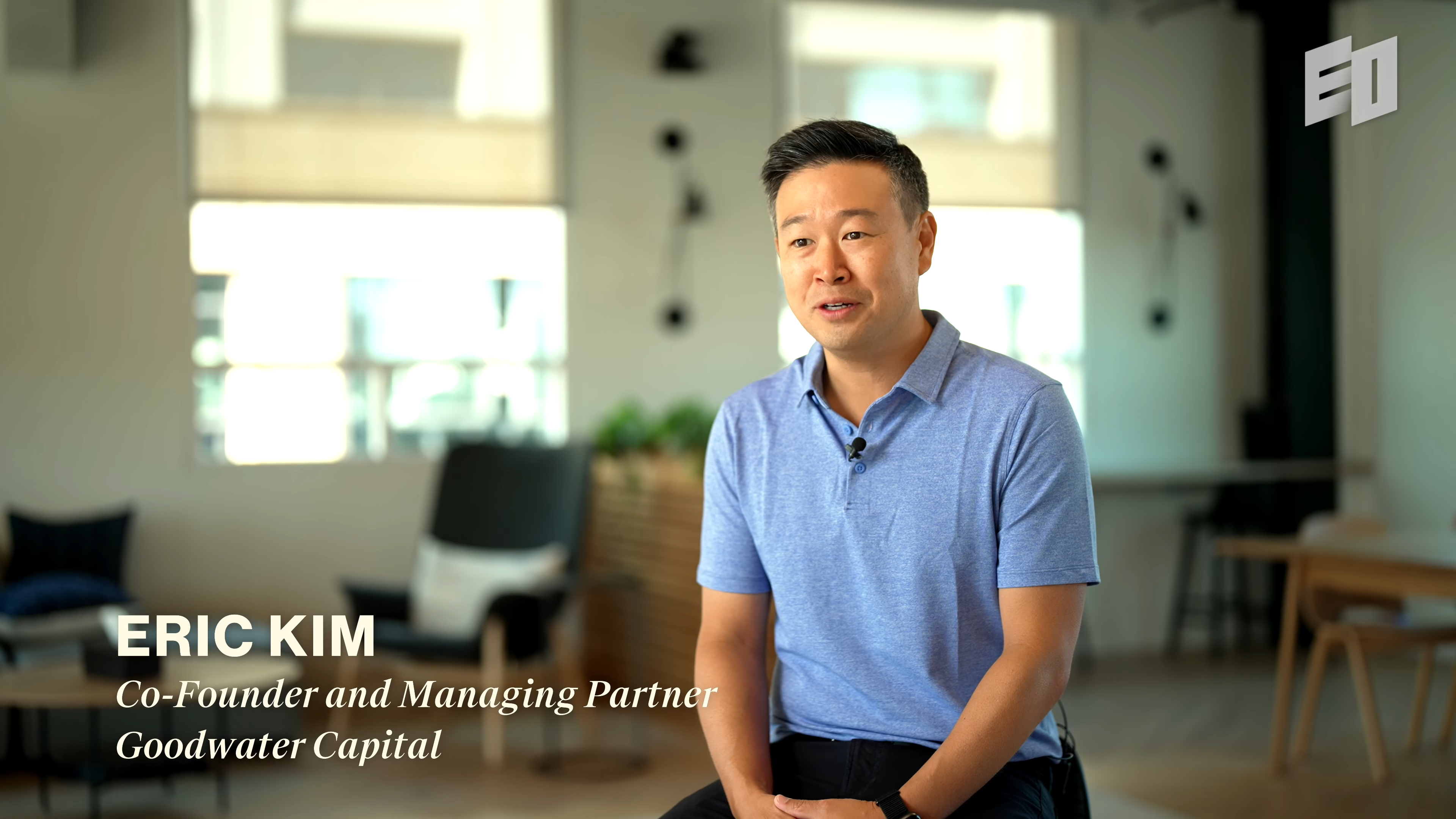
Hi, my name is Eric Kim, and I'm the co-founder and managing partner of Goodwater Capital. Goodwater Capital is a global venture capital firm that we founded in 2014, and we are entirely focused on consumer tech investing.
Today, Goodwater Capital has grown to over $3.3 billion in committed capital. We are in over 50 countries at this point through our Genesis portfolio, which is over 700 seed portfolio companies. In our core portfolio, which covers our early stage fund and our growth stage fund, we have about 80 companies in about 20 countries.
Our thesis is that consumer technology is changing the world, and there is an opportunity to use the internet and digital technology for good. Our mission is to empower exceptional entrepreneurs everywhere to change the world for good.
The Story of a Korean Dream in America
I'm so thankful to my parents. My mother and father lived through the Korean War, and they came to the United States to seek a better life with one suitcase and the little money they had in their pockets. What they did have was an education, because they were both trained as medical doctors. At that time, the United States had a severe shortage of medical doctors and was inviting overseas doctors to come, even if they did not speak English very well.
In my school, we were the only Koreans. I remember distinctly one day, my father calling me into his bedroom. I was 12 years old at the time, which is the same age as my oldest son is at this point, and my father just sat me down and said, hey Eric, I need to have a talk with you. At that time, my father, with these intense tears in his eyes, told me, Eric, you are growing up now, you are 12 years old. You are about to be a teenager, and life is going to be hard because you are an Asian American, because you are Korean, because of the color of your hair, the color of your eyes, the shape of your eyes, the color of your skin. Life is going to be difficult. You will immediately be discounted.
I think part of this was my father's own experience in the workplace, facing racism there or maybe some bias as well. But he understood that for me as an Asian American, it was important for me to understand that discount. He instilled into me that we really needed to be 120% or 150% better, so to speak, to really compare with our peers who did not have this Asian face or this background. That had a tremendous impact on my life in many ways. I felt a sense of urgency that I had to perform, that I had to just be better in many ways. That was a really important lesson.
As I've grown up and as I've matured, I realized that in many ways, yes, that bias exists, and yes, the prejudice exists, and racism exists. And yes, education and hard work were all keys for me to be hopefully successful in life. Over time, what I've also realized as well is that I need to embrace who I am, and not always perform for the sake of trying to be better itself. What if humility was a superpower? What if I could embrace that and not be afraid of it? That is something I'm really interested and excited about going forward too.
As an undergrad at Yale, I had the opportunity to intern at McKinsey and Company during the summer. In 2002, I graduated from undergrad and I was expected to start at McKinsey right away. I eventually went back to McKinsey and I spent two years there as a business analyst and consultant. I learned a lot and I did a lot of global projects. I spent over six months in China, I spent time in Southeast Asia, and I spent time all over Europe, and that really helped provide a global perspective, which is something you see in Goodwater today as well.
Then I went to Stanford University in 2005, and that is where I met my co-founder Chi-Hua Chien, who was class of 2006, so we overlapped for a year.
In 2007, I had the opportunity to join Maverick Capital. They were starting to build out their private investing practice, and so myself and a gentleman named David Singer worked very closely together from 2007 to 2014. During that time, we invested all over the world and from early stage to late stage. We were part of the Y Combinator venture capital syndicate, so we invested in every single Y Combinator company, all the way through to really late stage companies and pre-IPO companies too. That really gave me a sense of the art and science of investing, and it taught me to adopt an investor mindset.
Our first deal in Korea was actually Coupang. It was March of 2011, and soon after that we invested in Kakao in their Series A.
When we first invested in Coupang, they were the 28th social commerce company to launch in just South Korea itself. We launched a survey in South Korea and we asked dozens of people to compare Ticket Monster, We Make Price, Coupang and other retailers, and to compare their experience as well. Over and over again, specifically for women in their 20s and 30s, they loved Coupang because of their customer service. Why was that so important? It was because it created loyalty. If you had really strong customer service, consumers would come back to you because they knew they would be treated well, and that was a strong philosophy that Coupang had from the first day, which was how do you wow your end customer.
If you are doing something that the market generally agrees with, that is a really hard way to make a profitable investment, because the rest of the market is already there. You have to have some kind of contrarian or differentiated insight, and usually that comes through primary research that no one else has done. That was the key to making that investment back in 2011.
Kakao is a really interesting story. I'm very thankful to Han Kim, who is a very close mentor and friend of mine and who helped introduce me to the company. Prior to that, we had an overall thesis about mobile, about the power of smartphones and this whole transition away from desktop to mobile computing, and about how there were opportunities for gaming, for commerce and for communications to happen on mobile. We were looking for that killer app.
What prompted me to really become interested in Kakao and to seek out the company was that a really close friend of mine was visiting from South Korea. At the time, that person had a Samsung smartphone, and I asked her why she bought the Samsung smartphone. She said, so I could use Kakao. It actually saved her money. At the time, every time you sent a text message you were charged per text, and Kakao made that free.
Buying a smartphone is very expensive, and that upfront cost was an investment to save money over time, because it provided this core utility to everyone to be able to communicate for free. That was the insight that really struck me. People were willing to buy $300, $400 and $500 smartphones so they could just use Kakao, because they were saving money on the other end of that. That love, that customer love, was something we saw tremendous potential in.
I remember approaching the CEO, the founder and the management team at Kakao. Once I got introduced, I remember flying to South Korea and practicing the night before, presenting in Korean. The next day, when I visited the Kakao headquarters, there were only about 20 people there, and I remember pitching in Korean to the team. They were not pitching me. I made this whole presentation about our thesis, the research we had done and all of the consumers we had talked to.
It was in Korean, so I'm sure it was terrible and it came with a lot of stuttering. Maybe they were impressed by that, and they were willing to take our capital early on. But we really saw it, not from the outside in, but through the consumer voice, the love for the product. I remember at the time there were a lot of people who thought that investment in Kakao was crazy. Maybe even some of the early team members were not quite sure about the future. But when we talked to consumers, when we talked to people who actually used the product, they loved it so, so much.
One of the things I love to do when I go to cities, whether it is London or New York, is just to hang out in the subway. You can see what apps people are using, just from the color of the icons they are using. When you go to Korea, a lot more people were starting to use this yellow icon, Kakao, and then you would talk to them and ask why they used it. I can save money, I can communicate with my friends, and there is a group chat that becomes my community.
That was our key insight, that you could scale this and create a powerful network effect, so that as more people got onto the platform it would benefit all the pre-existing users as well. That is a really powerful phenomenon that increases retention, because as more people get onto the product, the product gets better. How many of those can you name? There are very, very few companies that do that. Once we saw that insight, we felt a very strong conviction to invest in the company.
They were both very early stage deals, a Series A for Kakao and a kind of Series A plus for Coupang. The returns were massive on a venture scale, the 100x to 300x type of scale.
The Best Strategy for New VC
Most venture capital firms, in my experience, do great work, but they do not necessarily have a strong sense of mission. That is what was important to us when we started Goodwater, to have a really clear mission statement, again, to empower exceptional entrepreneurs everywhere to change the world for good.
Goodwater has had a tremendous impact on the venture capital ecosystem because we changed the mindset. We moved away from an egocentric mindset, where individual venture capitalists are celebrated for how much money they made, and shifted it. There is nothing wrong with that, but we shifted it more toward a mindset of how we as a venture capital industry can have positive impact itself. I hope that many, many years from now, Goodwater is known for that.
Capital is a really valuable resource that you have to steward, and that is why we are called Goodwater. We think water is similar to technology and capital. Water is the source of life for every living organism, but the lack of water or too much water can lead to destruction itself. Technology and capital are the exact same thing, and you have to steward them. They can be a source for so much positive influence in the world, but they can also be used for things that are not so good, and knowledge and capital are not always the source of goodness in the world. So we want to be the Goodwater in the venture capital ecosystem.
We also thought that the world did not need another venture capital firm. There are so many great venture capital firms out there, like Sequoia, Benchmark and Accel Partners. The world did not necessarily need another venture capital firm, but what if you could create a venture capital firm that was not only mission oriented but focused on consumer internet and consumer technology itself?
A lot of venture capital firms at the time, and still today, diversified away from consumer tech. They went to enterprise, SaaS, security, hardware, climate tech or biotech. If you think about the best venture capital firms, where they started was by investing in companies like Google, like Amazon, like eBay. Six of the eight largest companies in the world are all consumer tech companies, including Facebook as well. Not only are there great equity returns there, but if you own that end customer relationship, you can create so much innovation that backward integrates all the way into the enterprise as well.
So we had this thesis that consumer technology and consumer internet were incredibly powerful, and that owning those end customer relationships was very powerful. That would span not just social networking and not just e-commerce, but also financial services, healthcare and education. All these big industries would be increasingly consumerized, because you could own those end customer relationships through digital technology. That was our big thesis when we started the firm in 2014.
At Goodwater, our philosophy is that investing is both an art and a science, so we leverage our technology and our software to get to the truth of the science part as quickly as possible.
Of our 65 or 66 person team, two thirds are data scientists, product managers and engineers. Since day one, we have been building an infrastructure, a software layer that enables us to look at consumer technology companies. We find so much value in looking at the data and in having this infrastructure to see companies on a global basis, and we track over 10 million companies in real time. So we have very accessible reports, consumer research, analytics and benchmarks that allow us to understand a company better than any other firm, we think, because we have so much data around it and we know how to apply it. When we see a new opportunity to invest in, we are very quickly able to assess whether this company is best in class, not only on growth but also on retention, customer love and differentiation. All the hard science of investing, we have really locked into a very strong process and a platform itself.
What is just as important, and what goes with it, is the art part. That is really understanding the entrepreneur, understanding that person's will and desire to win, and that person's desire to have impact itself. By taking all the science and being able to really get to truth as quickly as possible, you can then spend a lot more time with the entrepreneur, understanding their motivations, understanding what their long term goal is and understanding their vision for the company.
If you have 7 days in the week, in the old process it used to take 6 days in the week to do all the science, and then you had 1 day to maybe understand the soft part, or the art. We have reversed that. The analytics and all the components that our software and our data platform can understand very quickly mean that it takes 1 day to understand the science part, and we spend the other 6 days to really understand the entrepreneur.
Can we partner with this person? Do they have a similar philosophy around putting the company first? Are they open to feedback? We do reference checks deeply, and those soft elements of what makes for a great entrepreneur are where we are able to spend the vast majority of our time, because of this dual approach between art and science. That has been the heart and soul of Goodwater since day one, and it is something we continue to innovate on too.
Eric's Guidance for Aspiring VCs
We interview a lot of venture capital associates, VPs, principals and partners. One of our screening criteria is that if you want to be famous, this is not the place for you.
The Goodwater approach is one that is obsessed with finding generational companies that will have tremendous impact. One firm that I admire greatly is Sequoia Capital, and they had this saying that they were just one away, that if they just missed one great deal, that would lead them to potentially being a mediocre firm. So they had this obsession with finding great companies. If that is someone's singular purpose, if that is their obsession as well, which is to find great companies and to invest in them, that is what we look for in young venture capitalists. I think that is what young people who are looking to get into venture capital should ask themselves. Is this something that I'm really obsessed with, something that I would go to the ends of the earth for? I will fly over 200,000 miles, going back and forth between countries to visit entrepreneurs.
It is a really hard lifestyle. It is not glamorous, but you do it because you love it, and because you are obsessed with finding that insight about a company that will lead to an investment that no one else in the world might see. And if that is something that young people really want to do, and they are willing to put in the hard work and to have the discipline, it is like playing a sport. You have to be like an athlete. You have to be able to invest in your craft day in and day out and get incrementally better every week, and it is not something that will ever be handed to you. Maybe some venture capitalists just get lucky, and that is certainly possible, but to sustain a franchise and to sustain a career over the long term, it really takes a lot of discipline, hard work and an intensity that is driven by a passion to find and invest in great companies and support them throughout the life cycle of growth.
I teach a class on this at various institutions. How do you have an investor mindset that is able to see the big picture, always keeping that big picture, that home run vision, in your mind? Then you understand what the key components are that allow that to come true. What do you have to believe for that big vision to come true? Then you understand what the key risks are, and you are able to research those and underwrite those risks. Ultimately, you take a leap of faith that allows you to put it all together and to have conviction in your ideas.
Whether you are an investor or a founder, having those key components and being able to break it down, having this mindset for the key decisions you need to make, is something that we talk about internally. We certainly teach it for our investors, and I also think great CEOs have this investor mindset too, because they are doing capital allocation and they are making decisions.
So how do you go through that framework and be able to follow it, and then also know when not to follow it? When do you know to break the rules too? That is really where the poetry comes about, that you are able to innovate and create new things when you are able to have exceptions. But to do that, you actually have to know the frameworks and the rules first. We preach that the frameworks are really helpful, but also, really importantly, knowing when to break the rules is really important too.