When The Spirit Left the Stage
The Fate of Every Disruptor
"TechCrunch is a total waste of time. I don’t know why anyone goes."Garry TanCEO of Y Combinator
This was weird to me. As a journalist who has been covering startups, VC, and the tech ecosystem in Korea for several years, I have also been a steady reader of TechCrunch.
So when I received an invitation email from the TechCrunch Disrupt team a few weeks ago, I was thrilled. Thrilled to receive a direct invitation to a world I've checked on and read upon daily to keep up with what's happening across the Pacific.
One told me,
"I expected to meet founders at the booth, and listen to their enterpreneurial journey. But almost every staff member in the booths were PR or sales managers."
“There are too many government-backed or organization-backed group booths, and they felt more outdated than innovative. I also heard the event was smaller than last year, it definitely isn’t what it used to be.”
"Since we target large enterprise clients, it wasn’t super helpful for lead generation. Though it was interesting, I guess."
But this is far from what most people imagine TechCrunch Disrupt to be. Jay, one of my coworkers, let out a sigh when he heard the shift in TechCrunch.
"Wait, TechCrunch ended up like that? I remember the Battlefield scenes in 'Silicon Valley.' That used to feel like the dream."
Maybe this is what happens when things that were once small, raw, and risky grow into something polished and monumental. But that doesn’t make the shift of Disrupt any less striking. Digging into its history, we can find some clues.
The Coolest Stage in the Tech World
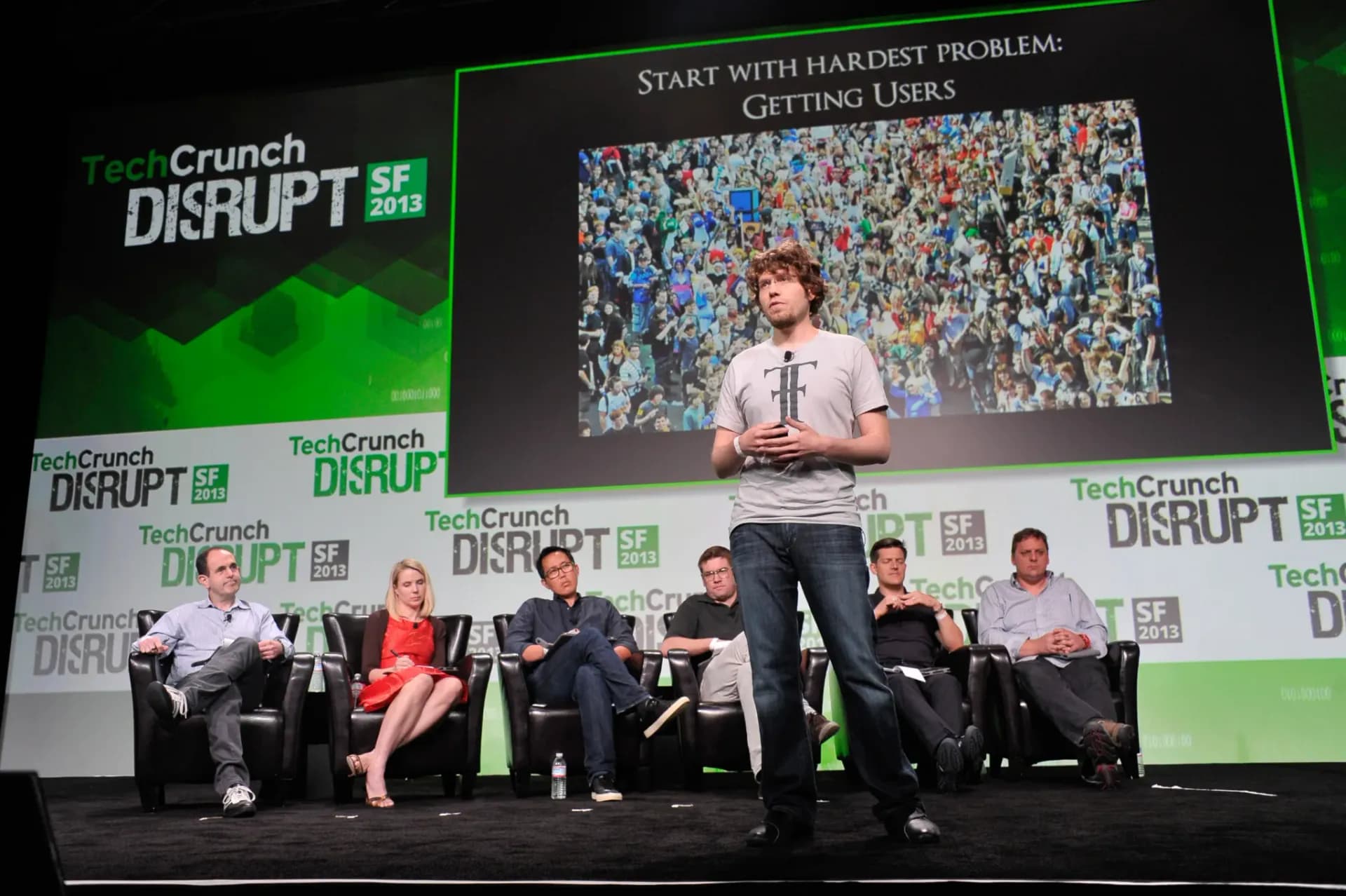
It was 2005, before the iPhone, before the cloud, when early-stage startup coverage was niche.
Arrington launched TechCrunch to fill that gap. Within a few years, the site had built an audience large enough to create its own conference: TechCrunch Disrupt.
"Give me a break. You are involved in a very tiny company."Carol BartzFormer CEO of Yahoo
"Very tiny."Michael ArringtonFounder of TechCrunch
"It probably takes you a long time just to convince yourself what to do. So fuck off!"Carol BartzFormer CEO of Yahoo
Zuckerberg acknowledged Facebook’s rocky stock debut and admitted the company had lost two years by overcommitting to HTML5 for mobile. But his openness struck the right chord. Facebook’s stock price rose 4.6% in after-hours trading that same day.
Some stories were even more dramatic. GroupMe, for instance, was born at a TechCrunch Hackathon, launched its beta at Disrupt, and was acquired by Skype shortly after.
Cloudflare co-founder Matthew Prince would later reflect on their Battlefield experience:
“It was an incredible experience for us, and we owe a significant amount of our success to the stage Disrupt provided. If launching at Disrupt does one thing, it delivers a huge burst of traffic.”Matthew PrinceCo-founder of Cloudflare
Disrupt wasn’t just a conference. It was the center of the startup universe. Until AOL acquired them for $25M, TechCrunch and Disrupt seemed to be thriving.
What It Means To Be a Leading Media Outlet
"The $20 million CrunchFund is the latest example of Mr. Arrington’s casting aside one of traditional journalism’s cardinal rules — that reporters should avoid conflicts of interest by maintaining distance from the people, organizations and issues they cover — and raises questions about whether industry bloggers are journalists."Claire Cain MillerReporter of The New York Times
A few key metrics illustrate how much Disrupt has changed, not just in tone, but in scale and impact.
(1) 20 → 200:
Increased Battlefield candidates
Disrupt says it gives startups more access to participate in the exhibition, but it's also important to note that the basic booth price has also risen.
(2) $1,995 → $10,000:
Increased basic booth pricing
Over decades, the basic booth price has risen 5x. Of course, naturally, this higher-tier package offers additional benefits.
In 2015, the “Startup Alley exhibitor package” was $1,995, which included a demo table for one day in the Alley with two complete conference passes.
However, both the price and benefits rose in 2025, costing $10,000 for a "Startup package" which included a booth for all three days, 10 event passes, access to investor networking tools, lead scanning, and marketing exposure as a silver-tier sponsor.
(3) 27.5% → 12%:
Decreased ratio of follow-up investment (within 18 months)
However, in an independent analysis of Battlefield Batches from 2018-2024, only 12% of those startups raised follow-up rounds within 18 months.
Of course, numbers are just numbers. However, many opinions circulating on online forums and blogs indicate that, in reality, TechCrunch Disrupt gradually lost its reputation with its target audiences.
"We need TBPN Disrupt."Anish AcharyaPartner of A16Z
"Do not waste money on TechCrunch Disrupt’s Startup Alley."Jason CalacanisHost of 'All-In'
"TechCrunch Disrupt: Hard for enterprise buyers. Worth it for launch PR, less for pipeline."Stephane PaillardCBO of Sesamers
Why Disrupt Losts Its "Centrality"
(1) The Departure of Its Founding Spirit
A founder is not just the person who starts a company. The founder is often the company's soul. Some people still say Apple never regained its spirit after Steve Jobs. It’s hard to imagine OpenAI without Sam Altman, or Nvidia without Jensen Huang.
In the media, that connection runs even deeper. A founder is not only the frontman, but also the voice: The editor-in-chief, the tone-setter, the risk-taker. That's why Michael Arrington’s departure helps explain so much of TechCrunch’s shift. He didn't just build the platform; he was the platform.
At the time, The Atlantic put it plainly: "It's becoming increasingly clear that TechCrunch has much more to lose than Arrington," in an article titled, "The Arrington-less TechCrunch Is Off to a Rocky Start."
After Michael's exit, a cascade followed. Several core members of the founding team, Paul Carr, MG Siegler, Sarah Lacy, and Heather Harde, all left within several months. This exodus gutted the voice, values, and volatility that once defined TechCrunch's identity.
Disrupt was an editorial product, too. It was a physical manifestation of TechCrunch's worldview. When the creators of that voice moved on, the rawness, risk and authenticity left with them.
Since then, there hasn't been a moment like the Carol Bartz onstage blow-up. And no one has asked hard-hitting questions quite like Michael. At least, not on the Disrupt stage.
(2) The Pressure of Profitability
As TechCrunch grew and changed hands, from AOL to Verizon to Apollo Global, and Regent, the pressure to generate revenue intensified.
The owners of TechCrunch didn't necessarily want the outlet to be sharp or distinctive. They wanted it to be profitable. That meant bigger audiences, safer programming, and more sponsor-friendly formats for Disrupt.
That shift is clearly reflected in the numbers. The conference attracted more participants than ever before. For the Battlefield, its scale expanded from 20 to 200. Attendance grew from a few thousand in the early years to over 10,000 by the 2020s. The number of stages was expanded from one to five in 2025, even peaking to eight in 2023.
Bigger audiences were not enough. TechCrunch began extracting value from its growing platform.
Over the decades, the basic booth price rose 5x, from $1,995 to $10,000. While the package includes more benefits, it also forces startups to pay more, even if they don’t need the extra perks. The Disrupt booths now resemble highly-priced PR products. They've lost their core purpose.
Similarly, the conference now focuses on "safe" topics or companies. There's no room to make enemies, stir up issues, or pose any marketing risks.
That shift makes sense. When you’re scaling a conference and relying on sponsorships, you don’t want unpredictable moments. You want clean narratives, safer bets, and guaranteed returns. But that drive for polish is exactly what drained the energy that once made Disrupt feel raw, indie, and essential.
(3) The Rise of Competing Platforms
But that landscape has changed. In 2013, Product Hunt launched. Wired called it the new "kingmaker," a title that once belonged to TechCrunch. One of its most iconic discoveries was Notion. When Notion debuted on Product Hunt in 2016, it swept the daily, weekly, and monthly top spots, earning massive attention from the tech community.
Social media also emerged as a powerful stage for startup discovery. Dollar Shave Club went viral after its founder starred in a YouTube video, generating 12,000 orders within 48 hours.
Glossier is another standout example. After launching on Instagram, the brand attracted over 18,000 followers in its first week and grew rapidly from there. For founders, digital spaces have become a powerful hub for connection and growth.
Offline, new alternatives to Disrupt also began to emerge. Zapier's founding team won the first-ever Startup Weekend hackathon in Columbia in 2011, which kick-started their company. Brian Armstrong, Coinbase's CEO, was inspired by Bitcoin early on and began attending local Bitcoin meetups in 2011.
With the rise of demo days, hackathons, and small-scale meetups, startup builders no longer needed massive conferences to break through. They began gravitating toward spaces that were more intimate, focused, and aligned with their needs.
Founders now have dozens of alternative ways to launch, get noticed, build hype, and even raise money, without ever booking a flight to San Francisco. TechCrunch Disrupt isn’t irrelevant. But it doesn’t hold the keys anymore.
The Decentralization of Startup Culture
To be fair, Disrupt's transformation from a niche gathering to becoming one of the most massive events in the world of technology is impressive on its own. It shows just how far the idea of "startups" has come, how it's become a part of mainstream culture. Some might call that progress. Or success.
The irony is that this very success has also distanced the culture from its roots. It used to be the central stage for insiders: The builders, the VCs, the die-hard tech geeks shaping the next wave. Now it feels more like an accessible experience for newcomers or observers.
Is that too critical? Maybe. But I'm one of those new faces. This article comes from a realization: the real inner circle was never something you could reach just by showing up to a famous conference.
In that sense, I find myself nodding to what Kate Jacobs Stanton from Moxxie Ventures said.
"I went for the first time in many years as a speaker and judge. No event is perfect, but I met a bunch of curious, ambitious founders - mostly outside the usual circles - trying to learn and connect."
"Not everyone has access to networks like YC. More community building events are."Katie Jacobs StantonFounder of Moxxie Ventures
And yet, nostalgia doesn’t mean we want or should turn back time. It just means we care about what’s being lost along the way.
Still, culture rarely dies, it just moves. The spirit Disrupt once embodied hasn’t vanished. So if you want to see where the real action is, you'll have to go where it’s happening: to meetups in local neighborhoods, to demo days hosted by hacker houses, to spaces where builders show up as themselves.
Yes, it's fragmented into countless nodes. It means that startup culture is decentralized. The essence of startup culture no longer resides in a single, central hub, but in smaller, grassroots spaces spread throughout the ecosystem.
Maybe this is where a smaller voice like EO Magazine can play a role: Not by chasing the main stages, but by documenting the early risks and messy ambition that still pulses at the edge of the scene.
The startup world is expanding into a vast, knotted mesh of ambition and noise. As storytellers, we still believe that the essence of the startup world lives in the messy, beautiful act of beginning.
So there's really only one thing left for us to do: Notice it, keep telling it, again and again, until something truly connects.