At a Glance
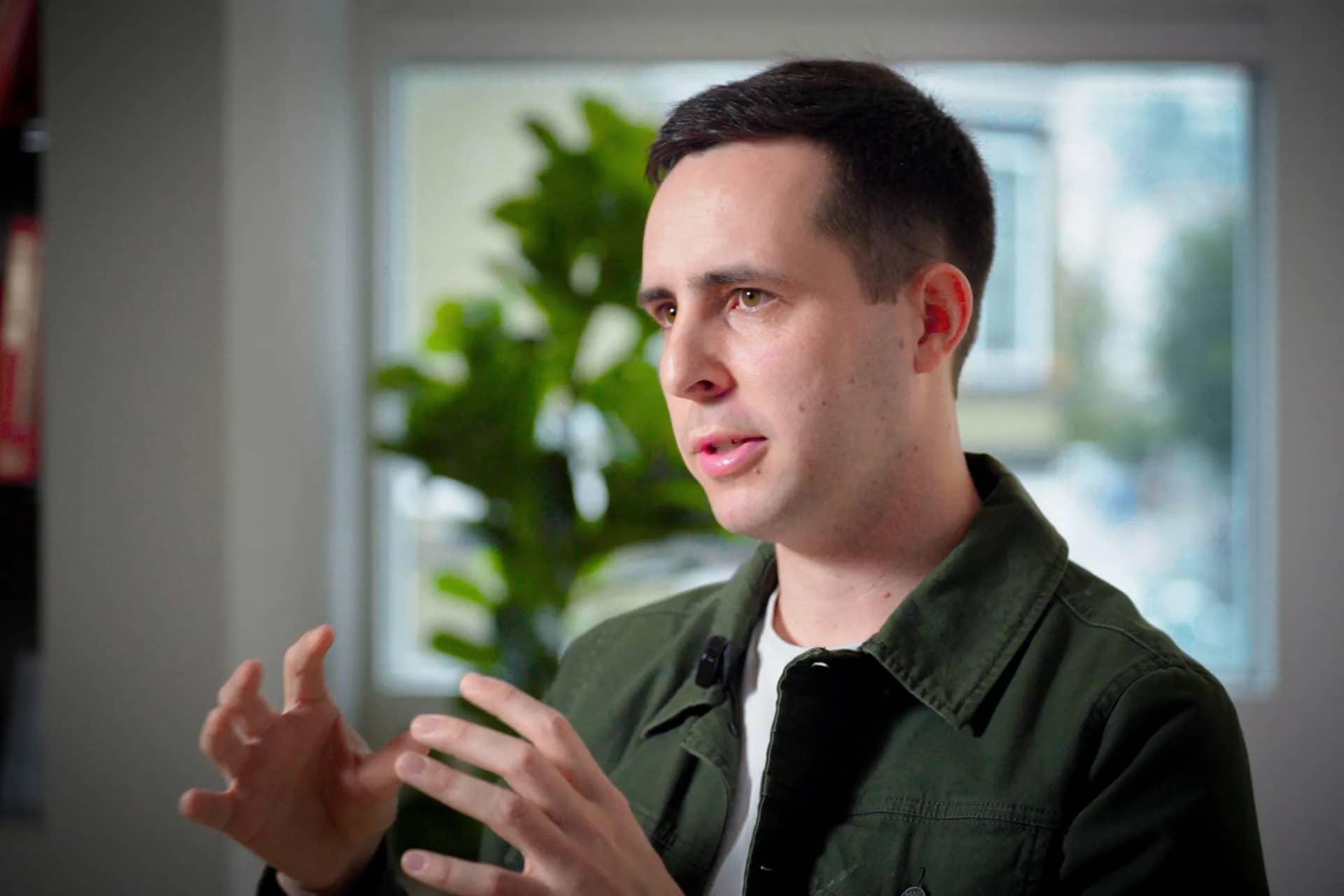
- Who: Tom Yeh is a professor of computer science at the University of Colorado Boulder who, after missing the deep learning wave as a student, taught himself the field from scratch and founded AI by Hand to teach others the same way.
- What: AI by Hand is a global education initiative that teaches the math behind AI models by writing it out by hand, aiming to make AI's "black box" accessible rather than mysterious.
In this interview, Tom Yeh explains why he spent an entire semester teaching C++ on a blackboard instead of live coding. He breaks down why writing AI math by hand, at "a humanly possible speed," changes how people learn. He traces a straight line from Jurassic Park's CGI to quantum computing to argue that some skills never go obsolete. And he lands on a blunt takeaway: AI cannot change people, only people can change AI.
Key Takeaways
Slow Learning Beats Fast Answers
Yeh built an entire following, and later a global education platform, around teaching AI math by hand rather than through code. He argues that writing at a humanly possible speed forces both teacher and student to actually process the material, rather than just watching it fly by.
An Answer Isn't the Same as Understanding
Yeh says AI can give you an answer immediately, but having an answer doesn't mean you know it. He measures learning by whether you can internalize and own an idea, not by whether you can produce a credential or a quick response.
Foundational Skills Outlast Every AI Tool
Yeh points to matrix multiplication resurfacing across CGI, big data, machine learning, and now AI as proof that core fundamentals are evergreen even as the tools built on top of them change every few years. He compares this to Gyeongbokgung Palace in South Korea, which was rebuilt in the 1800s on the same foundation that survived a fire centuries earlier.
What You Remember Isn't the Math, It's That You Could Learn It
Yeh says most students forget the equations a year after class, but what stays with them is the willingness to open up the black box and take on the challenge. That willingness, not the memorized formula, is what differentiates people who keep learning from those who never try.
Hire Problem Solvers and Team Players, and AI Adoption Follows
Yeh argues that if someone is a genuine problem solver or team player, they'll learn to use AI on their own, no one has to force them to be "AI native." If a company has to mandate AI adoption, he says, that's a sign they hired the wrong person to begin with.
AI Can't Fix a Bad Work Ethic, and It Can't Cheat-Proof Education Either
Yeh traces the "AI cheating" panic back to a deeper root cause: he saw the same problem with Chegg years earlier, and shutting down one tool never stopped students from finding another way to cheat. His conclusion is blunt: AI cannot change people, only people can change how they use AI.
Below is the complete transcription of the interview. Minor edits have been made for clarity and readability.
Introducing Tom, Founder of AI by Hand
My name is Tom Yeh. I'm a professor of computer science at the University of Colorado Boulder. I'm also the founder of AI by Hand, a global education initiative to make the black box of AI accessible and approachable by writing out all the math by hand. In doing so, you understand that AI is not a big mystery, it's something we can all understand.
What is the purpose of learning? Having an answer doesn't mean you know it. People can buy a degree, buy a certificate, but do you have ownership of the idea? Something core and foundational that doesn't change is evergreen. AI cannot change people, but you can change AI.
Why I Teach AI by Hand: The Power of Learning "Slow"
A transformer is meant to process individual words in a sentence. Say we're at token number four in my sentence, then this is a box I drew to show that each token actually has multiple numbers, in this simple case, three numbers.Tom YehYoutube "AI by Hand"
Unfortunately, while I was a student, I missed deep learning entirely, I was a bit too old. So I studied support vector machines, a traditional machine learning method. Then right when I became a professor, all of a sudden everyone was doing deep learning, and I had to learn deep learning all over again.
So what I'm doing today with AI by Hand is sharing my learning journey, how I, as an older professor, am trying to learn deep learning from scratch. I'm sharing my own struggle with understanding AI model math and algorithms. The only way I can get it is by drawing or writing it out on paper, that's where I actually get it.
So I started sharing my drawings, my way of mapping out the math, and a lot of people resonated with it. People started commenting, hey, I really like your approach to breaking this down by hand. So I thought, hey, maybe I'll just call it AI by Hand. There's a reason people resonate with this, connect with this thing I'm doing by hand.
Why do we like to calculate this by hand when AI can do it so well? When I was teaching an introduction to programming, I got feedback that I was going too fast and that I needed slower slides, so on, and... just too fast. Because I really like to share a lot of teaching and knowledge with my students. So I decided to teach an entire semester of C++ programming on the blackboard instead of doing live coding. So I decided to do that. I had a whole semester of just writing my notes down on a piece of paper.
As the semester progressed, I saw a few benefits. One, I can only go at a humanly possible speed of my own writing, I can't go any faster than I can write. Second, students can only learn at a humanly possible speed, they can only follow how much I write. And third, if students use their hand to copy my notes into a notebook, their hands aren't on their keyboard checking their Instagram messages, so it helps with focus too. Being by hand is really a way to connect back to our humans. So using your hand, you can go at a human speed, it comes to you in a human way. Over time I learned this, I started to see this value, so I went back to old school, by hand.
What is the purpose of learning? Is it about the physical or digital artifact that proves you've learned something, or is it about actually internalizing it, owning it? Do you have ownership of this particular idea? AI can give me the answer right away, but having the answer doesn't mean you know it. People can buy a degree, buy a certificate. Whether you own something, whether you value something, is actually proportional to how much time you spend acquiring that piece of knowledge. You have to first define what learning actually means to you.
The Foundation That Doesn't Burn
I remember when I was an undergrad, we learned linear algebra as part of a requirement for getting a CS degree, and then we learned matrix multiplication. I had no idea why it was even important. But it turned out that over time, computer graphics became really popular because of Jurassic Park's CGI, and everyone said, "Hey, everybody needs to learn CGI," and CGI uses a lot of matrix multiplication.
Then after a few years there was the big data movement, and it turned out you also needed matrix multiplication for that kind of processing. Then it moved into machine learning, forget about data science, we should all be machine learning engineers, again, matrix multiplication. Today it's AI, everybody needs to be AI native.
We should raise our kids and send them to AI school, matrix multiplication. In a few years we'll all be talking about quantum computing, and guess what, matrix multiplication again. So you see this trend, every couple of years something new keeps changing, but there's always something core and foundational that doesn't change, it's evergreen. You can revisit it a year from now, two years from now, it's still relevant, people still care a lot about it.
Whereas something like DeepSeek was popular at the time, but it's been a while now and it's not as popular as before. There's always a new thing, like Common Crawl was super popular, but let's see if it's still popular in two months. I don't know, but I'm pretty confident the transformer topic is still going to be popular.
A couple summers ago I had the opportunity to visit South Korea, and I got to visit where everybody else would go, the historical Gyeongbokgung, a palace with thousands of years of history, very beautiful. What struck me, when I learned a bit more history, was that the entire thing burned down in the 1500s except for the foundation, which was made of solid rock. In the 1800s they rebuilt the entire palace on that same foundation.
I like to tell that story because it reminds me of how this technology has been changing over and over again, but if you have a foundation on the maximum location, you can just apply it to AI. It doesn't really matter. Rebuild your skill on your solid foundation. That's why I focus on foundation, because I believe there's something you can always rebuild. It doesn't matter if the new tool becomes obsolete. If you only focus on surface features, on tools, and forget about foundation, you just keep rebuilding your house and you never raise your foundation any higher.
So how can you apply this to your own situation? Think about how you grew up, maybe your parents sent you to soccer or piano, and you became good at some skill. Is it piano, is it chess? Think about the way you acquired that skill, because that's actually something that doesn't change. As new AI tools come every day, the fact that you're capable of acquiring a very difficult skill is part of your identity that doesn't change. If you keep focusing on that, and you recognize, hey, I can acquire this, I can learn this skill, I can become really good at it, that's when you can keep applying that skill to a new AI tool.
I'm a good example. I was falling behind on deep learning for quite a while, but I had learned the skill of patiently breaking down difficult topics by writing everything down on paper, and that skill let me eventually catch up on deep learning even though I started way behind people who had been working on it for a long time. So for you, your piano skill or your soccer skill isn't useless, it will be the skill that helps you eventually once we figure all this out, and skipping one tool is absolutely fine, who knows what's next. But if you skip your next piano practice or your next soccer practice and give up on that, that's not fine, because in the long run that defines who you are, not the tool.
At this moment in my career as an educator, I've started to care less about whether people learn the math itself. A lot of times when I teach, you show up, you listen, you try to go through it, but I bet a year from now you won't remember any of it. What you can remember is that you were able to understand this, that you were willing to come and understand the foundation, willing to open up the black box. That willingness is what sets you apart from others, people who never try, never attempt, never take on the challenge. That's what differentiates you.
It's not really about how much you remember the equation for a transformer or the attention mechanism, it's about the fact that once upon a time, you tried hard to memorize this, you stayed in the library for hours and studied, and you succeeded. So the next time there's a learning challenge, you know you can learn it. That is more important, what differentiates people with no foundation is that the process implies they were 100% invested in learning it. That's what I value, versus someone who never really learned the foundation, which implies a lack of effort, a lack of willingness to invest the time to take on a challenge.
The 'AI-Native' Trap - AI can't change people, but people can change AI
When I was teaching intro to programming, I would really spend a lot of effort making new assignments every semester, because of places like Chegg where people share solutions, and we had all these technical workarounds, checking IP addresses to see whether people were accessing this, we even put traps on the site so if somebody accessed it we'd know. At the time I was like, hey, well, I hope Chegg can get all the business maybe shut down by the government, that would help us educators. And it did, in a way, because AI became the new cheating tool that put Chegg out of business.
And then when I realized, hey, Chegg is out of business, but the problem is still there, what's going on? It reminds me, again, we should keep going back to the source. There was a reason why people had to cheat in the first place, that's the main cause, it's not Chegg and it's not AI, those are just the symptoms.
Chegg is gone, people still cheat. I bet when AI is gone, people can still find a way to cheat. Is this AI-cheating panic distracting us from the bigger, fundamental problem of society's incentive system? Why are students compelled to cheat? It's that the system doesn't encourage real learning that actually takes time.
So when you hire somebody, what I care about is, does this person have good work ethic? Is this person a good problem solver? Is this person a team player who can communicate well with others? When you hire somebody, you go back to those basics; that's what you actually care about, that's what you want to keep in your employees. This AI thing is just going to be a byproduct.
Think about it. When you hire someone because they're a problem solver, in order to solve problems, that person is automatically going to learn AI, you don't have to tell them. The reason why you had to force your AI native, you go back, maybe you didn't hire the right person, maybe you forgot to emphasize that they need to be a problem solver.
Again, similarly, if you're hiring this person because this person is a team player, because this person is team player, the person will learn how to use AI to facilitate collaboration, you don't even have to tell them, they'll automatically do that too. Trust your instinct.
Continue to hire people like that, because those people will automatically adopt AI. If you're not a team player, AI is not going to make you a team player. If you always look out for your own interest and don't respect others, AI is not going to fix that. How can AI fix that? AI cannot change people. Only you can change AI.