Nov 01, 2025
How to Find $100M+ Startup Ideas in Any Market
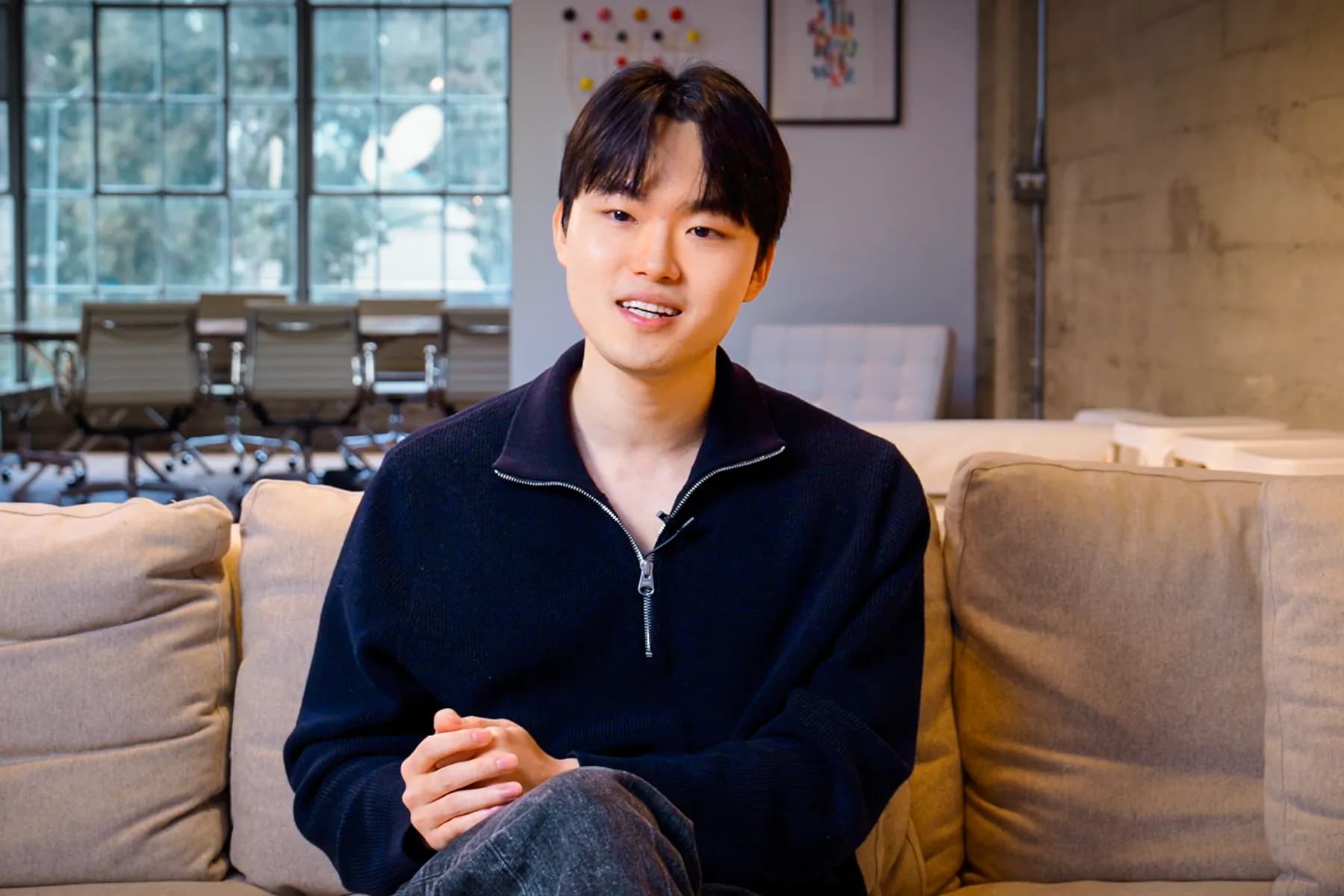
Interview with Muthu Alagappan, Founder of Counsel Health
Founder Focused


💡
At a Glance
- Who: Muthu Alagappan is the founder and CEO of Counsel Health, a physician trained at Stanford who spent years as an AI researcher and health-tech builder before founding the company.
- What: Counsel Health is an AI-enabled virtual care company. It pairs a supervising physician with an AI platform, aiming to multiply the world's clinical capacity rather than just speed up existing doctor visits.
- Traction: Counsel Health runs its own 50-state physician practice and recently announced a $25 million Series A co-led by Andreessen Horowitz (a16z) and GV.
In this interview, we find Muthu is more than his titles: he's a builder obsessed with safety, access, and quality.
Key Takeaways
Solve for 10x, Not 10%
Many AI health tools chase incremental efficiency gains, shaving minutes off a doctor's day rather than reshaping how care actually gets delivered. Aiming for a 10x improvement instead of a 10% one forces a founder to solve the root problem instead of speeding up a broken process.
Why Founder Market Fit Beats Fighting Every Fire at Once
A founder facing dozens of urgent problems at once will do a mediocre job across the board if they try to tackle all of them. Identifying the one or two problems a founder is uniquely suited to solve, and pouring outsized energy there, is what separates founder market fit from generic hustle.
How Counsel Keeps Its AI Safe Enough to Take Real Risks
Running an in-house physician group lets Counsel's AI be more aggressive in generating diagnoses and reviewing literature, because every suggestion still passes through a licensed physician before it reaches a patient. Owning both sides of the loop is what lets the company chase "do no harm" and "move fast" at the same time instead of picking one.
Should AI Replace Doctors, or Supercharge Them?
AI-only chatbots hallucinate and can't act on their own advice, and human doctors alone are capped by memory, time, and attention. Pairing AI with a supervising physician, rather than trying to replace one with the other, produces a system stronger than either alone.
What Once Held You Back Can Become Your Edge
A childhood speech impediment pushed him into public speaking just to prove to himself that a limitation wasn't permanent. That same instinct, treating an apparent weakness as solvable rather than fixed, became the growth mindset he now applies to rebuilding how healthcare gets delivered.
Watch the full interview now on EO's YouTube channel! Below is the complete transcription of the interview. Minor edits have been made for clarity and readability.
Introducing Muthu Alagappan, Founder & CEO of Counsel Health
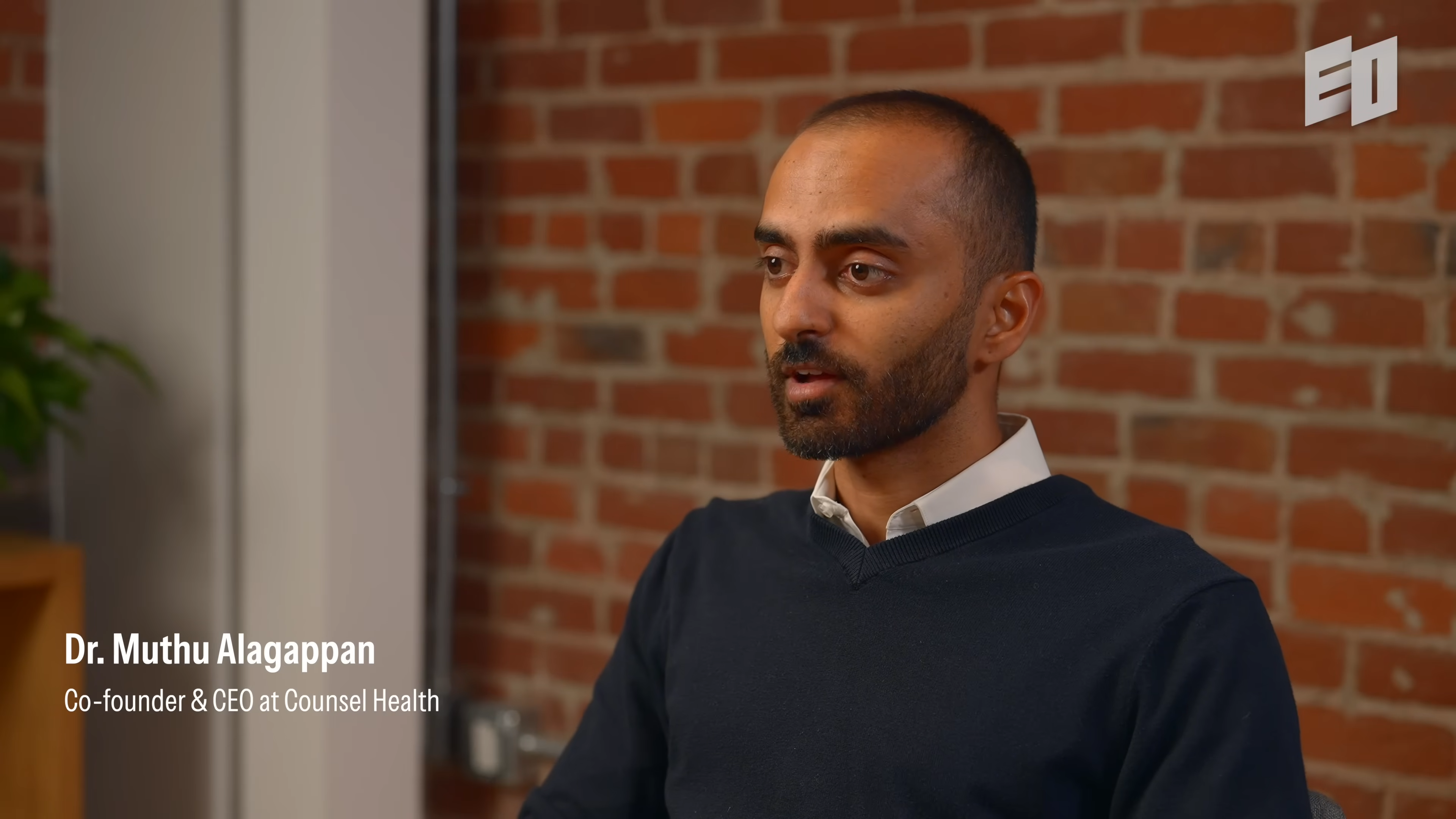
My name is Muthu Alagappan. I'm a physician by training, but I spent the early part of my career as an AI researcher at Stanford and have spent the last several years building health technology companies. I'm the founder and CEO at Counsel Health. Counsel Health is an AI-enabled virtual care company. We're redefining virtual care for the modern era, and our hope is that we can multiply the world's clinical capacity by creating perfect doctors to deliver the highest quality care to the next 10 billion people. What many patients describe to us as feeling like they have a doctor in their pocket. We're excited to announce our $25 million Series A, co-led by Andreessen Horowitz (a16z) and GV.
The Day I Knew I Had to Quit Being a Doctor
Growing up, I had a speech impediment where I couldn't say the letter R. I distinctly remember sitting in class, hoping the teacher wouldn't call on me to read out loud, and I actually remember counting the number of Rs in a given sentence to decide which one I should volunteer to read, just to avoid being embarrassed.
Later in life I did a lot of public speaking, speech and debate. To me, that was mostly a form of building conviction in a growth mindset, the idea that just because something is broken, or doesn't work, or isn't the way you want it, doesn't mean it can't be solved. In a way, that personal lesson, going from something being an impediment to eventually being a strength, stuck with me.
I grew up in Houston, which is home to the world's largest medical center, and to some of the best cancer hospitals, teaching hospitals, and medical schools. When you grow up in that environment and you still see cracks in the foundation, misdiagnosis, challenges with access, wait times, diagnostic errors, you start to realize that even the best we've ever created, the best medical centers, the best hospitals, the best doctors, are still not quite at the quality or capacity we need to serve the broader US and global healthcare needs.
There were a couple of times I felt the way we practice medicine today just isn't good enough. I remember many times being in clinic as a primary care physician, having a patient sit in front of me and explain their problems, and knowing there was some limitation in my memory, my recall, my ability to connect the dots, that was preventing me from helping this person in the best way possible. Humans were working off fallible memory, off logical and cognitive biases.
We may be hungry before lunch, and that's making us feel rushed with a particular patient. You're dealing with life-or-death decisions. Patients being rushed in with a heart attack. Being alone in the ICU at 2 a.m. with a patient whose blood pressure is falling and who isn't responding to any medications. How do you comfort a family member who's grieving the loss of their son or daughter?
It felt like all of these were shortcomings. I often felt guilty at the end of each clinic day, realizing that if I had a perfect memory, if I had read every journal article, if I had infinite time, I could help these people so much better than I was. I remember practicing medicine and wanting to have an impact on people, but feeling like that impact was constrained to one patient at a time, one visit at a time.
I've been fortunate in my career to go into the depths of both clinical AI and AI research, but also the practice of medicine, having depth of experience in both. One of the things I was really excited about when transitioning from clinical medicine into technology was the ability to scale impact, to help people not one at a time but at a large magnitude, where a single software application, a single new algorithm, a new technique, could suddenly help millions or billions of people. That's what first led me to move away from daily practice in medicine to helping build technology companies that could have this large-scale, paradigm-shifting change on healthcare overall.
Stop Improving a Broken Idea (Do THIS Instead)
Many of the AI solutions being worked on in healthcare were improving doctors' capacity by maybe 10% or 20%. But what that actually translates to is, instead of seeing four patients an hour, you're maybe only able to see five. While that's a meaningful improvement, we felt it wasn't enough to truly make a difference in access to care, in quality of care, in how personalized care was. Speeding up doctors by 20% wasn't going to solve that problem.
So we wanted to go at the root cause of the problem: not how do you do administrative work faster, but how do you actually deliver care itself faster, higher quality, more personalized. We set out on a mission to think in multiples, not percentages. What does it look like to 10x the world's clinical supply?
We had a choice: build software that tried to practice medicine on its own, or one that augmented existing doctors. We felt strongly that the right care model here would combine AI with human doctors for supervision and guidance, so you get the best of both worlds. We believe either alone is insufficient. AI-only chatbots have the problem of hallucination, a lack of supervision, and a lack of ability to actually act on the advice they give. Human doctors have the fundamental laws of physics that constrain their ability to see enough patients with enough quality in a given time.
We started thinking about our AI augmentation as a sort of Iron Man suit for our clinicians. Imagine a physician who can supercharge their own abilities, essentially obtain clinical superpowers by using our AI platform. They could suddenly remember every article they've ever read. They could review a patient's chart, even hundreds of pages, within seconds.
The other unique thing about Counsel is that we built our own physician group in-house. Today we run and operate a 50-state medical practice with our own employed physicians. That's important because it means we control not only the Iron Man suit but the Iron Men and women themselves, and we can truly create the best combination of human and AI working together. Many patients describe it to us as feeling like they have a doctor in their pocket.
I've tried to make decisions based on where my strengths were really important to solve some of the hardest challenges ahead in the world of clinical AI. These problems aren't specific to a single domain, they cross over between both. It requires you to understand how doctors do it today, but also the art of the possible with AI. If you only understood one of those two disciplines, you'd be fundamentally constrained, both in the creativity and the depth of the solutions you could create.
We all have different strengths, but where are my unique strengths most suited to have the most meaningful contributions in startups? This is often called founder market fit. Where are you, as a founder, best suited to solve a particular market challenge?
Choose Only One Important Thing or Achieve Nothing
One of the things I've found as a founder is there are always so many fires going on at the company, and it's impossible to devote your full attention to all of them at once. If you try, you end up doing a subpar job across the board. One of the things medicine has really taught me is the ability to identify, out of 20 patients you may be taking care of, who are the one or two that need all your attention right now, and how to really focus in an outsized way on the couple of problems, in this case patients, that matter the most.

When building a company like Counsel Health, there are two themes constantly in tension. One is the medical premise of do no harm, the Hippocratic oath. The other is the startup adage of move fast and break things, the idea that only by taking risks and moving quickly can you truly unlock innovation at scale. When building a medical AI care delivery platform like Counsel, those two things can be at odds. But we found an elegant way to resolve them.
First and foremost, we focus on do no harm. How do we ensure that everything we deploy, every aspect of the care model, not only has physician supervision baked in, but has been evaluated and tested to be high quality, safe, and at the very least exceeding the performance of the world's very best doctors? At the same time, because we have an in-house physician group, we're able to safeguard our AI. We can have our AI take risks, be more innovative in the way it suggests diagnoses and reviews the literature, knowing all of that will be safeguarded and supervised by a physician in the loop. In that way, we get to enjoy the best of both worlds: the end patient experiences no harm, and at the same time we can push the boundaries of what AI is capable of.
The ONE Thing I had to Tell Stanford
The world as we know it in healthcare, and most industries, will probably change fundamentally over the next five years. There's going to be a massive reshuffling of norms and paradigms. The way we interact with a lawyer, a doctor, an accountant, even an investor, will change greatly. We even wonder sometimes if we'll tell our children in 20 or 30 years about this concept of primary care doctors, and whether they'll look at us with a kind of admiration and wonder at the idea that there was only a single person, who didn't really remember your medical records, and if you traveled you couldn't really get access to them, and maybe one day that'll all feel a bit old-fashioned.
Not solving perhaps for the next five years, but solving for what the world will look like as a result of this reshuffling: if it's the case that everyone is accessing care via their phone, what does that mean in terms of computational and video needs on a phone? What does that mean for how we structure pharmacies?
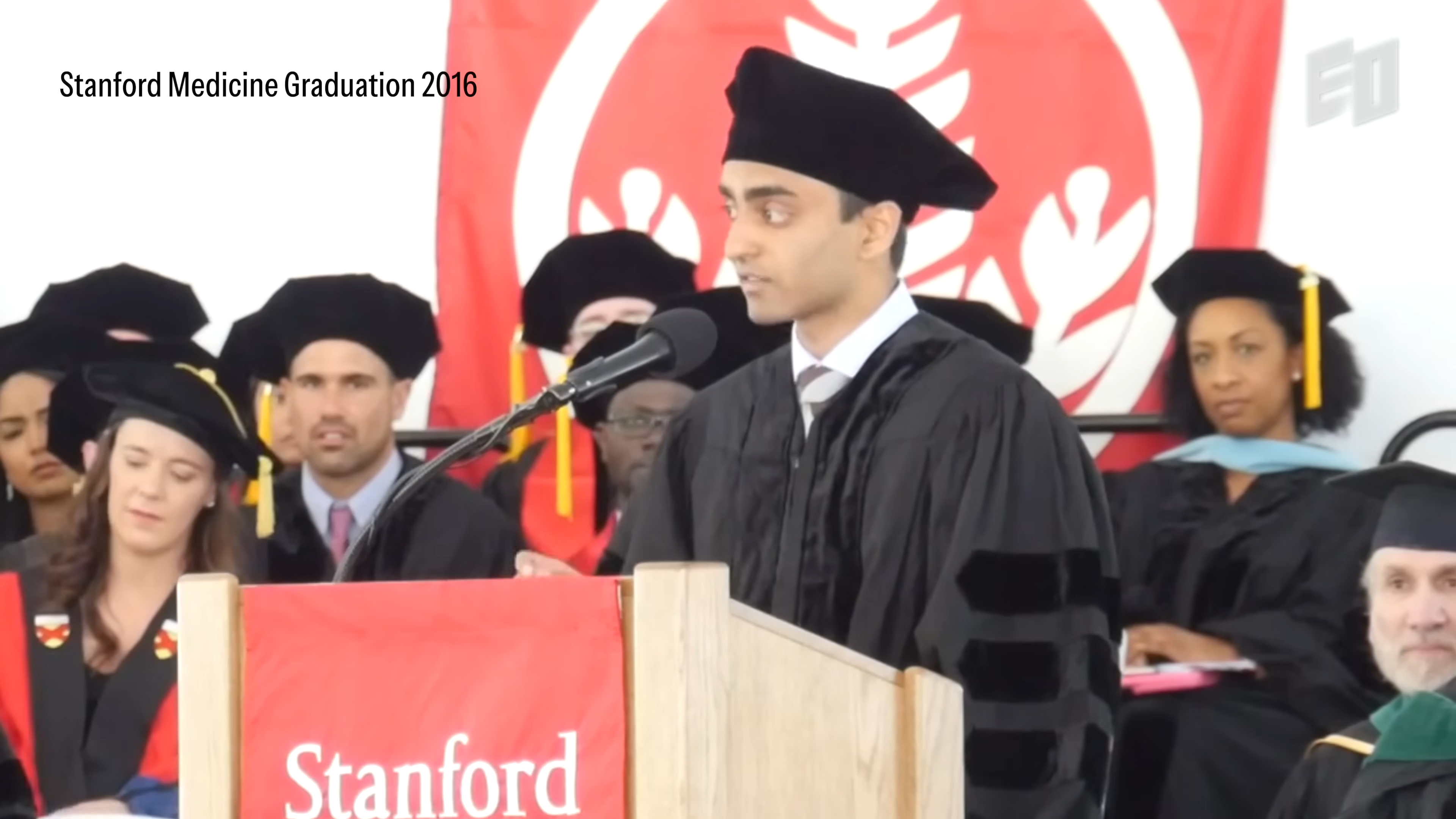
"Don't act like you hit a triple when you were born on third base. While today is a celebration, I think it's also a recognition that in one way or another, we were all born on third base."Muthu AlagappanDuring Stanford Medicine Graduation 2015
So many of us are born with so many things we're fortunate for, that we've been gifted. I view a lot of that as a responsibility to give back, not just proportionally, but in an outsized way. A lot of what motivates me is giving back in a way that feels outsized to what's been given to me, in terms of opportunities, the people I've met, the education I've been able to receive.