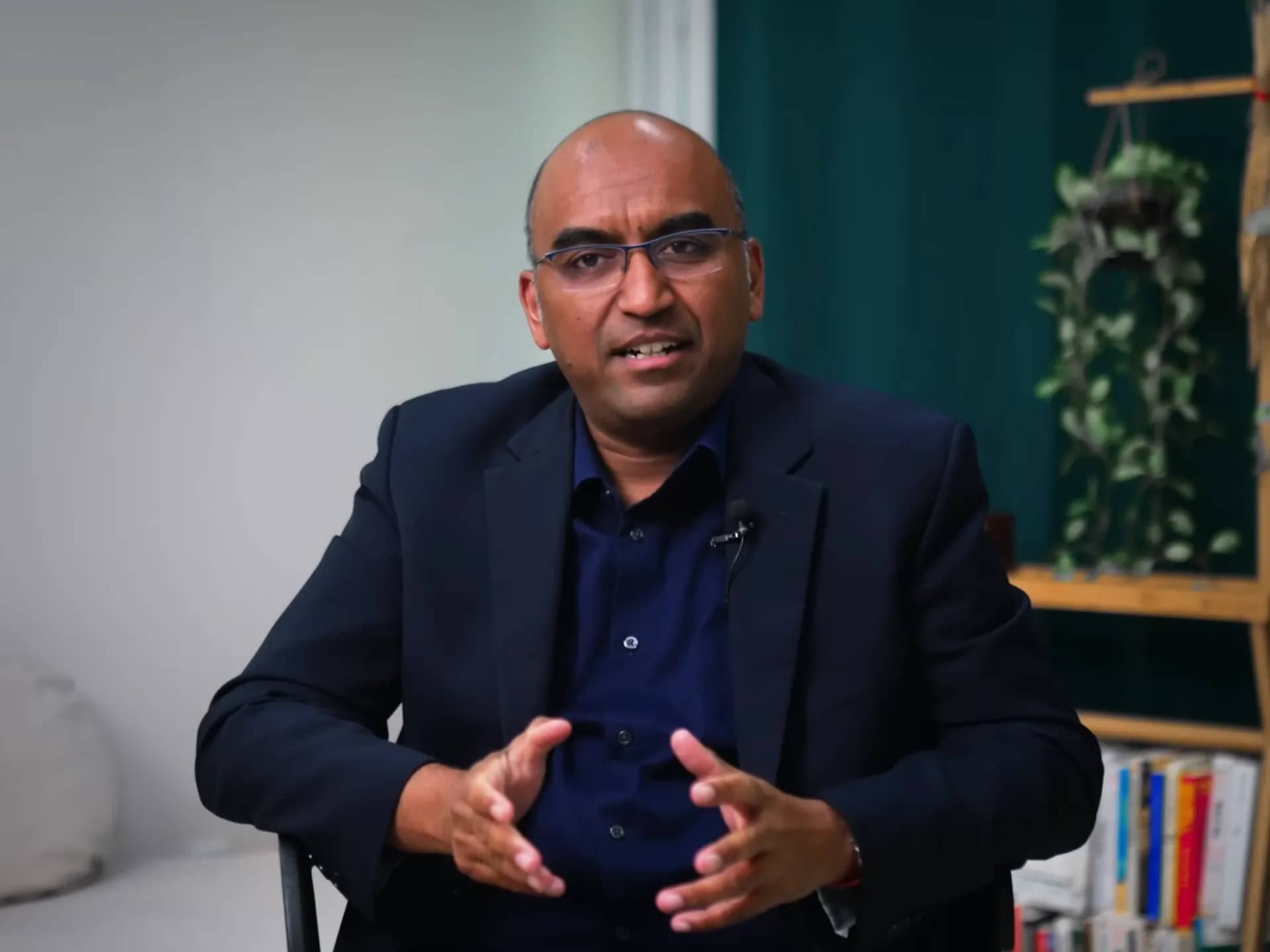
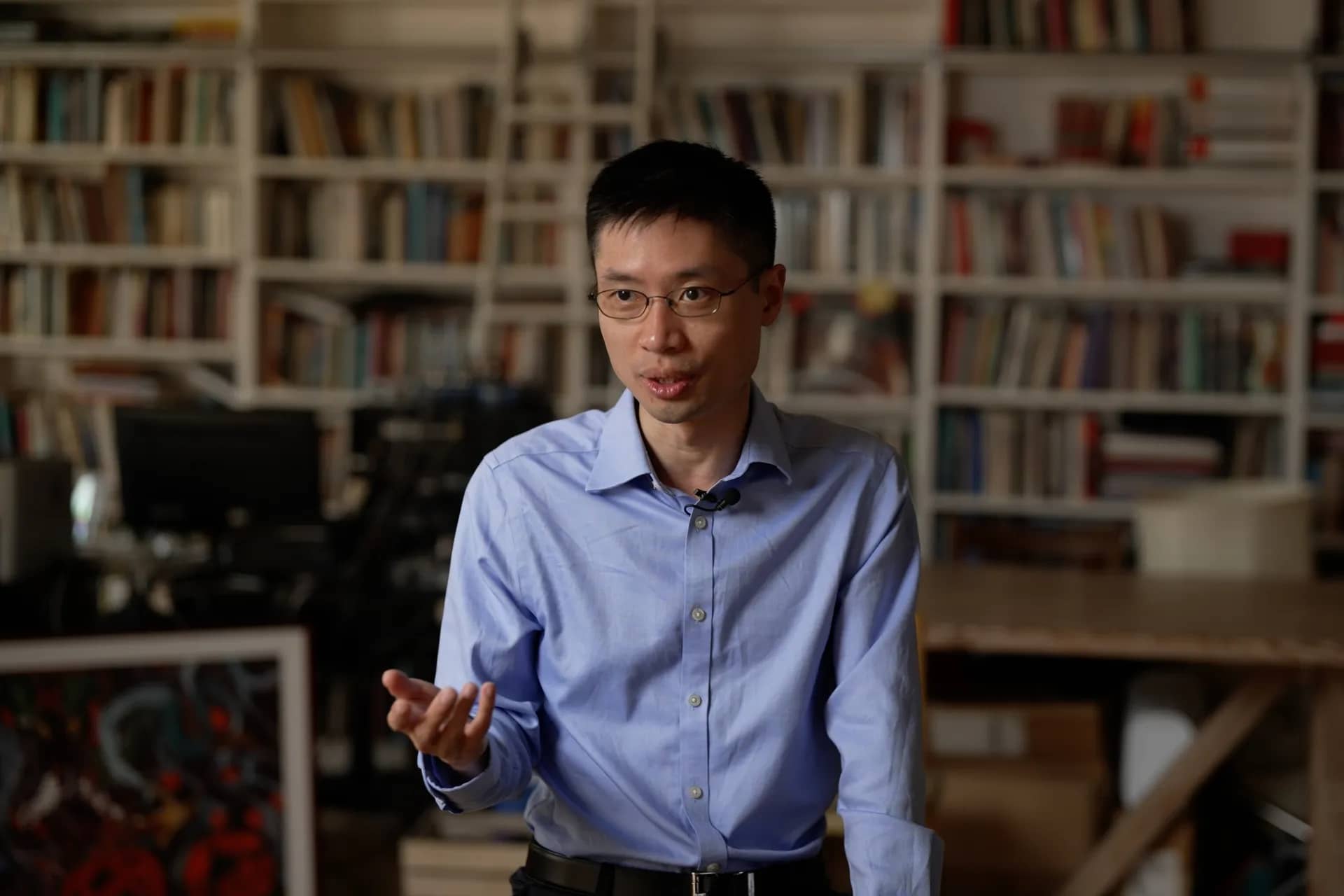
Interview with Po-Shen Loh, Professor of Carnegie Mellon University
At a Glance
- Who: Po-Shen Loh is a mathematician, professor at Carnegie Mellon University, and the national coach of the US International Math Olympiad team. He describes himself as a social entrepreneur focused on education.
- What: He built a live, human-taught math program that replaces test-prep drilling with practice at real thinking, staffed in part by professional actors trained to coach middle and high schoolers alongside math experts.
- Lesson: Loh treats direct contact with people as the actual source of value. He gathers it through free park talks, sixth grade classrooms, and his own improv training, then turns what he learns into ecosystems where every contributor wins at once.
In this interview, Po-Shen Loh, a social entrepreneur, illuminates issues within the education system while instructing tens of thousands of diverse students. Serving as a U.S. Math Olympiad coach and professor at Carnegie Mellon University, he endeavors to tackle these problems. He has developed a captivating educational system, reminiscent of Twitch game streaming. Explore the significant challenges and their solutions in the video.
Key Takeaways:
Why Test-Prep Culture Kills the Ability to Invent
Modern test prep trains students to recognize every possible question in advance so they are never surprised, the opposite of what made math competitions valuable in the 1980s. That endless drilling adds hours to a student's day and strips away the one thing that mattered: the chance to invent.
How Po-Shen Loh Turned Two Pain Points Into One Win-Win-Win
Students needed a live, expert teacher who was also likeable, a combination too rare and unscalable to find. He solved it by recruiting professional actors from his university's drama department, who needed stable part-time work, to coach students alongside math talent.
Curriculum as a Vehicle: Why the Subject Matters Less Than the Thinking
His live program deliberately teaches only algebra, geometry, combinatorics, and number theory, the same territory as middle school math competitions. The subjects are not the point. They are the vehicle for questions students have never seen before, which is the only way to practice thinking instead of memorizing.
He Took Improv Classes to Become a Better Math Teacher
Loh enrolled in improvisational comedy and acting classes to learn how to communicate better and reach more people beyond fellow math nerds. That personal experiment became the insight that let him recruit professional actors into his teaching model.
The Plan Reaches 100,000 High Schoolers and a Million Middle Schoolers
Loh estimates his model could scale to 100,000 US high school students, 1 percent of the country's total, who in turn teach roughly a million middle schoolers. Growth depends only on how fast families with middle schoolers discover a class that looks like a Twitch stream and is taught by smiling math geniuses.
Everyone Should Become an Entrepreneur or Intrapreneur in the AI Era
Loh calls the new world of AI a Wild West full of new opportunity, where the most successful people will be the ones best at creating value. He tells audiences everyone should act like an entrepreneur, or an intrapreneur building new things inside an existing organization.
Why You Cannot Create Value Without Talking to People
Loh's core belief is that value cannot be created by theorizing alone. The more people, and the more different backgrounds you understand, the better you can model their needs and come up with a solution that actually works.
Watch the full interview now on EO's YouTube channel! Below is the complete transcription of the interview. Minor edits have been made for clarity and readability.
Introducing Po-Shen Loh, Professor at Carnegie Mellon University
Hi, I'm Po-Shen Loh. I'm a mathematician. I'm a math professor at Carnegie Mellon University. I'm a social entrepreneur, and I'm also the national coach of the US International Math Olympiad team.
Thinking Outside the Box
If you have six matchsticks, how can you put them so that they make four triangles, where the side of the triangle is the same length as the matchstick? If you have six of them, you might start putting three of them like this, but then you only have three more. Now what? It turns out that the answer is that you take three matchsticks like this, and then you use one more up here, and you put it down like a pyramid. That's thinking outside the box, if you can call it that. Because this is not just on a piece of paper anymore. It's still six matchsticks, or six toothpicks, but it's not what you were thinking of.
I've done lots of different kinds of teaching. I teach people all the way from the International Math Olympiad team. I will also go to schools and teach sixth grade in schools, where unfortunately there might not even be any math teacher for the whole seventh grade. So I go and cover the entire range of education. I find this to be very interesting because that helps me learn what the challenges are.
The whole point of a school math test is to see whether or not you listened and you practiced. In fact, all the math competition problems in the US, and also in many parts of the world, are of this type. Which is why today, the way that I approach education and training is to try to help as many people as possible learn how to do those questions, which they won't have seen before.
But I want to emphasize the reason I've been doing a lot of work on this nowadays is because when I was doing math competitions in the 1980s, the way you got good at it was by thinking every new problem was a chance to practice mental flexibility. Today, unfortunately, there's a huge industry around test preparation and cramming, where people try to help students get high scores on these strange math questions by showing them all of the strange math questions they might possibly see. That involves studying for many, many hours, so that the hope of the parents is that when the students see the test questions, they are never surprised, because they have done everything many, many times. By the way, as you may know, this causes students to have to go to school and after-school programs and so many others. It's actually very bad for the student, but even worse, it takes away the student's chance to invent.
The way I change the world
Money doesn't buy you happiness, but money is important for impact and influence. So in fact, it's very important that the things we build are capable of generating enough money to create the impact. This just happens to be what drives me.
Ten years ago, I had this crazy idea that maybe if we made a website that would collect people's ways of explaining math and science topics, then people would explain the math and science topics and it would be free, and everyone would be able to learn math and science. I remember thinking, oh, that can't be very hard, we'll be done with that in a few months. I'm glad I thought that, because I'm still working on it.
So I had this whole thing called Expii. We were making a website with free explanations, but that didn't actually have a business model of its own. It wasn't generating money, so I had to find some way to support all of that. In April 2019, we started creating our own version of that in the United States, where we took charge of filming me teaching, and then we had a product which consisted of me teaching math that people could watch recordings of, and they would pay for it. This made some amount of money. But we still found there were pain points, and finally, about two years ago, I realized what people really want is to have a live human experience with somebody else who is an expert.
The only problem is that's quite rare and hard to find. There's also another challenge, which is that ideally that person you're talking to is friendly. If the person knows a lot but isn't friendly, that's actually not useful either. This is the hardest thing to deliver in education, because it's the least scalable. Of course, in the entrepreneurship world we always think about scalability, and yes, you can find one brilliant coach who teaches ten students, or maybe even 20, or even 100. That's a small scale compared to the size of the world.
That's when I suddenly realized I could make a giant win, win, win situation. So the main thing that I do now is an ecosystem, one that I invented, which unites many different types of people to all contribute in ways where everyone is winning.
One pain point was for the people learning math. The second pain point was from the people who are very, very strong at math already, for whom building the ecosystem would be even better, although I do want to emphasize this is helping them finish up to become extraordinary. The thing that made me realize I could put everything together was an experience I had about five or six years ago: I also took improvisational comedy classes myself, improv classes, acting classes. I was doing that because I was trying to learn how to communicate better, to get more people interested in math. But I realized that even a math nerd like me can take those classes and become able to talk to a few more people. So I realized, let me add that.
I walked over to our drama department, and I found out that there are lots of people who have extraordinary drama skills who are actually very interested in paid, part-time jobs to help coach high school students. So that's the third pain point. There are people who absolutely love what they're doing in the acting and drama world, but there's a practical need: how to find a stable, part-time job with flexible hours that they can use to support their passions. So suddenly, win, win, win. We have all three lined up, and that's why this thing scales.
The everyone-winning part is very important, because I work with high school students. In our company, any time anyone wants to ask high school students to do anything, my answer to my employees is always: that thing you want to ask that high schooler to do, can we explain to their parent why? For a very busy high school student, that thing has to be the best thing they can do with their time. If I can't explain that, they're not doing it. So this is the discipline we run to. This is how strongly we make it a win, win situation. We will never have a high school student doing something unless I could explain to their parent, we suggested for your daughter to do this because it's really good for her.
Beforehand, it was hard to imagine there would be a way to do that, until the answer became: because while doing this, they get to learn from a Broadway or Hollywood quality actor or actress, which is going to help them become extraordinarily successful. This took eight years to come up with, and two more years to scale. The speed at which we grow is purely based on how long it takes for people who have middle school children to realize that there are classes here where the class looks as good as a Twitch gaming stream, and it's taught by math geniuses who are smiling. These are things people could not imagine you would put all together at the same time. As people discover this, they switch over. They start joining our classes. Then we can bring in more high school students.
The scaling power this can reach, I estimate, could easily grow to 100,000 high school students in the US. That's 1% of US high school students, teaching about a million middle school students.
If you look at our live program, it looks a little strange, because you'll see that the only subjects we teach are a pretty small number: algebra, geometry, combinatorics, number theory. Why do we cover these? Because they're a curriculum that teaches you how to think. The only way to do that is by giving students questions they've never seen in school before. So I need to find a source of problems that you won't see in school. That turns out to be the middle school math competition curriculum, because the people making those problems were trying to make problems you don't see in school. But the difference between the way we do it and the way a lot of the training centers do it is that we're trying to use those as opportunities to help you practice thinking, instead of just showing you how to do the question enough times that it sticks.
So the topics we cover are specifically chosen because they're enough to teach a student how to generate their own ideas. Our philosophy is: if you finish all of that, you'll discover that you can learn anything. Our goal is not to make it so we have classes for you for every year of your life. Our goal is to make it so that, as fast as possible, you don't need any classes from anyone ever again.
How to create value
Today, everyone needs to learn how to grade the homework. This is the huge difference, because someday, if you want to do anything in the world, the first thing you will do is ask ChatGPT. Let me make this analogy stronger: if we look at any good software engineer, most good software engineers, if they're given a task they've never done before, the first thing they do is think about similar problems and search on Stack Overflow for examples. They don't expect that to give them the whole code they need to write, but they use it to research what kinds of technologies might be useful. As ChatGPT suggests solutions, they need to be quick, analytical thinkers to understand whether or not what ChatGPT said is correct. That's why what the world needs now is a large-scale way for everyone to learn how to grade homework, for everyone to learn how to come up with their own way of thinking, not just how to do the problems.
My general philosophy is: when you're learning, you should keep challenging yourself, and you should not be repeating. In the real world, when you're doing a task, if it's repetitive, you should get ChatGPT to do it, or a calculator, or a computer. But in order to know how to control those well in the real world, you need to learn how to think. That's the purpose of the learning process.
What I do for fun is meet and try to understand people whose backgrounds I don't fully understand yet. This is actually why we're talking right now. I happen to be talking to you in New York City. The way I got here overnight is I took the overnight bus. Some people don't take the overnight bus, because who knows who you're taking the bus with, but for me, I'm not scared by that. That's just called the real world. You can't understand the real world unless you actually start going into various parts of it.
My message on how to create value is: you cannot create value if you don't interact with people. You can't just theoretically think about the value. The more people, and the more different backgrounds you understand, the better you understand how they tick, what their needs are, what their limiting factors are, what they want to do. The better you are at modeling this, the more effective you'll be at coming up with a solution.
I started going to city after city, giving math talks in public parks. I put a schedule on my website and said, I'm going to go to all these cities, and people could sign up to show up for the talks. At the beginning, people were wondering, will anyone show up? But there would be 50 to 100 people showing up at these talks in parks. That was a fun journey, because to do it, I was traveling from park to park with all the AV equipment, speakers, and everything, to be able to have a stage in park shelters all around the US.
While doing that, inadvertently, that was customer discovery, because I was able to suddenly interact with and talk to thousands of parents and students, which started to make me realize what kind of challenges people had. About one to two months after that, the big idea came: we can actually have all these middle school students I've met all learn how to think at the same time, while these people who are brilliant become extremely polished, so that someday, later in their careers, they can be really successful. That was the idea.
It was like, somehow you can't really find pain points if you're not seeing people. That's also why, with a lot of the work I do, I go into schools. I love working on education, and I do it in a way where, even just last night, I was writing to somebody involved with a large network of schools, whose students, I believe, are also disadvantaged. Instead of just putting money or resources in from my side, I said I'm very interested: can we arrange for me to go into some of your schools and teach sixth grade?
What I'm explaining is that the way I do anything, if I want to work in a sector, I go and step in myself and start doing the work, and see what happens. That's actually how I came up with all these ideas, because the ideas I'm working on are all things I've personally experienced myself. I've experienced being a math person taking acting classes. I've experienced being a person learning how to think, taught by somebody who knows a lot of things and also smiles. So all the different parts gave me these ideas.
Now I can understand why you identify as a social entrepreneur
Yeah. We're not doing a very good job of maximizing lifetime customer value, if our goal is to solve the customer's problem as fast as possible. But this is what we want to do. This is social entrepreneurship. This is also why, if you ask me what my definition of success is: my definition of success is not just that we make a ton of money. My definition of success is whether we manage to convince a huge number of people on this earth to enjoy being thoughtful.
I love that entrepreneurship is about creating new things. So the message I've been sending on my entire tour is that this new world of AI is going to be a Wild West. There will be lots and lots of new opportunities. The people who will be the most successful are the ones who are very good at creating value.
In my public talks, I tell everyone: everyone should be a bit of an entrepreneur. They can be an entrepreneur, or they can even be an intrapreneur, which is a word in English we sometimes use to describe making new things within an organization. But the whole concept of creating value is actually going to be central in helping society survive, and everyone flourish, as we go forward into this age of AI, into this new world.