Nov 14, 2024
To Run a $5.2B Company with $200M ARR, I Focused on This
Interview with Jason Zintak, CEO of 6Sense
Founder Focused

💡
At a Glance
- Who: Jason Zintak is the CEO of 6sense, drawing on nearly 30 years of experience in sales.
- What: 6sense is an AI, big data driven sales and marketing platform for B2B teams.
- Traction: Zintak says 6sense grew from $5 million to $200 million in ARR over seven years and now serves 2,000 customers; 6sense completed a $200 million Series E round in January 2022, reaching a $5.2 billion valuation.
In this interview, Jason Zintak breaks down how he took 6sense from $5 million to $200 million in ARR, why he thinks leadership isn't actually lonely, and what happens to a deal when a customer's champion walks out the door. He closes with the one thing that determines whether a startup keeps a customer once its original sponsor is gone.
Key Takeaways
Trust Is Earned Customer by Customer
Early customer acquisition is less about tactics than about being vulnerable enough to ask for a chance and bringing real value to the relationship. Once a customer is won, he argues retention becomes the real test, especially in a tougher, post-pandemic macro that demands high value, high return.
Product Value Should Outlast Any Single Champion
When a customer's original sponsor leaves for a new role, it is the product itself, not sales relationships, that determines whether the account survives. He credits 6sense's mutual success plans with documenting outcomes that get passed along to the next executive.
The Team Is the Real Bet, Not the Idea
Many startups pivot away from their original idea toward whatever ultimately finds product market fit, so what matters most is the team doing the searching. He says that nucleus of team and leadership shows up as much in a company's culture as in its product.
Alignment Is Harder Than It Looks
Founders often assume their team is aligned when in fact there are too many competing pivots or agendas underneath. He points to chasing events and hype as distractions that feel productive for the ego but don't move the business forward.
Hire and Keep A Players, Even When It Gets Expensive
6sense's standard is simple: A players hire other A players, and A players want to work with each other. He argues tough personnel calls only get more expensive with time, so leaders should make them quickly.
Sales Success Starts With Being Informed, Not Slick
After nearly 30 years in sales, Zintak says the job is not about a polished pitch but about knowing enough to ask the right questions. He adds that genuinely caring about a customer's problem is what ultimately produces a better product and better results.
Below is the complete transcription of the interview. Minor edits have been made for clarity and readability.
Introducing Jason, The CEO of 6sense
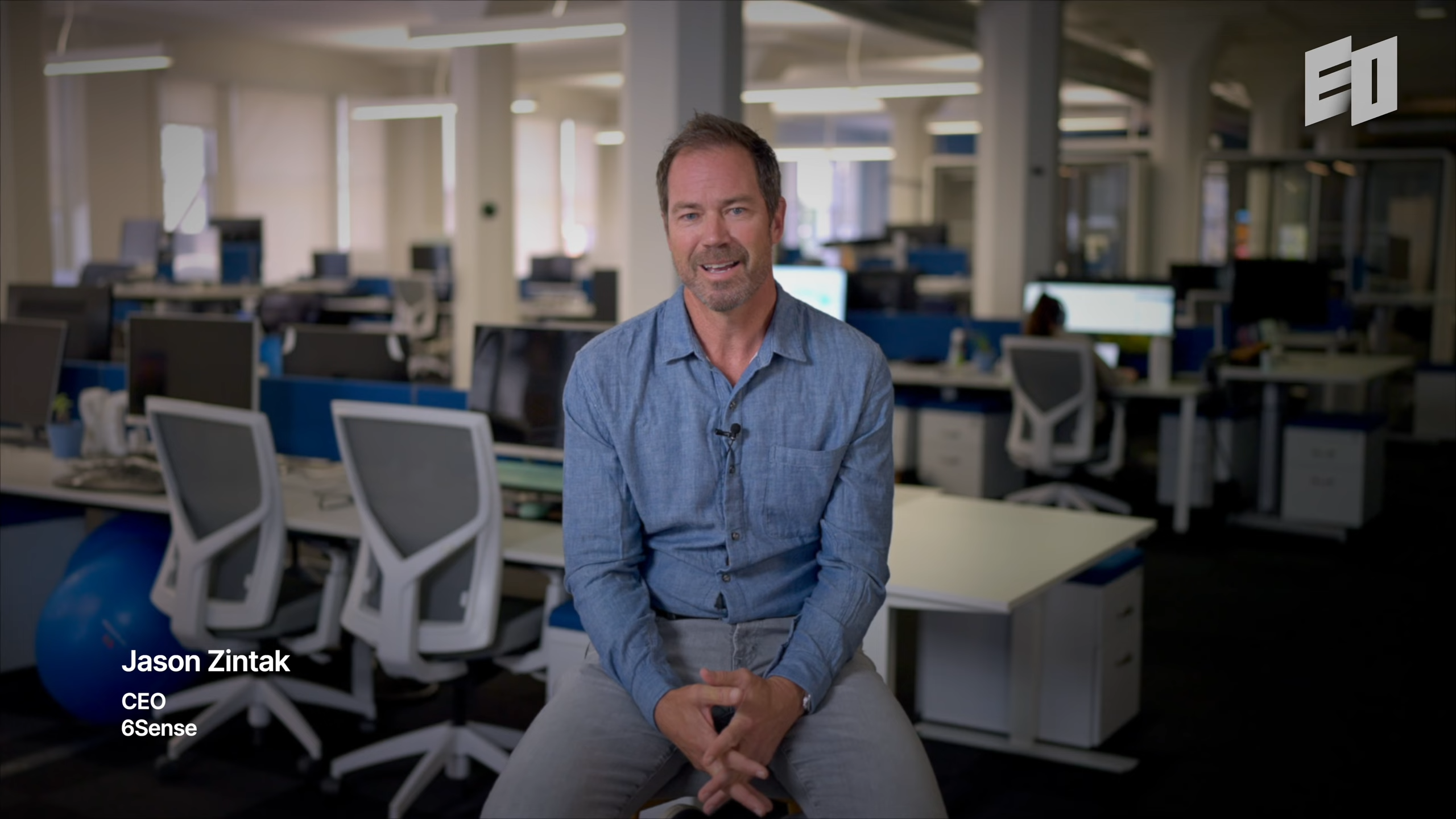
My name is Jason Zintak. I'm the CEO of 6sense. 6sense is an AI, big data driven sales and marketing platform. In the last seven years we went from $5 million in ARR to $200 million, completing our Series E, a $200 million fundraise, at a $5.2 billion valuation. That was roughly a year and a half ago. We have 2,000 customers and a great cap table of marquee investors.
Let Your Product Speak For the Customer
Customer acquisition in the early days is very tough, because why would anyone trust this startup with just an idea? Everyone finds a way or a relationship for that first customer, and it comes down to solving the problem.
If you can help someone solve a problem, and you find a friend or a fan, usually through a relationship, you might find someone to trust you and give you a shot. You need to be vulnerable with these customers, essentially asking, can someone give me a chance? You need to lean on a relationship and bring something of value.
If you find those aspects, you can probably get a customer, and then you have to try like hell to retain them, satisfy them, keep them, and make them better than ever. We're now in a macro that's more difficult post-pandemic, and that's all around high value, high return. Does it help me do my job better, more efficiently, with a dollar return? So we're focused on a mutual success plan with our customers. We set that plan, we communicate the plan, add innovation, and they'll give you honest feedback.
Feedback is a gift, maybe a painful one. We've lost customers along the way, but we get the feedback. I think the big mistake is not looking at yourself in the mirror as a company, judging where you actually are in your journey, and optimizing, changing, pivoting, and adapting around that feedback. In the B2B SaaS world, it's all about retention, retention, and retaining your customer. And can you cross-sell them, upsell them?
So what's the magic? Quite often we find your buyers leave the company the next year, and your original sponsors aren't there to renew. What do you do? The proclivity is new executive, new tool, so yes, we're faced with that as well. There's really one thing: if the baton gets passed on your product to another executive, will they find value in it? For us, I really focused less on the sales strategies around human intervention and tactics to relate with these execs.
Have we proven enough value through the product, delivery, and adoption of it that when the next person comes in the door, they can see it and feel it, such that they aren't tempted to replace it with their buddies from a past relationship? This comes back to our mutual success plans that we write with our customers. If it's documented and we achieve it, those measurements should all be passed along to the next exec. At the end of the day, it comes down to whether the product works and works well. It will be talked about inside the company if that's the case.
Do Business, Not the Hype
A common mistake is getting too excited in the hype of a startup, around a fundraise and a concept. It's all very energizing and intoxicating in a way, but at the end of the day, you have real work to do. In order to be a high performing team, everyone needs to get on board with the objective and go for it.
A mistake you make is thinking you're aligned, when you actually have too many alternate pivots or agendas. It's common to get distracted, going to too many events that really aren't progressing anything. That's good for the ego, but not necessarily the agenda of the company. It's not necessarily about the product either. We invest in teams.
Many, many startups start with one idea and end with a completely different one that ultimately finds product market fit. Smart people and good working teams figure it out. But what they're betting on, and what I can tell you from living it, is that it's the team that makes the difference. That nucleus of team and leadership is paramount, not only in the product but in the culture and the ethos of the company. It's one brick at a time to build the house.
I joined when we were 30 people, and we're now over 1,200. We constantly message what's important to us, and people who identify with that stay, and those who don't leave. That's appropriate, because you can't be all things to all people.
There's no shortage of leadership books that talk about making tough decisions, that leadership is lonely, and that you have to make the call instantly. I don't find leadership lonely at all. I like working with my team, and I find us to be more of a family, and I lean on them when I'm lonely, so it's not a big deal.
But you still have to make the tough calls. At the same time, this isn't personal, this is a job, this is a business. Our responsibility is to be the shepherd of the investments, financially, like the money we raise, as well as the people we hire. The true north should always be: is it the right thing for the business? Then everything else is explainable and makes sense.
We deserve A players. Why would you settle for anything less? If you're an A, you hire A's, you act like an A, and A players want to work with A players. So you've got to make the tough call decisions, because they get more expensive with time. Make them quickly.
Know Your Customer To Sell the Product
So the most effective thing, given my experience in sales, in nearly 30 years, is to be an informed seller. A lot of sales is not about how slick you can be in your presentation. It's much more about what do I need to know, what can I ask or get out of my prospect to be relevant. So I think the biggest job in sales is actually being informed, or asking the questions to help them solve their problems.
The more you know, the more responsible you'll be in your outreach and in personalizing your communication and your message. If you're asking me how I relate to our customers, that's really just back to being curious and asking questions. Most people's proclivity is to react first. Really, you should listen and ask more.
You've got to care. Too many people ask the question, don't care, and don't deliver a result. If you care for your customer, you will inevitably build a better product that delivers better results. When entering a new market as a young team, you need to be different somehow, and you need to appeal to the emotional aspect of why people buy, not just the feature and function. People react to emotions, the brain works that way. What is your purpose as a company? What are you delivering? Why would someone consider the new Acme company? You've got to strike a chord in your messaging. Why 6sense, or why new Acme Co? Reduce it to the core and simplify your focus.
What resonates with the customer? Why do they buy your product or service? In my past experiences, challenges seem to be similar and have a history of repeating themselves. How do we bring these products to market? What are the challenges in growing the company? There are patterns: we have people problems, product market fit issues, financing issues, and so on. But what I've learned is to remain calm. These are normal. I've learned to ask more questions, and that helps us get to the root of the problem as we try to solve any of those matters. Patience, for sure, is a virtue.
Exercise calm in the storm, so that people understand that leadership and that resolve. It's a big world: leverage your network, learn, listen, be humble. Probably the best thing I can say is have fun doing it. That should guide you and teach you.