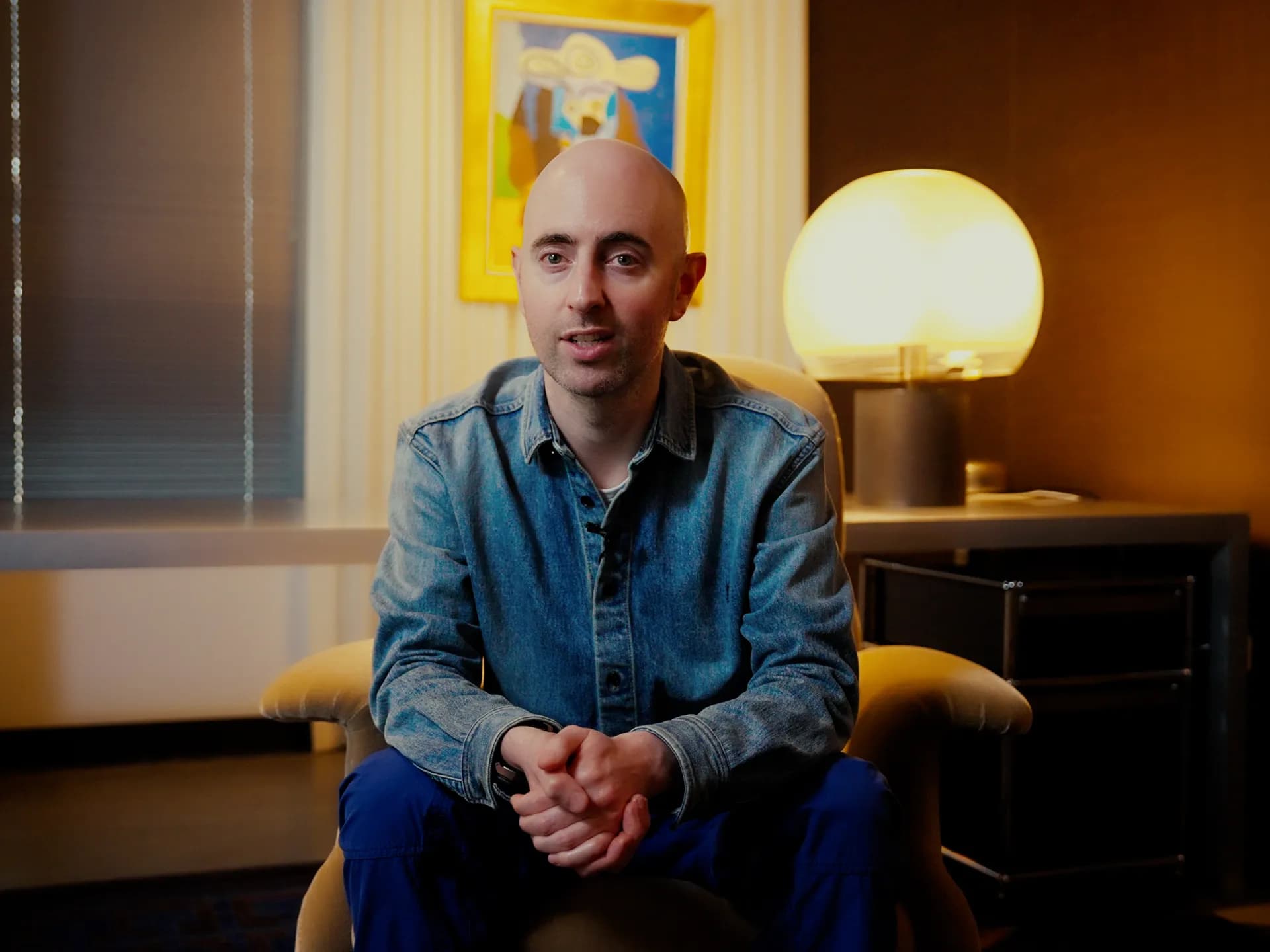
Intercom looks like a company that always wins. Rapid revenue growth in the SaaS era. A billion-dollar valuation. A swift pivot to AI positioned it ahead of legacy competitors. But that narrative, clean and linear, is a lie.
Behind the success is a story far more violent: Eoghan McCabe stepped down as Intercom's CEO half-blind from illness, watched the company nearly lose its way to infighting and cultural drift, then returned to make a bet so aggressive it meant deliberately killing $60 million in annual revenue.
In this interview, Eoghan speaks with unusual honesty about the psychological toll of startup life, the dangers of complacency, and the violent reinvention required to survive in an era where entire business models can be disrupted overnight. His philosophy is simple, ruthless, and surprisingly liberating: you must be willing to act like you have nothing to lose. Because in the end, comfort is the greatest risk of all.
Watch the full interview now on EO’s YouTube channel! Below is the complete transcription of the interview. Minor edits have been made for clarity and readability.
Key Highlights:
"I would wake up some days in 2020 and I couldn't see. I think I'm dying. I don't know why. That was about when revenue started to slow too. Startups are so hard, so unlikely to work."
"Particularly now with AI, there's never a point where you could stop reinventing and stop reacting to the market. If you get comfortable and complacent, someone else will catch up and eat your lunch."
"It only works when the CEO is willing to risk it all to make giant changes. I acted very unilaterally. I did not look for much input. I ignored a lot of advice. We'd actually switch off revenue for parts of the business. Very few people and boards and stakeholders are willing to do that. Very few people."
"So that's the secret. You must be willing to work like a startup founder. Startup founder doesn't have anything to lose. So they act like they've got nothing to lose."
"Particularly now with AI, there's never a point where you could stop reinventing and stop reacting to the market. If you get comfortable and complacent, someone else will catch up and eat your lunch."
"It only works when the CEO is willing to risk it all to make giant changes. I acted very unilaterally. I did not look for much input. I ignored a lot of advice. We'd actually switch off revenue for parts of the business. Very few people and boards and stakeholders are willing to do that. Very few people."
"So that's the secret. You must be willing to work like a startup founder. Startup founder doesn't have anything to lose. So they act like they've got nothing to lose."
An Irish Founder's American Dream
Could you briefly introduce yourself?
Eoghan: I'm Eoghan, the CEO and founder of Intercom. We're a 14-year-old company. Did very well in the SaaS game.
Our big, big, big bet and push right now is on Fin. Fin is a service agent turning into a customer agent. Really, the goal of Fin is to own the entire customer life cycle. We're one of the largest private software companies in the world.
Our big, big, big bet and push right now is on Fin. Fin is a service agent turning into a customer agent. Really, the goal of Fin is to own the entire customer life cycle. We're one of the largest private software companies in the world.
What inspired you to pursue a career in technology?
Eoghan: I was a dreamer. I watched TV shows about inventors and scientists. There was two shows I watched. One was called "Beyond 2000" and one was called "Tomorrow's World."
And in the early '90s, the future was still very bright. There was so much excitement and optimism for what technology would bring to the world. And everyone was just, yeah, really eager for what may come.
So these shows were about flying cars, about a future where we may get all our nutrition from eating little tablets. It was like fantastical kind of things and that really just inspired me and just fed my imagination.
And so yeah, I knew I wanted to be in technology. I wanted to be an inventor. What was most exciting about the internet was abilities that afforded people to connect with others across the world.
I grew up in Ireland in a small little part of Ireland. Like a lot of Irish people and a lot of people around the world longed for America because all of our culture, all of our movies was American. And the internet was a little way for me to connect with America, the American people.
My future, I wanted it to be about creating technology, somehow playing a part and being useful. And there was something about the internet that really drew me in, offered me an opportunity to connect with people in the wider world and get outside of my little part of Ireland.
And in the early '90s, the future was still very bright. There was so much excitement and optimism for what technology would bring to the world. And everyone was just, yeah, really eager for what may come.
So these shows were about flying cars, about a future where we may get all our nutrition from eating little tablets. It was like fantastical kind of things and that really just inspired me and just fed my imagination.
And so yeah, I knew I wanted to be in technology. I wanted to be an inventor. What was most exciting about the internet was abilities that afforded people to connect with others across the world.
I grew up in Ireland in a small little part of Ireland. Like a lot of Irish people and a lot of people around the world longed for America because all of our culture, all of our movies was American. And the internet was a little way for me to connect with America, the American people.
My future, I wanted it to be about creating technology, somehow playing a part and being useful. And there was something about the internet that really drew me in, offered me an opportunity to connect with people in the wider world and get outside of my little part of Ireland.
What kind of story does Intercom have as a company?
Eoghan: The story of Intercom was one of many challenges, many dark days, a lot of anxiety and fear over whether or not the thing we're building is valid. Will it all work out? We're the fastest to go from 1 to 50 million ARR since Salesforce. We did it in two and a half years.
These days that's nothing. In the AI days, there's people hitting up 100 million in a year in some crazy, crazy cases. But back in the good old SaaS days, 1 to 50 million ARR in 2 and a half years was pretty damn good.
But in some ways, this crazy growth that happens to you can leave you a little complacent. That's something that the current crop of founders needs to watch out for, which is that they shouldn't take their revenue growth for granted. They should learn to understand where it's coming from.
This hot, brilliant start certainly did wonders for my ego and insecurities. The 1 to 50 million ARR in 2 and a half years or whatever it was, faster than every other company but Salesforce, I felt great. But when revenue growth started to slow, I made some mistakes with our pricing. I felt the opposite of great. That was a real reality check for me.
These days that's nothing. In the AI days, there's people hitting up 100 million in a year in some crazy, crazy cases. But back in the good old SaaS days, 1 to 50 million ARR in 2 and a half years was pretty damn good.
But in some ways, this crazy growth that happens to you can leave you a little complacent. That's something that the current crop of founders needs to watch out for, which is that they shouldn't take their revenue growth for granted. They should learn to understand where it's coming from.
This hot, brilliant start certainly did wonders for my ego and insecurities. The 1 to 50 million ARR in 2 and a half years or whatever it was, faster than every other company but Salesforce, I felt great. But when revenue growth started to slow, I made some mistakes with our pricing. I felt the opposite of great. That was a real reality check for me.
Why Eoghan McCabe Left Intercom in 2020
What happened when Intercom's growth slowed down and your pricing strategy failed?
Eoghan: The only way I knew how to deal with it was embrace the darkness a little. I didn't know I was following this wisdom, but I was starting to believe like, oh, maybe I'm not so great. Maybe I am a failure. Maybe all this hubris and confidence was bullshit, actually.
And thankfully after really going to that darker place, I found my ego softened and my identity as this perfect entrepreneur and CEO faded and what was left was a far more realistic person who was comfortable with his mistakes. It gave me the confidence to lead without worrying about what might come next.
Then learning to love my imperfections and then moving forward and embracing the imperfections, finding that I'm just so much happier and better at what I do now that I'm happy and perfect.
And thankfully after really going to that darker place, I found my ego softened and my identity as this perfect entrepreneur and CEO faded and what was left was a far more realistic person who was comfortable with his mistakes. It gave me the confidence to lead without worrying about what might come next.
Then learning to love my imperfections and then moving forward and embracing the imperfections, finding that I'm just so much happier and better at what I do now that I'm happy and perfect.
What led you to step down as CEO in 2020?
Eoghan: I left as CEO in 2020 when I was sick and during the couple years that I was gone, there really was no strategy. We raised in early 2017 finally at a $1.25 billion valuation. And then I got sick in June 2018. So it was about 18 months later.
I found out much later that I got bitten by a tick. I would wake up some days in 2020 and I couldn't see. It was kind of like a dark blur and that was not ideal for the emails that I would have to answer, the documents I have to work on. And eventually I was just like, screw this. Enough was going wrong. I think I'm dying. I don't know why.
That was about when revenue started to slow too. Revenue growth was decelerating dramatically. The company was in a really dangerous place internally. There was a lot of focus on cultural issues, societal issues, political issues, a lot of infighting, a lot of judgment. When you're in the middle of it, in the middle of that storm, doesn't feel good, but you can't really put your finger on what's going on.
But from the outside, from a bit of a distance, I could see that we can do better. Going back to basics will be very fruitful and important for the company.
I found out much later that I got bitten by a tick. I would wake up some days in 2020 and I couldn't see. It was kind of like a dark blur and that was not ideal for the emails that I would have to answer, the documents I have to work on. And eventually I was just like, screw this. Enough was going wrong. I think I'm dying. I don't know why.
That was about when revenue started to slow too. Revenue growth was decelerating dramatically. The company was in a really dangerous place internally. There was a lot of focus on cultural issues, societal issues, political issues, a lot of infighting, a lot of judgment. When you're in the middle of it, in the middle of that storm, doesn't feel good, but you can't really put your finger on what's going on.
But from the outside, from a bit of a distance, I could see that we can do better. Going back to basics will be very fruitful and important for the company.
Killing $60M revenue to survive
What were the "basics" you realized Intercom needed to return to while observing from the outside?
Eoghan: Our only mission is to make incredible products, make a shit ton of money, make us and our shareholders very, very happy, make our customers happy, too. It's not that hard.
I then created a new performance management structure.We would grade every employee quarterly based not just on their work against their goals, but also their behavior against these new values.
And people who were exemplary against these values, we'd pay them a ton of money, equity, bonuses, promotions. We would celebrate and prop up these people. These are the people you want to keep. And the people that didn't fit, we'd politely, graciously thank them, send them on their way with a generous severance payment.
And you do that quarter after quarter, all the good people rise to the top. All the people who are a bad fit are gone. You very quickly end up with a very aligned, strong organization.
Despite that aggression, 18 months after I instituted the new values and the new performance management structure, we ran an anonymous employee engagement survey where all the company were allowed to rate the leaders, including me, our values, our policies, product strategy, how much did they agree with it, how much did they disagree?
For each question, there was only one or two percent of the entire population of the company, about 1,200 people who disagreed with any single point. And that is a result that I haven't heard from another company, but we never even achieved at this company in the past.
I then created a new performance management structure.We would grade every employee quarterly based not just on their work against their goals, but also their behavior against these new values.
And people who were exemplary against these values, we'd pay them a ton of money, equity, bonuses, promotions. We would celebrate and prop up these people. These are the people you want to keep. And the people that didn't fit, we'd politely, graciously thank them, send them on their way with a generous severance payment.
And you do that quarter after quarter, all the good people rise to the top. All the people who are a bad fit are gone. You very quickly end up with a very aligned, strong organization.
Despite that aggression, 18 months after I instituted the new values and the new performance management structure, we ran an anonymous employee engagement survey where all the company were allowed to rate the leaders, including me, our values, our policies, product strategy, how much did they agree with it, how much did they disagree?
For each question, there was only one or two percent of the entire population of the company, about 1,200 people who disagreed with any single point. And that is a result that I haven't heard from another company, but we never even achieved at this company in the past.
Why do you think this seemingly aggressive approach ultimately led to high satisfaction?
Eoghan: Creating a company designed for greatness and for great people to focus and do brilliant work and allow them to make a bunch of money and accepting no distractions or bullshit makes for a very happy aligned culture.
If people don't like the system, there's so many other great companies out there, including companies like Google. They're over there. We're just the one that isn't.
Maybe they were not going to choose to leave this month, but they would have left eventually. And so big picture, not only are we helping ourselves, but we're setting them on their path to find something they're better aligned with.
Everyone's happier when you start to be authentic and you share more about who you are and what you stand for. And that's not the typical playbook of a CEO, but the inauthenticity eventually seeps out and people start to question you and not trust you. Truth, honesty, and authenticity are the way forward.
If people don't like the system, there's so many other great companies out there, including companies like Google. They're over there. We're just the one that isn't.
Maybe they were not going to choose to leave this month, but they would have left eventually. And so big picture, not only are we helping ourselves, but we're setting them on their path to find something they're better aligned with.
Everyone's happier when you start to be authentic and you share more about who you are and what you stand for. And that's not the typical playbook of a CEO, but the inauthenticity eventually seeps out and people start to question you and not trust you. Truth, honesty, and authenticity are the way forward.
How Intercom Avoided Getting Left Behind by AI
What is the painful reality for technology companies, especially with AI?
Eoghan: Some of the great software brands of the previous generation now have kind of lost their way, their focus. Some of them are in negative growth territory.
The painful reality for technology companies, for people who would start them, is that particularly now with AI, there's never a point where you can stop reinventing and stop reacting to the market. If you get comfortable and complacent, someone else will catch up and eat your lunch.
And so part of our secret for how we've dramatically re-accelerated now is that we brought back that focus and that ruthlessness and it really paid off. It only works when the CEO is willing to risk it all.
When they have full moral authority from all their stakeholders and their board to make giant changes, dramatic, aggressive, violent changes. Because if they instead are trying to optimize for not rocking the boat, not damaging old revenue, they will just stay on the trajectory that they had been on.
The painful reality for technology companies, for people who would start them, is that particularly now with AI, there's never a point where you can stop reinventing and stop reacting to the market. If you get comfortable and complacent, someone else will catch up and eat your lunch.
And so part of our secret for how we've dramatically re-accelerated now is that we brought back that focus and that ruthlessness and it really paid off. It only works when the CEO is willing to risk it all.
When they have full moral authority from all their stakeholders and their board to make giant changes, dramatic, aggressive, violent changes. Because if they instead are trying to optimize for not rocking the boat, not damaging old revenue, they will just stay on the trajectory that they had been on.
What specific risky decisions did Intercom make to adapt to the AI era?
Eoghan: I actually decided that many tens of millions, I think something like 60 million ARR, we'd actually give away over a number of years. We'd actually switch off revenue for parts of the business so that we could focus on other ones. We focused on some specific parts of the business and then introduced this AI element which brought epic revenue growth there.
There was other parts of the business where revenue growth was negative for a while. Very few people and boards and stakeholders are willing to do that. Very few people, particularly professional CEOs who are hired to not break things.
So that's the secret. The process of reinvention and rebirth is highly destructive as well as constructive. You have to be willing to crack a lot of eggs.
There was other parts of the business where revenue growth was negative for a while. Very few people and boards and stakeholders are willing to do that. Very few people, particularly professional CEOs who are hired to not break things.
So that's the secret. The process of reinvention and rebirth is highly destructive as well as constructive. You have to be willing to crack a lot of eggs.
Eoghan's Ultimate Advice for Founders
What is your advice for younger founders regarding instinct?
Eoghan: For younger founders, I think what's important is to test your instinct. Don't be unafraid to just go with your gut and try it out because you won't calibrate against it or learn about it unless you're trying it.
And if you find yourself entirely unable to make decisions on your own, you're not a founder. Because the thing that typifies founders is that they are willing to bet on themselves.
And if you find yourself entirely unable to make decisions on your own, you're not a founder. Because the thing that typifies founders is that they are willing to bet on themselves.
As Intercom's CEO, have you also followed your instincts?
Eoghan: When AI came, and we started to build Fin, which is our AI agent, we realized that because the agent does the work that the humans do, the humans are not going to need the software they use to do the work.
These agents were highly disruptive to our existing business. We saw it as a threat and an opportunity. We really didn't have any choice. Now, we had the benefit of the fact that our business was not doing so well. So, we needed an opportunity.
The worst-positioned CEOs and companies were those who were unfocused, but they were doing kind of okay. If you're doing kind of okay, there's less room to get crazy and take big risks. But if you're kind of not doing so well, everyone's like, "All right, you've got a plan. We need a plan. Go for it."
So, we jumped on this and spent as much money as we could because of the opportunity, the risk, and we really needed a new direction.
It was actually controversial when we said, "We're going to bet a million dollars of our own money on pivoting to AI." It was controversial back then, but I think that the couple of years since then have proven us right. The future really is humans plus AI.
These agents were highly disruptive to our existing business. We saw it as a threat and an opportunity. We really didn't have any choice. Now, we had the benefit of the fact that our business was not doing so well. So, we needed an opportunity.
The worst-positioned CEOs and companies were those who were unfocused, but they were doing kind of okay. If you're doing kind of okay, there's less room to get crazy and take big risks. But if you're kind of not doing so well, everyone's like, "All right, you've got a plan. We need a plan. Go for it."
So, we jumped on this and spent as much money as we could because of the opportunity, the risk, and we really needed a new direction.
It was actually controversial when we said, "We're going to bet a million dollars of our own money on pivoting to AI." It was controversial back then, but I think that the couple of years since then have proven us right. The future really is humans plus AI.
What do you think about concerns that AI will cause people to lose their jobs?
Eoghan: I don't want to be Pollyannaish or just imagine this bright, glistening, perfect world. There will be change, and some of the change will be hard. But we've always continued to flourish. Even while technology has put people out of work, the work it's taken has been the most repetitive, demeaning, dangerous work, technology has always complemented humanity and made us better. Yeah. Within my little world of customer experience, I want to make sure we do that, too.
Startups are so hard, so unlikely to work. If you're working to solve a problem that can't be solved in an incredibly new way with a brilliant product, you need a new idea and a new approach. People can understand a problem but not have the ingenuity required to build an excellent product or have that taste.
Where people can have brilliant tastes and be expert craftspeople, build incredibly elegant interfaces, but not actually understand deeply a giant problem that needs to be solved. Great founders can marry those two things together. And that's actually really rare. It's far more rare than the number of startups that are out there being funded right now.
Startups are so hard, so unlikely to work. If you're working to solve a problem that can't be solved in an incredibly new way with a brilliant product, you need a new idea and a new approach. People can understand a problem but not have the ingenuity required to build an excellent product or have that taste.
Where people can have brilliant tastes and be expert craftspeople, build incredibly elegant interfaces, but not actually understand deeply a giant problem that needs to be solved. Great founders can marry those two things together. And that's actually really rare. It's far more rare than the number of startups that are out there being funded right now.
What makes a great founder in your view?
Eoghan: Life is short. People want to be around and inspired by people who are themselves inspired. Think about periods in your life, even when you've not considered working for someone. When someone themselves is excited, it's infectious. But when they're happy, it's infectious. And people want to feel that passion and an ability to share that authentically is the secret to great leadership, in my opinion.
There's no great founder who hasn't gone through these struggles. I have had moments of severe darkness, embarrassment, regret, self-hate, and now I look back at them and I'm like, it was shit at the time, but it's part of my story now. And so, yeah, I just think that a lot of these difficulties are just part of the adventure and will eventually stand to you one way or another.
But I'd say believe in yourself more. Follow your gut. You've got good instinct. Maybe you're wrong one in five or 10 times, but the other times are really right. Listen to yourself. Stop overthinking. Stop over-rationalizing. Stop trying to come up with the right solution as verified by every stakeholder and everyone on your team and everyone on your board. Go with your gut. Do what you think is right. Have the bravery to bet on yourself.
There's no great founder who hasn't gone through these struggles. I have had moments of severe darkness, embarrassment, regret, self-hate, and now I look back at them and I'm like, it was shit at the time, but it's part of my story now. And so, yeah, I just think that a lot of these difficulties are just part of the adventure and will eventually stand to you one way or another.
But I'd say believe in yourself more. Follow your gut. You've got good instinct. Maybe you're wrong one in five or 10 times, but the other times are really right. Listen to yourself. Stop overthinking. Stop over-rationalizing. Stop trying to come up with the right solution as verified by every stakeholder and everyone on your team and everyone on your board. Go with your gut. Do what you think is right. Have the bravery to bet on yourself.