Oct 24, 2024
How We Captured Silicon Valley in just 4 months
Interview with Rahul Vohra, Founder of Superhuman
Founder Focused

💡
At a Glance
- Who: Rahul Vohra is the Founder and CEO of Superhuman. A serial productivity entrepreneur, he previously founded email plugin Rapportive, which was acquired by LinkedIn.
- What: Superhuman is a high-velocity email platform designed to help executives, founders, and sales leaders navigate their inboxes twice as fast. The platform features on-demand and always-on AI capabilities, including automated draft generation, one-line conversation summaries, and live multiplayer collaboration tools.
- Traction: Superhuman saves users four or more hours every week, driving high user willingness to pay and expanding into enterprise team accounts with thousands of seats. The platform continues to scale through team-based subscriptions that generate sustainable negative churn.
Rahul Vohra built Superhuman to solve the chronic productivity bottleneck facing executives who manage infinite email volume every day. When generative AI emerged as an existential shift, Vohra personally led a small tiger team that launched Superhuman AI in just four months, pioneering features like instant draft generation and pre-computed email summaries. Today, Superhuman saves high-performing leaders over four hours a week while expanding into multiplayer collaborative inbox workflows. In this interview, Vohra details how to lead rapid AI execution without process paralysis, why founders must ignore competitor noise, and how transitioning from single-player tools to team software unlocks negative churn.
Key Takeaways
Make Existential Technology a Founder-Level Priority
When AI became an existential shift for Superhuman, Vohra did not wait for a new hire or a normal planning cycle. He made it a top company priority, personally ran the initiative, and assembled a small team that could move before the organization accumulated process.
Use Founder Fiat to Break New-Project Paralysis
Superhuman created an unusually small, fast, and chaotic AI team rather than assigning the work to a conventional product process. Vohra describes founder fiat as accepting responsibility for an early decision when data is absent, allowing the company to learn quickly and change direction later.
Climb the Confidence Ladder With AI Features
Superhuman started with on-demand writing assistance before attempting more expensive always-on features such as summaries and instant replies. Each useful release increased confidence and supported a more ambitious next step, turning AI development into a sequence of validated commitments.
Ignore Competition by Making Users Happier
Vohra says new email competitors repeatedly triggered short-lived panic, but the durable response was to keep improving Superhuman for its users. His forward view of AI agents follows the same principle, which is to build toward a useful future instead of letting rivals dictate the roadmap.
Measure Productivity Through Time, Throughput, and Speed
Superhuman measures email productivity from multiple angles, meaning time saved, messages completed, and response speed. Vohra combines direct activity comparisons with user surveys, then adds throughput and responsiveness so productivity reflects both efficiency and the practical value of moving work forward.
Build Team Software People Genuinely Want
Vohra distinguishes between software an individual adopts quickly and software a team keeps expanding. Superhuman first made its single-player experience lovable, then invested in multiplayer collaboration, aiming for a product teams choose because it helps them work better rather than because a manager mandates it.
Watch the full interview now on EO's YouTube channel! Below is the complete transcription of the interview. Minor edits have been made for clarity and readability.
Behind the Scenes of Developing Superhuman's AI
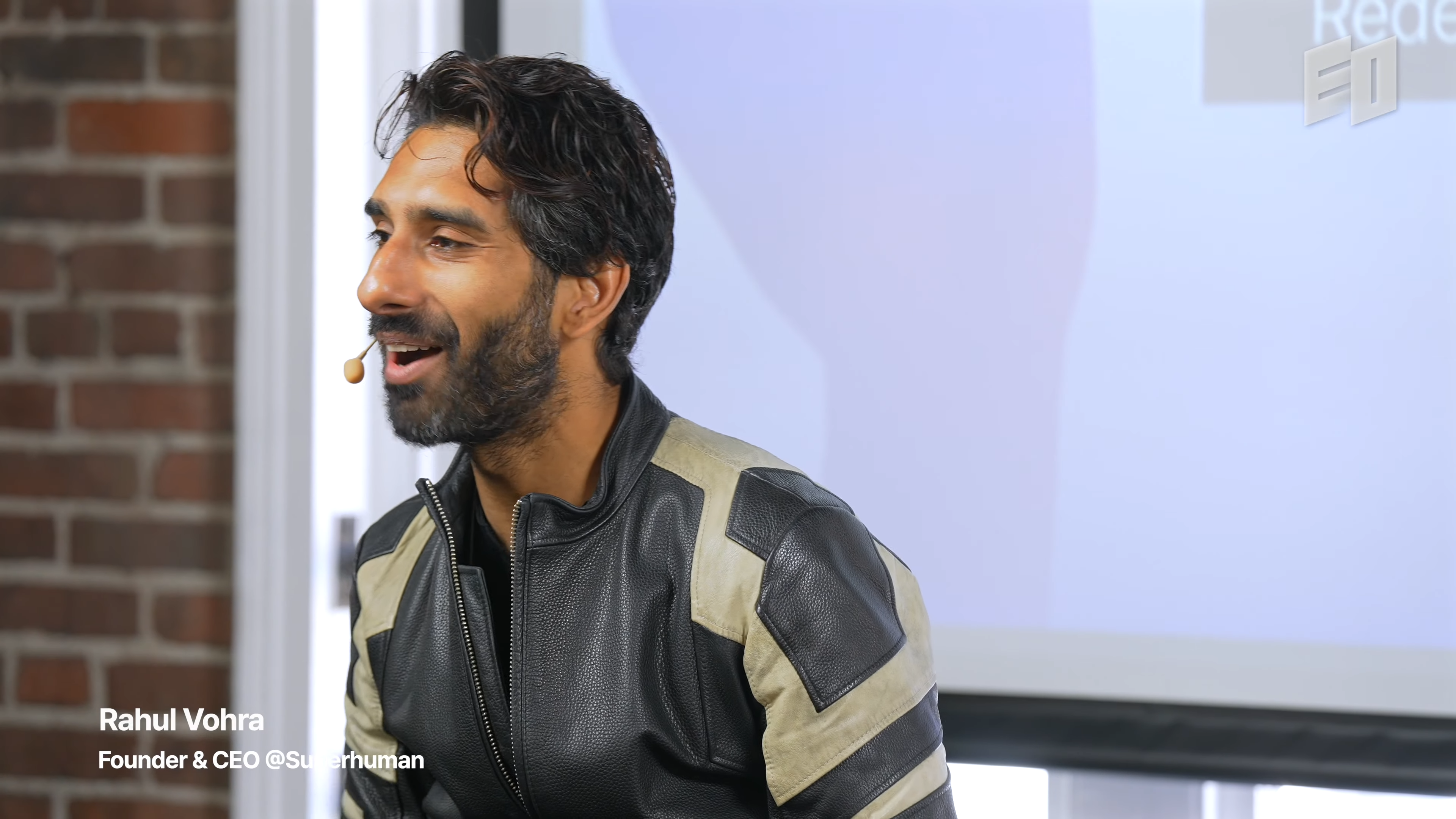
Rahul Vohra: My name is Rahul. I am the founder and CEO of Superhuman, where we make the fastest email experience in the world. With Superhuman, you get through your inbox twice as fast as before, reply one to two days sooner, and save four hours or more every single week.
Host: Rahul, we are going to be talking about productivity tools today, and you are building one. Let's start with the very first question. While you were building Superhuman AI, can you share when you first decided, okay, let's build this, and walk us through the steps you took until it was born? What challenges did you face, and how did you bring the team in?
Rahul Vohra: We started in February of last year, and believe it or not, nobody really knew anything about AI. We did not have a machine learning engineer on staff. We had never needed one. It just had not been important for what we were building. We had barely used large language models. We were vaguely aware, because how could you not be? But around January and February it became incredibly clear to me, as I think it did to all of us, that this was an existential moment. These moments do not happen often in the history of startups, but it was obvious that everything would change, and that this had to become one of the core pillars, one of the top three priorities of the company.
Because we did not have anyone on staff who knew what they were doing, we did not have time to hire for it, and it was existential, we approached it very differently from most new initiatives. For context, we were around 110 people at the time. Even so, we did not assign the project a product manager, as you might at a company that size. We decided I would run it personally. Fortunately, I had just hired a president, so I was able to hand day-to-day operation and management of the company to Paul. We created a small tiger team of myself, a designer and a handful of engineers. The idea was to run it like a startup, devoid of all process. We would get together regularly and build stuff, with founder fiat.
A lot of what a founder has to do sometimes is, in the absence of data, just say, this is what we are going to build. Trust me, I will own it if it is wrong. If it is right, we move on and build the next thing. You need to be able to short-circuit the decision paralysis that can happen as companies get larger and debating things becomes the way decisions are taken. Debating is great, and it is how many decisions should be taken. But for something brand new like this, I wanted to get at it really quickly.
Launched Superhuman AI in Just 4 Months
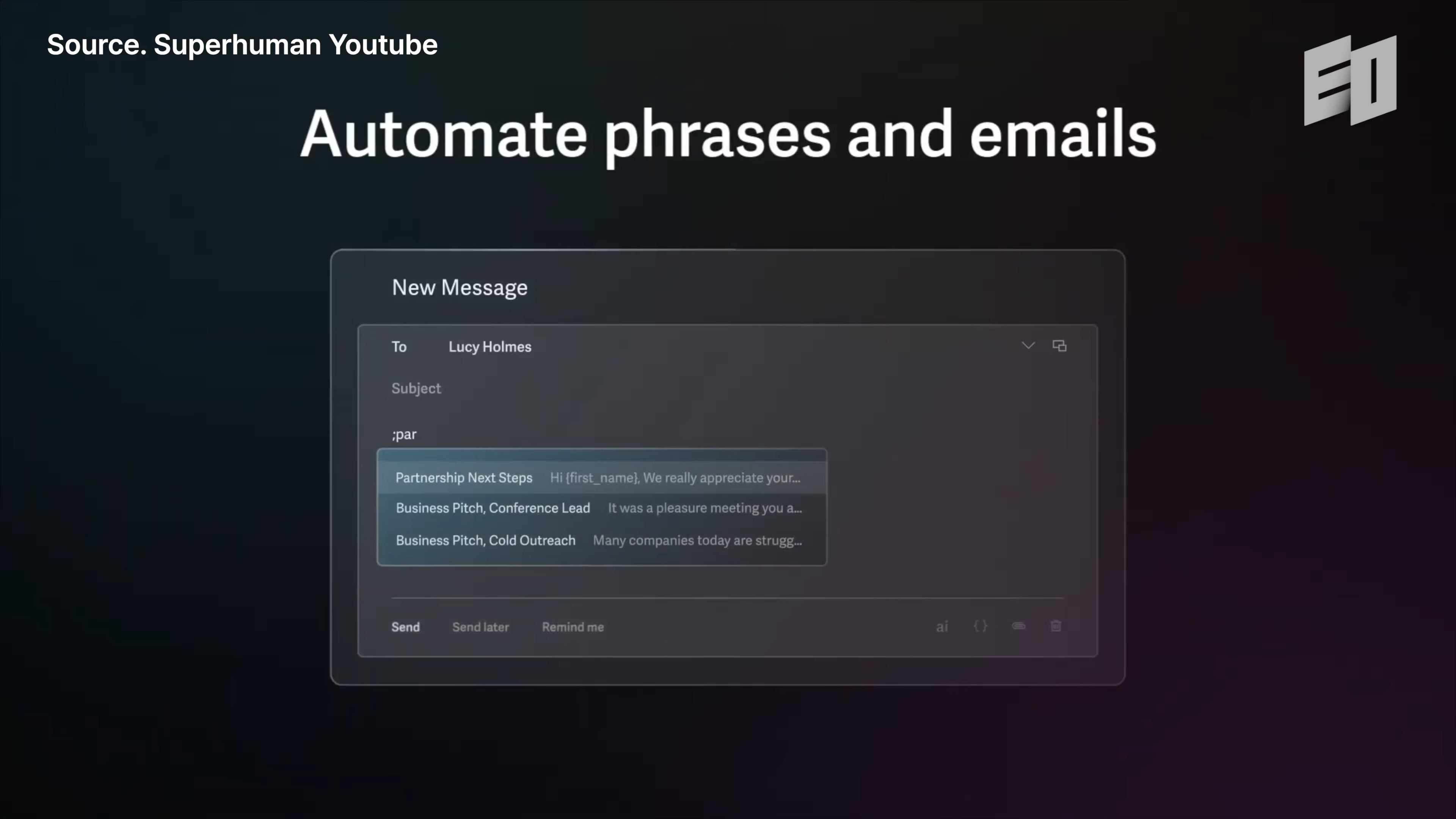
Rahul Vohra: So it was small, it was fast, it was chaotic, it was stressful, and we did it really quickly. A few months later, in June of last year, we launched the first version of Superhuman AI, which lets you write with AI. You jot down a few notes and we turn them into a fully written email in your own voice and tone, matching all the emails you have already sent. That feature is now familiar in basically every application we use, but it was the very first thing we built, and it really captured the hearts and minds of our user base and of Silicon Valley. It was a big deal at the time.
That is an example of what we call on-demand AI. It is relatively easy and cheap to run, because it only operates when people click the button. But it gave us the confidence to move on to the next phase, which we call always-on AI. This is AI that is constantly running in the background, all the time, which is much harder to build and much more expensive to run. The first always-on feature we built was Auto Summarize. Imagine that when you receive an email, a one-line summary is precomputed and always available on top of the conversation. When new emails arrive, it instantly updates, and if you want more, you hit a shortcut and see bullet points about the conversation. People really love that. It gave us the confidence to build Instant Reply, also always-on. Imagine waking up to an inbox where every email already has a draft reply. You hit edit and send, and sometimes you do not even need to edit. That gave us the confidence to build the next thing. We have been working our way up this confidence ladder, taking on more ambitious and more expensive projects.
I am no longer an individual contributor on that team, but I was for the first six months, to kickstart it. Now it runs like a regular project at Superhuman. That is one of the great things about having a great leadership team. Because I had just hired a president, I could leave the explanation, delegation and authorization of the idea to Paul. He explained to everyone what was going on and figured out the resourcing. I did not have to go through any difficult conversations to make it happen.
Don't Obsess Over the Competition
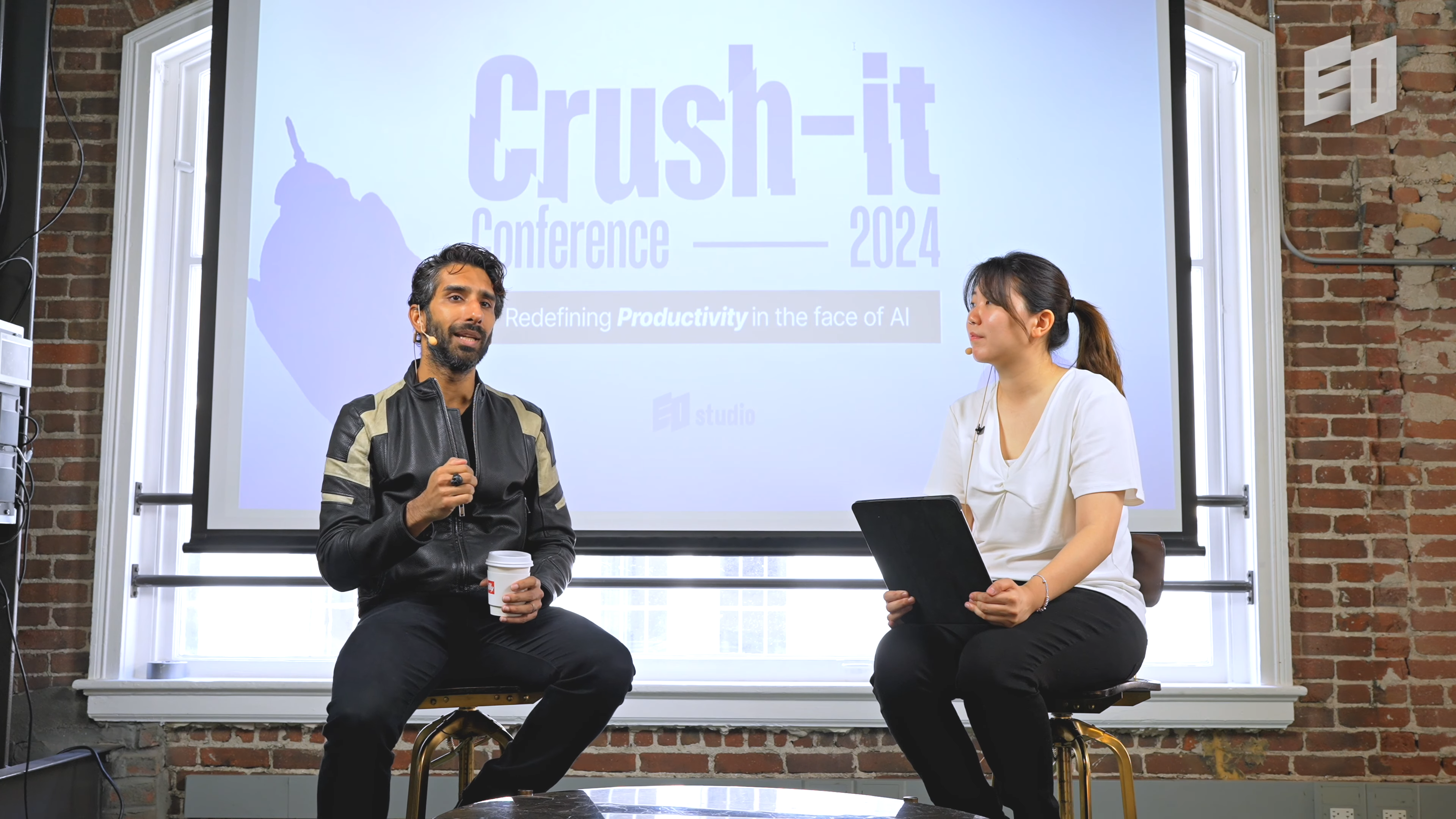
Host: There are all these AI agents coming up that do not just deal with email. Everybody is building AI tools to answer emails and book calendars for you, and other email software is trying to emulate features that have been popular in Superhuman. How do you see all of these agents and all of this competition coming along, and how do you see Superhuman moving forward?
Rahul Vohra: The topic of competition has come up so many times over the years at Superhuman. Every time there was a new email client, especially in the early days, some people in the company would panic, and I would talk about it. Then we would get on with building great software and delivering value to our customers, and every single time, it has come and gone. Paul Graham has a good piece of advice about this. Don't obsess over the competition. It actually doesn't really matter. Just focus on making your own customers and your own users incredibly happy. That is what we have always done, and the AI wave is no different. The agent wave is no different.
We see Superhuman as a core part of this evolution of the productivity landscape, and we are working hard towards an agentic future. We believe in a world where one day you will have a Superhuman AI agent, and if you use the product today you can see the beginnings of that in features like Ask AI. Imagine an AI that can triage your inbox on your behalf, schedule meetings on your behalf, and write and one day even send fully written emails on your behalf. An agent that can work not just on tasks but on complex problems, break them into subproblems, work on them in parallel or in sequence, resolve ambiguity, ask you clarifying questions, go off and research things, and interrogate internal systems, APIs or even other agents. I have just described a lot, but over the next year or two we will get there, faster in some places than others. That is what we are building towards.
How to Make Customers Willingly Pay for the Product
Host: Let's get into building productivity software. When people say they love productivity tools, there are many. But when it comes to paying for them, I feel people shy away. Oh, I love productivity, oh, it is paid, and they do not use it. For Superhuman, from very early on, you had people lining up to use your first product. What makes the difference for a product people are willing to pay for, and what edge did you have at the very beginning?
Rahul Vohra: In terms of why people have been, are, and will continue to be willing to pay, think about who sends and receives a ton of email. Who does email for a living? Founders and CEOs, obviously, and most people in this room. If you are not already doing email for a living, as your companies grow you soon will be. But it goes much deeper. It is account executives, account managers, customer success, business development, recruiting, business owners, realtors, and leaders and managers of every kind. They all do email for a living, and a core part of their job is to be responsive. If they are not, they block their team, miss opportunities, or in the worst case damage their own reputation. So there is a carrot and a stick. There is the danger of doing email poorly, which sadly most people do, and the benefit of doing it really well, because it is core to the job. That is why people are willing to pay.
How to Define and Measure 'Productivity'
Rahul Vohra: So how do we define productivity? Most companies start, and we certainly did, with the time they save people. There are two ways to measure that. You can measure it directly, by timing how long an activity takes inside Superhuman versus in Gmail or Outlook, counting how many of those activities people do, and multiplying it out. That is the bottom-up measure. You can also do it top-down, by surveying your users, and we do both. At Superhuman we are fairly famous for our product-market fit engine, a completely different kind of survey designed to get you to product-market fit. As part of it, we ask people how much time we are saving them. Triangulating bottom-up and top-down is how we get to four hours or more every week.
But that is just the beginning. There is a lot else you care about when you measure email productivity. One is how much email you actually get through. One thing that is unique about being a founder, or in any of these high-email roles, is that there is an infinite number of emails to answer, so inbox zero across the entire inbox may simply be impossible. So another way to measure productivity is the rate at which you respond. If you work for an hour, are you responding to 10, 50, 100, 200 or more emails? What we can show is that people in the same amount of time respond to 2.4 times the number of emails they would in Gmail. That is the second metric.
The Big Difference Between Great Founders and Bad Founders
Rahul Vohra: The third metric is how rapidly you respond. Some of you may have seen the interview with Sam Altman from when he was president of Y Combinator. He noticed a big difference between excellent founders and bad founders in how they respond to email. He defined excellent founders as those who went on to build billion-dollar companies, and bad founders as those whose companies eventually failed. As you would expect, the bad founders took days or weeks to respond. The good founders responded within minutes, literal minutes. The billion-dollar founders you know today respond faster with the product than without it.
Email as a Collaboration Tool
Host: Can you tell us more about how you view email as something more than a communication tool, if you do?
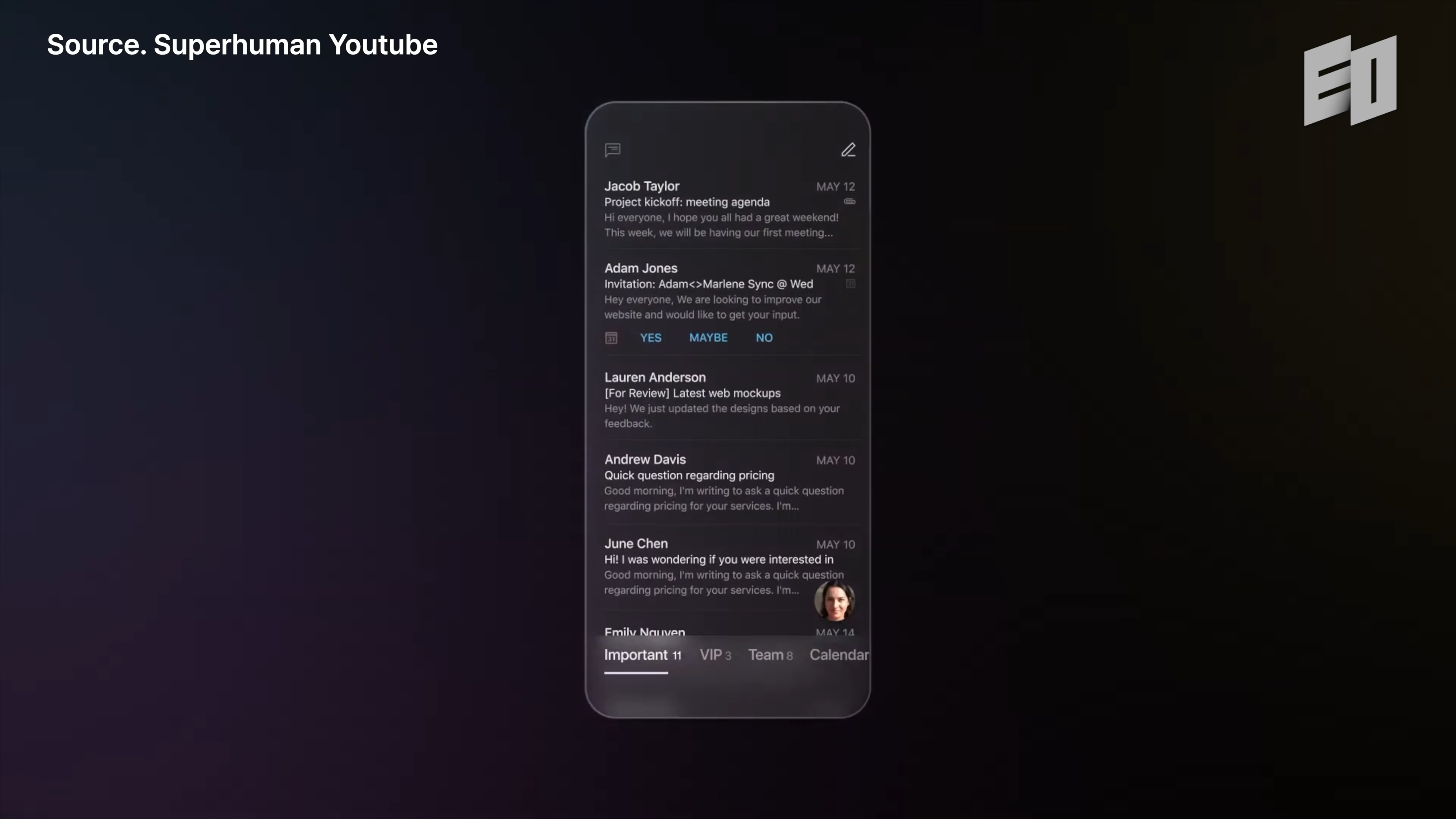
Rahul Vohra: We think it is not just communication. It is fundamentally a collaboration tool, and we believe that so much that we reimagined the entire email experience to be multiplayer. Inside Superhuman, you can take any email and share a live view of it with your team. You no longer have to repeatedly forward, BCC or take screenshots. As new emails arrive on that conversation, your team can see them, even if they are not recipients, either in Superhuman or on a web page. You and your team comment directly on those emails, and the comments are not email objects. There is no risk that they leak. They are stored entirely separately, and you can have a safe conversation about whatever you are trying to do. We believe in this collaborative future of email so much that we rethought the whole experience to build these features. It was a huge lift, well over a year, but that is what we have been building.
Host: Can you talk about what has changed for you in building email as a collaboration tool and offering it to teams? What is so different about it, and what makes it better for your company too?
Rahul Vohra: Over the course of the last year we have scaled from relatively small and mid-market startups to teams of several thousand, which is really exciting to see, and that kind of revenue ramps quickly. The reason I would have gone multiplayer sooner is that it is much easier to build a strong business when you sell to teams. Selling to an individual is a double-edged sword. The good news is you only need to convince one person, so you can tell a very clear story. You do a lot of email, you are the founder, the CEO or the salesperson, imagine doing it twice as fast, responding more quickly, working more deals or closing them faster. But it is harder for that person to stick around, because someone else may come along with an equally clear story.
In general, very few software companies have scaled to be extremely large off single-player subscriptions alone. We could name them right here, Spotify, Netflix, and I am trying to think what else. What makes those companies feasible is that they can credibly and reliably add tens, if not hundreds, of millions of new subscribers to the top of the funnel every year, because they only retain 50 to 60% of subscribers by the end of any given year. When they stop being able to do that, they have to start raising prices. That is what Netflix does, and it is not a great business in the very long haul unless you can keep adding users.
So if you are building a subscription business, it is much more robust to build something you can sell to teams. It is harder in other ways, because you have to convince a team to adopt it. But once a team does, it is so much stickier and so much harder for them to churn out. At that point you can reach what a lot of investors call negative churn. You will lose some seats in a company, or even in a cohort of companies, but the seats you acquire in that same cohort more than offset the ones you lose, so any cohort expands in revenue over time even if certain accounts churn to zero. That is what most B2B SaaS businesses do. They grow off the back of cohorts expanding.
So we did the long, hard grind of building it single-player first, making it work with Gmail and Office 365, on iPhone, Android, Mac, Windows and web. That took many, many years. We made it something individuals actually wanted to use before coming back and making it truly multiplayer over the last year. I did not want to build an email client that your boss forces you to use. I wanted to build a piece of software that you genuinely fell in love with and wanted to use.
Host: Thank you, everyone, and thank you, Rahul, for the amazing talk. Let's give him a round of applause.