At a Glance
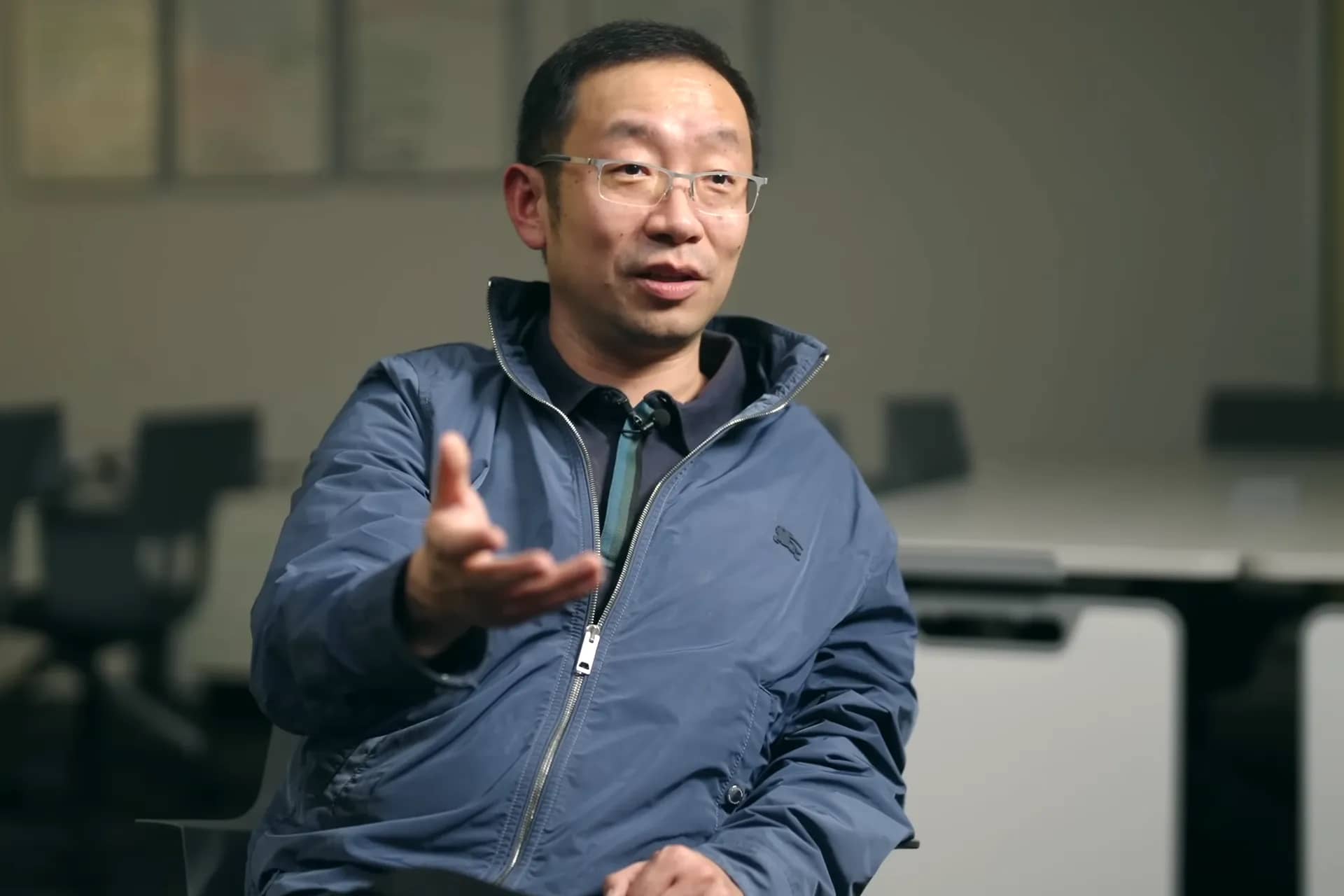
- Who: Li Jiang is the Director of the Stanford AIRE Program. Inspired as a child by cartoons like Transformers, he dedicated his career to building educational frameworks that prepare the next generation for an AI-driven society.
- What: The Stanford AIRE Program trains students to combine artificial intelligence tools with Stanford's Design Thinking methodology. The curriculum emphasizes human-centric innovation, focusing on empathy, clear problem definition, rapid prototyping, and continuous user feedback.
- Lesson: Why attempting to block AI tools like ChatGPT in education is impossible, how data-driven systems like AlphaFold automate execution tasks so humans can focus on creative breakthroughs, and how a five-step Design Thinking loop systematically unlocks individual creativity.
Li Jiang grew up inspired by Transformers to build robots, a passion that ultimately led him to direct the Stanford AIRE Program. Rather than fearing automation or banning tools like ChatGPT in classrooms, Jiang advocates for teaching AI thinking alongside Stanford's classic Design Thinking framework. His methodology trains students to delegate execution tasks to machine algorithms, allowing humans to focus on empathy, problem definition, and 0-to-1 innovation. In this interview, Jiang outlines how parents and educators can help students navigate artificial intelligence, re-architect learning assignments, and systematically build human creativity.
Key Takeaways
Teach AI Thinking Before Technology Outpaces Education
Li Jiang argues that students should learn AI thinking early enough to distinguish machine strengths from human strengths. AI literacy is not simply technical training, because it helps young people recognize where machines can assist and where human innovation remains essential.
Let Machines Handle Patterns, Then Protect Human Innovation
Li uses AlphaFold to show how machines can solve problems that humans have only partially mapped. Once AI handles that kind of pattern work, people can concentrate on creating what does not yet exist, using technology as support for innovation rather than competition.
Design Thinking Makes Creativity More Systematic
Li says Stanford’s design-thinking method cannot turn everyone into Steve Jobs, but it can make people more innovative than they were before. A repeatable process gives learners a way to practice creativity instead of treating it as a fixed trait that only some people possess.
Innovation Starts By Defining The Right Problem
Li’s design-thinking sequence moves from empathy to definition, ideation, prototyping, and testing. He emphasizes that teams often fail before ideation because they have framed the wrong problem, so clear definition and willingness to return to it are central to useful innovation.
Empathy Reframed Nepal’s Incubator Problem Completely
A Stanford project initially assumed Nepal needed more expensive incubators, but fieldwork revealed that medical centers already had machines and villages needed affordable home versions. Visiting users corrected the problem definition, proving that empathy can change both the product and the place where it belongs.
Use ChatGPT To Explore Education’s Future Together
Li lets students use ChatGPT to write essays, then discusses how they used it and how it felt. His approach treats new technology as something education should study openly, helping teachers understand its effect while preparing students for a future shaped by AI.
Watch the full interview now on EO's YouTube channel! Below is the complete transcription of the interview. Minor edits have been made for clarity and readability.
Introducing Li Jiang, Director of the Stanford AIRE Program
I'm Li Jiang, and I'm the director of the Stanford AIRE Program. The era of AI is in the near future, and I would say it's actually now. It has started already. I'm passionate about trying to figure out what the right way is of teaching the next generation in the era of AI and robotics.
Know AI Thinking
A lot of people are afraid of AI, so they try to avoid it. They say they want to stay away from that. But the thing is that this is probably one of the most powerful tools we have ever invented. If you don't use these tools, then you cannot really compete with other people.
I think there are a few things we need to change. One is that we need to start to teach AI thinking as early as possible. AI thinking will allow them to know the difference between a human and an AI, and the human part is really the innovation part, from 0 to 1. That's where AI cannot do a good job. We need to focus on that.
3 Things of AI Thinking
There are 3 important things about AI thinking. The first thing is that you need to have a general understanding of how AI works. In the past, AI was mostly based on rules or specific algorithms that we write into the computer. The humans set the rules. Now we have developed different algorithms, like deep learning and reinforcement learning, based on data, because we have much more powerful computers that can handle way more data. They will try to find the most optimized solution based on the current data, and the more data you have, the better the solution you usually get.
If you do the first one, the second one is that you gain the ability to differentiate human ability from the machine's ability. I think probably most of the audience don't know there's a scientific research area called structural biology. Scientists in this field study the structure of a protein. Proteins are so important for all living creatures. The whole world has something like 100 to 200 million proteins.
In this research area, a lot of scientists focus on determining the structure of these proteins. We humans have found the structures of only a very small number of them, less than 1%. However, there is an AI called AlphaFold, from DeepMind. In the past two years, AlphaFold has predicted the structure of almost all the proteins in the world, and they put it in an open database online. So once the machines can do a job, let the machines do it, and then we focus on the human part.
After you get the first two, the third one is that you will have the ability to work with AI and use AI to help you accomplish other jobs. The critical part is going from 0 to 1, which basically means we invent something that didn't exist before, and we probably can do 0 to 1 better with AI providing a lot of information and things like that. So we should prepare our kids to learn how to innovate, to generate new ideas, and to use AI to help us with that kind of thing.
How Do We Invent New Things?
Design Thinking Makes Creativity Systematic
Creativity is something that is really hard to teach, and some people think creativity cannot be taught. How do you teach people creativity? This gets changed by Stanford design thinking. We can use this method to teach you how to systematically make innovations.
Design thinking is a methodology that we use here at Stanford to teach people how to make innovations. We do not make you as innovative or creative as Steve Jobs or Elon Musk. However, we can use this methodology to make you more creative and more innovative than yourself.
Design thinking has steps that you can follow. The first step is to empathize. First, you have to understand who you're inventing for. Are you inventing for your parents, or are you inventing for children who are studying in school? You have to understand who the users are, then you empathize with them, especially with their emotions.
Then you go to the second step, which is called define. A lot of people didn't have the right problem to start with. You have to define that problem clearly. Then you go to the third step, which is ideation, using brainstorming to generate a lot of ideas. You get feedback from the users and pick the good ones to prototype. After you do the prototype, which is the fourth step, you test with the user and get feedback. Maybe the feedback is good, maybe the feedback is bad, but you have to redesign or reinvent.
We have a phrase, all design is redesign. If you realize that you actually didn't define this problem right, then you go back to step 2. You have to go through these iterations. Eventually you will have some very nice inventions.
Redesigning an Incubator for Nepal
When you read books or listen to lectures, after you finish, you haven't understood it yet. You have to use it several times to really feel it. Let me give you an example. In one of the classes at Stanford, the project was about how to get more incubators for Nepal. At first, a lot of people were just trying to say, well, let's design it in California. But then we say, you have to gain empathy. You need to go to the real place. If you have never been to Nepal, how can you design for that?
They actually flew to Nepal and went to the mountains, and to their surprise, they saw a lot of these expensive incubators in the medical centers. They are not lacking those machines, but they don't know how to operate them. They had found the wrong problem. They had to redefine the problem, so they went back to these villages and talked with the farmers, who said, we do need those things, but not in the medical centers. We need them in our home, and we need the cheap ones.
So they designed a very cheap machine that functions as a baby incubator, and it had very good success. That's a good example. The problem was defined wrong at first, and then they went into this design thinking process, found a way to redefine the problem, and solved the right problem.
I Let My Students Use ChatGPT
There are a few things that are most interesting about AI and robotics. I think the first one is ChatGPT, because it's probably a surprise for a lot of people that AI can talk with people in a very natural way. It cannot only chat with you, it can also write code for you. It seems like it knows a whole lot and is smarter than a lot of people, which surprised people. It's also going to change education for sure, because now kids can use ChatGPT to write essays and do homework. So teachers need to think about how to deal with that.
Actually, I just gave my students an assignment yesterday. I asked the students to write an essay. I said, we just talked about ChatGPT in the class, and now I'm going to give you an assignment to write an essay with the help of ChatGPT. I'm not asking you to not use it, I'm asking you to use it. And then after that class, I will have a short discussion with each of you about how you used it and how you feel about it.
I think that with technology advancement, you cannot try to ignore it or avoid it. It's happening, and it's just like water, you cannot block it. You have to go with it. For me, I want to understand how ChatGPT is going to impact the education system, and I want to work with our students to understand that better. That's why I gave this homework to my students.
Dreams, Optimus Prime, and the Future of Education
I'm a big fan of Autobots and Transformers. I grew up with those cartoons and I'm a big fan. Even now, I'm still a big fan of Optimus Prime, and that really inspired me. I always wanted to make cool robots, from when I was a little kid, and I think most kids have a dream when they're young. It's easier to inspire a dream when someone is in the early ages. After people grow up, they kind of lose their interest. They lose their dream. They don't know what to do. It's actually critically important for these little minds to have dreams.
My ultimate goal is to find out what the ideal education system for the future is. The education part is really important. It has a profound impact on the next generation's future, and that is my ultimate goal.