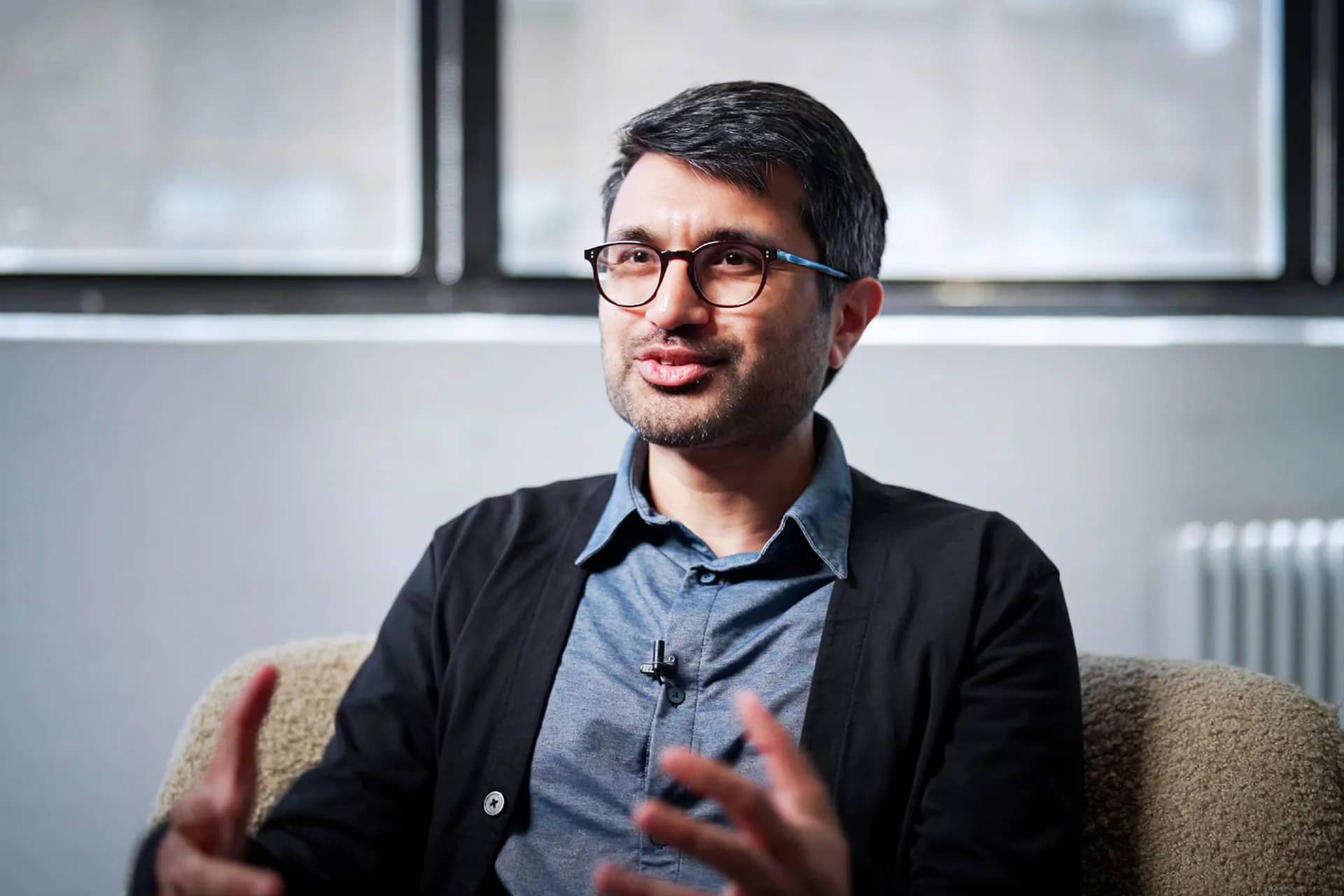
Interview with Max Junestrand, Founder of Legora
At a Glance
- Who: Max Junestrand is the CEO and co-founder of Legora.
- What: Legora is the AI platform where legal work happens, helping lawyers draft, review, and research faster.
- Traction: Legora grew from three engineers and zero clients to over 750 clients and 300 people in two years, more than doubling revenue every single quarter, and is now valued at $5.5 billion.
He didn't come from law. He didn't come from code. He started Legora at 23 and built it into a $5.5 billion company before turning 26.
In this interview, Max Junestrand talks about the mindset behind Legora's rise, the intensity of building for demanding customers, and why great companies are often built by teams that move in sync under pressure.
Key Takeaways:
Why Being a $5.5B Unicorn Still Feels Like Day One
Junestrand argues the legal AI market has only done 0 to 1, with 1 to 10 and 10 to 100 still ahead. He says Legora can't afford to be a fast follower; it has to keep acting like the innovator.
He Had Term Sheets in Hand. He Flew to San Francisco Anyway.
Legora already had European VC term sheets and business growing in Europe when it chose Y Combinator instead. Junestrand felt Sweden was too small an ecosystem to play in the big leagues, so he took calls between 1am and 10am to keep serving European clients while building a US presence.
The Jaw-Drop Demo That Sold Legora's First Law Firm
Incubated inside Mannheimer Swartling, Sweden's largest law firm, Legora let lawyers upload their own old memos and watch the AI draft a first pass. Junestrand says that moment of seeing their own work redone by the system is what turned early skeptics into believers.
How Legora Earned Trust With Lawyers Who Don't Give Second Chances
Junestrand says lawyers are too busy to tolerate a broken onboarding, so the product has to work on the first try, every time. That meant being explicit with clients about exactly what the tool could do today versus a quarter or a year from now.
What Question Does Max Junestrand Ask Every Candidate He Hires?
He still interviews everyone who joins Legora and asks them to describe the hardest problem they've worked on, then asks how they'd solve it differently today. He says the answer reveals how much capacity a person has to grow, which he treats as the most important hire signal.
Founders Must Be Their Own Toughest Boss
Junestrand says a CEO's role changes faster than anyone else's as a company scales, so there's no fixed way of doing the job to fall back on. He describes the discipline required as refusing to work on the easy things and forcing himself onto the hard ones instead.
Watch the full interview now on EO's YouTube channel! Below is the complete transcription of the interview. Minor edits have been made for clarity and readability.
Introducing Max Junestrand, CEO & Co-founder of Legora
Hi, I'm Max. I'm the CEO and co-founder of Legora. Legora is the platform where legal work happens. We solve legal tasks with the help of AI, with the mission of creating 10x lawyers. Over the past two years, we've grown from three engineers in Stockholm, zero clients, to now over 750 clients and 300 people, more than doubling every single quarter.
From Zero to $5.5B in 2 Years
I think for me, without competition there is no excitement. I don't get stressed being in a competitive environment. I get energy from it. I grew up in Sweden in the Swedish archipelago. It was a small community where I didn't get enough competition. I got very interested both in sports and in video games. I used to compete in this video game called Dota 2. Having gone through that very competitive environment, I wanted to take some of that with me to college.
Gaming a lot for me back in those days taught me that if you want to be great, you have to grind. It's not enough to just play more hours. You got to play smarter and you got to learn more. You have to bring a level of intensity better than anybody else. In Dota, you're five players on one team. That group of five people have to collaborate seamlessly to reach the right goals together. Some of my leadership style is probably influenced by some of the early gaming, working with individuals who in many aspects I find much smarter than myself. I think that is a core job of a CEO: to be able to attract people within all different types of fields who bring skill sets that you don't have, and then you got to make the band play together. Then when they start to work together, something new unlocks, and we're playing what I like to call the infinite game, both on a product level but also on a company level.
When I think about our space, as I said, it really feels like we're still on the starting line, despite having grown the company from zero to unicorn. We've done 0 to one, and now there's a journey of 1 to 10, and then 10 to 100, left to do.
One of the things that made the legal industry very attractive to us was that there were so many problems, meaningful problems, to go and solve. I think incredibly important for Legora since the very beginning has been to grow together with our customers. We were incubated in the biggest law firm in Sweden, Mannheimer Swartling. They were generous enough with their early time and space. We actually got a conference room in their office. When I was doing a demo, I would ask the users to take maybe one of their old memos, or part of a case that they had worked on, upload it into the system, and then ask Legora to do a first draft of it. When they saw the results, it was kind of a lean-back, jaw-drop moment. I think those types of experiences breed momentum and give you a lot of energy to keep moving forward even faster.
The Secret Behind Hypergrowth
We had a couple of different options. We could have raised money from European VCs. We had a couple of term sheets. Or we could accept the offer to join Y Combinator and go to San Francisco. Did we have to do YC? I don't know, because we had so much business already growing in Europe. But what attracted us to going to SF was Sweden is a small ecosystem, and so if we want to play in the big leagues, we need to be in the States. If we are going to do this thing, let's be the best at it. I didn't want to bring complacency into my job. I want to do things, and I want to be the best at it, and I want to do really hard things.
We wanted a foot in the door towards the American market. We went from zero to almost a million ARR in like a month and a half during Y Combinator, and a big reason for that was because I was spending a majority of my time still in Europe. I tried to make it work from San Francisco. I bought this ring light to shine on my face when I took calls between 1:00 a.m. and 10:00 a.m., over the night, towards the other side of the world.
For Legora, it's incredibly important to be where our customers are. When we think about both serving them on the ground, but also tuning the product to their needs, it's just a must-have. When we entered the US market, we really wanted to make sure that who we work with in the US as our first set of clients are excellent lawyers, excellent law firms, but also carry a lot of weight in the market, and we were very lucky to be in contact with Cleary Gottlieb, and also Goodwin Procter. I think with both those two firms there was a lot of alignment in what they want to achieve with AI and how Legora can help them get there. We had alignment, and then it was time to go.
After that, we quickly opened an office here in Manhattan. We're at a much scrappier place than what we're in today. I handled the first 30 law firms and in-house teams coming onto the platform, with all the onboardings. The learning that we took from those early days is that you only get one shot. Lawyers are so busy that you don't get a second chance onboarding them on the product. It has to work, it can't break, the use cases need to work and need to solve, and you need to do a good job of setting expectations of what the product can do today versus what it will be able to do a week from now, a quarter from now, a year from now.
They understand that not only is this tech here to stay, it is the way that work will be done. They want to get on the train, they want their voices to be heard, and they want to have a say in what that future looks like. That is awesome. That is not something that we take for granted. My favorite accomplishment so far is frankly just reading through our customer love Slack channel, where we collect feedback and aggregated usage of the real impact that the product is having for the people that we serve. There's nothing as rewarding, at least for me, as when people that we serve let us know we've made their day better, or we've helped their business in some way, or they were able to finish a piece of work and get home to their families to see their kids before they went to bed. I think the focus on delivering the most value for our users, other problems around that seem to solve themselves.
Be Your Own Best Boss
As you can see, we're in our new space here in New York, and there's quite a few empty desks here behind me. We're growing super aggressively across all different teams. I think we're going to have filled almost all of this before summer this year. The team is about 300 people today, spread across several offices in Denver, New York, London, Stockholm, India, Sydney.
I think the hardest part for me growing the company from 3 to 300 was that your role probably changes the fastest. You cannot be married to the way that things were done, or to what you're doing. You just got to wake up every day and think about how do I optimize for the business today, and maybe a month, a quarter, a year out. Those are the decisions you have to take. You need to be your own best boss, and you have to be very disciplined about not working on the easy things, but working on the really hard things. And I think it's your responsibility as the founder and as the CEO to keep the company focused. We can't be fast followers. We got to be the innovators.
Most importantly, it's how do you scale and continue to keep the culture? I have some ideas around that. I take a very active part in our recruiting. I still interview everyone who joins the company. One of the things that I look for in everyone that we hire is how much capacity does this person have to grow? Tell me about the hardest problem that you worked on. What was that problem? What did you directly contribute to solving that problem? And how would you do it differently if you had to go back to that problem today? Because I think the ability to learn from the way that you approach a problem the first time, to the time that you have to approach a problem the second time, is super important. The most important skill that you need to bring to the table. And then I always look for a sense of ambition. We're looking for people who want to take responsibility of the outcome of the company, the outcome that we deliver in the market. That value has probably been the most important part of helping us go from where we were to where we are today.
If I were to give some advice to myself starting out again, you need to really be excited about what you're doing, because if it goes well, you're going to be working so hard, and you're going to be focused on these problems for such an intense period. I wake up every day, and I'm thinking about how do we deliver more value and how do we make Legora a more successful business. I think had we picked something we weren't as excited about, that would have been much harder. I can't wait to have a town hall in Q1 of 2027, see the size and see what we've accomplished by then, because if you would have told me that we would be sitting here Q1 of 2026, back at the start of 2025, I would have never believed you. Yeah, there's a lot to be excited about.