
"In 5 years we could have AGI systems that completely automate all human labor. Every human is gonna become a product manager of a team of AIs."
Will Bryk's prediction sounds like science fiction, but as CEO of Exa—a next-generation search engine that raised $17 million from Lightspeed and Nvidia—he's building the infrastructure that could make this future possible. While traditional search engines rely on keyword matching, Exa understands meaning, powering AI agents that need to navigate and extract knowledge from the web.
In this interview, Will shares how he went from arguing with OpenAI's Greg Brockman about the scaling hypothesis to building his own scaling bet on search, why planning beyond one year is "impossible" in today's AI landscape, and how a history book research project revealed Google's fundamental limitations.
Watch the full interview now on EO's YouTube channel! Below is the complete transcription of the interview. Minor edits have been made for clarity and readability.
Key Highlights:
"In 5 years we could have AGI systems that completely automate all human labor. AI's do all the repetitive work and humans do all the novel work. Every human is gonna become a product manager of a team of AIs."
"1 year plans make sense right now. 3 year plans are really hard, and 5 year plans are impossible."
"I was actually on a beanbag with Greg Brockman, and we were arguing about the scaling hypothesis... Greg was arguing that if we just keep scaling these things, we'll get there. We'll get to AGI."
"We are building transformer-like systems for search and we also know that if you keep packing data and compute into the search engine, it'll get better and better. That's a hypothesis we have. It's like our own scaling hypothesis for search."
"We see a world where there are agents everywhere, GPT-5 level AI agents navigating the web, doing all sorts of tasks. This future is coming. They're going to need search, all of them."
"1 year plans make sense right now. 3 year plans are really hard, and 5 year plans are impossible."
"I was actually on a beanbag with Greg Brockman, and we were arguing about the scaling hypothesis... Greg was arguing that if we just keep scaling these things, we'll get there. We'll get to AGI."
"We are building transformer-like systems for search and we also know that if you keep packing data and compute into the search engine, it'll get better and better. That's a hypothesis we have. It's like our own scaling hypothesis for search."
"We see a world where there are agents everywhere, GPT-5 level AI agents navigating the web, doing all sorts of tasks. This future is coming. They're going to need search, all of them."
The Impossible Art of Planning in the AGI Era
How do you plan for a future where AGI could automate all human labor?
Will: In 5 years we could have AGI systems that completely automate all human labor. AIs do all the repetitive work and humans do all the novel work. Every human is gonna become a product manager of a team of AIs. How are you supposed to plan for that? I think it's extremely hard to predict where the world will be in 5 years. 1 year plans make sense right now. 3 year plans are really hard, and 5 year plans are impossible.
So because the AI market is changing so fast, like every month. Like new systems come out that make new things possible. The right way of navigating that is to think from first principles about like what does the market need that still will be true in a year, because if you're thinking about what does the market need right now, a month later something new is going to come out and they're not going to need it anymore. So you have to think a little more long term. You have to be a little more strategic than in the past.
So because the AI market is changing so fast, like every month. Like new systems come out that make new things possible. The right way of navigating that is to think from first principles about like what does the market need that still will be true in a year, because if you're thinking about what does the market need right now, a month later something new is going to come out and they're not going to need it anymore. So you have to think a little more long term. You have to be a little more strategic than in the past.
From Westworld Watching Party to Scaling Hypothesis Convert
Tell us about your early exposure to AI and how your thinking evolved.
Will: For example, like when I was in college, AI was not at all as prominent as it is today. Everyone today talks about AI, but there were a few people who were aware of what was going on. I was lucky enough to go to a Westworld watching party at OpenAI, and I was actually on a beanbag with Greg Brockman, just chilling on this beanbag, and we were arguing about the scaling hypothesis, and the scaling hypothesis is this idea that you keep putting more compute into Transformers and they'll just keep getting better, and that's how we get to AGI.
That was a crazy idea when I was in college. The vast majority of people didn't believe it. I didn't believe it. Greg was arguing that if we just keep scaling these things, we'll get there. We'll get to AGI, and I was arguing that we need new types of methods. I think we were both right in our own way, but we kept seeing progress from GPT-1 to GPT-2, GPT-3, eventually GPT-4, and at some point along that trajectory I was like, holy cow, like these systems, when you scale them, they just get really good.
I think the people who were earlier to that conclusion did better and we kind of apply the same scaling logic to Exa. We are building transformer-like systems for search and we also know that if you keep packing data and compute into the search engine, it'll get better and better. That's a hypothesis we have. It's like our own scaling hypothesis for search.
That was a crazy idea when I was in college. The vast majority of people didn't believe it. I didn't believe it. Greg was arguing that if we just keep scaling these things, we'll get there. We'll get to AGI, and I was arguing that we need new types of methods. I think we were both right in our own way, but we kept seeing progress from GPT-1 to GPT-2, GPT-3, eventually GPT-4, and at some point along that trajectory I was like, holy cow, like these systems, when you scale them, they just get really good.
I think the people who were earlier to that conclusion did better and we kind of apply the same scaling logic to Exa. We are building transformer-like systems for search and we also know that if you keep packing data and compute into the search engine, it'll get better and better. That's a hypothesis we have. It's like our own scaling hypothesis for search.
How is Exa different from traditional search engines like Google?
Will: It's very different from traditional search. Just like Google or Bing, which basically have stayed the same for, you know, many years, whereas like Exa is getting better like this. And so we're thinking a lot about like where is the future going. So we see a world where there are agents everywhere, GPT-5 level AI agents navigating the web, doing all sorts of tasks. This future is coming. They're going to need search, all of them.
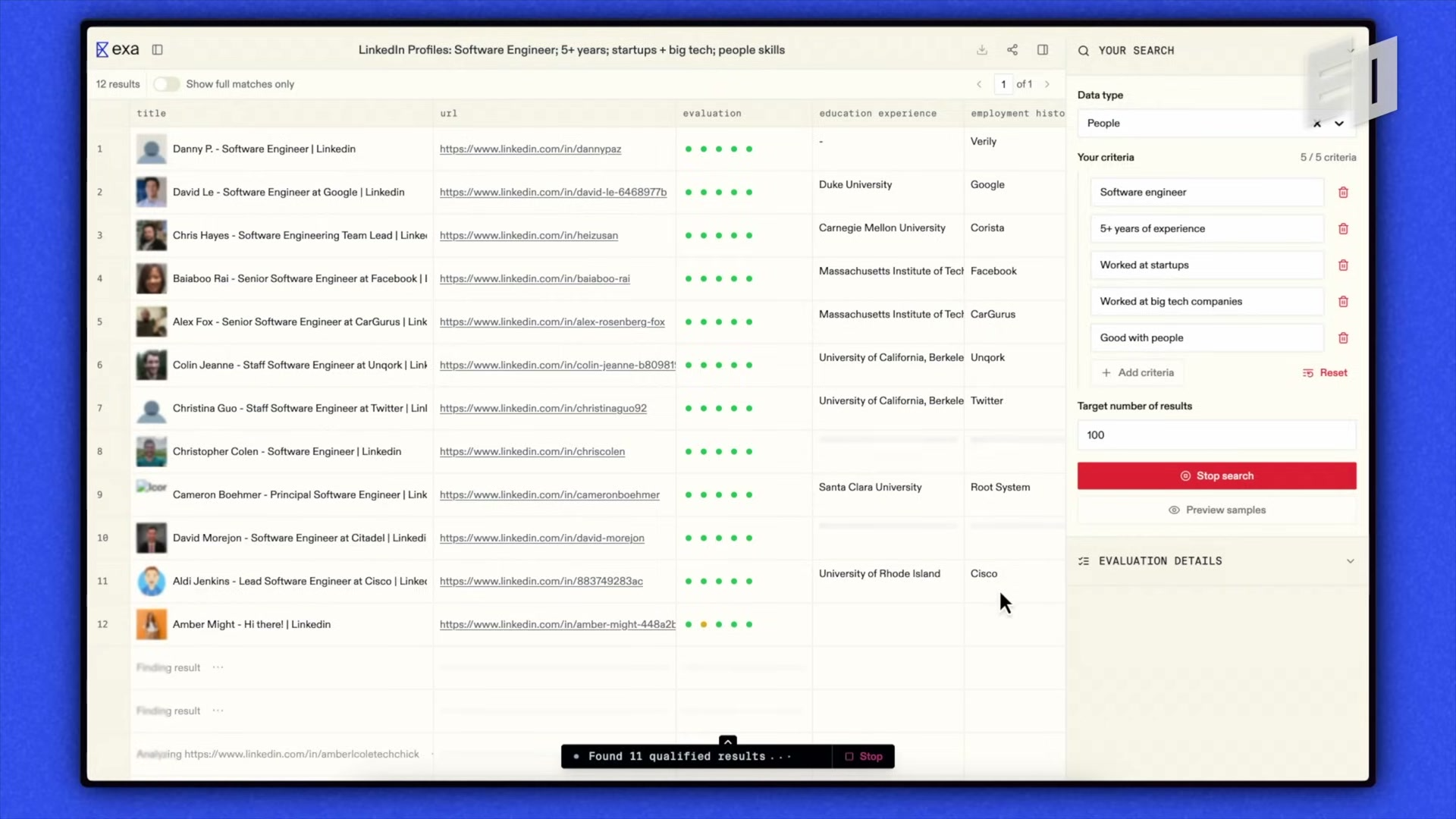
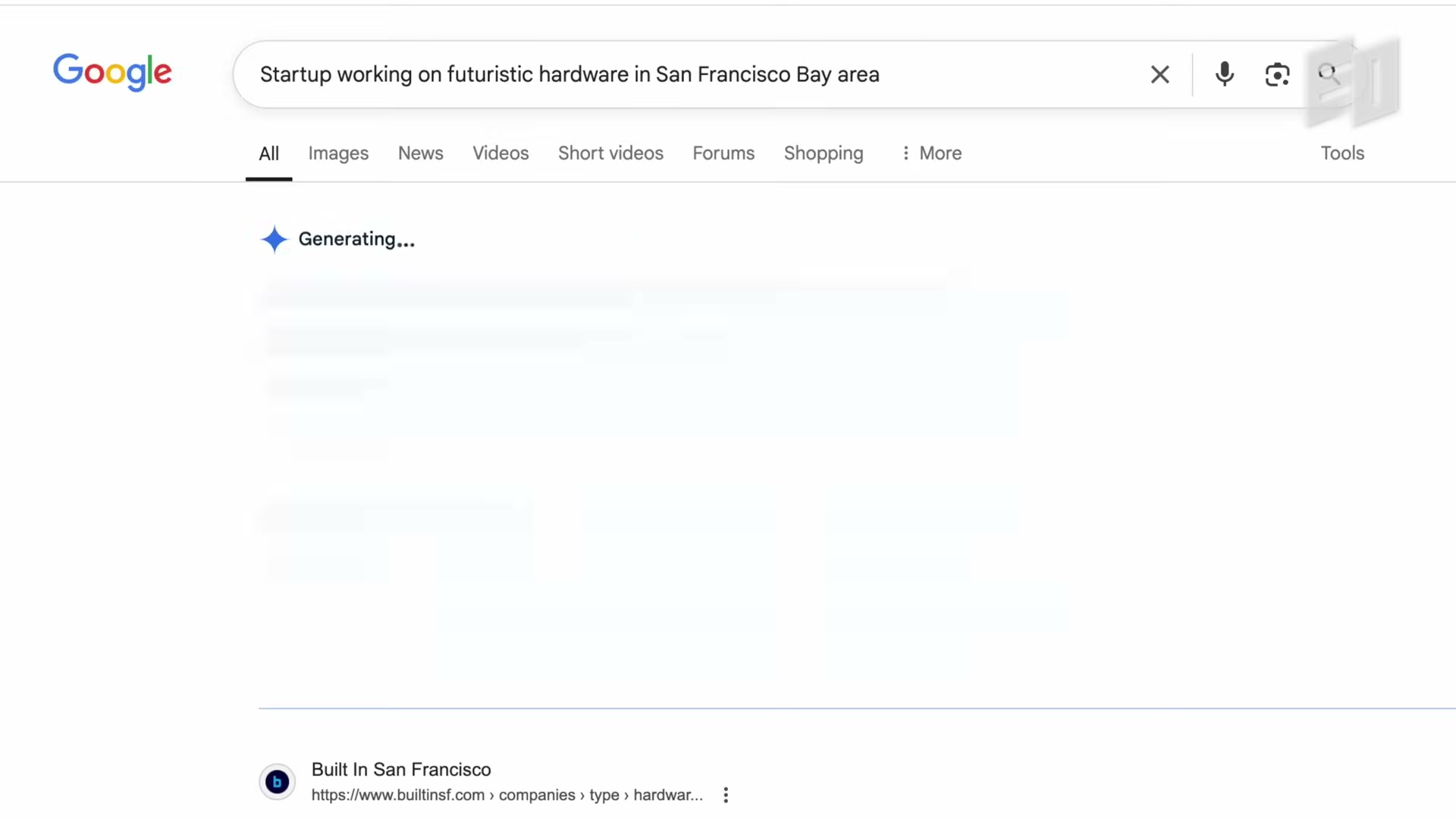
Hey, I'm Will, I'm the CEO of Exa. We're building the next generation of search. One good way of understanding Exa is in contrast to traditional search. So traditional search engines use mostly keywords. OK, so if you're using a traditional search engine and you want to find startups working on futuristic hardware in the Bay Area. Traditional search engines will use keyword matching. The results they give you will be documents that contain the words startup and hardware in Bay Area, but startups that are working on futuristic hardware in the Bay Area, they don't typically have those terms. Like you might have a rocket company in SF. A traditional search engine won't be able to find that rocket company, but Exa can because we understand the meaning of documents. We understand the meaning that, oh, if it's a rocket company in SF, then it does match startups working on futuristic hardware in the Bay Area.
We believe it's possible to have perfect search over the web, meaning whatever information you want, you get exactly that. We help companies integrate this high quality knowledge into their applications. So we recently raised $17 million from Lightspeed and Nvidia. Our revenue is doubling every quarter. We're building the next generation of search.
Hey, I'm Will, I'm the CEO of Exa. We're building the next generation of search. One good way of understanding Exa is in contrast to traditional search. So traditional search engines use mostly keywords. OK, so if you're using a traditional search engine and you want to find startups working on futuristic hardware in the Bay Area. Traditional search engines will use keyword matching. The results they give you will be documents that contain the words startup and hardware in Bay Area, but startups that are working on futuristic hardware in the Bay Area, they don't typically have those terms. Like you might have a rocket company in SF. A traditional search engine won't be able to find that rocket company, but Exa can because we understand the meaning of documents. We understand the meaning that, oh, if it's a rocket company in SF, then it does match startups working on futuristic hardware in the Bay Area.
We believe it's possible to have perfect search over the web, meaning whatever information you want, you get exactly that. We help companies integrate this high quality knowledge into their applications. So we recently raised $17 million from Lightspeed and Nvidia. Our revenue is doubling every quarter. We're building the next generation of search.
From Physics Dreams to The Social Network Reality
What led you to pivot from physics to computer science?
Will: I came into college wanting to study physics to like I want to understand how the universe works and I thought physics was the right way to do that. Something big that influenced me was watching The Social Network because I, I was studying at Harvard and The Social Network took place in Harvard. It was actually a very accurate movie and it was very inspiring to see this guy change the world just on his laptop. I realized that you could have like a massive influence just coding on your laptop in a way that you couldn't. As much with physics, it was very clear that that the AI could understand the problems of physics, so I went into computer science and I think that turned out to be right because now like the AI is getting so good that it should be able to just tell us the answer or infuse it into our brains.
When Google Fails: The History Book That Started Everything
What inspired you to start Exa?
Will: Before Exa on the side, I was writing a history book. I got really excited about world history and I decided I'm just gonna write a book about it because I'm. Like no one has captured in a book the level of excitement that I had. And so I was doing a lot of research for the book. I quickly realized that Google is actually not good enough for that type of research. Like Google is great for surface level investigations. Once you start like trying to go deeper and trying to understand any topic deeply on the web, Google really fails.
For example, if I want to find like all the research papers on poverty in ancient Rome, it's actually really hard to find that on Google. Not every paper will the word poverty. And so I was doing the research for this book and it was really hard to find things. And then at the same time GPT-3 had recently come out and GPT-3 was this magical creature really that I could talk to and it could understand like anything I say at a very deep, complex level. And so the thinking was, what if we could apply the same technology of GPT-3 to search? What if you can make a search engine that actually understands you at a deep level and it's been the same goal ever since.
For example, if I want to find like all the research papers on poverty in ancient Rome, it's actually really hard to find that on Google. Not every paper will the word poverty. And so I was doing the research for this book and it was really hard to find things. And then at the same time GPT-3 had recently come out and GPT-3 was this magical creature really that I could talk to and it could understand like anything I say at a very deep, complex level. And so the thinking was, what if we could apply the same technology of GPT-3 to search? What if you can make a search engine that actually understands you at a deep level and it's been the same goal ever since.
Eighteen Months of Banging Heads Against Walls
What was the early development process like for Exa?
Will: The first year and a half of Exa we did research into search models into how can we take transformer models and apply them to a search engine. No one's really done that before. It took a long time to figure out how to do it well, and that required persistence. Like we were just banging our head against the wall for a year and a half, trying out different models, trying out different data sets, and eventually we got something that worked really well. If we didn't have the persistence, you know, 6 months in we might have given up, but we didn't.
Early November 2022, we launched the. First version of Exa to the public, we built a search engine that was perfect for AI applications. Basically AI systems, they have all this intelligence, but they're lacking in knowledge. And so when they need knowledge, they go make a call to Exa and get exactly that knowledge.
Early November 2022, we launched the. First version of Exa to the public, we built a search engine that was perfect for AI applications. Basically AI systems, they have all this intelligence, but they're lacking in knowledge. And so when they need knowledge, they go make a call to Exa and get exactly that knowledge.
The ChatGPT Moment That Changed Everything
How did ChatGPT's launch impact Exa?
Will: Then ChatGPT came out a few weeks later, and that was a big moment for the information ecosystem. But for us it was really interesting because we started getting requests for API access to our search engine. We started getting requests for API access first from a friend who was actually like living downstairs. I told him, no, sorry, we don't have API access, and I didn't really think much of it. But then we, then we got a request for API access from someone from some company in Germany, and we also told them no, sorry, we don't have an API. And we kept getting requests for API access and we realized that because of ChatGPT people were starting to build. AI applications all over the place for all sorts of businesses and all these AI applications needed search like the AIs themselves needed to search and that's when we start to realize, OK, Exa could be really useful for these AI applications.
Yeah, so our initial customer found us and so one lesson there is just like be a really good listener to the market like what are people repeatedly saying they need and you might have some idea of what. You know what you're going to sell, but then if people keep requesting something like API access, maybe you should start listening to them. Like we cared more about learnings from the customer than getting a lot of revenue. And so yeah, we were like opening our ears to what do the customers need. Over time developed a hypothesis about how we should price and what types of customers we should pursue.
Yeah, so our initial customer found us and so one lesson there is just like be a really good listener to the market like what are people repeatedly saying they need and you might have some idea of what. You know what you're going to sell, but then if people keep requesting something like API access, maybe you should start listening to them. Like we cared more about learnings from the customer than getting a lot of revenue. And so yeah, we were like opening our ears to what do the customers need. Over time developed a hypothesis about how we should price and what types of customers we should pursue.
Predicting the Future from First Principles
How do you predict where AI and technology are heading?
Will: I think you can guess where companies like OpenAI and Anthropic are going to build based on like what are like what are big markets that they could tackle. Like agents, like automating work is a clear huge market and so they're clearly going to do that. OK, so now you know what types of things they want to do. Can they do it? Well, then you think about the fundamentals of LLMs. You think like, OK, LLMs can, as long as you can make training data for some objective, they will get. Better at that objective. Can you make training data for agentic behavior? Definitely. You just have a bunch of examples of navigating the web in order to buy plane tickets. And if you have a million examples of that, then now the LLM will know how to buy plane tickets.
Yeah, so any sort of tasks such that you could create data for it, LLMs will get near perfect at that task. So that's like a fundamental way of thinking about this. So will AI get really good at navigating the web? Yes, that's pretty easy because it's, it's easy to generate lots of navigating the web data. Will AI get really good at robotics? Yes, but probably on a longer term horizon because gathering lots of robotic training data is harder because it's hardware and hardware is hard to work with. So what do we learn from that? We learned that AIs navigating the web will come pretty soon. AI's navigating robotics will take longer. So just from like simple first principles you can guess where things are going. Picture in your mind how crazy good technology will be and AI will be in a year and then build for that world.
Yeah, so any sort of tasks such that you could create data for it, LLMs will get near perfect at that task. So that's like a fundamental way of thinking about this. So will AI get really good at navigating the web? Yes, that's pretty easy because it's, it's easy to generate lots of navigating the web data. Will AI get really good at robotics? Yes, but probably on a longer term horizon because gathering lots of robotic training data is harder because it's hardware and hardware is hard to work with. So what do we learn from that? We learned that AIs navigating the web will come pretty soon. AI's navigating robotics will take longer. So just from like simple first principles you can guess where things are going. Picture in your mind how crazy good technology will be and AI will be in a year and then build for that world.
Explore more