Jul 08, 2026
He Built $100B at Google, Then Failed. Now He Runs an $80B+ Company
Interview with Sridhar Ramaswamy, CEO of Snowflake
Founder Focused


0:00 / 0:00
💡
At a Glance
- Who: Sridhar Ramaswamy is the CEO of Snowflake, the AI data cloud, who spent years scaling Google's advertising business before leaving to found the search startup Neeva, whose team and technology later became part of Snowflake itself.
- What: Snowflake is the AI data cloud that helps enterprises manage their data and build AI directly on top of it, through products like Cortex and Snowflake Intelligence.
- Traction: Under Ramaswamy, Snowflake is now valued at more than $90 billion, and the same team that built search and AI at Neeva is the one building Snowflake's newest AI products, Cortex and Snowflake Intelligence.
In this conversation, Sridhar shares what he learned from Google, why every startup is an act of belief, what it really means to build a 10x product, and why founders have to remember that they are more than their failures.
6 Key Takeaways:
Why Does Every Startup Require a Little Bit of Religious Faith?
Ramaswamy calls founding a company an act of madness as much as belief, since you are betting that you can do something nobody else has done. At Neeva, he and his team believed they could build a search engine 10x better than Google, but the product they shipped was only somewhat better, never close to the bar needed to unseat an incumbent with Google's distribution. The conviction has to come first, but he says founders also need the honesty to know whether they have actually cleared that bar.
Every Job Has Its Own Definition of Excellence, So Go Find It
The hardest part of a new role is rarely the skills you already have. It is figuring out what excellence actually looks like in that specific job. As a first-time public company CEO, he had never worked with financial analysts before, so his advice is to find people who already know what excellent looks like and get feedback from them until you do too.
What Do Most People Get Wrong About Leadership?
Most people reduce leadership to managing people, but the real job is being a cultural icon who sets what the entire company values. That means a leader has to imbue the spirit of the company's own products into how they operate, not just direct headcount. At Snowflake, he says that shows up as staying hands-on with product quality rather than treating leadership as a purely administrative layer above the work.
The Two Things That Actually Build Iconic Companies
Ramaswamy boils iconic companies down to two things. First, high quality products priced competitively are the ultimate form of defensibility, more durable than any single feature. Second, a leader's job is bringing in people who are hungry and malleable, since something you are excellent at today might be done better by an AI model tomorrow, and only adaptable people keep up with that.
Faster, Cheaper, Better: The Bar for a Compelling Product
At Snowflake, Ramaswamy tells his product managers and engineers that a product needs a compelling reason to exist, and that reason comes down to being faster, cheaper, or better than the alternative, ideally all three. He sees this as the same core principle across consumer and enterprise products, since technology only earns its place by visibly disrupting how value gets created for the customer. Belief in your product is not enough on its own; it has to clear that bar for someone to actually switch.
Failure Is Hard, But It Plants the Seeds for What Comes Next
People are more than their failures and more than their successes, because holding onto that identity is what lets you keep building after something does not work. Neeva did fail, but the team that built its search and AI capabilities is the same team now building Cortex and Snowflake Intelligence. For him, that is proof that a failure's real cost is never the whole story until you see what grows out of it.
Below is the complete transcription of the interview. Minor edits have been made for clarity and readability.
Find Work That Makes Time Stand Still
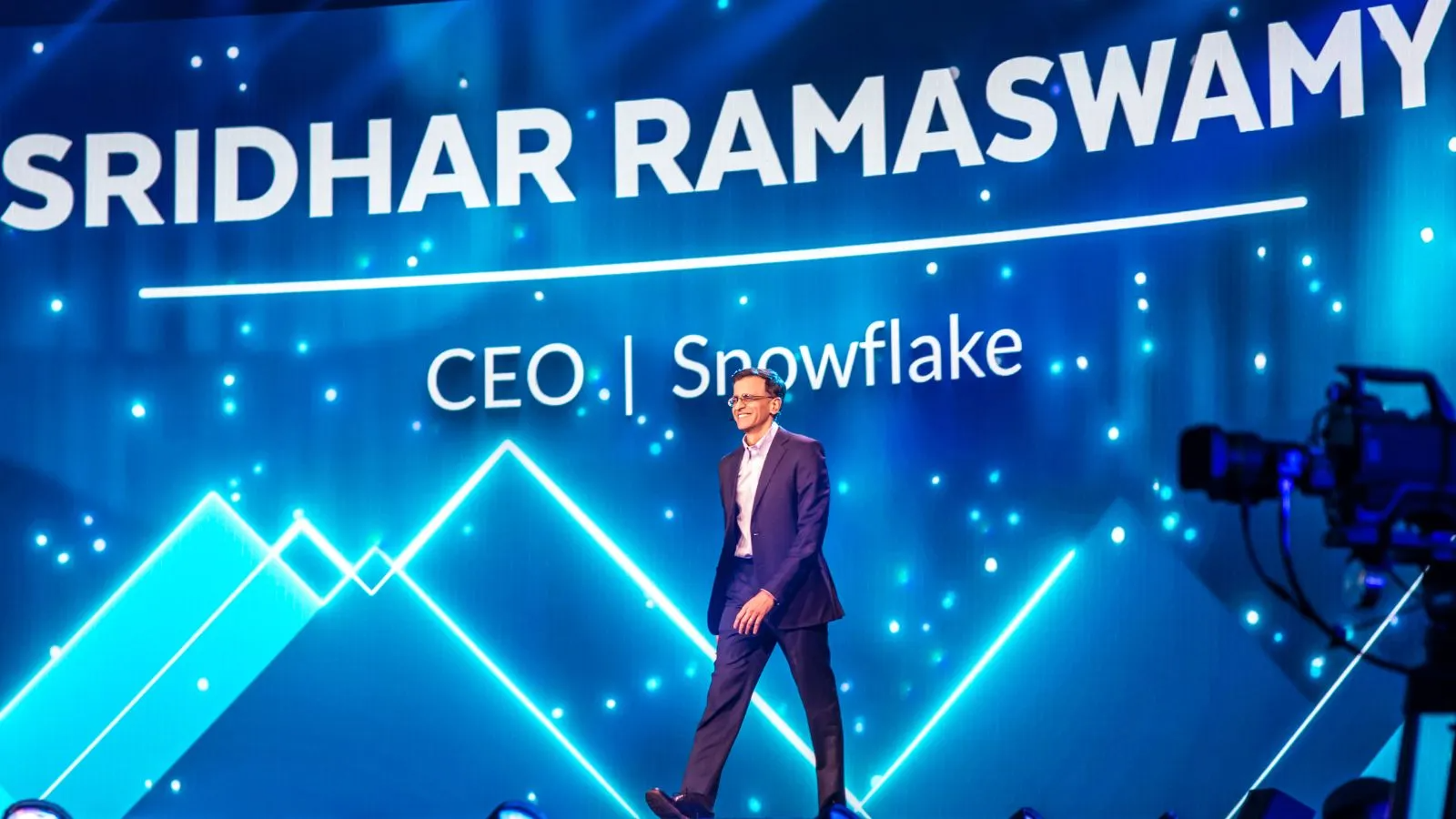
Hi there, my name is Sridhar Ramaswamy. I am the CEO of Snowflake, the AI data cloud. I'm also a proud husband and father of two sons that are both computer scientists. So, data and computing runs in the family.
I have worked in technology and computing all of my career. I grew up in India, primarily South India. Sometimes people ask me about what my career arc was like, how I navigated my early times. To be honest, when I first came to the US, I didn't even think about working in the industry or what kind of job I would get.
I came to get a PhD, and for somebody that grew up in India (a very technically focused, hyper competitive but very structured environment), doing a PhD is very strange, because most of the time when you go ask a professor what you should work on, they will typically tell you that you should work on something interesting, which is terrifying for a 22-year-old that does not really know research to figure out what to do. But that itself is a journey where you have to understand existing areas, come up with brave hypothesis for where that area could go, and then do research. To be honest, what I didn't realize at the time was I was okay doing research, but I was never passionate about doing research.
When people ask me today what they should work on, I typically tell them you should work on something that makes time stand still. There are things that all of us do where we are happy to spend more and more time doing it.
Reinventing Himself as a Software Engineer
After 10 years of doing research, I actually decided that I wanted to reinvent myself and become a software engineer. Software engineering, writing code, is still my passion. I love the act of creation. I love the act of producing something from nothing.
My success at Google came because I liked software. I liked creating systems, but I also liked creating business impact. There was no better team on the planet than the search ads team, where technology translated into great product and enormous amounts of money for somebody like me to grow. So my career has been a happy combination of yes, being at the right place at the right time, but also finding things that were truly resonant to me.
Along the way, like with everyone else, I've had amazing mentors, obviously the founders of Google, but also people like Bill Campbell, who is known as the coach in these areas. He's been coached to among the greatest leaders the world has ever known.
Every Job Has Its Own Definition of Excellence
The first and most important thing that you have to internalize is that every job has its own set of requirements. There are many things that you might know. There are things that you have to learn.
As a first-time public company CEO, for example, I had not really dealt with analysts that cover Snowflake from a financial perspective. Getting to know them, establishing relationships with them, and understanding what it takes to work with them is something that I had to learn. I happily learned it.
My biggest piece of advice would be every job has its definition of excellence. So try and figure out what that is. If you don't know, that's okay. Find other people that know. Get feedback from them about what it takes to be excellent. That way, you can aspire to be as good as the best in how somebody does their job.
3 Leadership Principles for the AI Era
My Snowflake story honestly is a bit of an accident. My original agreement with the company was that I would come join and stay for 6 months. I'm a reluctant leader. I didn't start my career thinking that I would be a leader, but I saw it as hugely impactful to the organization that you are a part of.
Too many people think of leadership as purely that of people management. You're also a cultural icon that sets the tone for what is valued in the company. And in my mind, that means that leaders need to truly imbue the spirit of what the company's products are about.
I pride myself on being a very hands-on leader that knows the details, that cares deeply about the craft of what we do. I think of software engineering as a craft, as something that is a tangible product that makes a difference to our customers. In Google, it was advertisers and end users. Over at Snowflake, it's our enterprise customers.
Why Great Leaders Stay Close to the Product
I'm obsessive about things like product quality, making sure that it's the highest quality that is there. I think that's an important quality that a leader needs to have, which is to feel the mission of your company is great products, or the best defense, especially today when there is so much changing. It means that you really have to focus and understand what is great today and what is great tomorrow, and keep building towards that. High quality products that are also priced very competitively are the ultimate defensibility. Taking care of your customers, being there for them when things are not going well, is also equally important, because customers will remember that you are there for them when things were not going well. These are some of the things that create iconic companies. That is number one.
Number two: as a leader, you need to understand that bringing people in, helping them grow, and helping them thrive is your most important job. I look for people that are driven and malleable. Why do I say that? That's because in a time that is changing as rapidly as it is right now, we want people that will go the extra mile to learn how to do things better, will strive to achieve more.
I also feel you need to be very malleable, meaning you need to be adaptable, because something that you are very good at yesterday might be better done by an AI model today. You cannot hang on to that. You have to keep learning new things, both in your personal life as well as your professional life.
Hiring People Who Can Adapt
As a leader, you need to find people who are hungry, who want to get things done, and nurture them. Give them opportunity. Be there for them when things are not going well, and be very supportive when things are going well.
You need to make sure that you learn how to share credit. Credit is never diluted by sharing, and good leaders always share in the happy news when good things come out of their teams. But they always stand in front when things are not going well and say, "This is my responsibility. These things didn't go well because I could have done better." That kind of giving (both nurturing your team but protecting your team) is very important.
This is not to say that you cannot have a very high bar for who should work in your team. I am routinely a very demanding boss. I expect a lot out of my team. I expect a lot out of myself. But everybody who works with me understands that it is always in the spirit of making us (Snowflake, the company, us as a team) better. That helps you be an effective leader, and one that is also very genuine.
Finally, my life principle is also that I'm an open and transparent leader. I communicate very directly. I give feedback very directly. I take feedback very directly. If people tell me that I can do something better, I never grudge that feedback. I think of that as something as a gift that they are giving me that can help me be better at it. And that kind of an open environment can be very conducive to things getting done very quickly, and us being able to get better very quickly as well.
From Google's $100B Plan to Founder Failure
Eric Schmidt, our CEO at the time, made me and a few other folks write a hundred billion revenue plan. This is like 2007-2008. We all thought that this was the funniest thing ever, because the idea that one company could make $100 billion just sounded so preposterous.Sridhar Ramaswamyon Sourcery with Molly O'Shea
To be honest with you, the hundred billion dollar plan was a little bit of a planning exercise, and we worked on it even though we didn't really believe in it.
But the real challenge came just a few years later, when desktop growth completely flatlined. People stopped buying new PCs, and so that meant that our query growth at Google stopped. This is when mobile started taking off. But the terrifying thing for Google the business was that mobile just did not make any money. So the only place we had growth was in mobile search, and yet mobile search monetized at a fraction of desktop search. So we worked 5 years to bring mobile monetization on par with desktop search, and that was key to Google thriving through 2014, 2015, and honestly through to today.
When Mobile Almost Broke Google's Business
When you look at it from the outside, it can look like a smooth journey, but it was an ocean full of big turbulence. Something like a hundred billion dollar plan was so audacious that you could not immediately translate it.
On the other hand, we kept working at it. We had a good system that would try to improve query monetization, for example, by 5% every quarter. That was part of what drove the overall increase in Google revenue.
Why He Left Google to Build Neeva
Then again, big achievements can also raise questions in your head. In many ways, us hitting things like a hundred billion, being the SVP of ads and commerce at Google, eventually led me to say that I should do something differently. It gave me both the pressure but also the freedom to go do something else.
You Are More Than Your Failures
Why Neeva Failed and What I Learned
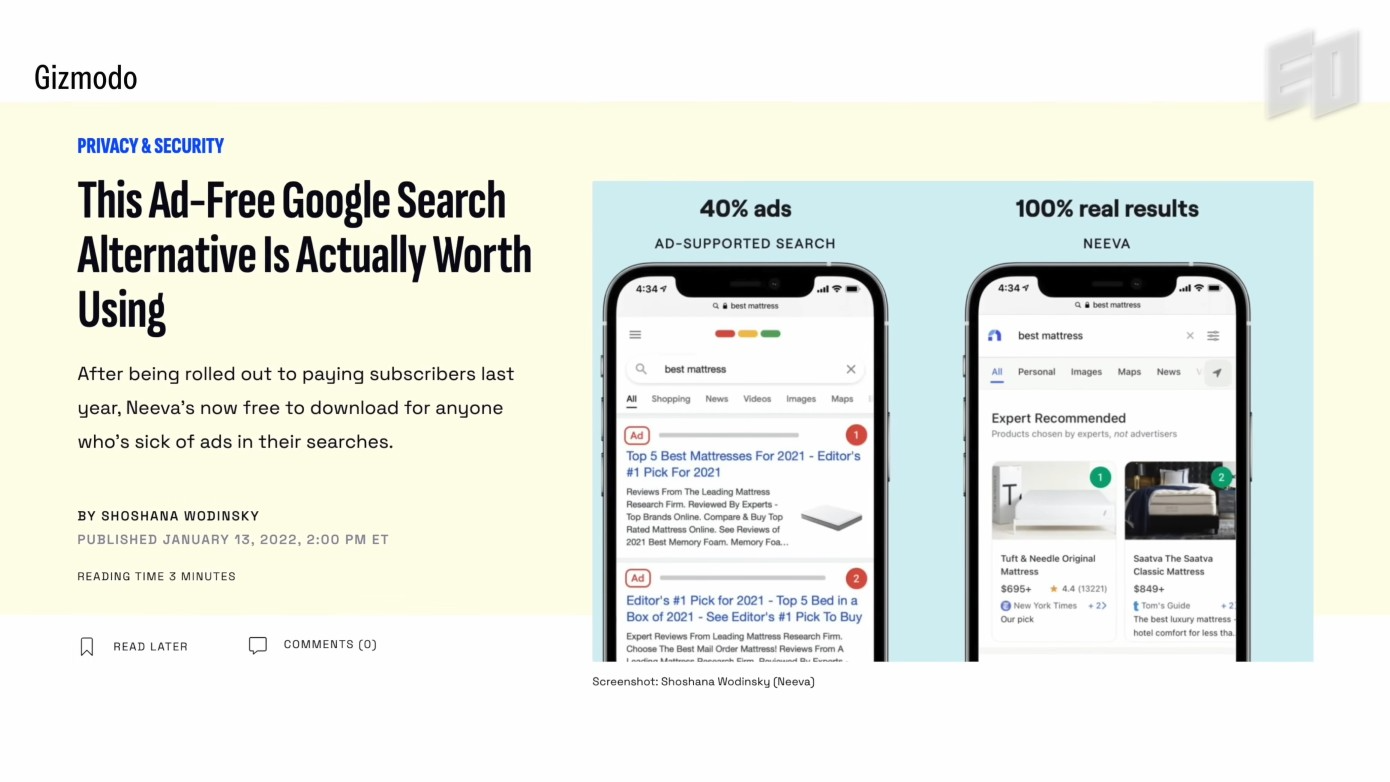
I went and started a company, and we came up with this audacious thesis that a search engine that was free could in fact be a better search engine.
Looking back, I would say that the biggest mistake that we made in conceiving Neeva was not setting the bar for that product to be 10x that of how Google search was. Google has incredible distribution. It pays money to every browser. It pays money to every distribution point. We had to have realized that if we wanted people to adopt Neeva, we needed a 10x product. Until AI came along, we were not really ready for creating that 10x product. That's a lot of the reason why it did not succeed as a company.
Look, my company just was not as successful as my stay at Google. That's okay. I actually think that resilience, being able to deal with failure, is even more important than just succeeding.
I'll tell you something. Every startup is an act of believing. It's also an act of madness, because you think you can do something that other people have never done before. You need to have that kind of a belief. It's a little bit of a religious feeling.
When we started Neeva, we wanted to build a product that was 10x better than Google. It's just that that is a very, very high bar. The product that we built was a little bit better than Google, but not really 10x better. And that was a lot of the issue that we had in distribution.
In many ways, I consider ChatGPT to be the successor to Google in terms of information. I go to ChatGPT often because it can solve problems for me with a nuance that a Google search is never going to have.
I sometimes take just pictures. My coffee grinder stopped working. I just took a picture of the grinder, put it in ChatGPT and said, "Hey, this is not working. What's the problem?" And it told me probably that the top was not screwed on tight. I go and tighten the top, and lo and behold, the coffee machine starts working. That is the modern search experience.
How to Keep Building After Failure
My biggest message to founders is all of you need to believe that you can do something better, but you need to make sure that there is a compelling reason for users to want to use your product. At Snowflake, for example, I tell our PMs, our engineers, that the bar is faster, cheaper, better. Your product has to be one of these for it to truly succeed, ideally all of it.
I think core principles remain the same: that it's about creating value, whether it's for consumers or for enterprise customers. What these technologies all do is they disrupt how value is created. Making sure that their products are leveraging whatever is coming out today with the best models into their product, into how they think about creating value, is going to be really, really important.
10 years from now, if Snowflake were to become an iconic company like a Google or an AWS, I could not be happier. I hope I'm around for that time to actually see it. That's the collective aspiration that we are driving towards. We want to be a company that truly makes a difference to all of the enterprises that are out there. Snowflake's mission is to use the power of data and AI to help every enterprise realize its full potential. And in 10 years, I hope we are well on our way to doing this for most companies on the planet.
You Are More Than Your Successes, Too
First of all, failure is hard. It's a little bit like a deep gash or scratch that you get. You can deal with it. It is still hard. But I think dealing with it makes us try harder. It makes us appreciate success a whole lot more.
Yes, Neeva failed, but out of that failure came all the seeds that were there, necessary to make Snowflake an amazing company in AI. The team that built search at Neeva built search at Snowflake. The team that built our AI mode at Neeva is the one that's building Cortex and Snowflake Intelligence, which are the successors, and the future of where Snowflake is going.
Every failure has important lessons, but it is important to accept failures. Accept that you're human, but also accept and internalize that you're more than your failures. I tell people, I tell my children, I tell myself that we are more than our successes, and we simultaneously are also more than our failures. Having that strong conviction in who you are as a person, I think just makes you believe in life, and makes you act with purpose as you get things done. And honestly, you cherish your successes even more, because you understand that it is something amazing and unusual.