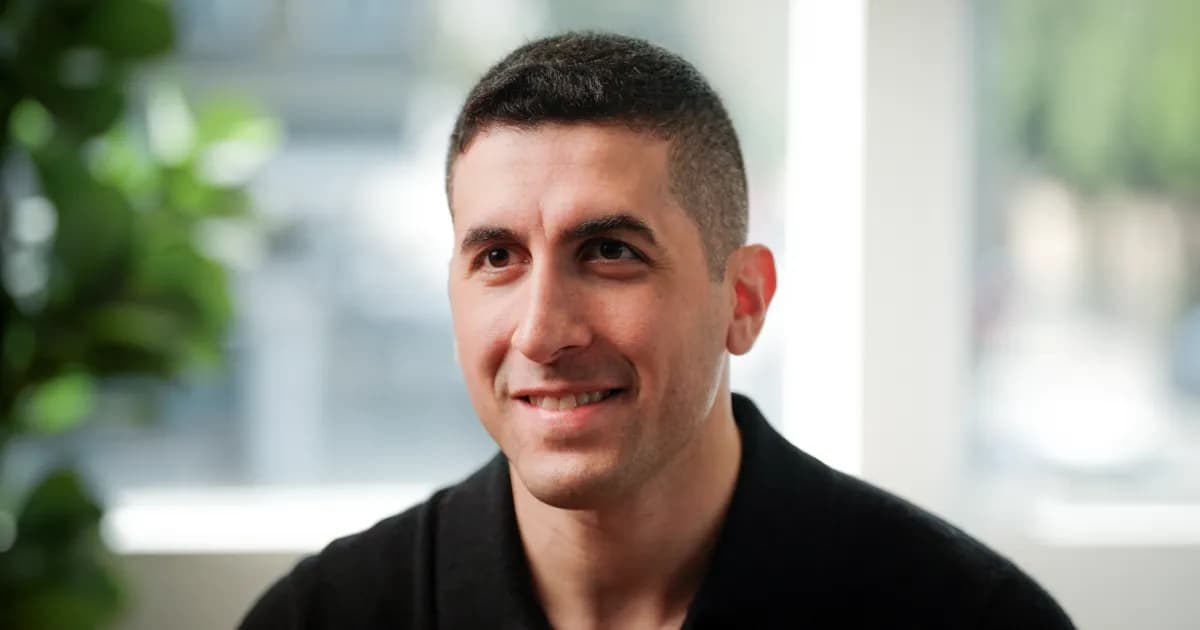
Interview with Rajeev Dham, General Partner of Sapphire Ventures

At a Glance
- Who: Rajeev Dham is a partner at Sapphire Ventures, a $10B+ growth-stage B2B software investor. Its portfolio includes LinkedIn, DocuSign, and monday.com.
- What: He breaks down how Sapphire evaluates AI-era SaaS startups, from category leadership and market velocity to founder conviction.
- Lesson: Rajeev Dham breaks down why market size means nothing without velocity and category position, why founder conviction can outweigh a crowded field of competitors, and why AI alone will never be the differentiator that saves a pitch.
In this interview, Rajeev shares sharp insights on navigating saturated markets. While many ask, "Is AI disrupting SaaS businesses?" he believes AI alone isn't a true differentiator.
Key Takeaways
Why Every Founder Needs a "Why Now"
Every enterprise SaaS category is already saturated and getting funded at the earliest stages. Rajeev pushes founders to answer why the world needs another company like theirs, not just why their product is good.
How a Category Leader Sucks the Air Out of a Market
A dominant player in a market pulls in the best employees, investors, and capital. Its lead compounds from there, so Rajeev looks past raw market size to who already holds that position.
Is Market Size the Wrong Thing to Chase?
A large market means nothing if customers are happy with what they already have. Rajeev looks for energy: companies coming up for renewal and real appetite to switch, not just addressable market slides.
Even a Healthy Company Can Miss the Wave
A business can be performing well and still be sitting in the wrong pocket of the market while a competitor with a different angle captures more velocity. Rajeev says it's the hardest trend to notice from inside a company that's already doing fine.
What Should a VC Actually Do for a Founder?
Rajeev wants founders who tell him to get out of the way on strategy, but come to him for benchmarks like compensation and pricing models. A VC who needs to operate the business isn't backing the kind of entrepreneur he wants to back.
From Advising Deals to Having Skin in the Game
Rajeev started as an investment banker at Goldman Sachs, advising companies on decisions rather than making them. He moved to venture because he wanted the uncertainty and upside of actually being in the deal, not just recommending one.
Watch the full interview now on EO's YouTube channel! Below is the complete transcription of the interview. Minor edits have been made for clarity and readability.
Introducing Rajeev Dham, Partner of Sapphire Ventures
Hey, I'm Rajeev Dham. I'm a general partner with Sapphire Ventures. Sapphire is a growth-stage, B2B-focused software investor. We invest in the US, Europe, and Israel. Sapphire's portfolio includes LinkedIn, ExactTarget, and DocuSign. It also includes Looker and MuleSoft, along with more recent investments like monday.com and Glean, an enterprise AI company. We're managing over $10 billion in capital.
I started my career not as an investor but as an investment banker. I worked for Goldman Sachs, in their financial institutions investment banking group. Your primary role there is to advise companies on what you think they should be doing in response to a particular situation. That might mean evaluating an M&A deal, going public, or raising financing. That's your job as an investment banker. But ultimately, even after a couple of years, I had a realization. Instead of advising these companies, what would it feel like to actually invest in them? Then I could help advise them from the board level, with some skin in the game and chips on the table, in companies I was excited about.
There's a lot of uncertainty, but it's exciting. These are growth markets, and you're redefining a market or creating a new one. I feel like a kid in a candy store, learning all the time from entrepreneurs: what they're building and why. It's really exciting to me.
How a $10B+ VC sees the market differently
On the market side, you want to make sure there's a good market size. Ideally, you want to make sure the company is an emerging leader. At our stage, that often means a next-generation leader. One thing we look for is category leaders. There are very few markets where three or four players are all roughly the same size. Often the category leader just sucks the air out of a market. They attract the best employees, the best investors, and the most capital. They get the best customers, who tell other customers this is the only game in town. That lead just compounds over time. So we tend to look at not just market size but positioning within that market.
Given the saturation in the software and SaaS space, one thing we're looking at recently is why now. What's different? Maybe a company has an AI angle that's going to create some accelerated growth over the long term, but is there something else inflecting or changing? I like to ask: what's the energy in the market? What's the velocity in the market? You may have a big market size. But if everyone's happy with what they have, it's hard to sell new software into it. What's the energy around adopting new software? What about companies coming up for renewal in that market? I think that's critical.
Even if your business is scaling nicely, it's worth taking a step back and understanding the broader market context. Is there an underlying trend, an inflection point, or a pocket in your competitive space that might be more interesting? Your company can be going nicely now, but another company or another pocket of the market might be positioned for even higher growth. We call it missing out a little bit on the wave. That's incredibly hard to see when your company is performing well and you want to stick to your lane. But it's important to understand that broader context. I've seen it multiple times. Another company has a slightly different twist, or operates in a slightly different segment of the market with more velocity. They end up taking off with the whole prize.
One thing I look for a lot, and ask customers about, is velocity. That means the velocity of product improvements and the velocity of changes a CEO or a management team makes on the go-to-market side. How quickly are those changes made? How decisive is this management team? There's a saying, grow fast or die, and I think that's kind of true in the startup world. There's something about the compounding nature of growing fast. You almost have to hit escape velocity to make it out as a startup and become a successful company. If you don't, the laws of gravity of private SaaS catch up to you. That's hard, and there's a lot of pressure. Competition builds because people see your company growing fast. So you've got to hit that escape velocity. I think this velocity of decision-making, across both product and go-to-market, is what matters in an organization.
Is AI killing SaaS?
Recent market conditions are interesting. It's highly saturated, with hundreds if not thousands of companies. I think the latest count was rather large, maybe $30 million to $300 million ARR enterprise software and SaaS businesses, from infrastructure to application businesses. There's a plethora of them out there in the private markets. Every single category is saturated, and also getting funded at the very early stages.
So if you're a founder tackling something, I'd really push yourself to ask: why does the world need another one of these? Tackle something that's a new problem area, something that's never been done before, or a vertical that hasn't been touched before. The other trend I'm seeing is that every vertical is being touched by both software and AI now. Ask yourself why now, and why the world needs another one of these companies. Because ultimately, investors are looking for that too. What's the difference in this narrative?
It's true that at least 50% of the pitches we hear are AI already, maybe even 60 or 70%. But that doesn't mean SaaS is dead. To me, those are still SaaS companies. AI alone is not a differentiator. It may use AI as a technology enabler, but AI is not the product. AI is just a small piece of the product that they're leveraging in creative ways. If AI is your full product, there's probably something wrong, and we probably won't invest. You have to have an approach that includes some non-AI technology, integrations, and workflows that are different. That's what I think is critical, and that's what people are looking for.
How to find a right founder, It's not a number
I invested in monday.com in 2019. What was interesting to me about monday.com was that you had two founders, Eran and Roy, who had incredible conviction in their own direction and vision. When they presented to me and a group of my colleagues, it was that same night that I booked a red-eye over to Tel Aviv to see them in person. They were shocked and surprised. There was a plethora of companies here in Silicon Valley attacking the same market, maybe with more recognizable Silicon Valley logos as customers, but Eran and Roy had a different way of doing things. I saw that they had true belief in their vision, and it was very well thought out why they would succeed. It was that founder conviction I saw that really left an impression on me. That was just really unique.
In our time together, I noticed something. People sometimes assume growth-stage investing is formulaic. Everything's working, you price the company, and you try to get the money in. There's still a lot that has to work out even at later stages, and at monday.com there was a lot that still had to work out. But there was something that excited me, something that stuck with me about that company and that meeting, that kept me energized on three or four hours of sleep a night for multiple nights. To me, that's become a signal. I used to think it was a flaw. Maybe it still is. But now it's a signal to me. That happened with monday.com, and it's happened with many other businesses since. Our business is pretty simple in some ways: it's investing in people you like and admire, people who move you in some way.
I think every investor needs to adapt to the entrepreneur and founder they're working with. If a VC needs to operate the business, that's not really the entrepreneur a VC wants to back in the first place. We want to back an entrepreneur who essentially says, get out of my way, I know what I'm doing here. But can you tell me how much I should compensate this salesperson? Can you tell me how many of your companies operate in three different distinct go-to-market segments? Are there metrics or KPIs? Can you introduce me to a CTO in your portfolio? Can you sit down with me and talk about usage-based pricing models versus seat-based pricing models, and how that's evolving across your portfolio? Those are the questions a VC should be there to answer, versus going in deeply and trying to operate the business or dictate strategy too deeply themselves. So again, I try to adapt to the company and the situation.
One thing I've realized, from Glean to monday.com, is this. An entrepreneur wants you to walk with them the same way, as an investor and a potential board member. They want to know you're truly bought into their vision, and that you have real passion and conviction for their company. I think that's still paramount in terms of winning a deal and figuring out what you want to invest in.