Sep 10, 2025
The $2.2B Founder's First Advice
Interview with Sadi Khan, Co-founder of Aven
Founder Focused


💡
At a Glance
- Who: Sadi Khan is the Co-founder and CEO of Aven. He previously spent 12 years as an engineer and product manager at Microsoft and Facebook before leaving retirement to build financial infrastructure for consumer debt reduction.
- What: Aven issues home equity-backed credit cards, offering homeowners fast, lower-cost access to capital by combining the low interest rates of secured HELOCs with the speed and convenience of a credit card.
- Traction: Reached a $2.2 billion valuation following a $110 million Series E round in 2025, slashing loan origination times down to 15 minutes for homeowners across the United States.
Sadi Khan left retirement after a 12-year career at Microsoft and Facebook to target America's $1 trillion credit card debt burden. Noticing that credit card interest rates remained stubbornly high above 20%, Khan co-founded Aven to give homeowners instant access to low-cost capital by backing credit cards with home equity. Today, Aven holds a $2.2 billion valuation after raising a $110 million Series E round, compressing home equity access down to 15 minutes. Khan's thesis highlights the value of extreme technical talent density, why CEOs must master industry regulations, and how a commitment to rational, emotion-free leadership creates predictable company execution.
Key Takeaways
Pair Cheap Capital With A More Convenient Experience
Sadi Khan saw a mismatch between expensive but convenient unsecured debt and cheaper but cumbersome secured debt. Aven paired home equity with a credit card form factor, aiming to cut access time from weeks to about 15 minutes while reducing borrowing costs.
A Single Graph Can Clarify A Market Opportunity
A CFPB graph showing credit-card balances rising toward a trillion dollars while interest rates stayed around 20 to 25 percent became Aven's Northstar. Sadi Khan saw a technology industry that had changed everything except the cost of capital for consumers.
Invest Disproportionately In Truly Elite Technical Talent
Sadi Khan considers the gap between the 99.9th and 95th percentile engineer enormous, so Aven prioritizes acquiring and retaining exceptional technical talent. He looks for intelligence, sustained work ethic, and mission alignment, because ambitious consumer finance work requires all three over time.
Understand History Before Inventing Something New
Before building a regulated mortgage and credit-card product, Sadi Khan read the relevant rules and studied what the industry had already tried. He argues that founders need deep domain understanding to distinguish genuinely better ideas from familiar ideas wearing new packaging.
Make Decisions Through Prioritized Axes, Not Pros And Cons
Sadi Khan rejects pros-and-cons lists in favor of ranking the decision axes that matter most, then comparing options against those priorities. He applies the same simplification to leadership and company economics, linking rational execution to profitable progress on Aven's mission.
Watch the full interview now on EO's YouTube channel! Below is the complete transcription of the interview. Minor edits have been made for clarity and readability.
Introducing Sadi Khan, Co-founder and CEO of Aven
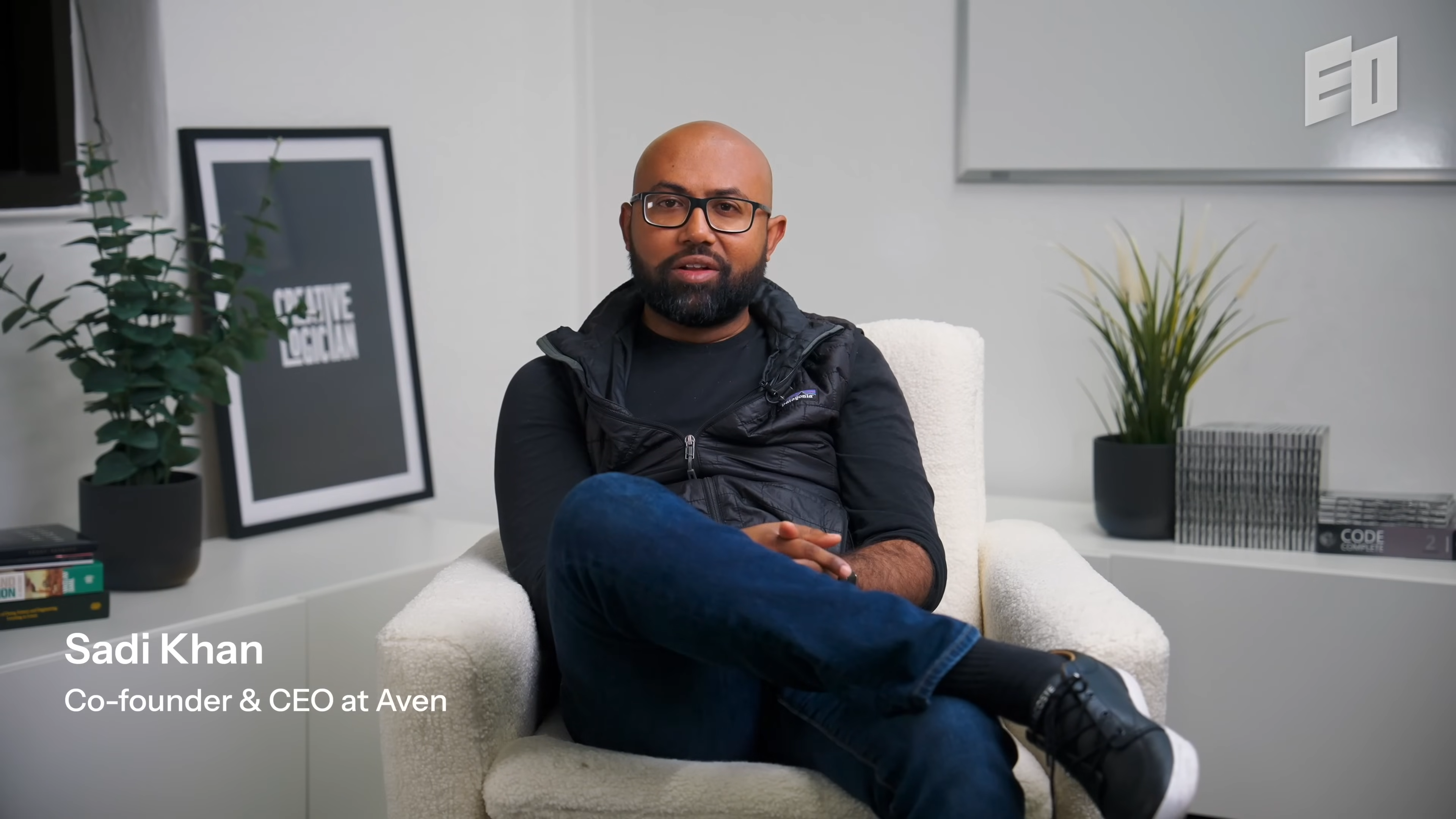
I'm Sadi Khan. I'm the co-founder and CEO of Aven. We announced our Series E fundraising, where we raised a little over $110 million at a $2.2 billion valuation. This is doubling our valuation from last year.
Aven's mission is to reduce the cost of capital for consumers. Today there's $1 trillion of credit card debt in the United States. Consumers are paying almost $200 billion a year on just interest payments, not the principal, just the interest. If we can reduce that by 50%, then we will have saved US consumers $100 billion every single year.
Meet Sadi Khan & Aven

Our thesis is very simple. We think that unsecured debt in the United States is very, very expensive, but transactionally very efficient to get access to. On the other hand, secured debt, debt backed by assets you already own, is much, much cheaper for consumers, but it's transactionally quite inefficient.
Take home equity, for example. It's the largest asset class that US consumers own today. However, it takes weeks to get access to your home equity, and it costs thousands of dollars in origination fees, both for you and for the lender.
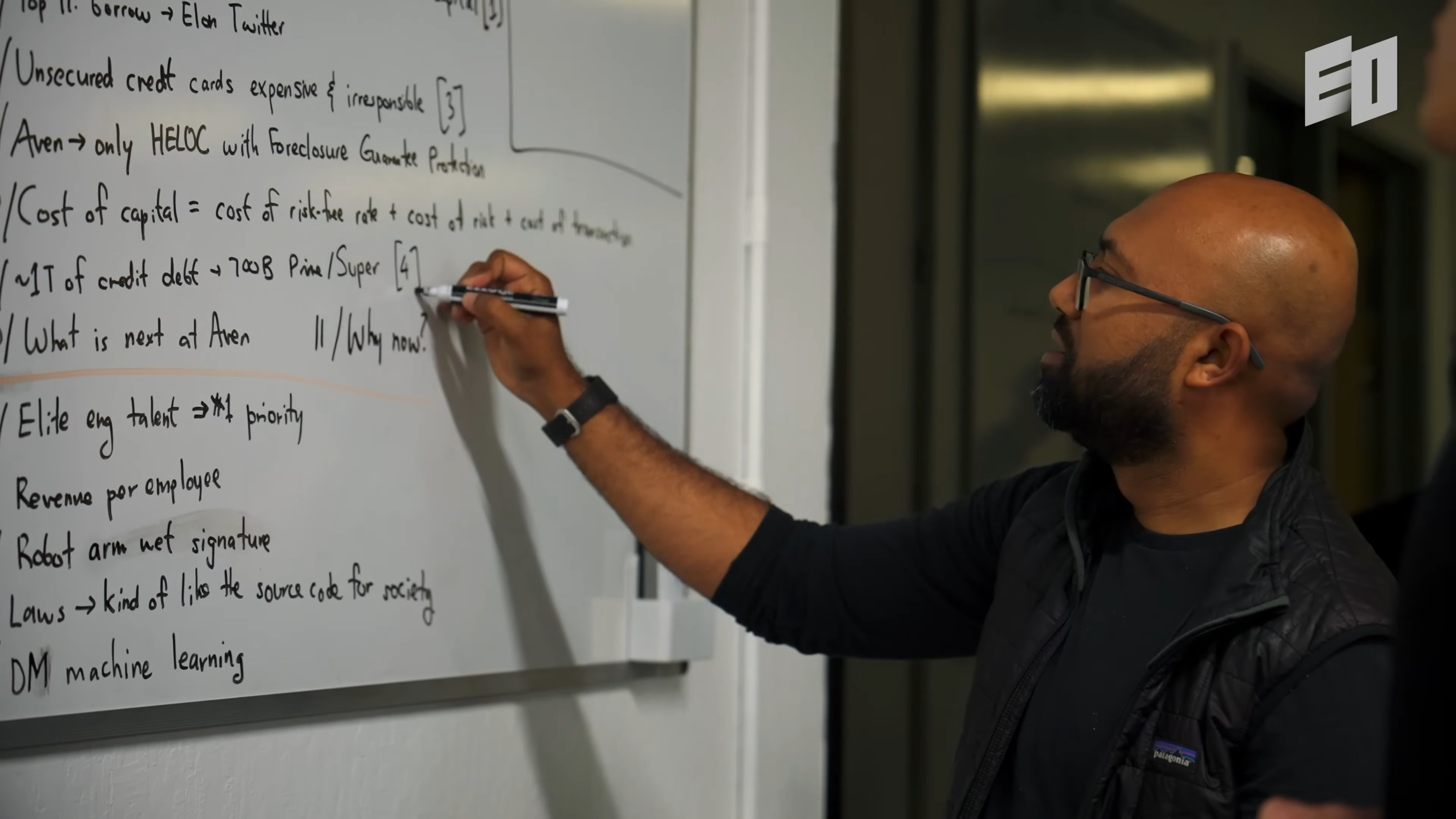
Aven set out to solve this problem. We built our flagship product, the Aven home equity backed credit card, a home equity line of credit in the back and a credit card in the front, with the goal that in as fast as 15 minutes, we want to reduce your interest rate by 50%. Aven isn't stopping there. We're excited to continuously invest in building new and better products that are the lowest cost, most convenient and most transparent access to capital for homeowners across America.
About 7 years ago, I retired from Facebook and stepped down, and I was taking some time to figure out what I wanted to do next.
Retirement was very challenging for me. I've been an engineer and a product manager my whole life, and I felt that I didn't have much value I was creating in society in my retirement time. It didn't last very long. My wife would claim that I was only retired for 3 months. I would claim I was retired for 6 months. The truth is somewhere in between.
I became excited about this core thesis, that most people in the world, when they're looking to solve problems, will end up solving problems about helping society be healthier or be wealthier. If you want to help society be wealthier, you either want to help people make more money or help people save money.
How One Graph Created a $2.2B Company

One of the interesting graphs I stumbled upon at this time was a publication from the CFPB, which to this day is our North Star graph. It shows that the total revolving balance, the total balance on credit cards since the inception of credit cards, has grown up to $1 trillion over the last three quarters of a century. This graph just goes up and to the right, and it doesn't seem like it's decreasing anytime soon.
But there's another very fascinating line overlaid on this graph, and this line shows you the interest rate on this credit card revolving debt over the same period of time. Over half a century, the interest rate on credit cards has hovered between 20 and 25% for this entire period of time. If you look back in history over this time, we've invented the internet. We've invented all of the modern tech companies we see in Silicon Valley, from Facebook to Google to Nvidia to Amazon, but we haven't been able to reduce the cost of interest on $1 trillion of credit card debt in this period. At this point we're inventing entirely new currencies, from Bitcoin to Ethereum, but the cost of capital for consumers has really not changed.
In the pursuit of helping society be wealthier by helping consumers in America save money, we thought that was ridiculous, and we thought we could build better products for consumers to help them save money.
That's how we started Aven, taking the largest asset class that US consumers own, which is home equity, which is also the most inconvenient to access. It costs thousands of dollars to access home equity, and today it takes about 3 to 4 weeks. We decided to make that much more efficient by machining this process for maximal efficiency. We were able to bring it down to almost as fast as 15 minutes, with transactional costs that are orders of magnitude lower than anything else in the market, and we put it in a form factor that consumers are comfortable with and already familiar with, which is a credit card. That is our flagship product, the Aven Home Equity card.
What 12 Years at Microsoft & Facebook Taught Me
Through my time at Microsoft and Facebook, probably the single most important thing I learned is the value of an extremely elite technical team.
The differential between the 99th percentile, or the 99.9th percentile engineer, and the 95th percentile engineer is not small. It is a huge amount. The amount of resources you spend on the acquisition and retention of the absolute best technical talent far surpasses any other investment you should make and can make. At Aven, my single highest priority, and I think the team's, is the collection and retention of the absolute best technical talent in the world.
There are 3 main things we look for when we look for great technical talent.
The first is raw intelligence. We are unapologetic about looking for the absolute smartest people we can find in the world. We will ask for SAT scores and other forms of standardized tests, as controversial as that may sometimes be. I will personally review transcripts and look at exactly what grades people got in what classes. For engineers specifically, we look for people who've taken courses in operating systems, distributed systems, compilers and game engines, the hardest technical courses one can take, and how did they do in them? Importantly, did they attempt the really, really hardest courses that can be taken? Intelligence is massively underrated in how important it actually is in helping build products and companies. That is our number one and most important thing we look at in technical talent.
The second is work ethic. You can have all the intelligence in the world, but if you don't want to apply it, if you do not have the motivation and the endurance to apply that intelligence, you're not going to create much output or much value to society. So we look for people who have the endurance and the ability to work hard consistently over time. At Aven, every Sunday at 6 p.m., our entire leadership team meets to identify, finalize and lock in our roadmap for the next 7 days. This allows us to operate with high precision and high velocity, and it gives us a very important thing, which is that we should not be wrong in our roadmap for more than 7 days, because we revisit it every 7 days to make sure we're working on the right set of things in the right priority order with the right set of people.
The third thing that's really important in elite talent is an alignment with the mission of the enterprise, in our case the mission of reducing the cost of capital for consumers. Trying to reduce the cost of capital for all of America is an extremely ambitious undertaking, so the person we bring in needs to be super smart, super hardworking, and has to have an alignment with this mission and with the ambition level of this mission, so they can sustainably work on it for a very long time and push the boundaries of how we would achieve it day in and day out.
If Aven is to be successful, we will drive the single biggest change in the cost of capital in American history, and we need to find the absolute best talent in the world so we can do that. If we can't find the absolute best technical talent, we will not be successful. That is why we spend so much of our time and energy on this specific problem, and it's probably the most important thing I ever learned at Microsoft and at Facebook.
Aven's flagship product, the first product we wanted to build, was a home equity backed credit card. The reason it was very important for us to understand the legal and regulatory landscape for this product is that this is a very highly regulated industry. It is both a mortgage product and a credit card product, and it's very important for me as the founder to have a deep understanding of the regulatory landscape, first to understand whether we can build it, and second to make sure we build it in a safe and compliant way.
That's why I personally went through and read a lot of the regulations in the space, whether the Dodd-Frank Act, the CARD Act, TILA and others. I think it is very, very important for founders and CEOs to be very deeply involved in the details of the products being built by the company.
Most Founders Don't Know Why They'll Fail
In the case of founding a new company, or building a new product even at a big company, oftentimes the core value is inventing something new, something that hasn't existed before or hasn't been built yet. In order to build something new, I think you must first understand the history of what has been tried before, so that you can efficiently build something new.
Most new ideas are terrible. Most new ideas are bad. There are very, very few new ideas that are actually better than all the old ideas before.
In order to assess that, in order to deeply grok whether or not your idea is better, it is often very useful to understand the ideas, at least the big ones, that have been explored and built before. Why is your new idea better than what has already been built? To answer that, you must often invest the time to understand and learn very deeply about this industry and this domain, and about all the smart people who have come before you, so that you can come up with good new ideas and assess that they are indeed better than what has been built before.
Do Half of What You Think You Should

In the first 2 or 3 years of building Aven, we made a series of product decisions, people decisions and process decisions. On the product, we would have been even more ruthless in prioritizing the feature set we were building for in the first version.
This is generally true for most product managers when they launch a new product. If you were to look back and ask any product manager what products they've launched and what they would do differently, almost all of them would tell you they would have cut 5 out of the 10 features and shipped a smaller, narrower version of the product to a smaller set of people, and really gone deeply into a more focused feature set. I think that also applies to Aven and to the product we built. I would have made it narrower and simpler in the first version.
The other big thing is that in the early days there were these really funny stories of consumers going through our origination process and not being sure that this was real. We would get tickets and calls saying, we don't know if you guys are a scam or not, and we'd have to respond, including sometimes myself, saying no, we're very real, we're a real company, we're here to help you get access to your home equity, and we have a real product you can use. Sometimes it was that ability to talk to somebody at the company, and to hear a voice from the company, that gave them the confidence to continue and go through our application process.
One of the interesting things that happened with Aven is that we were able to find people who were on the border of potentially considering a home equity line of credit. Many folks were actually in the process of applying for a home equity line of credit with other lenders, and then they would see an ad from us and think, I wonder if this is true, can I get home equity credit in as fast as 15 minutes? They would almost test us out as an experiment to see if this is real. When they went through the process, they would be amazed and shocked, and then they would actually book an account with us instead of with whoever they had started their application with before. That was an interesting lesson learned, because many people in the beginning didn't believe this was possible to do.
Why Feelings Are Your Biggest Scaling Enemy

My ideal form of leadership is one that is maximally rational. I observed and learned a lot of that from Mark at Facebook.
The reason this is important is that being extremely rational is very predictive behavior, and being predictable as a leader is very, very important, because people can then replicate or predict what you would do even when you're not there. That is important for people to be able to reproduce your decision making system even when you're not present. My goal as a leader is to make decisions that are so rational that if everyone else also had the same information I had, they too would all make the same decision.
The two incremental things that I provide as a leader, which an individual contributor in the company doesn't necessarily have, are that I have significantly more context and a lot more information than others sometimes, and my job is to make sure as many people have that context as possible. Second, I have the privilege of being able to optimize for a much longer time horizon than anyone else in the company. These two things are the incremental value propositions I bring to a decision that is not always possible for every other individual contributor to bring. But if they were to have those two things in their mind, they should be able to compute the same conclusion I come to, and that is my goal as a leader.
If I were to make decisions just because I emotionally felt this was a good decision, the problem is that even if I'm occasionally right, those decisions are very difficult to scale. I can tell somebody that I felt we should do X, and sure, because of my authority some people will do X, but when that person needs to explain it to two more people, it is very difficult for them to say anything other than, well, Sadi feels that way, instead of explaining the logic of why we made this decision. That logic is a very scalable form of decision making that you can send to a lot more people to execute effectively.
This is really important, because a lot of what an early-stage startup, or frankly any company, does is try to perfect its execution, and the only way to perfect execution is to have extreme clarity. To have extreme clarity in what we are trying to do, you must often have extreme clarity on why we are doing it in the first place. That clarity must stem all the way from the CEO and the founder to the individual contributor working on the smallest and most minute of diffs that need to go out the door. It stems from a philosophy of trying to be maximally rational.
The reason for this is quite simple. If we are to achieve our mission of reducing the cost of capital for as many consumers as possible, the first and most imperative item we must achieve is that we must first not die. If we are dead, then we aren't helping too many people reduce their cost of capital.
In order to not die, we must make sure we generate profit and are, to a certain extent, a good business. Then we derive how many people we can save how much money for, and that becomes the maximal optimization function in a sustainable way. Therefore having a very disciplined approach to the profitability of the business, while at the same time maximizing our mission, is actually quite rational for us to pursue.
The most important goal for any person and any company is to create a lot of value in the world, and profitability comes from capturing some amount of that value you create and doing it efficiently. Today there's $1 trillion of credit card debt in the United States. Consumers are paying almost $200 billion a year on just interest payments, not the principal. If we can reduce that by 50%, then we will have saved US consumers $100 billion every single year. Our profit should come from the savings that we bring to the consumer, because that's the value we've created, and our goal is to be profitable by saving people money. I think that achieves our mission and is very rational and mission aligned with what we're trying to achieve in the world.
Kill Decision Fatigue Before It Kills You
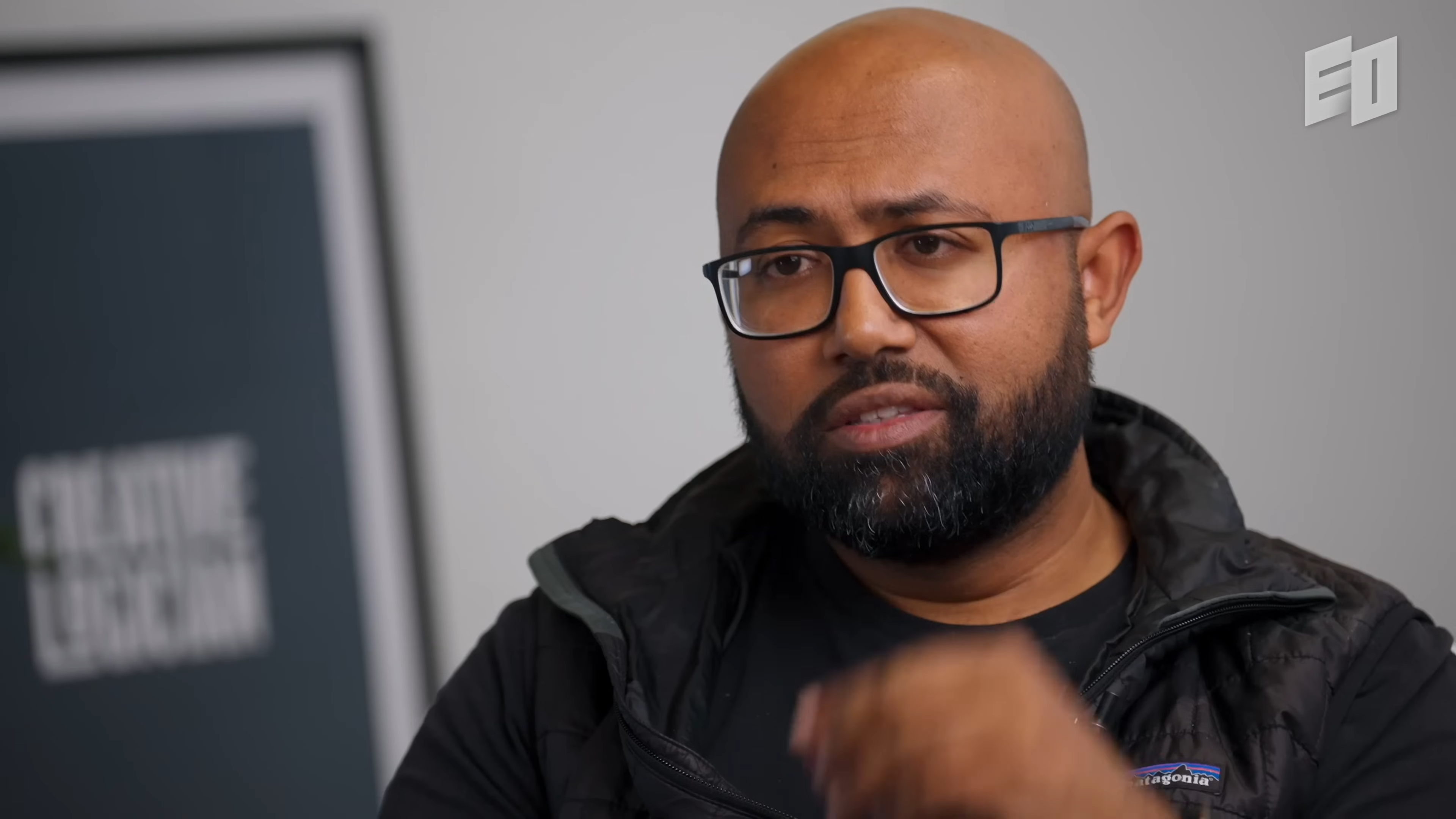
One of my somewhat controversial opinions around decision making is that I really hate pros and cons lists. They're maybe one level below useless.
I think a much more effective framework is to first lay out the axes of the decision that are most important to least important, and then to list out each of the options and where each option sits relative to that particular axis.
For example, let's say you need to make a decision about what car you want to buy, and the axes that matter are things like price, performance, reliability and style. Much more effective than trying to build a pros and cons list between a Toyota Camry and a Honda Civic is to list out your priority for each of these axes. Is it speed and performance? Is it style? Is it cost? Is it reliability? Once you prioritize this set of axes, you can look at your option space and see which one fulfills the highest order priorities for your decision.
I'm such a big believer in this that we actually teach this process in our boot camp at Aven. I tell people in boot camp that this is the process I've used to make almost all my decisions in my life. I would argue this was also the process I used when I was looking to get married very early in my life. This is a very important framework to help people make decisions, not just in their professional life but in their personal life. The simple shift of focus away from the options and toward the prioritized list of axes that matter is much more functionally beneficial to the quality of decision making.
I will add that I wear the same clothes every day, the long sleeved black t-shirt, the blue jeans and the vest. I am a very big believer in simplifying as much of my life as possible. I have a very boring personal life. I live 5 to 6 minutes away from the office. I moved my home to be near the office. I don't drink. I don't party. I don't really go out that much. I enjoy spending time with my family. I like to cook twice a week, and I have a very regular routine with my family on the specific nights of the week that I cook for them. I go to the gym and I work, because I have a very simple life.
Another thing I like to optimize is my computer, keyboard, mouse and chair layout. I have 3 workstations, one at the office and 2 at home, and all of them have the exact same mouse, the exact same keyboard and the exact same monitor layout, so that I can very optimally get to my workstation and begin working instead of setting up or adjusting my keyboard or my mouse. You probably know this already. If the keyboard is off by even 1 millimeter, your typing error increases massively, because you have to adjust.
One of the reasons our company is located in the South Bay and not in a major city like San Francisco or San Jose is that we want to provide our employees some calm and some serenity, so that we can focus on the mission at hand and not be distracted by the hustle and bustle around us.
I like to have a frankly very boring life. I told somebody that if I were to know everything that will happen to me between today and my death, I'll be very happy. I have no need for surprises or excitement. I love boring. Boring is great. If my life could be just boring, I'll be very happy.