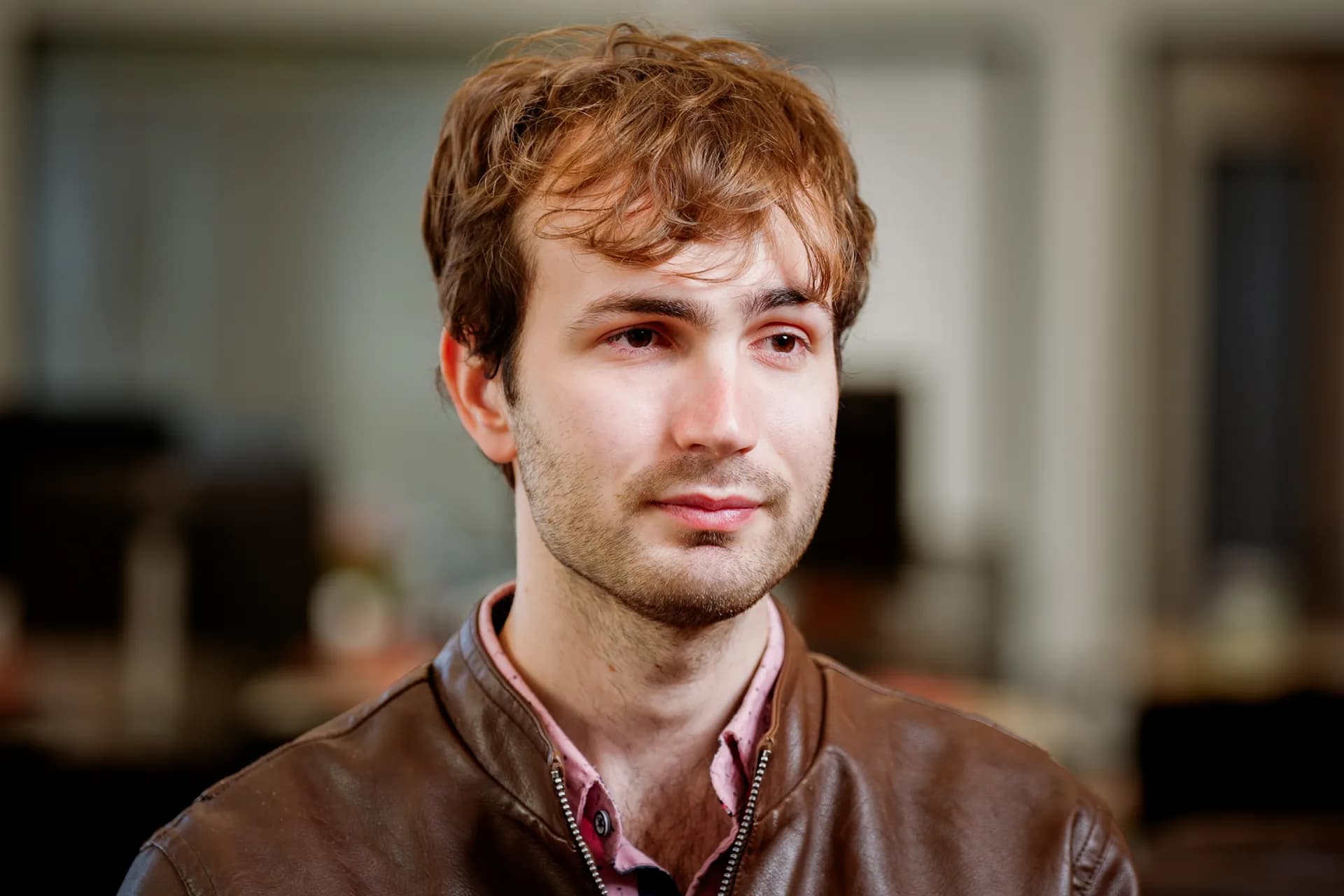
Interview with Dan Siroker, Co-founder of Rewind AI

At a Glance
- Who: Dan Siroker is the Co-founder and CEO of Rewind AI. A Stanford computer science graduate, he previously served as Director of Analytics for Barack Obama's 2008 campaign and co-founded Optimizely, growing it to $120 million in ARR before launching Rewind.
- What: Rewind AI is an AI-powered personal memory assistant designed to capture, transcribe, and index everything a user sees, says, or hears on their computer. Operating locally on Apple Silicon for total privacy, the software creates a searchable, passive record that grants users perfect memory.
- Traction: Raised $33 million in venture capital, including a $1 million initial check from Sam Altman and a $350 million Series A valuation led by NEA after pitching the company deck publicly on social media. The platform grows at 15% month-over-month in ARR driven primarily by organic word of mouth.
Dan Siroker founded Optimizely after using A/B testing to generate $40 million in extra donations for Barack Obama's 2008 campaign, scaling the company past $120 million in ARR. After experiencing hearing loss and discovering how technology can restore biological senses, Siroker launched Rewind AI to give humans perfect digital memory. Powered by local Apple Silicon processing, Rewind passively records and indexes everything users see and hear while protecting privacy. His journey highlights why founders must trust their conviction over consensus advice and how creating entirely new product categories solves deep human problems.
Key Takeaways
A Simple A/B Test Uncovered Forty Million Dollars
Dan Siroker’s Obama campaign tested a polished portrait, a video, and an informal family photo. The family image won unexpectedly and generated an incremental $40 million in donations, showing how evidence can overturn expert intuition and reveal a more relatable path to action.
Democratize Good Ideas By Removing Implementation Friction
Optimizely grew from Dan’s observation that A/B testing was valuable but difficult and expensive to run. By making experiments accessible to nontechnical marketers, the product lowered the cost of trying a good idea, increasing the chance that teams would actually learn from it.
Founder Passion Is A Leadership Responsibility
Dan says Optimizely’s rapid expansion left him managing work that drained his energy after the product problem had been solved. Staying close to meaningful product questions would not have been selfish, because preserving his passion was essential to attracting, retaining, and inspiring strong people.
Founder Intuition Is Built From Many Data Points
Dan’s conviction is not a rejection of evidence. Engineering feedback, customer voices, sales, markets, and investors all contribute to a founder’s pattern recognition. When those signals form a strong intuition, ignoring it can create deeper regret than a decision that simply fails.
Let The Problem Lead The Technology
Dan advises new-category founders to begin with a persistent problem rather than a fashionable technology. Rewind grew from the desire for perfect memory and the limits of note-taking, illustrating how a broken substitute can point toward a fundamentally different product category.
AI Should Accelerate Human Purpose, Not Replace It
Dan believes AI is most valuable when it serves a person’s purpose, whether that means family, creation, or meaningful work. Rewind’s vision is augmentation rather than replacement, using technology to remove limitations so people can spend more energy on what matters to them.
Watch the full interview now on EO's YouTube channel! Below is the complete transcription of the interview. Minor edits have been made for clarity and readability.
Introducing Dan Siroker, co-founder of Rewind AI
I'm Dan Siroker, the co-founder and CEO of Rewind. At the beginning of my career I studied computer science at Stanford, then left Stanford to start a career at Google as an associate product manager. In November 2007 I joined the Obama campaign, and that inspired me to start my first company, Optimizely, which we grew from zero to $120 million in annual recurring revenue and 450 employees. We sold that company, and that is when I started Rewind.
Rewind is a personalized AI powered by everything you have seen, said or heard. Our vision is to give humans superpowers, and we want to do that by using technology to augment our biological limitations and by using tools like Rewind to give you perfect memory. We are growing 15% month over month in terms of ARR today. We have raised $33 million from great investors, and our very first investor was Sam Altman. I pitched him on the vision for Rewind, and within the first meeting he committed a million dollars of his own funding. The next round was our seed round led by First Round Capital, then another round by Andreessen Horowitz, and more recently our Series A was led by NEA.
The Journey To Building a Product With $100M ARR
Ultimately, what seem like overnight successes required a lot of pain to get there. The first idea and the first company I actually started came after I graduated from Stanford. My research at Stanford was on predicting the stock market by looking at financial news, so I started a company around that. I do not even know if I ever incorporated it, but for a year after I graduated I toiled away by myself building cool tech, and this is where I learned firsthand the importance of distribution.
It was also really lonely. Working on your own without a co-founder is very challenging, just for the psychological ups and downs. So I spent a year toiling away on my own, and the drive to do that came from impact. That has always been the driver behind entrepreneurship for me, which is how do I have the biggest impact. It made me realize that I really should learn the skills necessary to be a successful entrepreneur.
I had this misguided idea that I would get those skills from Google, so that is why I went to Google. I thought it would help me learn what was necessary to be successful as an entrepreneur. It was misguided because most of what I learned at Google was how to navigate Google. About 80% of the things I learned were how to be successful within Google, and 20% was applicable, things like how to work with great engineers, how to cut scope, and how to define and build great products.
I actually think the best thing I could have done back then was joining an early-stage startup. Had I joined Facebook at the time, which was an early-stage startup, or even Dropbox, I would have learned so much more about what it takes to be successful as an entrepreneur, because that is what your challenges are every day.
In November of 2007 I was working at Google and Barack Obama came to campus. At the time he was third in the polls behind Hillary Clinton and John Edwards, and he had this vision for how to use what we were doing at Google, using evidence and data and feedback, and bring that to the government. I remember feeling really inspired in that talk. The last thing he said when he came to Google was that he wanted us to be involved, which is a euphemism politicians use to encourage you to donate to their campaign.
I took him literally. I actually flew on a plane two weeks later to Chicago, where the campaign headquarters were, and I just said I am here as a volunteer, what can I do to help. That is what led to this opportunity to do A/B testing and experimentation, things I had seen at Google but was now bringing to the campaign. Ultimately that became a job. I quit my day job at Google, moved to Chicago and became the director of analytics for his campaign.
The role of analytics in the campaign was entirely new in 2008, and the reason it was possible was that Barack Obama was third in the polls. The campaign manager, David Plouffe, had a mentality he described as the risk reward mentality. He basically said that if we just did everything like every other campaign, we would end up just like everyone expected, which is third. So he had this mindset of taking some risks and doing things differently than every other campaign.
A good example from 2007, when I joined, really made this mentality something the campaign embraced. We did an A/B test. If you went to barackobama.com at the time, the first thing you would see was a very presidential looking photo of Barack Obama asking you to sign up on the email list. We ran an experiment comparing that in real time to a really compelling video, a video we were excited about, with snippets of his 2004 Democratic National Convention speech. We all thought that was going to win, and we wanted to prove how smart we were by using an A/B test.
Just on a whim, we also included a few other pictures. One picture we included was a black and white photo of Barack Obama with Michelle and their two kids, very informal, sitting on the grass. It turned out that last photo dramatically overperformed compared to the rest. This photo did surprisingly well, and it is the last photo that some white-haired, grizzled political veteran would have picked. In hindsight you look at it and see that it normalized him as a likable guy, and it showed a different angle to him as a candidate.
We did an analysis, and that one change alone led to an incremental $40 million in donations from the email addresses that we got from that page. That is just one example of how using data and A/B testing really helped inform the decisions we were making.
One big lesson I learned from the Obama campaign is the power of A/B testing. It is not a new idea, it is really just the scientific method applied to the real world. That is ultimately what inspired me to start Optimizely, which was trying to build a product I wish we had in the Obama campaign, to make it easy for anybody to do A/B testing. At that time the tools we used on the campaign, and the ones available online, were very expensive, and they required a developer to be part of the process.
The insight we had from the campaign was simple. A/B testing is a good idea, it is just hard, so let's take a good idea and make it easy. In some ways that has been the journey I have had on any product I have tried to build, which is to take something that is a good idea at its foundation and democratize it, make it possible for anybody to do.
So Optimizely at its start was really trying to build a product I wish we had in the Obama campaign, to make it easy for anyone to do A/B testing. The way it worked was that you took a snippet of JavaScript that we would give you and put it on your website, and that URL never changes. Then you could run A/B tests directly in our visual editor. This was a breakthrough at the time, because the alternative was that every time you wanted to run a new A/B test you needed a developer to be part of the process.
The early hypothesis for Optimizely was that the most valuable thing we could build was the lowest friction way for non-technical people to run a series of A/B tests. The hypothesis was that if we lowered the friction it would increase the chance that somebody does an A/B test, and if they do an A/B test they end up having an impact. So it came from this very basic idea that if the friction was high and the cost to implement was high, people just would not do it, and if you do not do an A/B test you are not going to get the value.
It seems simple now in hindsight, but in the moment the alternatives from companies like Adobe required huge professional services contracts. They required really sophisticated experiments, and you needed lots of multivariate tests to justify the upfront cost of running them. With Optimizely we flipped it on its head. We did not even actually support multivariate testing, because we realized it is so much easier for a marketer to run a series of A/B tests, and maybe some parallel A/B tests, to learn, incorporate the winner and move on, rather than creating a huge sophisticated experiment upfront that is impossible to get statistical significance on.
That was the thesis we started with, and it really worked well. That is the reason building a product you wish you had is so powerful. You have an intuition, and your intuition is the product you wish you had. This was exactly the product I wish I had in the Obama campaign, to be able to very quickly run these A/B tests.
I would describe the distinct phases in Optimizely's growth this way. From 2010 to 2013 was really rapid growth. We were lucky to get product market fit very early, around $7 million in ARR in three years, and we raised our Series A led by Benchmark, which was a $28 million Series A. Then we raised a $57 million Series B not long after, and then a Series C. We were just growing and growing and growing.
The next phase, from probably 2013 to 2016, was uncontrolled growth in the team. It is one thing to raise more money than you need, and you can and should do that. But if you couple that with the mistake of spending more money than you need to, that is really bad. I did not do a good enough job as CEO of saying no. You hire a great head of marketing who says she needs a demand gen person, field marketing and events, and I would say great, I hired you to be the CMO, so go for it.
I did not have the constraint of a lack of capital, and then I did not have the discipline, when we did have the capital, to really make sure we were growing efficiently. So I think we grew far too quickly in terms of the team. We did not need hundreds of people to do what we were doing, and that was a mistake. We got too big too quickly in terms of the team, and what happens when you get to hundreds of people is that you spend all of your time getting people aligned and just getting them to march in the right direction.
I think that was also a big missed opportunity. We kind of squandered the lead we had, and we were not moving as quickly as we could. I personally was pretty burnt out. I had been doing Optimizely for well over a decade, and in some ways after three or four years I fell out of love with the business. We had actually solved the problem we set out to solve, which was building a product that made it easy for anyone to do A/B testing.
I made the mistake in my mindset at that point of thinking that my job was to hire people better than me, empower them and delegate to them. Ultimately that meant I spent a lot more of my time on parts of the business I did not love. I ended up spending so much more of my time in those parts of the business, and that just did not give me as much energy as the product side. Most of my day was things that drained my energy. That was something I wish I had done differently.
At the time I looked at folks like Lew Cirne at New Relic, who was famous for being a public company CEO who still codes. I should have done that. I should have modeled myself after him, knowing that it is not selfish. At the time I thought that would be selfish, but what I realized is that the bigger selfish thing would be to fall out of love with the company, because when you do that it is so much harder to attract great people, to retain them and to inspire them. Had I just been more focused on problems I was actually passionate about, I think we ultimately could have achieved much greater success.
I am proud of the outcome and I am proud that we sold it, but it is only a glimmer of what we could have done had I still had the same passion for the company 13 years in that I did three years in. The most salient lesson I learned from Optimizely is a pattern, the pattern of the things I regret most. This is what the pattern looks like. My gut says we should do A, somebody else says we should do B, and we end up doing B for all the good reasons. It is a board member who suggested it, or an executive I have hired. Then B does not turn out well.
Those are the things I regret most, and not because things did not turn out well when I went with my gut. That has happened plenty of times and I just do not remember any of it. The things I remember most are when I went against my intuition. I did not have the confidence in my conviction to argue for my intuition, and we ended up going down a different path that ultimately failed.
That is where the biggest lesson I learned was confidence in my conviction. I did not realize that as a founder you have so many data points coming in, from engineering to customer voice to sales to the market and the investors, and that helps you form this intuition that is sometimes really hard to articulate. When your gut says you should do A and you really feel like you should do A, you are going to regret doing B if it does not turn out well. That is the lesson I have learned, and now with Rewind I have much more confidence in my conviction. There are plenty of times we do A and it does not turn out well, but most of those are two-way doors, and most of those we can go back and change.
How To Find A Startup Idea That Won't Fail
The very first seed of what turned into Rewind was losing my hearing. When I tried a hearing aid, two things happened. One, I could hear again, which was amazing. But an equally amazing thing I realized in that exact moment was that I had not realized how bad my hearing had gotten. It is this simultaneous realization of how great hearing is. I remember when I first had it in my ear, I rubbed my shoulder and thought, that makes a sound. I turned a faucet on and was amazed that there was a sound coming from it.
What that told me was clarity around what I think is a secret, which is that we all live our lives limited by our own biology. We all live kind of like a horse with blinders on, and we do not even realize what we do not have until you can feel it. That moment put me on this hunt, and it took 10 years to bring it to life. The hunt was for other ways that technology can augment human capabilities, transcend these limits that we have by our own biology, and give us superpowers.
The hypothesis when we started Rewind was that there are so many things in our lives that we forget, and that if we could give users the feeling of perfect memory, that would change their mindset. They would be willing to record things and capture things for the benefit of having the feeling of perfect memory. We actually started very narrowly. We started on meetings, and the first MVP we launched was called Scribe. It was a bot that joins meetings, transcribes the meeting and lets you go back and see your recording of it. We launched that and learned a ton.
We were being asked all the time to go beyond just meetings. People said they would love to be able to remember other things, not just the meetings they were in, and the technology had finally caught up to the vision. That is when we pivoted from what was Scribe to what is now Rewind. It was this simultaneous confluence of hardware getting good enough, Apple silicon in particular, and learning that people wanted this product. We knew that being able to capture everything was far better than just meetings, because often what happens is you try to remember something and you might remember a detail but you get the source wrong. That ability to be comprehensive was a thesis from the beginning, because if we could be comprehensive then we could finally deliver better on this promise of perfect memory.
So often people think about starting a startup by looking at different categories and different markets, and they think about how to build a better mousetrap in an existing market. For some people that is right. There are people for whom optimizing incrementally, making something better, is just how they are wired. Personally I am much more excited about creating new categories, because I think there are so many things in our lives today that technology can make better, and the way to actually have a 10x or 100x improvement is to build something new, not to build something slightly better than before.
Rewind is an example of that. It is a fundamentally different way of approaching the same problem. If you think about the most common thing people do today to try to remember, and if you describe it, it will seem so anachronistic. The entire idea of note taking is rooted in this idea of trying to remember something better. If you think about it that way, you need foresight, you need to know what you might want to remember later, you need to be able to search it, and you need to be able to put effort into it.
Our approach is entirely different. It is passive, it is capturing everything, it does it without being perceptible and it does it in the background. That is a way to think about it, as an entirely new category of note taking, although note taking is all trying to solve the problem of remembering better. We would not take notes if we all had perfect memory. If you all had perfect memory you would not use Rewind, and so that is the new category we are building, the category of giving you perfect memory.
The best advice I would have for entrepreneurs who want to start a new category is to focus on the problem, not the solution. It is very easy to fall in love with some sophisticated new technology. GPT-4 came out, and it is easy to say okay, cool, now what problem do I solve with it. Instead, if you start with a problem, if you believe that there is a problem of people not having perfect memory, then that problem is something you can solve by building entirely new categories.
I think you need to really obsess over a problem and deeply understand the problem, and try to look at the substitutes. What do people do today that is kind of weird and broken? Like I said, note taking is kind of weird and broken, and it is an inkling that there is a problem to be solved. It is just that the status quo is so inept. If nobody actually is piecing together products that exist today to try to solve your problem, then it may not be a real problem.
Usually the signs of a new market or a new category are people gluing together things that were not meant to be put together to try to solve the problem. There is a hodgepodge of duct tape and baling wire to try to solve something, and the core of what they are trying to solve is a job to be done. It is something they want to exist in the world because they have a problem. So that is my best advice. If you want to create a new category, really think about the problem, and then let that lead the technology and not the other way around.
3 Key Advice For Early-Stage Founders
This April we did something kind of crazy, and it was not a consensus good idea when we discussed it internally. We raised our Series A in public. We took our pitch deck, I recorded a seven-minute version of it, I think I only did my third take, and I put it up there unedited. It took off and it really resonated. We got 2 million views on social media, thousands of offers to invest, hundreds of really qualified meetings that came out of that, and ultimately an amazing lead investor in NEA, who led our Series A at a $350 million valuation.
It all started with two really pragmatic concerns. One was that we had such an opportunity to build trust with users by being more transparent. Our product is different, it is new, it is a new category, and at first blush you sort of ask what happens to this data. People are concerned about privacy. They ask what about this company, and what if Google buys this company, then all of a sudden I am going to get targeted with better ads. So we really wanted to start with how we build trust with users that we are a going concern, a business that is going to be around for a while.
Simultaneously, I was getting hundreds of investors reaching out wanting to meet, some of them very important luminaries, and I just did not want to blow them all off. So I decided to create a video that I could send to all of them, and while I was at it, put it up on Twitter to see if that actually gets trust from users. Those were the two data points that led us to publishing it. In hindsight, why did we even do that? We had three years of runway and we did not really need the funding, but we went from three years of runway to six years of runway, which is even better.
Right now we are growing 15% month over month in annual recurring revenue, and the primary source of that growth is word of mouth. I think building trust with users, especially as a startup, is critical. Users, especially early adopters, want to love your product and they want to love your business. You probably are solving a problem for them, so that matters so much to them. But they also do not want to get screwed. They do not want their data to be sold, and they know that startups might get desperate and do things that are ultimately not in their best interest or their users' best interest. If you can assuage those concerns by being transparent, that goes a long way. Every time I have made a bet on transparency, it has paid off. Maybe one day I will regret being so transparent, but so far it has worked really well.
That was sort of the recipe, and there are so many ways to build trust because there is so much status quo. I doubt a CEO of a Fortune 500 company would put their candid 360 feedback out there. If Tim Cook did that, then great. But if Tim Cook cannot do that and will not do that, then one way I can beat him is by doing it, by being a startup that is willing to take those kinds of risks. I think that sets us apart from the big tech incumbents.
I am a big fan of flywheels. What I would recommend, especially to early-stage startup CEOs, is do not get obsessed with the greatest flywheel and frameworks. Make something people want. At the end of the day your job is to build a product that people want and that solves a real problem for them. If you are lucky enough to do that, then over time you can start thinking about how you build sustainable competitive advantage and how you build differentiation, so that even if a competitor knew exactly what your playbook is, you could ultimately beat them because you are investing in a flywheel that gets better.
It is tempting to look at companies like Amazon and say, how did Amazon get so big? Jeff Bezos famously talks about investing in things that do not change, looking at how the world is going to be the same in five years or 10 years. Will people want more selection or less selection? More selection. Will they want lower prices or higher prices? Lower prices. Will they want faster delivery or slower delivery? So okay, let's build a flywheel around faster delivery, more selection and lower prices. That sounds great, and Amazon has that famous flywheel on a napkin.
But at the end of the day it started with building a product people wanted, getting them books over the mail and getting them the selection that they could not get elsewhere. You need to start there before you have the luxury of thinking about flywheels and sustainable advantage. I know I am not the only one, and I have definitely made this mistake before, of getting ahead of yourself. You have got to start with building a product people want.
The advice I would give to founders trying to find a problem that they can build a business around starts from a couple of dimensions. First, really be honest with yourself. Is it a problem? Is it a painkiller or a vitamin? There are a lot of things in our life that are small and could be solved better with a product, but you also have to accept that change is hard. People are stuck in their habits, they are used to doing the things they are doing, so anything you build needs to solve a problem that is not just a slightly better version of something that exists. It needs to be a painful enough problem that they are going to change their behavior to use your product.
So that is first. Really be honest with yourself about whether this is a problem, and whether it is a problem that you have. You might think it is a problem you have, but be honest about whether you would actually change your behavior to use the product that you are thinking about building.
The second dimension is that if you focus on a problem and think about the future of your focus on that problem, either what you are doing is a good idea or a bad idea. If it is a bad idea, it will probably fail and you will change ideas. If it is a good idea, you might have to live with this problem for 10 years, for 15 years or for 20 years. So make it a problem you care about. Make it a problem you might be obsessed with.
The way I looked at it with Rewind is that the problem of giving humans perfect memory is a problem I would want to spend the rest of my life pursuing, even if it failed. Even if it was not successful, I would rather be on my deathbed saying that at least I tried to give humans perfect memory and failed, than not try to solve that problem. I think if that lens is something you use, you end up actually solving a real problem. And if you are successful, which you should hope you are, you are still going to want to be around in three or five or 10 years to make that problem and that product and that company as big as it possibly could be.
The one thing that AI cannot replace, and in fact the one thing that AI should help us pursue, is purpose. That is the one thing AI cannot do. AI cannot give us purpose, and as humans what makes us uniquely human is our purpose. Why are we here? It may be to spend more time with family, it may be to create something out of nothing. If AI can be in service of your purpose, that is an accelerant. That is a superpower. It is not a replacement. It makes you better at what you do in pursuing your purpose. If anything you do in your day that does not help us pursue our own purpose can be taken away and augmented with AI, then I think that is a good thing for humanity.
Our vision is to give humans superpowers. If we are successful, I see Rewind being as ubiquitous as glasses are for vision or hearing aids are for hearing. It is a tool that people will try, they will use, and then they will think to themselves, how could I live life without this. That is my dream. Our hope is that if we are successful, people look back to today kind of in shock at how we lived our lives when there was so much more that technology could do for them.