A founder of Relay.app explains why staying at Google is now a career risk
We should all be having dozens or hundreds of agents working for us. One founder built a team of 40 AI marketing agents and he's the only marketing person at his company.
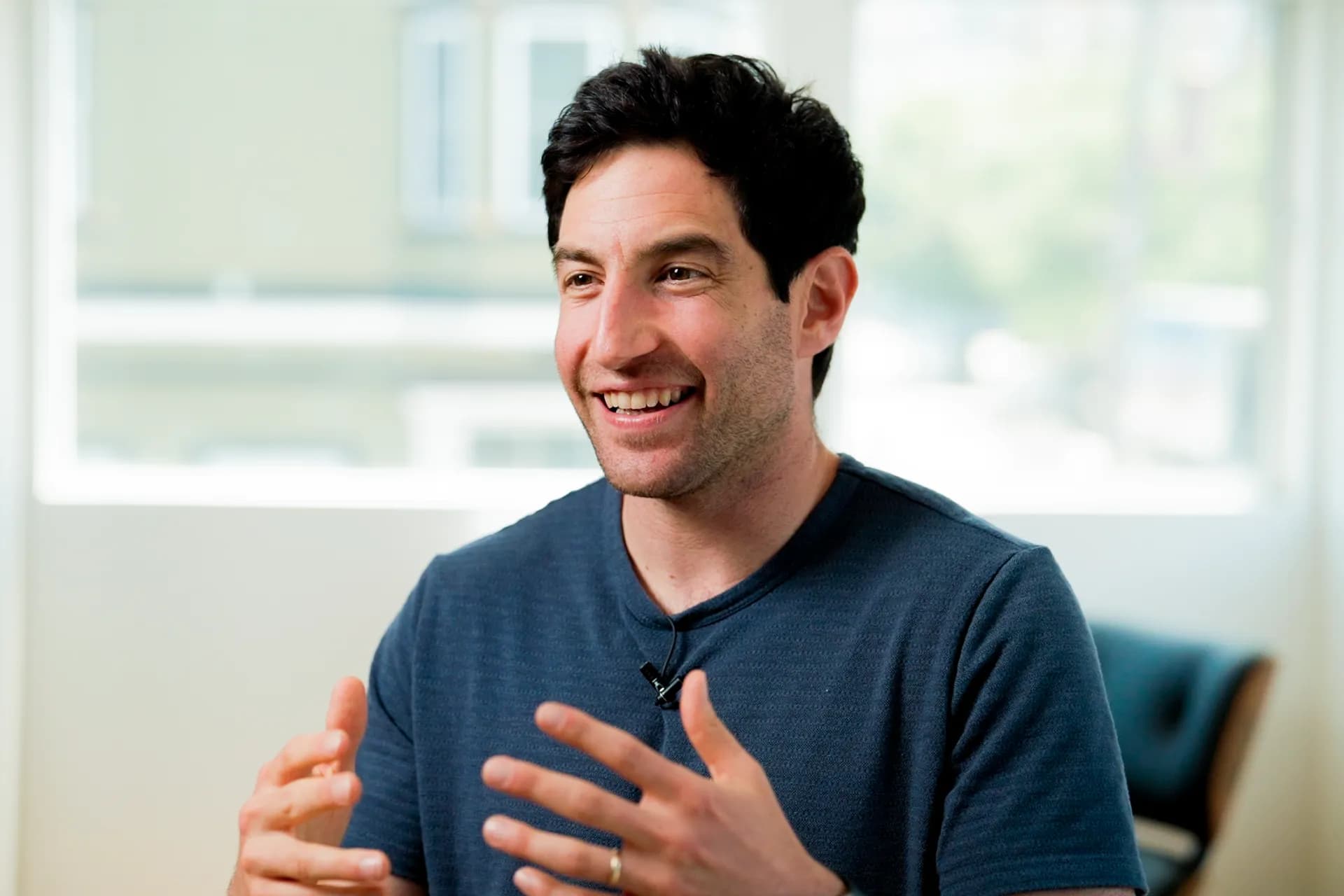
Jacob Bank, founder and CEO of Relay.app, didn't just talk about the AI agent revolution; he lives it. With a 9-person team doing the work of 15, and an AI bill of just $500/month replacing what would have been $50,000/month in contractors, he's proving that the future of work is already here.
In this interview, Jacob shares why thinking of AI as your intern is wrong, why staying at Google is now the riskiest career move, and the two rules he used to build a 40-agent system from scratch.
Watch the full interview now on EO's YouTube channel! Below is the complete transcription of the interview. Minor edits have been made for clarity and readability.
Key Highlights:
"Building AI agents is the fundamental skill that will define every professional's career for the next 30 years. It's a requirement."
"A high quality marketing contractor — let's say I had four people at $12,500 per month each. That would be $50,000 a month. And my AI bill is $500 a month."
"The riskiest career is if your skills are too tied to the environment of one particular company that could change over time."
"Risk is stagnation. Progress means learning and growing and pushing yourself."
"Number one: the ability to clearly articulate what is important, what needs to be done, and give guidance on how to do it."
"Number two: I want them to think about areas where their unique personality and abilities can shine in a way that AI wouldn't."
"A high quality marketing contractor — let's say I had four people at $12,500 per month each. That would be $50,000 a month. And my AI bill is $500 a month."
"The riskiest career is if your skills are too tied to the environment of one particular company that could change over time."
"Risk is stagnation. Progress means learning and growing and pushing yourself."
"Number one: the ability to clearly articulate what is important, what needs to be done, and give guidance on how to do it."
"Number two: I want them to think about areas where their unique personality and abilities can shine in a way that AI wouldn't."
Lesson 1: AI Is NOT Your Intern
Can you introduce yourself and tell us about Relay.app?
Jacob Bank: My name is Jacob Bank. I'm the founder and CEO of Relay.app. It's a platform to build AI agents and workflows that get work done on your behalf. Right now, we're a nine-person team: five engineers, two designers, a product person, and myself. If we did not have AI, we would probably need to be a 15-person team to achieve the same level of accomplishment that we have now.
Once upon a time, I was an AI researcher, then a startup founder, and then a longtime product lead at Google. I've been working on Relay.app since 2021, so I've seen the whole AI boom over the last three years from a very close vantage point.
Once upon a time, I was an AI researcher, then a startup founder, and then a longtime product lead at Google. I've been working on Relay.app since 2021, so I've seen the whole AI boom over the last three years from a very close vantage point.
You used to say AI is like an intern. What changed your mind?
Jacob Bank: A year ago, I said, "Hey, think of an AI as your intern." And then I realized that was the wrong mental model. There are certainly tasks that AI can do that you would give to an intern. But AI can also do strategy analyses and competitive analyses and content creation tasks that an intern definitely could not do.
Can you give us a concrete example of how you use AI in a role you're not naturally good at?
Jacob Bank: I am not good at sales calls. I do not have a background in sales. It does not come naturally. But it turns out there are some techniques that are pretty valuable in sales calls. So I have an AI coach that reviews all the transcripts of my meetings and says, "Oh, you could have talked about this better. You could have articulated this value, or you were too eager to jump into a demo there. You should have asked some more discovery questions."
If you go out and hire a sales coach, a good one is like $10,000 a month for one meeting a week. You can build a pretty good AI sales coach by yourself with a little bit of transcript training and it'll cost you like five bucks a week to run.
If you go out and hire a sales coach, a good one is like $10,000 a month for one meeting a week. You can build a pretty good AI sales coach by yourself with a little bit of transcript training and it'll cost you like five bucks a week to run.
How do you think about applying this coaching model beyond sales?
Jacob Bank: Whenever there's a new role or function I'm taking on that I don't have experience in, I think about how I can set up the right coaching relationship, where I give my AI coach the raw data of what I'm doing and then have it give feedback to me on the right cadence, whether it's after every call, once a day with a summary, or once a week. That's why I'm now realizing that thinking about AI as an intern was so wrong.
Lesson 2: Managing People Won't Be Your Job Anymore
What does the future of work actually look like day-to-day?
Jacob Bank: Back when I was at Google, there was a role called tech lead manager. It was a hybrid where you were both the technical expert and the manager coordinating the team. It's a very hard role. But I think that's what the future holds for all of us. We all need to become super ICs, super individual contributors.
Everyone is going to look like me, where about two-thirds of your day is individual contributor work. I'm making YouTube videos, editing blog posts, publishing content, talking to customers. And then one-third of my day is coordinating my team of AI agents that helps me with those things.
Everyone is going to look like me, where about two-thirds of your day is individual contributor work. I'm making YouTube videos, editing blog posts, publishing content, talking to customers. And then one-third of my day is coordinating my team of AI agents that helps me with those things.
Which jobs are most at risk of disappearing?
Jacob Bank: If your job is as a junior content marketer to take a YouTube video and write a blog post based on it, that job won't exist anymore. You cannot build a career just doing single individual content repurposing tasks like that.
And if your job is to manage a team of a thousand people at a large corporation. I don't want to say that job is going away entirely, but companies are going to be smaller and leaner. That skill set of managing a thousand people is going to be less and less important.
And if your job is to manage a team of a thousand people at a large corporation. I don't want to say that job is going away entirely, but companies are going to be smaller and leaner. That skill set of managing a thousand people is going to be less and less important.
Is there an upside to this shift for workers?
Jacob Bank: The thing that's so exciting about this Super IC future is that that's the work most of us love. Everyone I know who was in a complete organizational management role was thinking, "Ah, I wish I could be closer to the work, closer to the customer." And junior people are like, "I wish I had a bit more strategic influence on what we were doing."
Now every role will combine the best of both worlds. We will all need to be strategic enough to decide what needs to be done and see what good looks like, but also still hands-on enough to edit the blog post, edit the tweet, and make the video ourselves. That's the future of the workplace.
Now every role will combine the best of both worlds. We will all need to be strategic enough to decide what needs to be done and see what good looks like, but also still hands-on enough to edit the blog post, edit the tweet, and make the video ourselves. That's the future of the workplace.
Lesson 3: Two Rules to Build a 40-Agent System
How did you actually go from zero to 40 agents?
Jacob Bank: Yes, it's a bit overwhelming to see 40 agents all at once, but if you click into any individual agent, they're very simple and they all have very specific jobs. Every time we create a new YouTube video, it creates a LinkedIn post automatically. Every time the CEO of one of our competitors posts on Twitter or LinkedIn, it lets me know. Every week, it checks our competitor pricing and lets me know if anything important has changed.
One by one, I built up this team of AI agents to help me.
One by one, I built up this team of AI agents to help me.
Rule #1: What's your advice for someone just starting out with agents?
Jacob Bank: I have not had good luck trying to build a single agent to do 25 things at once. That is one difference from human employees. When you hire a social media marketer, you want them to own all of social media. But with AI agents, especially if you're a beginner, start simple. Create one agent that can do one thing, a second agent for a second thing, and maybe one agent that sits above them and helps invoke them when necessary. Build up over time. Do not start with a 40-agent org chart. Start with one.
Rule #2: What happens when an agent isn't working?
Jacob Bank: AI agents are not a set it and forget it kind of thing. I'm constantly modifying mine. For example, I thought it would be cool if customers got a personalized Google Doc after an assessment call. So I built an agent to create that. After doing it 10 times, I was like, "The customers aren't reading the Google doc. I should have just included it in the email." So I fired that agent and repurposed it to drop the summary directly into the follow-up email.
Have you ever shut down an entire category of agents?
Jacob Bank: We were very focused on SEO a year ago and then realized it's just not the important channel for us right now. So I told my AI SEO agents, "You guys can stop for now. I'll come back to you in the future." In the same way you'd tell an SEO agency we don't need you at the moment.
And the really cool thing is there's no emotional baggage. There's no disagreements. There's no coordination costs. I just have an idea, and the agent says, "Yeah, absolutely. Let's do it." I don't want us to think about it as replacing people. I want to think about it as giving me superpowers.
And the really cool thing is there's no emotional baggage. There's no disagreements. There's no coordination costs. I just have an idea, and the agent says, "Yeah, absolutely. Let's do it." I don't want us to think about it as replacing people. I want to think about it as giving me superpowers.
Lesson 4: Staying at Google Is the Riskiest Career Choice
How has your view on career risk changed over time?
Jacob Bank: In my parents' generation, a safe career was working at one large Fortune 500 company for 40 years. A risky career was starting your own company or moving between companies every couple of years. I think that has completely flipped.
The riskiest career is if your skills are too tied to the environment of one particular company that could change over time. The most robust careers belong to people who are starting their own companies and having lots of different life experience.
The riskiest career is if your skills are too tied to the environment of one particular company that could change over time. The most robust careers belong to people who are starting their own companies and having lots of different life experience.
What would you say to someone deciding between staying at a big company versus joining a startup?
Jacob Bank: If you ask 10 people what's riskier, staying at Google or joining a startup, most will say it's safer to stay at Google. And in terms of cash compensation for the next year, yeah, that's true. But if you think through the long-term lens, how broad a network have you built, how many new skills have you developed, how have you pushed yourself, it is way riskier to stay at a company like Google than it is to join or start a startup.
How do you reframe the concept of risk for people who are hesitant?
Jacob Bank: I never want to communicate that you should take more risk. The way I frame it is: optimize your career for personal growth and learning new skills. Often the way to create personal growth is to go into newer and more uncertain environments where you'll have more responsibility. I don't think that's risky. I think the riskiest thing you can do is to stagnate.
Risk is stagnation. Progress means learning and growing and pushing yourself. I had no marketing background. I was not even on any social media platforms until a year ago. But I worked really hard at it for a year, and now I love it. It could have felt risky to put so much effort into a marketing strategy we hadn't tried, but no, it was an opportunity to learn and grow in a new direction.
Risk is stagnation. Progress means learning and growing and pushing yourself. I had no marketing background. I was not even on any social media platforms until a year ago. But I worked really hard at it for a year, and now I love it. It could have felt risky to put so much effort into a marketing strategy we hadn't tried, but no, it was an opportunity to learn and grow in a new direction.
What's your message to people who are skeptical about AI agents?
Jacob Bank: There are two ways you can react to the current AI agent moment. You can say, "I'm skeptical. I don't believe it. I'm going to keep working the way I've always worked." Or you can say, "Whoa, this is a cool tool that's going to completely change the way work is done, and I want to be on the cutting edge of how I'm using it." Please be person number two. That's going to serve you much better.
Lesson 5: What a Founder Who Uses AI All Day Wants His Kids to Know
How do you think about raising kids in a world being transformed by AI?
Jacob Bank: I think often about how different the world my kids are going to live in. Where we live in San Francisco, it's very close to the main testing area for Waymo and Zoox. My two older daughters are sitting behind me on a cargo bike saying "Waymo, Zoox, Waymo, Zoox." For them, it is so normal to see a car with nobody driving it. I'm so happy that I think neither of them will ever need to drive a car by themselves. It'll be so much safer and more convenient.
There are other areas where I have more mixed feelings, like I don't want them just scrolling YouTube Shorts all the time. So the general approach I take is: give them as many real-world challenges and experiences as possible. You still have to learn how to ride a bike. Skinned knees are good for kids. If you're skinning your knees, it means you're trying something and taking risk in the real world.
There are other areas where I have more mixed feelings, like I don't want them just scrolling YouTube Shorts all the time. So the general approach I take is: give them as many real-world challenges and experiences as possible. You still have to learn how to ride a bike. Skinned knees are good for kids. If you're skinning your knees, it means you're trying something and taking risk in the real world.
What skill #1 are you most focused on building for their future careers?
Jacob Bank: Number one: the ability to clearly articulate what is important, what needs to be done, and give guidance on how to do it. That will only be more important in the future because our jobs will increasingly be about how we efficiently instruct AI on what it needs to do. That's why I really want my kids to learn logic and philosophy, so they can very clearly articulate what they want.
And skill #2?
Jacob Bank: Number two: I want them to think about areas where their unique personality and abilities can shine in a way that AI wouldn't. That's why I record our own YouTube videos because it's an expression of my personality, and people build a social connection with that.
Those are going to be the two fundamental skills for the future: How good are you at articulating what you want and telling that to AI? And how good are you at building social connection with others? Those are going to be durable skills for the future of any career.
Those are going to be the two fundamental skills for the future: How good are you at articulating what you want and telling that to AI? And how good are you at building social connection with others? Those are going to be durable skills for the future of any career.