Interview with Matt Beane, author of The Skill Code & Associate Professor at UCSB
At a Glance
- Who: Matt Beane is an Associate Professor of Technology Management at UC Santa Barbara and the co-founder and CEO of SkillBench. He discovered the concept of shadow learning after studying medical residents who broke the rules to build surgical skill.
- What: He is the author of The Skill Code, which examines how AI is reshaping the way people build expertise, and leads SkillBench, a startup that turns AI usage data into action.
- Lesson: Matt Beane breaks down why AI's endless flood of B-plus content is a trillion-dollar threat to human skill, how challenge, complexity, and connection keep people learning once experts stop needing novices, and why leaders must act before the deskilling bill comes due.
Matt Beane, Associate Professor of Technology Management at UC Santa Barbara & author of The Skill Code, breaks down why AI's endless flood of B+ work is a trillion-dollar threat to human skill, and how challenge, complexity, and connection keep people learning when experts no longer need novices. He also shares what leaders and organizations should do before the deskilling bill comes due.
The B+ Trap: Why AI Makes Mediocre Ideas Too Easy to Ship
AI can produce endless B-plus content almost for free, and constant exposure to good-enough output erodes people's memory of what A-plus actually looks like. The most valuable function of expertise has always been the discipline to say no to a decent idea in favor of a great one, and AI removes the friction that used to force that discipline. Wise leaders now have to manufacture that friction back in, rewarding people with cash, promotion, or visible recognition specifically for killing a B-plus idea before it ships.
What "Burning Tokens" Actually Proves
Jensen Huang's line that a $500,000 engineer should be burning at least $250,000 in tokens is being used across the industry as a productivity mandate. But burning tokens is like burning calories: doing a lot of it proves nothing on its own if you're just running in circles. The real question a team should ask before scaling AI usage is whether an idea clears the bar of A-minus or better, not how much compute it consumed getting there.
The Three C's: What Every Skill-Building Job Actually Needs
Studying rule-breaking shadow learners across dozens of occupations revealed the same three things they were all fighting to protect: challenge, complexity, and connection. Challenge means staying close to, but not past, the edge of your ability, with an expert present to help you process the frustration of small failures. Complexity means engaging with the whole system around your job, not just your narrow task, and connection means having a mentor relationship built on real trust, since people work harder to earn respect from someone who believes in them.
Why Leaders Should Show Their AI Failures, Not Just Their Wins
The most effective leaders using AI right now aren't the ones broadcasting their biggest wins. They're the ones who spend real personal time building with the most advanced models and openly report when an attempt failed and why they abandoned it. That visible failure signals something more valuable than any success story: that nobody has this figured out yet, which gives everyone else permission to experiment honestly instead of performing competence they don't have.
Inverted Apprenticeship: Why Cutting Junior Hiring Is a Mistake
Many firms have spent the last year slowing junior hiring to retain senior expertise, but that instinct is backward. AI-native junior employees can already do astonishing things regardless of experience level, and the real opportunity is building bidirectional learning where senior people learn from junior ones as much as the reverse. Healthy organizations should be willing to take a short-term productivity hit to build this two-way apprenticeship now, before the gap becomes permanent.
The 30-to-40-Year Bet: Is AI Going to Beat Humans at Everything?
It's no longer a fringe view that AI could be better than humans at literally every task, including empathy, judgment, and creativity, within the next 30 to 40 years. What matters most is not the technology itself but whether governmental, educational, and institutional systems can adapt fast enough, even on a 50-year timeline. The choice isn't whether change comes, it's whether we act now to make AI part of a less painful path forward or let disruption arrive on its own terms.
Watch the full interview now on EO's YouTube channel! Below is the complete transcription of the interview. Minor edits have been made for clarity and readability.
2025 was the year of try everything with AI: get results with AI, do your very best experiment, learn licenses for everyone. 2026 is the year the board of directors comes to the CTO and says, where is our return on investment? Jensen Huang from Nvidia is famously on record saying that if he's paying $500,000 for an engineer, they need to be burning at least $250,000 worth of tokens.
You can burn many tokens very inefficiently. All AI can do most of the time is create B-plus content, lots of free B-plus content, and you will forget what an A-plus looks like. A wise leader in an organization will reward people with cash, promotion, or visible recognition for stopping a B-plus idea.
Lesson 1. The B+ Trap: When AI Makes Average Ideas Too Easy to Ship
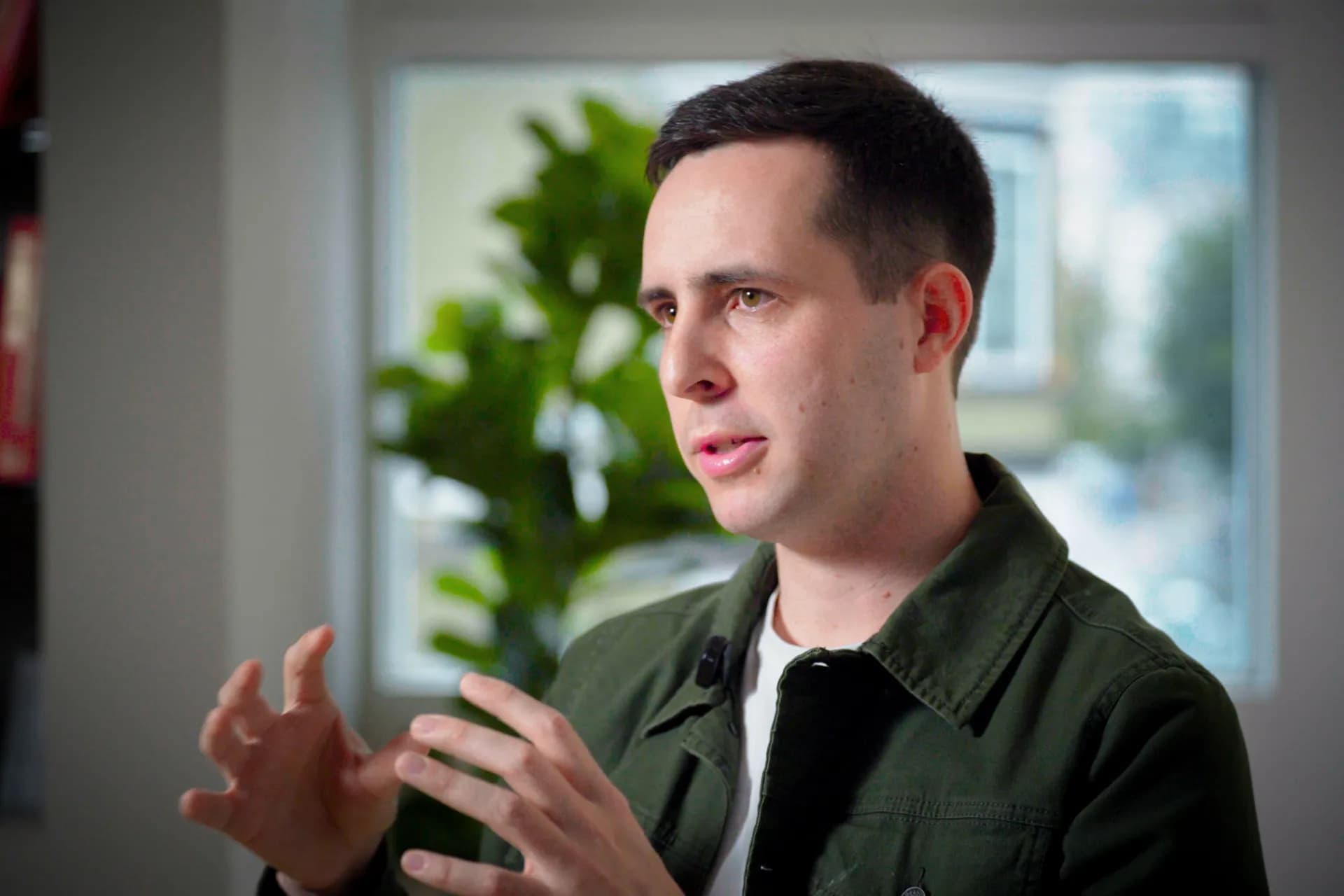
I'm Matt Beane. I'm an associate professor at UC Santa Barbara's Technology Management Program, and CEO and co-founder of SkillBench, a startup in the AI enablement space.
I wrote an article about this called "Don't Let AI Dumb You Down," and I put that on my Substack. That was two and a half years ago. Immediately, I saw this technology and thought, this is a major risk. I can produce lots of lines of code. I can produce documents for free or cheap. Should I have done that?
Courtesy of Matt Beane
Some experts say the most valuable function of expertise is to say we will not do that thing: that's a B-plus idea, not an A-plus idea, so we skip it. Unhealthy organizations are made of people who create problems for themselves: they see lots of ideas and go do them, and it turns out they produce lots of B-plus ideas.
That's not good enough. You have to have restraint. You have to only do the maximum-quality thing, and AI will make that harder. Even when you're in a task and you produce some output that could be good, there are quality problems inside it. If you haven't trained yourself to think clearly and do whatever expert process you're trying to do very well, you will miss those quality problems, and you'll slowly and subtly prevent yourself from learning, and you might even lose skill.
I said in the book that this is a trillion-dollar problem, and I think it's really true. If we don't take active steps to protect ourselves from this, we will de-skill ourselves, other people, and the next generation, and that will harm the economy. Not right now, but a few years from now.
The difference between those who care and are trying to protect their learning and those who are just pushing through with AI comes down to disposition. Are you driven to make sure you can do your own independent work and get your own independent results? Sometimes it's just something about a given individual that makes them fight to protect their learning, but a lot of it also has to do with incentives and the social structure you're embedded in. If the nature of my job is to produce more lines of code as a software engineer, then I'm focused on shipping more code or burning more tokens today.
This is another version of the same problem. Jensen Huang from Nvidia is famously on record saying that if he's paying $500,000 for an engineer, they need to be burning at least $250,000 worth of tokens. You can burn many tokens very inefficiently. It's like saying you burned a lot of calories today. That could be fine, but did you just run in circles?
Courtesy of WEF
The immediate first question is whether that's a B-plus idea or an A-minus idea. You have to set a threshold. A wise leader in an organization will reward people with cash, promotion, or visible recognition for stopping a B-plus idea from moving forward. You have to do more to create incentives for people to insist on superb ideas only.
And then someone who does pick an A-plus idea will win, and you'll go, wait, I didn't know you were allowed to do this. And it's like, yeah, this is how innovation works. You have to be very patient. You have to be persistent. You have to focus on: nope, that's not good enough.
Lesson 2. What Shadow Learners Reveal About How We Build Skill
Courtesy of Matt Beane
In 2018, I published the first paper out of my dissertation, which was on robotic surgery. This is what generated the idea of the shadow learning process. Shadow learning is building skill through non-approved, inappropriate means. Why would people do this? The reason has to do with current circumstances in surgery, and I've since checked this across more than 35 occupations. When a new technology arrives that disrupts the way you do work, it also disrupts the way you're supposed to learn on the job. Most of our skill comes from doing the work, and most of that comes from interacting with experts on the job. New technology lets the expert do more work independently, which means there's less room for the novice to participate.
So you show up to the work hoping to learn and build skill just by doing it, but the expert is on Zoom and never comes in. You don't get to interact with them, so what are you learning after a year or two? Not as much. Most people will continue to try to learn the old-fashioned way: they'll try to find ways to get involved in projects, and they'll struggle. But a very rare few, instead of trying to participate through the normal channels, will find norm-bending, culturally inappropriate ways to build skill.
In robotic surgery, for example, the medical residents who were most effective at building skill found ways to operate on patients without the senior surgeon in the room, given this barrier to participation.
It's not illegal, but it's not appropriate for a junior resident to operate on a patient alone, yet this is what the residents who built skill quickly did. They also, for instance, spent a lot of time on YouTube watching recorded video of surgery, up to a hundred times as much as a normal resident.
So shadow learning means: I can't build skill the normal way, so now I have to invent deviant or rule-bending ways to build it. I've found this in every other occupation I've looked at. These are not practices we should copy, obviously it's not appropriate, but these people are fighting to protect something in their work experience that lets them build skill.
Lesson 3. The Skill Code: Challenge, Complexity, Connection
Courtesy of Matt Beane
Where the Three C's Came From
Figuring out what they're fighting to protect was the purpose of writing my book. In the first third of the book, I looked across all the shadow learners I'd found, across many contexts, to figure out what they had in common. None of them explicitly identified these characteristics. None of them had a plan to say, I'm going to protect these things in my work. But if you look at their behavior, you can see what they were fighting to protect, and that's the first third of my book: challenge, complexity, and connection, the three C's in the skill code.
So the point is, the shadow learner is a critical source to go to in order to figure out what they're fighting to protect, and what we can do to keep working conditions healthy for productivity and for skill development. Not to copy them, but because they're a diagnostic: they give you critical information.
Challenge
Challenge is probably the most intuitive of the three for people: you need to be close to, but not at, the edge of your capability to build skill while you're working. It has to be difficult, require a lot of focus. You're not happy and relaxed. It's an intense, somewhat stressful experience, and you're performing a little below your best because you're straining. You must have a healthy amount of this challenge in order to really build skill.
The other piece is that an expert is there to help you manage the frustration that comes with that challenge. It's natural that when you try to do something at the edge of your capability, you'll fail in small ways, that's required. When you fail, you get frustrated, and if an expert is present and doing a good job, they can put that failure into context: yeah, you tried this and didn't quite succeed, but you're now capable of attempting a task you couldn't even attempt last week. They help you understand that your frustration is natural and that you've already progressed quite a bit. The expert's role is to help you process the frustration of challenge enough that you can keep pushing yourself further.
Complexity
The next of the three is complexity, which is about how you digest and engage with the broader work experience you're embedded in, not just the focal task. The focal task for a surgeon might be making a suture well and tying a knot. These are very focal skills you have to get good at. But a good surgeon who's learning well is also engaging with the nurse, the scrub tech, the hospital's supply chain, its finances, the computer and IT systems. They're trying to understand the entire system of work they're embedded in, and they give themselves time to reflect on that whole system so they can process and understand it.
Engaging with complexity makes you better able to handle surprise and discover new ideas, because you're more attuned to the system as a whole. You must always preserve space and time to reflect on the circumstance: look left, look right, try to understand. You yourself can do a great deal just by being curious and engaging with the broader system. Performance pressures in jobs are very high, though, and it's very hard for individuals to devote the time and effort to this kind of engagement.
Leaders in organizations can do a lot to enable it. For instance, you can run a job rotation program. I've seen two warehouses: in warehouse one, people go in, get on the line, do their job, and get paid the same wage as someone in warehouse B, who learns more because for two to three days they work on the line, put their item in the bag, then rotate to a different part of the line. These rotations expose you to different parts of the experience. Same wage, same job, same job title, but that person ends up more adaptive.
Interestingly, the leaders in those organizations aren't doing this to develop employees: when I ask them, it's fascinating, they're doing it to build resiliency in the line. What matters to them is that the building is an effective processing unit, which means it needs to handle surprise and notice problems and catch quality issues.
Connection
And then the third C is connection: a bond of trust and respect between human beings. We don't often think of trust and respect as critical for learning, but if you reflect on your own work experience, when did you learn the most and why, often it's a who. There's a person who trusted you, who gave you an opportunity, who gave you honest feedback, and you wanted to earn their trust and respect by getting better. I can speak for myself: this was part of my career for sure.
This kind of bond of trust and respect gives the novice motivation to do better, because it's important to you intrinsically: that's how humans are wired. We want to earn the trust and respect of mentors and senior people, and it goes the other way too. For senior people, it's meaningful to realize you can help a junior person develop and give them challenges; to do that well, you want to earn their trust and respect in return. And for the junior person, it also means that senior person will give you your next opportunity. They'll help you. So it's a functional thing as well, not just relational.
Challenge, complexity, and connection were consistently evident across all the shadow learning I looked at: all these people breaking and bending rules were finding unconventional, inappropriate ways to protect those three things. But that's what they were grabbing for.
Lesson 4. What Wise Leaders Do Differently
Courtesy of EO
Lead by Example
What's the leader's role in protecting good target selection? Individual leadership action is, and has always been, important, and it will remain important. You have to lead by example and get primary data: personal experience with how people are actually doing the job in the organization. The most effective leaders I see now spend significant personal time with the most advanced AI, building things and showing how quickly they can do that in a way that's valuable to the organization, including displaying failure and waste, reporting to the organization as a leader and saying, I tried to do this thing with AI and it was very bad, I decided it's a bad idea. Revealing this shows people that no one knows how to use this technology yet, so modeling it is very important.
Be Assertive About Hiring Junior Talent
The general trend in the economy over the last year or so is that firms have slowed hiring at the junior level and tried to retain and grow talent at the more senior level. That's very short-sighted. You need to be much more assertive about hiring junior people who are AI-native and can do astounding things with AI, even if they're less professionally experienced or have no experience, and set up learning dynamics that are bidirectional, so the senior person can learn from the junior person and the junior person can learn from the senior person.
I call this, in my book and my research, inverted apprenticeship. Especially when new technologies arise, you need bidirectional learning: new employees have a fresh perspective on the organization and can help improve things. Healthy organizations are willing to take a short-run hit to productivity to make sure they're ready for tomorrow.
Chimeric Future
It's very rare in human history to get a general-purpose technology that really changes the way we do things. It's going to be messy at the beginning: no one will get it right, and we all have to learn from each other. So it's important to hold high standards, but also be forgiving with yourself and others, and understand that everyone's going to be wasteful and make mistakes.
I think it's important to be open to the possibility that within 30 to 40 years, AI will be better at everything than humans are. Literally everything, all tasks, including empathy, judgment, and creativity. That's not a crazy view to hold anymore. It's not obvious to me that our governmental, educational, and institutional systems will adapt fast enough, even given a 30-year timeline, even given 50.
That means change will be more disruptive and difficult. We can either make AI part of the solution, and build a better, less painful path to the future that benefits more people, or change will come in more painful ways. I want to live in a future where we're grateful AI arrived, where we can look around and see that everybody is better off because of it, not just a few. I think we have to act immediately, and together, to create that kind of future.