* Introducing "Inside Hacker Houses" series:
The essence of startup culture has always lived in small, imperfect, grassroots spaces. Like hacker houses, hackathons, and early product meetups... where nothing is polished, and everything remains at risk.
EO believes that this early, messy phase is where startup culture is most alive. So instead of chasing main stages, we go inside the places where people are just beginning to build. This series documents founders at that moment, inside hacker houses, inside uncertainty, inside the act of starting.
The essence of startup culture has always lived in small, imperfect, grassroots spaces. Like hacker houses, hackathons, and early product meetups... where nothing is polished, and everything remains at risk.
EO believes that this early, messy phase is where startup culture is most alive. So instead of chasing main stages, we go inside the places where people are just beginning to build. This series documents founders at that moment, inside hacker houses, inside uncertainty, inside the act of starting.
The Algorithm's Letter
"Hi Hyeri and Wendy, Wanted to connect you two ahead of the event today…"
The email arrived before the event. That alone was unusual. Most conferences don't send intro emails. It felt like hospitality, like the host cared about my experience.
But something else felt different, too. It wasn't just a name and a generic "you should meet." It explained why, with specific reasons drawn from that person's background and mine. It mapped the overlap and made the value obvious.
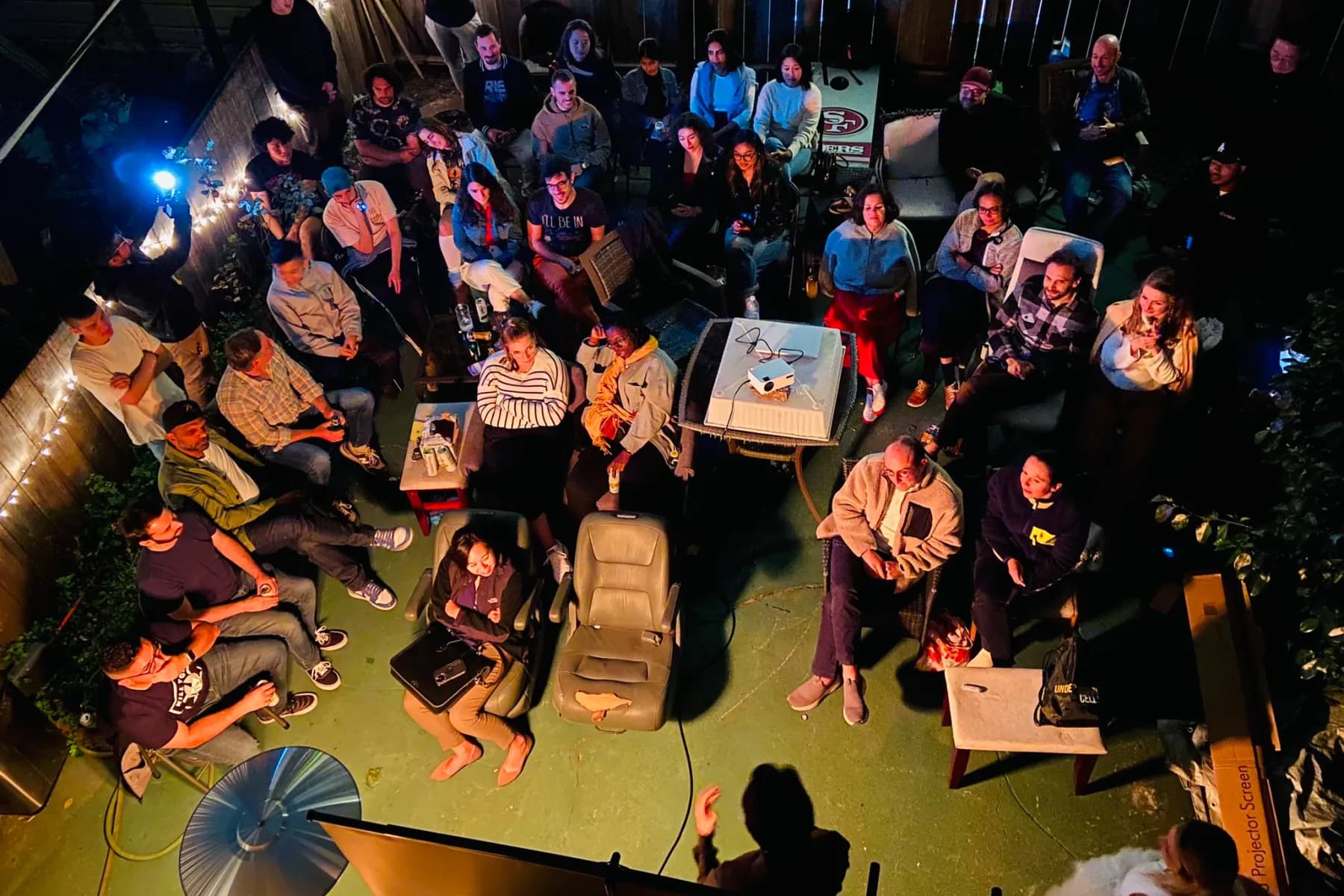
Hours later, at a demo day hosted by a San Francisco hacker house, I saw who sent them. A founder stood on stage and said, "You all probably received those emails." When I got a chance to speak with him afterward, he told me the truth: it was AI.
I asked if we could talk more.
A few days later, at 5:35 AM, Nir joined our video call while walking. He wakes at 4:30 every morning, so 5:35 wasn’t early for him. Deep work until noon. A quick workout and meal. Lighter work until evening. Chinese study before bed. If there’s time, he reads.
This isn't the routine of some starry-eyed hacker house kid. It's the routine of someone who knows time isn't guaranteed.
He arrived in the US just months ago with nothing. No network, no reputation. In that short time, he's already running paid pilots with Fortune 500 companies and conferences of 10,000+ people.
Where does that kind of intensity come from? How does someone land in a new country and start closing enterprise deals within months?
The answer goes back to a seven-year-old selling pirated CDs, to parents who refused to treat their children like children, and then to a tragedy that stripped away everything except what matters most.
$30,000 a Month, Still Empty
Your first business started when you were seven. What was it?
I used to download CDs and games with my brother and sell them to all of my schoolmates. That's how I made the first money from a business.
Was it just about earning money, or did you find it fun?
The motivation mainly came from how my family raised us. We were middle-class, but we were raised to be accountable. Even when I was younger, I needed to do my own homework. No one would tell me to do that. No one would wake me up. My parents believed you should be treated as adults from an early age.
What pushed you toward more serious business?
When I was 14, I worked as a waiter. I saw people 25 doing the same job. And I thought, okay, in 10 years I don't want to be doing the same thing. What can I do proactively to change that?
So I went online during summer vacation, started learning new things, and that led me to open my first e-commerce business at 15.
What were you selling?
Bike seats and bike parts. The choice was purely data-driven; there was nothing I was super passionate about. I saved money from the job, bought 250 units from China, shipped them to the US, and started selling on Amazon.
It went pretty well. At 17, I had three remote employees, and the business was doing $10k–15k a month. But then I faced lawsuits from competitors and made a few mistakes that cost me a lot, but taught me even more about eCommerce. After a year or so, revenue started to decline, so I decided to sell it and move on.
You definitely had a knack for business from a young age. So what business did you start after that?
It was for iOS apps on the App Store. We launched many applications, then started buying some of them. We bought apps from people, and then we figured out how to make more money from them.
For example, we bought an existing app that has 10,000 monthly downloads. We knew how to make more money out of these 10,000 downloads. That was the business model.
If you could pull that off, you must have had a real eye for business. Can you give an example of how you improved monetization?
It was mainly about the offer. You just need to understand the user journey and A/B test to see what works best. For example, in games like Candy Crush, there's a screen where you can buy a bonus or extra life. Most of it was free with limited access; full access costs extra.
How did you find these apps to buy?
I hired 50 people, gave them access, and taught them to use a tool that can scrape and show all the different applications on the App Store. Every day, each of these 50 people emailed 200 builders. So we emailed thousands of people a day.
But you stopped when you were 19. Why?
I felt empty. I reached a point where, even though in our better months we were making like $30,000, on paper it looked great, but it hit me that there was nothing more to it than numbers. I wanted to do something more meaningful.
Then the War Started
What did you do instead?
I started focusing on founder communities and interviewing founders through podcasts. This was about five years ago, when no one had podcasts, so I managed to interview everyone I wanted. I personally know 40 to 50 of them who still run online businesses full-time and started from zero. I thought it changed people’s lives.
Around the same time, my brother built the largest finance community in Israel, and I helped him along the way with the podcast, YouTube channel, and some growth projects. It's now the largest in Israel. The community has about 300,000 people, which is huge for a small country like Israel.
That's impressive. You really found something that time.
Around that time, I had just started something, and a week after I launched the first version, I flew to Europe for conferences. Then the war in Israel started.
A lot of people my age, 22 to 24, people I knew, died in the war. Before I flew, I was roommates with one of my friends, and his girlfriend rented my room because she wanted to be with him. She was going to a music festival. When the war started, terrorists attacked the party and killed a lot of people, including her. The person I rented my room to didn't come back from that party.
I'm so sorry for your loss. I can't even imagine how difficult that must have been.
At that point, I started doing NGO work, a nonprofit to help people who were affected or who lost family members. I did it full-time for about eight months. I managed around 850 people, 60 to 70 of them on-site, and the rest were online.
That must have been incredibly difficult. What did you learn from it?
After those seven or eight months, I realized that although I'm young, life can be shorter than people think. That's when I knew I could not wait any longer if I wanted to do something impactful. I decided to fly to New York and start my startup. I had some vision but didn't know exactly how to start. I just felt this urgency.
Hearing your story, I can tell there's something deeper driving you. That urgency to not waste time.
Yeah, and part of it comes from my culture. We tend to be very straightforward. Sometimes it can be interpreted as offensive or rude, but everything is very direct and to the point.
Can you give an example?
Sure. If I present my idea to someone back home and he doesn't like it, he won't tell me it's interesting to my face. He'll say, "I don't like it because of X, Y, and Z." Then I'll say, "Okay, that's good feedback. I agree on X. I'll fix it." This creates much better feedback loops, and you can always improve.
10 Minutes, 150 Teams, All Legwork
You arrived in New York with nothing. How did you even start?
I had a handful of people that I knew in New York, almost none. It was from the nonprofit that I was leading.
One of them helped me a lot. I stayed at his house for like 45 to 60 days in total. He gave me food and shelter. He also gave me advice on New York, startups, and everything in between. I couldn’t have done it without him.
What did you do every day at that time?
Each afternoon or evening, I went to one or two meetups. Even if it wasn't super relevant or high-quality, I managed to be there for 10 or 15 minutes, exchange contact information with the host or sponsor, who represented a big company, and then move on to the next one. So it's a lot of legwork. For me, it was a way to get clients beyond just networking.
What was the business you wanted to build so badly that you flew all the way to the US?
The long-term vision, where I want to build this company to be in five to 10 years or more, that's something I've been thinking about for years now. It goes back to the founder community and the value I saw there.
I learned that one founder, one startup, one business can change many people's lives, not only the founder's. If you have a valuable business, it can change your customers' lives for the better.
So for me, the best way to make the biggest impact is to build something that helps as many founders as possible succeed. That's what our company, ‘Leverage’ is doing. That's the mission.
That's a very big, abstract mission. But right now, Leverage is a tool that connects people at events. How does that connect?
Because it's a good way to start. The vision is bigger than that, but this is a very practical way to begin.
Especially with AI now, trust online is decreasing because of deepfake videos and software that allows you to send personalized messages at scale. That is causing a lot of people to go back to in-person events.
As a startup, I still need to solve a real business problem and make money. Conferences and events are a huge space with a specific, urgent problem. It's a problem we're solving that aligns with the broader vision.
I agree with your practical perspective. Okay, let's move on to how Leverage's MVP turned out.
The first MVP was me manually going through the list and matching people. So it was very scrappy. You need to be resourceful. I even tested if ChatGPT or anything like that could do that. With more than 20 or 30 people, it didn't even manage to do that. Even ChatGPT couldn't help me with most of the things.
Did it work well?
We had good responses. At the very basic level, it's just guessing who is relevant for you. But the bigger the event gets, the more people are there, and the more you're relying on luck to meet the right person for you. So even if we add value at a very minimal level, it's better than just bumping into someone hoping they're relevant to you.
How did you scale from there?
We spoke with over 150 enterprise teams and mapped out almost everything their teams do before a big event, like a conference or a trade show. After mapping that, we found it's very manual. After that, we not only automated but also significantly improved many of the tasks they were doing.
"Interesting" Doesn't Mean Interesting
What were the hardest problems you faced?
How lonely and challenging it can be. Especially for founders moving from their home country. You can hear about it in a book or a podcast, but when you're actually living it yourself, it hits you how little you understood.
It might sound cliché, but the journey shapes you. Whenever there are hardships, it builds you. It forces you to improve. That's something I didn't fully understand until I experienced it.
The second thing was adapting to the US culture. It took me some time to understand they might not be as straightforward.
Why did that matter?
For example, I'd ask ten people about an idea. Ten people say, "Interesting." I'd think, "Great! Let's build it!" But later, it clicked that those ten people were just being nice. They didn't feel I should do it, but it's less in their culture to say, "I don't think you should do that because X, Y, and Z." In my culture, if someone says it's interesting, it truly is.
How did you get their actual feedback?
The best and most accurate way is to know whether they're paying for it. That's the best way. At the end of the day, if you're solving for them in practice and you're genuinely helping them, you will know if they're paying.
So how do you make money? Do you charge when you're involved in an event and make connections?
Usually, we charge sponsors. We help them make introductions with their ideal clients. For example, we can send 50 emails to their ideal clients and even curate side events, such as dinners. They pay us directly.
In other cases, we work with the host. Let's say attendees can pay an extra fee for a VIP upgrade that guarantees five meetings. Our tool makes it possible to offer that kind of option. Then, we share revenue with the host.
How many events have you worked with?
Around 30 in the last three months. We also have a few big conferences lined up for 2026, four already confirmed, with around 10,000 people each. And we're working with sponsors directly on paid pilots. Companies like JPMorgan, PwC, Atlassian, Lovable, and Monday.com.
Amazing. What was their reaction?
Some of them liked it immediately, even before we started the trial, because they were suffering from the problem.
One director at a major finance company said, "What you guys are building is not only relevant for my team, but for our entire organization. It's a long sales cycle, but I'll do my best to help. If you're patient enough and actually deliver, it will be relevant for the entire organization.”
We heard similar feedback from several other big companies, and that gave me strong conviction at the beginning, even before we made our first dollar. It was extremely early, like maybe only a month in.
Oh, when did you get your first paying customer?
A few weeks later, we closed the first paid pilot with a very large company. Then a few others followed. That felt different.
How did you feel about that?
I realized, “Okay, we're not just solving a theoretical problem.” And it felt great.
At the end of the day, you don't want to get only "it's interesting" or "it's relevant for my entire organization." Those are nice words. But when someone pays? That's when you know it's real. That's the best form of validation. ,
The Highest Leverage Point
Now, can you tell me a bit about how Leverage works?
When it scans, it visits each attendee's social media and their company website to gather more information. After matching, the host can view all matches and approve them. It connects to your event software to pull all attendees, and if you want to send emails, we have a Gmail integration that does so.
You mean the host confirmation is the key stage?
The host always has the final say on which matches go out. So currently, we still keep a human in the loop. It's 99% proactive, but the last click is still made by a human.
There's still a trust gap. People in tech are generally more receptive. But more old-school people, often older, are a bit more concerned.
So it sounds like you're also targeting more established enterprise clients.
We have a few paid pilots running with some of the largest banks and software companies in the world. I don't want to get into specifics, but there are even more starting in Q1 of 2026 because of new budgets. We're definitely building good momentum.
What's your six-month target?
Realistically, I think $1-2 million in ARR within six months is a good target. Our first paying client came about two months in, and with our current pipeline, that goal is feasible. There's also everything else that will compound. We just need to stay focused.
Does that mean you'll start raising funds soon?
We'll probably do that in the future. Currently, I'm just focusing on making sure the paid pilots go great, even more than what they expect. We want to deliver above and beyond.
Everything will be much easier when we're actually focusing on delivering a great product that exceeds expectations. That means more traction, more clients, more revenue. Everything compounds from there.
Beyond events, where do you want Leverage to go?
Across all the events we work with, we understand what every attendee needs and has, because we're matching them. As we gather more events and people, we can build a large marketplace that connects everyone and matches people regardless of which event they attended.
And not just matching. We want to provide the platform to agree on terms and make the transaction. From finding your ideal match to closing the deal, whether it's a co-founder, investment, employee, or partnership.
Why does connection matter so much to you?
We believe that a single right person can change a business. It changes the founders' lives and, hopefully, their clients' lives too. Creating that impact at scale is what keeps me going. If you have a goal much bigger than yourself, it gives you true purpose.