
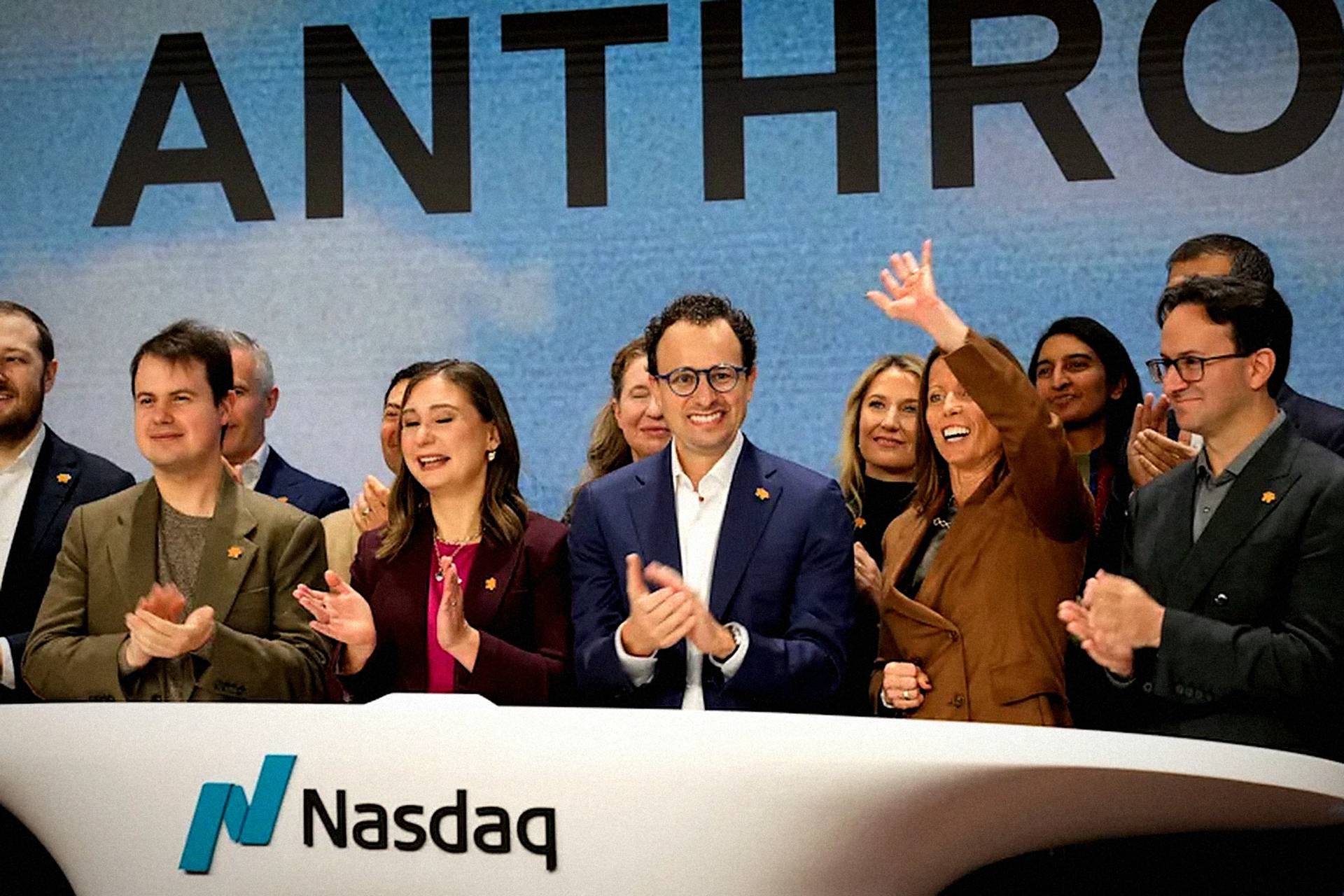
Jensen Huang founded Nvidia and led it for 33 years, until his board ousted him last week after an affair scandal. Huang says he would be honored to return. His employees and big names from Elon Musk to President Trump want him back, and two large investors asked the board to keep the door open. All they can do is write letters. Why couldn't anyone stop the board? He owned 3.6% of it, with one vote per share, like everyone else. Today Anthropic starts trading after a record $81.3 billion IPO. Its seven founders made sure no investor can vote in a board that would do that to Dario Amodei. One share, held by the seven of them, carries 50.1% of the votes.
Anthropic's Golden Share Gives Seven Founders the Vote, and Investors Paid Anyway
Dario Amodei, Anthropic's CEO and one of the seven co-founders who hold its golden share.Photo: Jason Henry/Bloomberg.
Anthropic's S-1 splits its stock into five classes. One of them is a single share, owned by an LLC of the seven co-founders, that carries more votes than every public shareholder combined.
Anthropic's Five Classes of Stock
- Class A (sold to the public): One vote per share. Together never more than 49.9% of the vote.
- Class F (the seven co-founders, one share): 50.1% of the vote, no economic value, never diluted. A majority of the founders decides how it votes.
- Class T (the Long-Term Benefit Trust, one share): Names four of the seven directors.
- Class N (strategic partners such as Amazon and Google): Same economics as Class A, no vote. Amazon and Google will own more than 28% of Anthropic after the IPO, more than all seven founders combined.
- Class E (employees): Votes only on a few limited matters tied to the trust.
The founders are also selling. Each sold about 3.4 million shares in the IPO, roughly $280 million at $83. Together they still own 12.7% of Anthropic and, counting their own Class A shares, control 61.1% of the vote. None of this was hidden. The filing tells buyers that Class A holders "generally will not be able to affect the outcome of any matter" put to a stockholder vote. It also gives the reason. The co-founders, it says, are "distinctly equipped to be stewards of our mission."
Anthropic's prospectus warns Class A buyers that they "generally will not be able to affect the outcome of any matter" put to a vote.Source: Anthropic.
Buyers paid anyway. Anthropic priced its shares at $83, above the $70 to $78 range, and the order book was reportedly about seven times oversubscribed. Demand for AI stock may explain that price as much as any comfort with the structure. Talk of a $2 trillion valuation fell to about $1.5 trillion as revenue growth slowed. Still, every buyer had the terms in hand before paying.
Huang's exit shows what the founders were guarding against. When a company's value rides on one or two founders, the vote is the first thing those founders lock down.
A golden share looks like a very good deal for founders. Investors may accept it only until the terms change after they buy. Meta, the company best known for founder control, is testing that now. Its shareholders have taken Mark Zuckerberg to court.
Meta's Shareholders Accepted Zuckerberg's Control for 14 Years. Then He Changed the Deal.
Meta's two share classes and the proposed nonvoting Class C. From Meta's 2026 proxy statement and the shareholder complaint. Graphic: EO.
Meta has run on two classes of stock since its 2012 IPO. Class B shares carry 10 votes each. Zuckerberg owns about 13% of Meta and controls about 60% of its votes. Shareholders have put forward one-vote-per-share proposals 13 times since 2014, and his votes defeated every one. Anyone who bought Meta stock bought that arrangement.
He has tried to stretch it before. In 2016, Facebook proposed nonvoting Class C shares so Zuckerberg could give away most of his stock and keep control. Shareholders sued in Delaware. Facebook dropped the plan in September 2017, days before Zuckerberg was due to testify, and he said he would sell shares instead.
On October 21, Meta disclosed a new nonvoting Class C. The company needs money for AI and is raising about $98 billion in stock for it. Zuckerberg also faced a possible California billionaire tax, which would have forced him to sell enough stock to cut his votes to about 53%, according to the complaint. Under the plan, every shareholder gets one Class C share for each share held. Zuckerberg could sell 20% of his new shares at once, about $23.8 billion, and the rest over eight years, without giving up a single vote. California voters rejected the tax in November.
Two Steamfitters Local 449 pension funds and two individual investors sued in Delaware's Court of Chancery on October 27, on behalf of Class A holders. They argue that Meta "had ample capacity to raise capital under its existing Charter," that the board's special committee was pressured into the deal, and that the plan is a betrayal of the bargain Zuckerberg struck with investors when Meta went public in 2012. Meta has since sold $25 billion of stock and $15 billion of bonds without the new class.
The shareholder complaintSteamfitters Local 449 Pension Fund v. Zuckerberg
On Wednesday, the day Anthropic priced its shares, Meta told the court it will not issue the new shares while the case runs. Meta's shareholders are not suing over the control they bought in 2012. They are suing over a new deal handed to them after they bought.
What Gets Decided Next, and What It Tells Founders
Three things will show whether Anthropic's design becomes the model for the AI companies that list next.
1. The Meta case
Delaware rewrote its rules on deals with controlling shareholders in 2025. The first big test came on October 16, when a judge paused Cloudflare's plan to add nonvoting Class C shares, finding that its special committee likely did not act in good faith. That ruling is not final. Meta's case is the second test. The other path is Google's, which settled a similar suit the day before trial in 2013 and issued its Class C shares the next year.
2. How ANT trades
Buyers paid $83 for shares that cannot change the board. Whether the stock holds that price is one signal on the structure, mixed in with demand for AI.
3. The next AI listings
SpaceX already trades with Elon Musk holding 82.4% of the votes on 46.4% of the shares. OpenAI and the others still private will pick a structure after watching both cases.
How much of each company its founders own, and how much of the vote they hold. Anthropic's figure counts the founders' own Class A votes on top of the golden share's 50.1%. Graphic: EO.
The table shows why the design comes first. AI companies raise so much before they list that founders end up with small stakes. Anthropic's seven together own 12.7% after raising tens of billions of dollars privately. When the stake shrinks with every round, control has to come from the share structure, not from ownership.
Anthropic wrote founder control in before it listed. Zuckerberg tried to add more after, and ended up in court. In the AI era, voting control has become the first term a founder has to design, and the design has to be finished before the listing. If Delaware stops Meta's plan, a founder who did not set up control before listing will find it much harder to add afterward. If Meta settles as Google did, the plan can come back on new terms.


