At a Glance
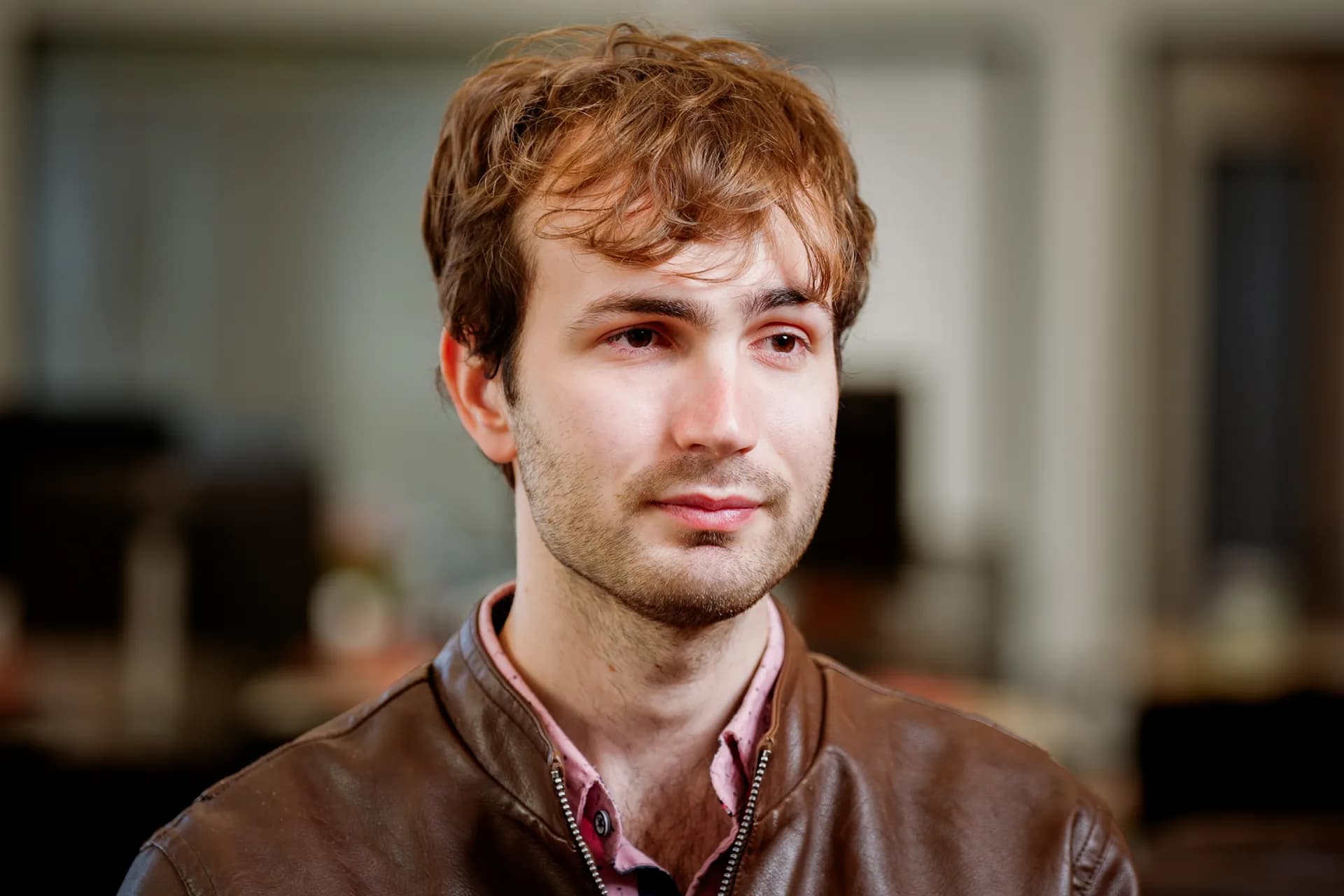
- Who: Tim Hwang is interviewed as a founder connected to FiscalNote. Their perspective is grounded in the transcript's account of the work, the decisions behind it, and the lessons that emerged while building, leading, researching, or operating in this field for founders and operators today.
- What: This interview examines A motel TV-watching college student builds a $1.4B company as described by the speaker and the practical path used to address the underlying problem. It covers product choices, market context, customer or user needs, and the operating decisions that shaped the work discussed in the transcript.
- Traction: At FiscalNote, the company journey combines a specific market opportunity with disciplined execution. The transcript traces how the speaker moved from an initial problem to product decisions, customer learning, team or capital choices, and measurable progress, while showing which constraints and turning points shaped the path forward.
Tim Hwang discusses A motel TV-watching college student builds a. The transcript makes the challenge concrete, sleeping in the back of the office while calling hundreds of customers. The interview then explains the decisions that shaped the response and the lessons learned through customer feedback, market shifts, team building, research, or execution. Readers will see how the speaker tested assumptions, handled constraints, and turned experience into practical guidance for founders and operators.
Key Takeaways
Choose A Macro Trend That Will Not Change
Tim Hwang built FiscalNote around the belief that the world would become more complex and politically consequential, leaving organizations overwhelmed by laws and regulations. The company’s durable insight was to choose a trend he expected to persist, then use technology to make that complexity usable.
Calculate The Ask Before You Ask Investors
While working from a Motel 6, Tim sent Mark Cuban a short cold email and received a response within 45 minutes. FiscalNote had calculated that it needed $740,000 for twelve months, giving the conversation a precise, credible funding request instead of a vague ambition.
Build A Network One Conversation At A Time
FiscalNote’s founders began with no Wall Street, Silicon Valley, or major-company connections. They built access through LinkedIn outreach, warm introductions, cocktail parties, handshakes, and business cards, treating network creation as an effort-driven process rather than a privilege they had to wait for.
Validate Demand Through Hundreds Of Customer Calls
The team listed 2,000 companies in a Google spreadsheet, bought a phone from 7-Eleven, and called hundreds of prospects to test whether the problem was real. After roughly 100 to 200 conversations, a defense contractor paid $20,000, turning repeated questions into concrete validation.
Founders Must Make Mission Feel Like Opportunity
Tim says strong mission is what persuades talented people to leave comfortable jobs for uncertain startups. The founder’s responsibility is to make a once-in-a-lifetime opportunity believable, because high-quality people are drawn to founders who can connect sacrifice with a compelling future.
Ask Why Now Before Scaling The Company
Tim treats timing as one of the most important startup questions, which is why this idea is right now, rather than five years earlier or later? A company can ride the tailwinds of a market trend only when its founders recognize the window and act before it closes.
Watch the full interview now on EO's YouTube channel! Below is the complete transcription of the interview. Minor edits have been made for clarity and readability.
Introducing Tim Hwang, founder of FiscalNote
My name is Tim Hwang, and I am the founder and CEO of FiscalNote. FiscalNote is a legal and information data company. We collect laws and regulations and help people understand how those laws potentially impact their organizations. We service everyone from the White House to the CDC.
We have raised probably about a quarter billion dollars in venture capital from people like Mark Cuban and Jerry Yang, and we recently went public for over a billion dollars. To subscribers of EO, we are definitely interested in talking about the challenges of building a company in the US, the B2B market and startup landscape, and of course how to build a unicorn startup globally. Enjoy.
A Politician vs a Startup
To be honest, I never thought of myself as an entrepreneur. Ever since I was in middle school and high school, my dream was to go to law school, become a prosecutor, and then run for political office and become a politician. To me, business was always a practical way to make an impact.
When I was about 16 or 17, a friend of mine called me and said there was a guy running for president that I should check out. He had a really funny name, but he was a really interesting guy. So I went online and watched his speech, and I felt that even if he did not become president, we should actually try to make him become president.
I ended up working for Senator Obama's presidential campaign back in 2007 and 2008. It was such a life changing experience, because it was like one big startup. We had to build offices in all 50 states. The campaign had to raise about a billion dollars in capital, and then we had to deploy it to consumers, about 300 million Americans, within about 12 months.
That idea of sleeping in the back of the office with pizza boxes, working until two or three in the morning and trying to get someone elected, was a very energizing experience. As I was going into college in 2010, I started getting involved in startups and I felt that this was the place where I wanted to be. In politics, you spend years and years trying to make change in the political system. In startups, you can very quickly build a product, get it to market, help customers and change their lives.
At the time, I had just finished my degree at Princeton and had just started my MBA at Harvard when I had the idea for FiscalNote. I was extremely focused on making sure the company was going to succeed. We had a vision of where we wanted to be, and it was pure execution at that point. Everything else was noise to me at the end of the day.
After we raised our seed round of capital, it was clear that I was never going back to school. We had raised millions of dollars and we had dozens of employees. We had to actually make this a success.
The Truth Never Changes
The way that we make decisions, and particularly the first decision when we started the company, was to ask what is a real truth that is not going to change in 20 or 30 years. Will the world become more complex or less complex? Will the world become more politically challenging or less politically challenging?
To me it was so obvious that the world was heading in a direction where it was going to become much more complex and where politics was going to be much more important. The problem was very clear. When you talk to customers, they are just overwhelmed with regulations and the complexity of politics.
Maybe 20 years ago, CEOs did not have to care that much about politics. That was something else going on over there. Today, if there is a political issue, they always bring the microphone and ask the CEO what his opinion is.
The one unique thing that we got right was that we picked a macro trend that was never going to change. We essentially take laws and regulations from each and every country around the world. We collect them using AI, and then we use machine learning and natural language processing to help people process that information, search it, and eventually make decisions based off of that data. You can think of it as almost like the Bloomberg terminal for law.
We raised our first round of investment at the end of 2013. To be honest, we had just built a tiny little product, and we said that we really needed to expand this business, because we were working out of a Motel 6 in Silicon Valley.
One night I was watching Shark Tank, the TV show. My co founders and I were sleeping in this motel room and just looking at the TV, and I said, oh man, would it not be great if Mark Cuban invested in our company?
The next day I went on Google and typed in Mark Cuban email address, and then I went to the Contact Us page of his TV company, and right there was his email address. So I shot him a three or four sentence email. The subject line was changing government. In the email I said, my name is Tim, I just graduated from college, I am starting this company, here is what we are going to do, and here is how I am going to change the world. And he responded within 45 minutes.
Mark Cuban and I went back and forth over email for a couple of days, and then he said, okay, great, I want to do it, I am going to invest, how much are you raising? At the time, we were raising $740,000 because we had calculated exactly how much we needed for 12 months. He said he would do the whole thing, and Mark was our very first investor.
That was our first little venture round and it came together very quickly. To be honest, I feel that we were extremely lucky, but that definitely changed our lives for sure.
The reason a lot of founders struggle to get investment is that many of them, particularly first time founders, do not know what makes a company investable and what makes a company non investable. What a lot of founders need to do is educate themselves on the particular interests of an investor.
There are many different types of investors, B2C investors and B2B investors. If you are starting a consumer company, a B2C company, you definitely should not email a B2B investor, because they are not going to be interested. A lot of the venture investing mindset is very pattern recognition oriented, and investors are very interested in trying to invest in something like this other company they already know.
That is why a lot of startup founders say they are Uber for this or Airbnb for that. These investors are looking for individual things in an investable business. They are looking at the business model and the future profitability. If you are going to be the CEO of a company, you need to know all of those things. It is your responsibility to understand that market, understand the investable landscape, and then actually try to build a company in that general context.
Hustle
We started this company when we were 21 years old. We were straight out of college. We had zero network. We had zero connection to Wall Street, zero connection to Silicon Valley, and zero connection to major American companies.
We built that network ourselves, literally going on LinkedIn and reaching out to one person at a time to get a warm introduction. We literally went to cocktail parties and forced our way in through the back door, shaking people's hands and taking their business cards. We hustled really hard, and it was a very effort driven mechanism to build that network.
Any business requires a huge level of network. If you want to build a successful B2C company, eventually you are going to need to do B2B work, whether it is with advertisers or with partners. Of course network is going to matter quite a lot.
We definitely did not have an aha moment, and it was actually very unsexy. It was really just pure hard work and effort, just trying to get to the right answers as quickly as possible.
We had a Google spreadsheet, and on this Google spreadsheet we listed out 2,000 company names and we literally bought a phone from 7-Eleven. We called hundreds and hundreds and hundreds of companies and we asked them whether they had this problem. Could they spend five minutes with us, could they take 10 minutes with us? So when we built the product, it was after maybe 100 or 200 conversations with people who had this particular problem and needed this particular issue solved.
Our first customer was a defense contractor, so from that perspective we got validation very quickly. They came in and they paid $20,000. We actually still have that contract framed in our office, because if we could get one customer, we could definitely get ten customers. If we could get 100 customers, we could definitely get 1,000 customers, and with 1,000 customers you essentially become a unicorn.
I think we have a competitive advantage in technology. The investments that we made in AI essentially prove that collectively we can build a company and a product that our customers want.
Let us say you are a pharma company. Pharma companies are trying to understand what their competitors are thinking about and what the government is thinking about. For us, sitting at the center of everything, we have the FDA as a customer and we have the CDC as a customer. I can tell you that the FDA is going to pass a particular regulation and that you should probably look at it. You essentially become experts in that particular policy arena, and companies rely on you to provide that intelligence.
To be totally candid, there are many points where FiscalNote could have failed. But in the back of my head I would always say that failure is not an option and that we were going to do whatever it takes to make this a success. That pure raging determination is probably what enabled the company to get to this point today.
When we were founding FiscalNote, I was 21 years old. I was a series A founder by the time I was 22, and we were managing 100% of the company by the time I was 24. It was very rapid growth.
To be totally honest, I do not come from an extremely wealthy family. My parents grew up pretty modestly and came to the US speaking almost no English. I grew up in the US, I went to school in the US, I went to college in the US, and I work in the US.
There is still a sense of not being American. It is a challenge, because there exists in the business culture an invisible club. Imagine there is a very exclusive club, and trying to break into this club has been something that I have been trying to do for the last ten or 15 years.
You definitely get ignored a lot. People assume that you are not going to be a great executive or a great communicator. They probably think that you are some engineer. I also think it is very lonely.
I was at a dinner of all the CEOs in the DC area, and I was looking around the room and I was the only Asian person in the entire room. I texted my co founders and said, dude, this is so messed up, how am I the only Asian in this room? There are circles of five or six CEOs, typically Caucasian men, all standing there drinking. You try to walk into the little circle and make conversation, and they look at you and they ignore you, even though I honestly think our company is probably one of the biggest companies in that room.
When we were starting FiscalNote, we knew that we were disadvantaged and that we were going to have to work much harder and try much harder. If you want to get covered by the press, you are going to have to contact ten times more reporters. If you want to get investment, you have to contact ten times more VCs, because you are probably going to get ignored. I think that probably gave us a little bit more drive to want to put in more effort.
To me, startups are the purest form of opportunity. If you have an idea and you work hard at it and you constantly put effort in, and you put in the hours and the passion and everything, the company should succeed.
People Are Drawn To The Mission
That is what makes startups so exciting. Building a startup requires the founder to have a very strong sense of mission. Why does this company exist? What purpose does this company serve? That mission is going to be what draws people to the company, and the people who are attracted to that mission are going to find your company very compelling.
Life is extremely short. In that short amount of time, do you want a 9 to 5 job making somebody else wealthy, or do you want to come and change the world?
Now imagine this. You are a software engineer making a decent amount of money, six figures, and you get a cold email from a startup founder saying he has this company, the product is not built yet, and they just raised a small amount of money. Do you want to quit your job and come work for us, take a huge pay cut and get a little bit of stock? 90% or 95% of people would say no, because why would they do that when they have such a comfortable life?
Your job as a founder and CEO is to convince that person that this company is going to be a unicorn. You have to look them straight in the face and tell them that they are going to quit their job and take this opportunity, because it is a once in a lifetime or twice in a lifetime opportunity and they are not going to regret it.
That works because high quality people are drawn to high quality founders. If you take capital and hire a bunch of B players or low quality people, then the company is not going to succeed.
For FiscalNote, we have typically, almost in every case with the exception of one or two, acquired founder driven companies. For me, founder driven companies are very different and very special, because the founders themselves picked each person individually in their organization.
They also have a very strong sense of responsibility about making the company a success. They have typically taken some level of venture capital, so there is this very aggressive speed mindset, and they tend to treat their employees very well, almost like a family environment.
If you combine that experimentation and bias for action with a family like environment and a sense of ownership, that is a really great culture to have. It is something that we had at FiscalNote for a long time.
I do not know exactly what it was, but when we were very young we had a very good team. We had computer science PhDs quit their jobs. We had people who had come from the military. We had this very strong sense of mission, even though we had a small amount of time, and very quickly we built a team that was going to stick together for good times and bad.
At FiscalNote, we were probably working 16 hours a day, seven days a week for almost two years. I told my employees that I needed them in the office somewhere between 9.30 am and 10 pm, seven days a week, every single day. At a seed stage company you have 18 months to hit a particular milestone, so you need to be in the office seven days a week.
In those types of cases, having a founder or CEO who is able to draw and attract a team with the same mindset and the same mentality is extremely important.
Why Is Your Idea Important Now?
Just because you receive investment does not mean that you are going to succeed. It is actually highly likely that you are going to fail, because at this point you have taken the money from the investors and you now have to spend it, and you have to spend it very quickly because the market is changing. The landscape is changing, competitors are popping up, and investors expect you to generate a return in a particular amount of time.
Timing is probably the most important thing in my opinion, and it depends on the sector and on the technology. The good thing about technology is that these timing trends happen all the time. In 2007, Steve Jobs got up and introduced the iPhone, and that launched a whole next ten years of mobile investing, mobile companies and mobile startups. When a trend like that arrives, you have to be able to jump on it immediately.
From a startup perspective, when you pick the idea, you have to understand not just why this company exists, but why now. Why is this timing right now the perfect timing for the company? Having done startups for almost ten years, I think that is probably one of the most important questions that founders have to ask themselves.
Why is the timing for this exactly right now? Why was it not five years ago or ten years ago? Why is it not five years from now? If you can get that timing exactly correct, the startup should be able to ride the tailwinds of some general market trend.
You Have To Know Yourself Better
The biggest decisions that we made were always about people. People problems are what really break down companies, particularly for series A or series B companies. Those companies have significant management issues.
If you watch the movie The Social Network, it is really interesting. They go from their dorm room at Harvard and then literally 10 minutes later they are in this massive office with hundreds of employees. I was just thinking to myself, what happens in the middle? In the middle there are so many problems, and so many of them are people problems.
I remember when I was a series A and series B founder, every time an executive would quit I would have to jump in there and manage the entire team myself. Suddenly I would go from managing four or five people to managing 20 people overnight, and then you have to do damage control and all these different things.
Startups are a very analytical job and a very self reflective one. It is almost like swimming. You have to constantly know what your limits are and what your energy level is. Startups are the same thing, because everything stops and starts with you.
You founded the company. It was your idea, and you take responsibility at that level. You have to know what your strengths are, what your weaknesses are, where you are going to fail and where your blind spots are. If you do not know what those fundamental personality traits or flaws are, then it is going to be very hard to do your job.
If you can really hone in on what that is, that mentality becomes constant, because when you make a mistake you put it into your framework, and when you make another mistake you put that into your framework as well.
For instance, I have a bias. When I am hiring executives, I look very heavily at their resume and I do not interview enough for particular skill sets. I have definitely made that mistake one too many times, where you over hire on the resume and under hire on the personality traits. I had to train myself to remove that bias from my head to make better decisions. That again is a very introspective thing, and you just have to constantly be thinking about it on a daily basis.
An Individual Changes The World
People ask me why I think America is so great at startups. I think it is because the startup culture has always been in America. America has built some of the most celebrated businesses, like Starbucks, Apple and Amazon. These companies are gigantic, but they always start from one singular person having an idea and putting in the effort.
The emerging generation of people in their twenties and thirties has a sense of disillusion. They feel that there is not enough hope or not enough economic opportunity. I think that startups are the answer. They are the economic torchlight that can guide the future of economies.
How do you connect the dots between the hope and disillusionment of people in their twenties and thirties and the future of economic opportunity? It comes down to starting businesses and building startups that solve problems, that go out there and are able to scale. When you succeed, it is an unbelievable feeling.
I am lucky to be the youngest Asian American publicly traded CEO on the Nasdaq or the New York Stock Exchange, and I feel like this is the beginning of my career. Even though we have been building this company for the last seven or eight years, Jeff Bezos was 30 or 31 years old when he founded Amazon. I still have a very long career that I would like to embark upon, and I think it starts with making sure that FiscalNote is successful and has the pathway to become an even greater company than it is today.