Dec 21, 2025
Axiom and the $64M Conviction Bet on AI Mathematics
An interview with Carina Hong, Founder of Axiom
Founder Focused

When Mathematics Meets Machine Intelligence
At a time when artificial intelligence is rapidly transforming how we write, code, and reason, one of the most ambitious frontiers remains largely untouched: mathematics itself.
For centuries, mathematical discovery has been defined by solitude, patience, and rare flashes of insight, breakthroughs that often take years, or even lifetimes. But what if that process could be accelerated? What if mathematical intuition, proof, and theory-building could be scaled the same way computation was scaled in the last century?
In this interview, we meet Carina, a 24-year-old founder who believes the next great leap in human progress will come from an unlikely collaborator: an AI mathematician. Through her journey from Olympiad problem-solver to startup CEO, she lays out a bold vision for how AI, mathematics, and human taste might converge to unlock entirely new kinds of intelligence. And, with it, new markets, sciences, and ways of understanding the world.
For centuries, mathematical discovery has been defined by solitude, patience, and rare flashes of insight, breakthroughs that often take years, or even lifetimes. But what if that process could be accelerated? What if mathematical intuition, proof, and theory-building could be scaled the same way computation was scaled in the last century?
In this interview, we meet Carina, a 24-year-old founder who believes the next great leap in human progress will come from an unlikely collaborator: an AI mathematician. Through her journey from Olympiad problem-solver to startup CEO, she lays out a bold vision for how AI, mathematics, and human taste might converge to unlock entirely new kinds of intelligence. And, with it, new markets, sciences, and ways of understanding the world.
Watch the full interview now on EO’s YouTube channel! Below is the complete transcription of the interview. Minor edits have been made for clarity and readability.
From Solitary Proofs to Scalable Intelligence
Hi Carina, could you tell us a bit about yourself and what Axiom is building?
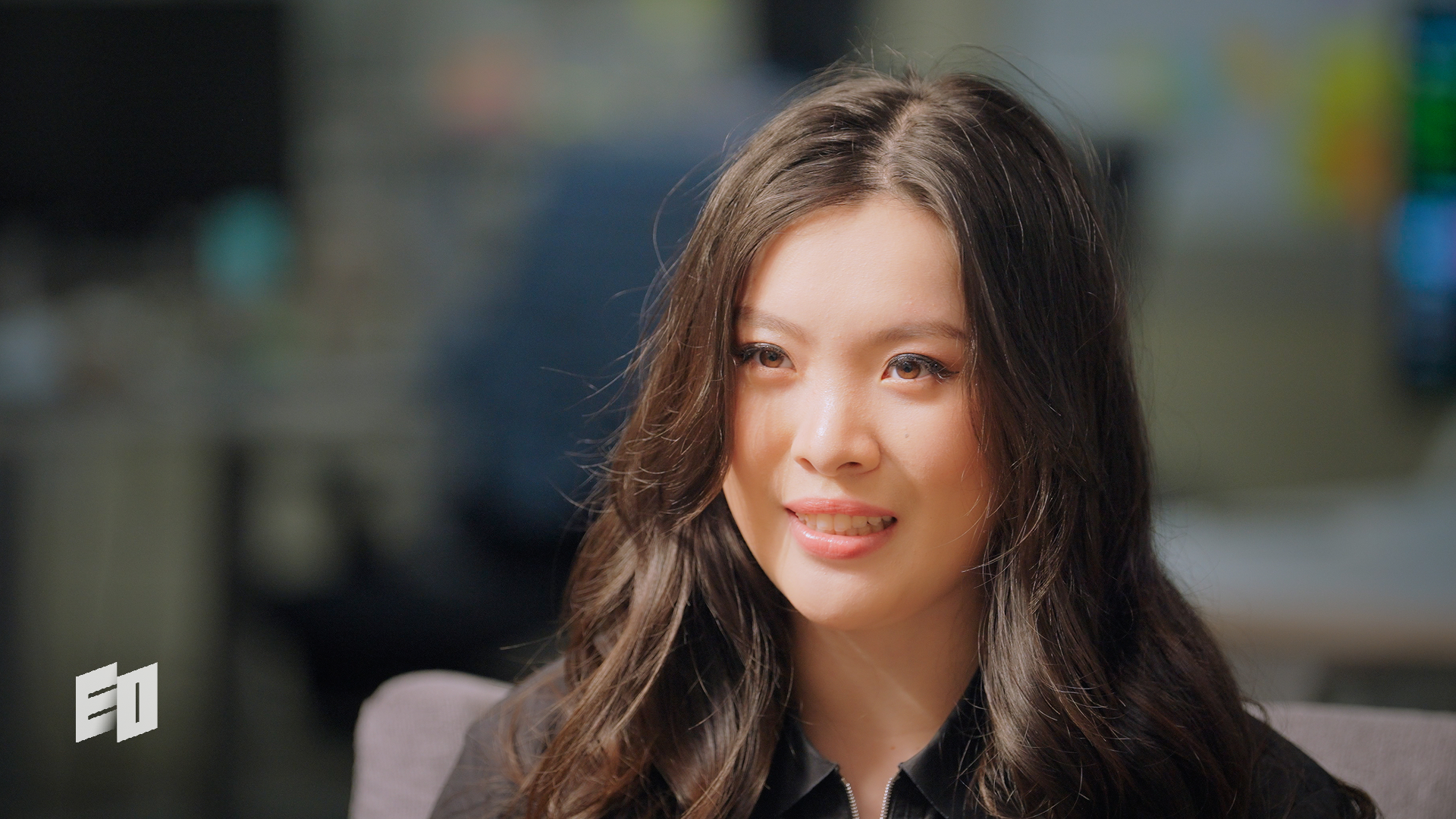
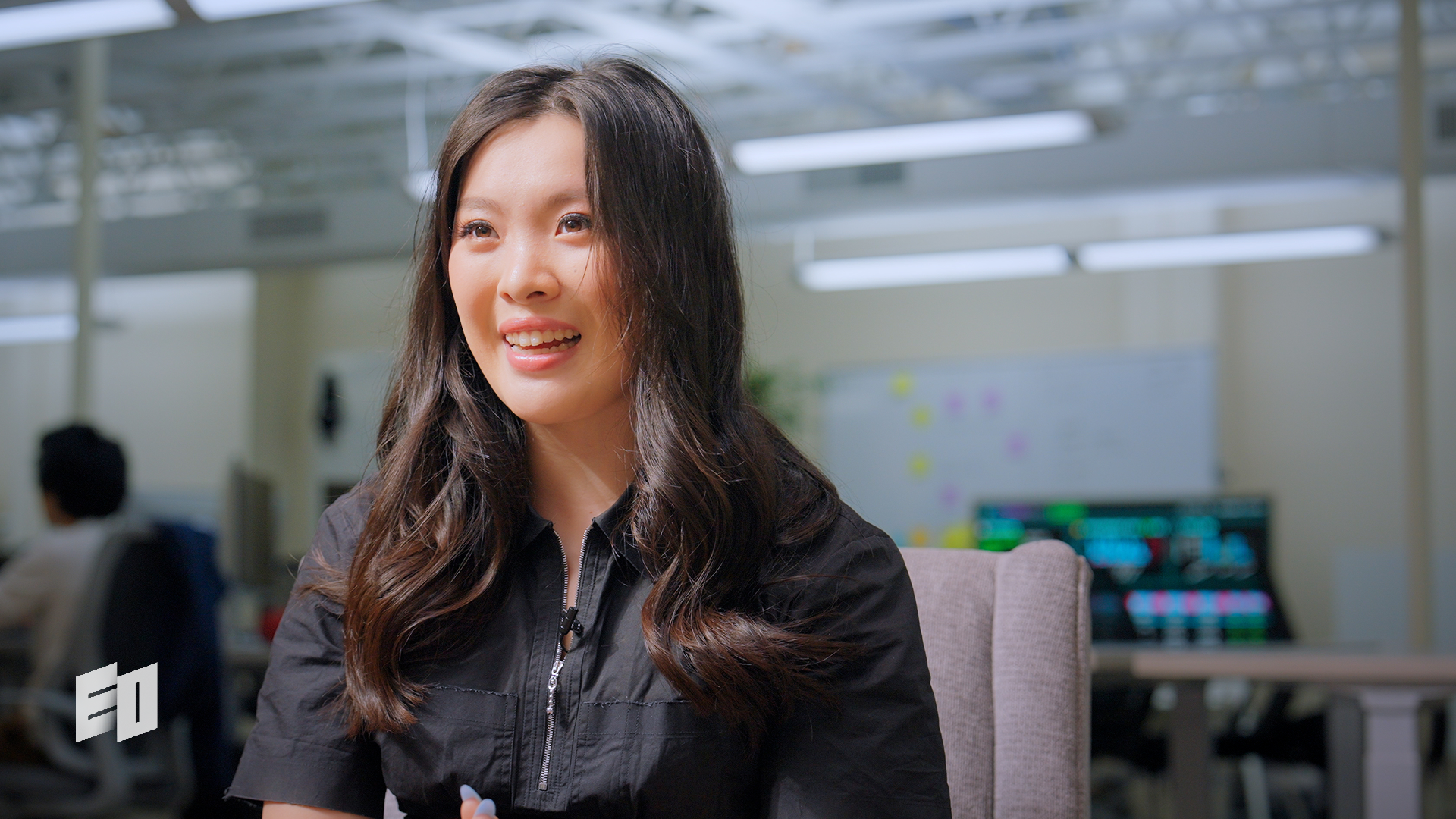
Hi, I’m Carina, founder and CEO of Axiom. I was a mathematician for most of my life. I double-majored in math and physics at MIT, where I plunged into the ocean of mathematics and worked on very interesting research projects that settled some open conjectures. I was then a Rhodes Scholar at Oxford, pursuing a degree in neuroscience, and during that year, I also stumbled into AI at the UCL Gatsby Institute, which is essentially the home of DeepMind. After that, I went to Stanford as a Knight-Hennessy Scholar, pursuing a joint JD–PhD, before dropping out to start Axiom.
We are building an AI mathematician—the first model that will eventually evolve into a self-improving, superintelligent reasoner. To build an AI mathematician, you need three pillars: AI, programming languages, and mathematics. Because of this vision, we assembled a world-class team of experts from each of these three pillars, coming together in a very interdisciplinary way. Axiom was fortunate to raise a $64 million seed round, with investors valuing us at a $300 million valuation. I’m 24 years old.
What do you see as the core limitations of human-only mathematics, and why does this make an AI mathematician necessary now?
Math is full of hardship. Math research is a process, almost like a monk praying in a temple day after day, pushing harder and harder. The dopamine hit you get feels a little bit like The Queen’s Gambit: it feels natural and effortless. You can look at how far you’ve come in the competition, and usually, the clock is ticking. That feeling is really amazing—it’s exhilarating.
If you have a hedge fund, you might only be able to afford quant researchers who are typically paid $14 million a year, but if you have an AI mathematician at $5 an hour, you can suddenly afford to tackle a market with a total trading volume of, say, $8 million. That market likely hasn’t been deeply studied before and wasn’t previously considered a target. We are entering an era of mass intelligence, and an AI mathematician is a crucial part of this future.
Why Math Will Save the World
What drew you so deeply to number theory in the first place?
My background is in combinatorics and number theory. It’s about patterns—patterns everywhere in sets and numbers. There are unexpected correspondences. I love everything about number theory. Obviously, Gauss. Reading about Gauss’s life was incredibly inspiring: all those “aha” moments, the long nights pushing toward a eureka moment. It’s fantastic. I think it’s the crown jewel of mathematics. As G.H. Hardy put it, it’s quite beautiful, and it feels seamless compared to other fields of math. It involves a lot of symbolic expressions, and the symbols themselves look beautiful on sketch paper. I remember deciding that I wanted to be a number theorist.
Why do you believe AI, specifically AI mathematicians, can dramatically compress that timeline?
Historically, every mathematical tool, after its invention, has led to tremendous breakthroughs—not just in fundamental science, but also in real-world applications. The abacus led to the bloom of trade and commerce. Integrals and calculus led to mechanics and thermodynamics, and eventually the Industrial Revolution. Babbage’s Difference Engine, a mathematical tool designed to calculate logarithm tables faster, became the prototype of the computer. A mathematical tool sparks a flywheel of real-world applications, which in turn requires more computational tools.
This connects to Jevons’ paradox: when the price of a tool becomes elastic, unexpected use cases and applications emerge, requiring more tools and making them even more valuable. By putting an AI mathematician at your fingertips, we believe many orders of magnitude of new use cases and markets will be unlocked.
If you look pragmatically at the time span between a major invention and its real-world applications, it has historically taken centuries. AI compresses this timeline. Imagine AI mathematicians working together with applied scientists—something human mathematicians rarely do. AI mathematicians can move into applied fields and solve complex systems that have never been theoretically understood. We believe this is incredibly powerful and will shorten century-long timelines dramatically.
Problem Solver to Theory Builder
You started with math competitions at a very young age. How did your early Olympiad experience shape the way you think about problem-solving and learning?
I grew up loving math. Every time you solve a math problem, you get instant reinforcement, a dopamine hit, that makes you want to keep going. I started solving Olympiad problems in elementary school. Around fourth grade, about a thousand bright kids were assembled into 24 classrooms to compete. It was stressful because after each exam, you were ranked, and only the top performers could advance. But it was also eye-opening. I read proofs like quadratic reciprocity and learned about mathematicians I’d never heard of, many from France and Germany. It felt like intellectually exploring the world, and that motivated me to work harder.
Those elementary school Olympiad problems were designed to be fun and grounded in real-world scenarios, like two trucks passing each other. You convert the story into equations, solve them, and then translate the result back into the real world. That process felt magical to me. It’s a form of mathematical thinking that’s highly transferable to other fields.
At some point, you encountered research math, where progress can be slow and uncertain. How did that change the way you thought about mathematics?
Later, I was introduced to research math, which was eye-opening in a different way. Research math involves delayed gratification. Problems are extremely hard and can take a long time to solve. You don’t get dopamine hits anymore. As an Olympiad student, you might solve a dozen problems a day and feel great. In research, months can pass with no visible progress. That’s often the reality.
I wanted to become a better mathematician, to shift from being a problem solver to a theory builder. I owe a lot to my mentors, who taught me how to do research, how to be patient, and how to look for unexpected connections across fields. That’s how I got into research and continued fruitful collaborations, including work with Professor Ono.
Why Taste is Important in the AI Era
As AI becomes capable of more and more technical work, what role do human intuition and taste still play in mathematical discovery?
Developing new mathematical theories by understanding how past theories flow into one another is fascinating. You invent definitions in a natural way, link them together into conjectures, and then prove them elegantly.
But what does “natural” mean? What does “interesting” mean? What does “elegant” mean? These are questions of taste. By learning many branches of math, I began to develop my own taste. In an era where AI is prevalent and capable of so much, taste becomes critically important—it distinguishes a great scientist from a mediocre one. Understanding taste and intuition using modern machine learning techniques is a difficult technical challenge, but one our team is excited about.
But what does “natural” mean? What does “interesting” mean? What does “elegant” mean? These are questions of taste. By learning many branches of math, I began to develop my own taste. In an era where AI is prevalent and capable of so much, taste becomes critically important—it distinguishes a great scientist from a mediocre one. Understanding taste and intuition using modern machine learning techniques is a difficult technical challenge, but one our team is excited about.
The Hardest Problems Are the Strategy
Was there a formative moment in your education that fundamentally changed how you think about mathematics and rigor?
When I was 15, I attended the Ross Mathematics Program. It was a beautiful summer where professors taught us to think deeply about simple things. On the first day, they asked us to prove that zero multiplied by anything is zero. It felt obvious, until we were required to derive it strictly from a small set of axioms. Many of us were stuck on that “simple” problem for more than 24 hours. But it taught me rigorous, axiomatic reasoning. The name Axiom comes from this inspiration.
How does that way of thinking translate into how you're building Axiom?
We want to build a knowledge graph and expand the frontier of mathematics through deductive logic, using the proof programming language Lean. Building an AI mathematician requires many techniques working together. My colleague Hugh Leather has been applying deep learning to code generation since 2017. Others pioneered AI for mathematical discovery, such as using transformers for symbolic integration. Our CTO, Shyam Gupta, worked for many years at FAIR and on large reinforcement learning systems like AlphaGo.
We believe solving the hardest problems is the best way to win. This mission is incredibly attractive to talent. I love the fast-paced environment of startups. I love executing with a team, unblocking others, asking for help, and getting instant feedback. It reminds me of being a child solving math problems, being fully immersed. Experiencing research engineering day to day is truly a once-in-a-lifetime opportunity.
Math is the Sandbox of Reality
What makes math such a uniquely powerful way to understand the world?
Math is the foundation of many sciences, and it’s also a sandbox for reality. You can take real-world objects, turn them into variables, and reason about them theoretically. Understanding math allows you to generalize across domains. In machine learning, we’ve found that strong mathematical reasoning often transfers to coding and other areas. Math concepts appear unexpectedly across applied sciences.
Math is also a digital playground. Modern machine learning models rely on real-world data, but math lets us experiment entirely in the digital world, solving reasoning problems without relying on physical data. It’s a playground for testing our understanding of reality and the universe.
Math is also a digital playground. Modern machine learning models rely on real-world data, but math lets us experiment entirely in the digital world, solving reasoning problems without relying on physical data. It’s a playground for testing our understanding of reality and the universe.
How do you see AI changing the human experience of doing mathematics over the next decade?
Math research is hard. It’s like a monk praying in a temple day after day, hoping something blooms. Being stuck can feel depressing, especially when your identity becomes blurred with your work. Many mathematicians struggle with this. With AI, we hope to make the process more enjoyable.
Instead of a human banging their head against a problem for weeks or months, an AI mathematician can help prove lemmas, while the human guides the collaboration forward. That journey becomes far more exhilarating. This is the vision we believe in, not replacing humans, but collaborating with them. Five or ten years is hard to imagine clearly, but we believe this is a fundamental technology that will define a generational company.
Instead of a human banging their head against a problem for weeks or months, an AI mathematician can help prove lemmas, while the human guides the collaboration forward. That journey becomes far more exhilarating. This is the vision we believe in, not replacing humans, but collaborating with them. Five or ten years is hard to imagine clearly, but we believe this is a fundamental technology that will define a generational company.