
Mar 10, 2026
From Cancer Diagnosis to a $6.8M AI Startup
Pensive CEO Yoonseok Yang explains how surviving cancer at 18 reshaped his view on purpose, bold decision-making, and building AI that empowers humanity.
Founder Focused
At 18, Yoonseok Yang graduated from one of Korea’s most prestigious high schools and received a cancer diagnosis on the same day. It was a devastating moment for both him and his family, but it also gave him a clarity he might never have gained otherwise. The experience reshaped how he thought about time, purpose, and what he truly wanted to do with his life.
That new perspective eventually led him to co-found a $6.8 million AI startup. Today, Yang is the CEO and co-founder of Pensive, an AI learning platform that helps instructors grade up to 10× faster without sacrificing accuracy. Backed by Mayfield Fund, Sequoia Capital scouts, and Reach Capital, Pensive is tackling one of higher education’s most overlooked problems: the overwhelming task of grading thousands of student assignments.
In this interview, Yoonseok shares:
Why a cancer diagnosis at 18 became his ultimate decision-making framework.
How he went from failing to sell a single backpack in a freezing street market to raising $6.8M.
Why he believes most founders are thinking about AI the wrong way and what the bold ones should be doing instead.
Why a cancer diagnosis at 18 became his ultimate decision-making framework.
How he went from failing to sell a single backpack in a freezing street market to raising $6.8M.
Why he believes most founders are thinking about AI the wrong way and what the bold ones should be doing instead.
Watch the full interview now on EO's YouTube channel! Below is the complete transcription of the interview. Minor edits have been made for clarity and readability.
Key Highlights:
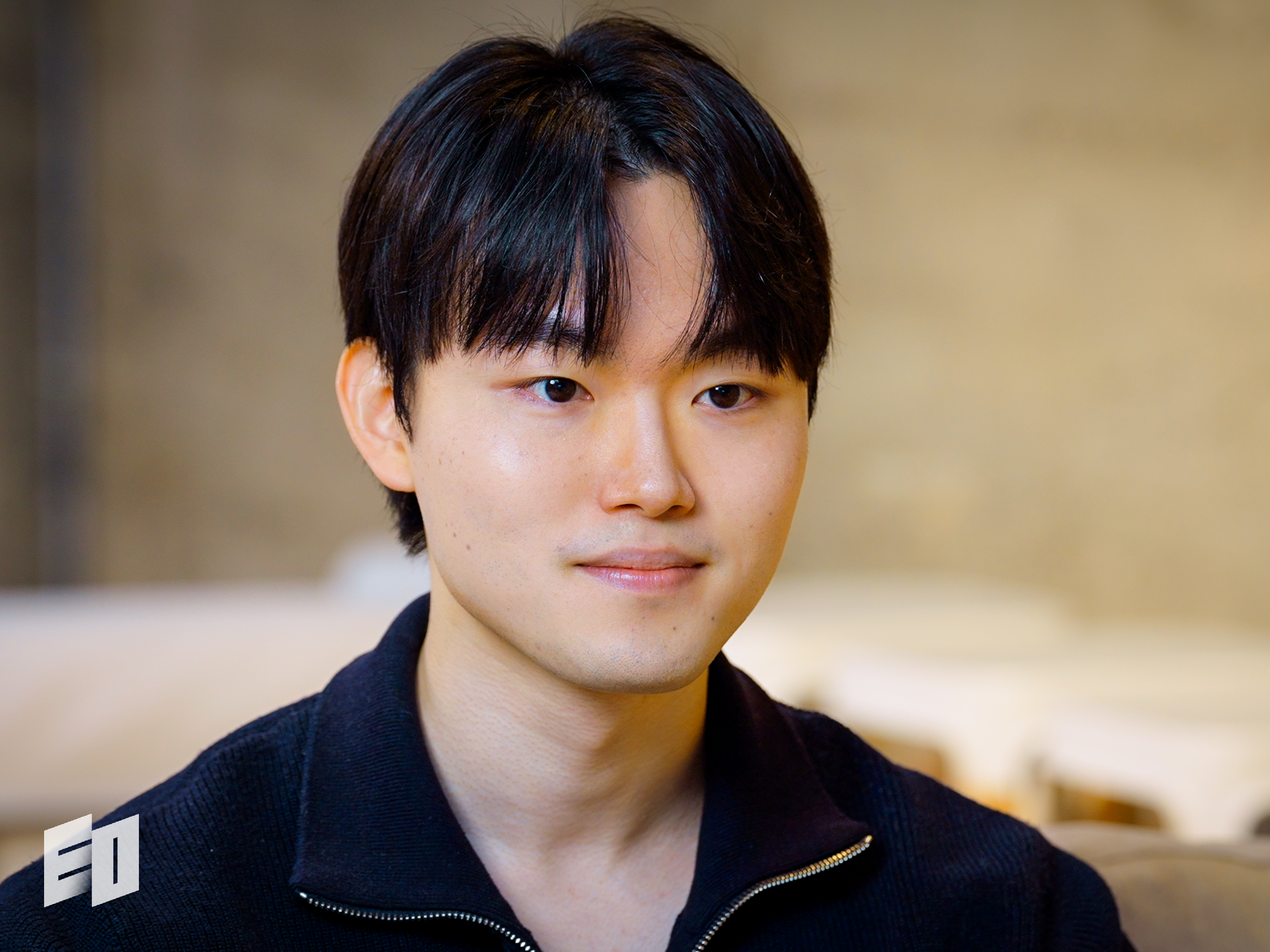
"Right after I graduated from my high school, I went to a local hospital that said, 'Oh, there's a 1 cm tumor in your thyroid.' And the doctor confirmed that it's actually thyroid cancer."
"If I were to die after 10 years, would I be doing the things that I'm doing right now? If you're putting 10 years of a timeline, you can eliminate all the other side tracks and excuses that was clouding your vision and the things you want to achieve in life."
"Obviously, helping AI to automate grunt work of humanity is meaningful. But at the same time, I don't think there's enough founders who are thinking to use AI to empower humanity."
"If we cannot empower humanity with AI, we lose purpose. There's no meaning as humanity to evolve as AI gets smarter and smarter than us."
"I urge all the smart and young founders to go after bolder and harder problems to solve. Act on it. Be bolder than others. Make bold bets. If you act on these bold opportunities, you'll be getting surprisingly bigger returns."
"If I were to die after 10 years, would I be doing the things that I'm doing right now? If you're putting 10 years of a timeline, you can eliminate all the other side tracks and excuses that was clouding your vision and the things you want to achieve in life."
"Obviously, helping AI to automate grunt work of humanity is meaningful. But at the same time, I don't think there's enough founders who are thinking to use AI to empower humanity."
"If we cannot empower humanity with AI, we lose purpose. There's no meaning as humanity to evolve as AI gets smarter and smarter than us."
"I urge all the smart and young founders to go after bolder and harder problems to solve. Act on it. Be bolder than others. Make bold bets. If you act on these bold opportunities, you'll be getting surprisingly bigger returns."
Chapter 1: Born Into a Lawyer's Path, Chose a Founder's
You grew up in South Korea. What was the pressure like growing up there?
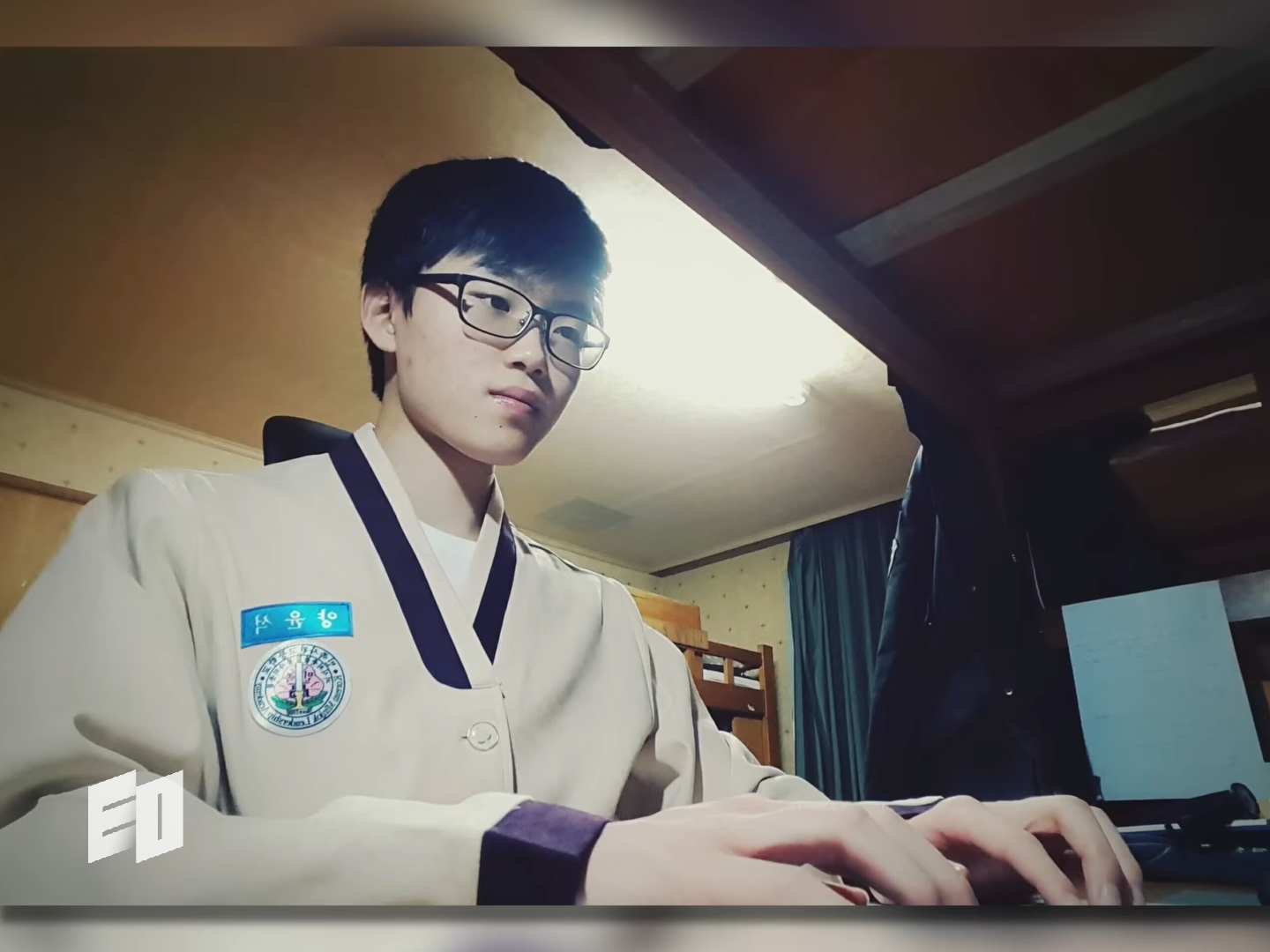
Yoonseok Yang: I was born on a small island in South Korea. In Korea, which university you are graduating from matters a lot in civil society success. So when I look back at my elementary and middle school years, I would study by myself until 2:00 a.m. to really keep up and be competitive with my peers.
What made you stop and question all of that?
Yoonseok Yang: When I was turning 14, it kind of hit me. What am I getting after studying hours and hours and being stressed? I would just read books in different subjects to really try to find an answer to this very question: why am I studying so hard? What is it for?
That's the time when I first found out about founders; people like Steve Jobs and Bill Gates who would create something new making impact globally. I was just fascinated by their stories. I want to be like them. I want to be like those legendary founders who would make great impacts in the world.
That's the time when I first found out about founders; people like Steve Jobs and Bill Gates who would create something new making impact globally. I was just fascinated by their stories. I want to be like them. I want to be like those legendary founders who would make great impacts in the world.
How did your dad react when you told him that?
Yoonseok Yang: My dad's first reaction was, "Founders like Steve Jobs and Bill Gates, they are geniuses and you don't have the DNA. Yoon, you just have to study hard, get to a good university in Korea and then just become a lawyer."
Did that discourage you and what did you do about it?
Yoonseok Yang: Looking back, I do agree with the claim that founders are special people. But at the same time, I didn't think that I was incapable of becoming a founder. So rather than just obeying his words, I really thought "if I make this $100 in allowances that I have saved so far in my piggy bank into $200 and bring it back to my dad, he would now believe that I'm worthy of being a founder."
So I went to a Korean street market and tried to sell backpacks. It was freezing cold and no one wanted to buy a backpack. I failed to sell a single backpack for 2 hours. My hand was frozen because I was grabbing my bag the whole time. So I tried to sell in different ways, using a different strategy, what is unique to myself? It was my story. Why am I selling these backpacks in the first place?
I was mainly targeting people who seemed like they would have a son like me. I'd reach out to them and say, "The thing I'm selling to you right now isn't a backpack. It's a memory. Every time you're wearing this backpack, you'll think of myself selling these backpacks in a freezing winter in the street market. Even when you're down or you have challenges throughout your day, you'll be thinking of that memory and getting some courage." So I sold my first backpack with that story.
So I went to a Korean street market and tried to sell backpacks. It was freezing cold and no one wanted to buy a backpack. I failed to sell a single backpack for 2 hours. My hand was frozen because I was grabbing my bag the whole time. So I tried to sell in different ways, using a different strategy, what is unique to myself? It was my story. Why am I selling these backpacks in the first place?
I was mainly targeting people who seemed like they would have a son like me. I'd reach out to them and say, "The thing I'm selling to you right now isn't a backpack. It's a memory. Every time you're wearing this backpack, you'll think of myself selling these backpacks in a freezing winter in the street market. Even when you're down or you have challenges throughout your day, you'll be thinking of that memory and getting some courage." So I sold my first backpack with that story.
But selling backpacks wasn't the founder vision you had in mind, was it?
Yoonseok Yang: Exactly. I wanted to found a company that is long-lasting, creating something durable and something new. From that point on, I decided if I want to be a founder, I need to be technical. I need to learn the hard skills so that I can build software and build a product that I can sell. Because I really wanted to start a generational global company, coming to Berkeley, I founded my first company after just one month of entering college. That's how much I really wanted to be an entrepreneur.
Chapter 2: The Mission Worth My Life
Before founding Pensive, you went through a lot of pivots. What was that process like?
Yoonseok Yang: Prior to founding Pensive, I was pivoting eight times throughout the whole year. There was something missing. I was looking at the market, looking at the pain points, writing hypotheses, validating each hypothesis, building scalable small MVPs, talking with users; all the necessary things that YC tells teams to do. The biggest thing that was missing was founder-market fit. Am I a founder who can actually pursue this idea for the next 10 years? If you don't have a purpose and a mission to really solve these problems, I think it's very challenging to wake up every day and be excited to solve that problem.
How did a cancer diagnosis at 18 become your answer to that question?
Yoonseok Yang: One of the core ways I make decisions right now is I just think that I will be dying after 10 years. Right after I graduated from high school, I got diagnosed with thyroid cancer. And even though thyroid cancer is the most curable cancer, it was complete chaos for my family, my friends, and myself. I was shocked. I never knew that I'd be diagnosed with cancer at the age of 18 when I thought I had decades of life to live and yet I'm diagnosed with cancer. I had a possibility of dying in the next 5 years.
Hearing this in such an unpredicted way really changed my mind of viewing things in the world. If you only have 10 years of your life, would you actually do what you're doing right now? Suddenly you can eliminate all the other side tracks and excuses that were clouding your vision. "I want to get more credentialed, I want to get my master's degree, I want to get my PhD, and then I want to found my startup". If you only have 10 years of your life, would you actually do that? That really puts things into perspective and makes me ask myself: what is the most important thing, and how do I want to spend the next 10 years of my life? Because you simply don't have time after that 10 years.
Hearing this in such an unpredicted way really changed my mind of viewing things in the world. If you only have 10 years of your life, would you actually do what you're doing right now? Suddenly you can eliminate all the other side tracks and excuses that were clouding your vision. "I want to get more credentialed, I want to get my master's degree, I want to get my PhD, and then I want to found my startup". If you only have 10 years of your life, would you actually do that? That really puts things into perspective and makes me ask myself: what is the most important thing, and how do I want to spend the next 10 years of my life? Because you simply don't have time after that 10 years.
Is there a framework you use to make those big decisions?
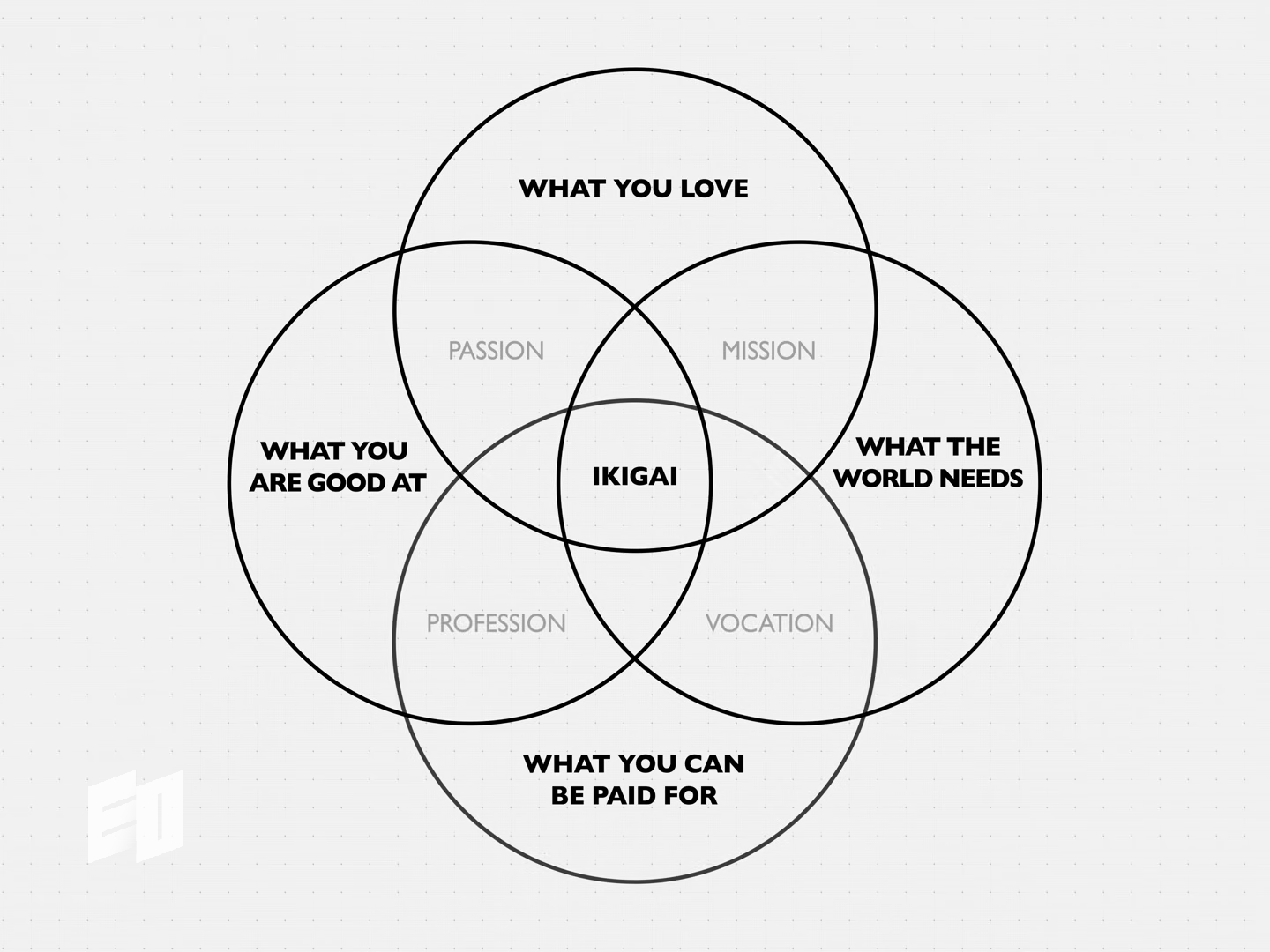
Yoonseok Yang: I love a framework called Ikigai. Ikigai is a framework where when you're choosing something to do, you have to consider four different things altogether. You should do a thing that you love, you should do a thing that you're good at, you should do a thing the world needs, and you should do a thing you can be paid for.
When I think about the things I really care about and that the world needs, there are three major problem sectors I'm really interested in: learning and education, energy and climate change, and healthcare and curing cancer. The thing I was particularly good at was learning and education. Prior to founding Pensive, I worked on a lot of machine learning models and language models and adopting them inside education at a company called Riiid. Working in a fast-growing startup that grew 20 times, I learned a lot about how to operate an educational startup. That's why I believe learning and education as a whole is a sector that I love, a field that I'm good at, a field that I can be paid for, and especially now, the field the world needs the most.
When I think about the things I really care about and that the world needs, there are three major problem sectors I'm really interested in: learning and education, energy and climate change, and healthcare and curing cancer. The thing I was particularly good at was learning and education. Prior to founding Pensive, I worked on a lot of machine learning models and language models and adopting them inside education at a company called Riiid. Working in a fast-growing startup that grew 20 times, I learned a lot about how to operate an educational startup. That's why I believe learning and education as a whole is a sector that I love, a field that I'm good at, a field that I can be paid for, and especially now, the field the world needs the most.
Chapter 3: Resourceful Execution Outruns the Market
Edtech is notoriously hard to sell into. How did investors react when they first heard your pitch?
Yoonseok Yang: Investors were surprised by how quickly we were executing. When they hear edtech and especially selling to colleges they freak out. They don't want to invest. Edtech is traditionally one of the hardest sectors for venture-scalable outcomes in higher ed. So the execution speed of our team was the most surprising point given how slowly the sector moves.
Where did the idea for Pensive's core product actually come from?
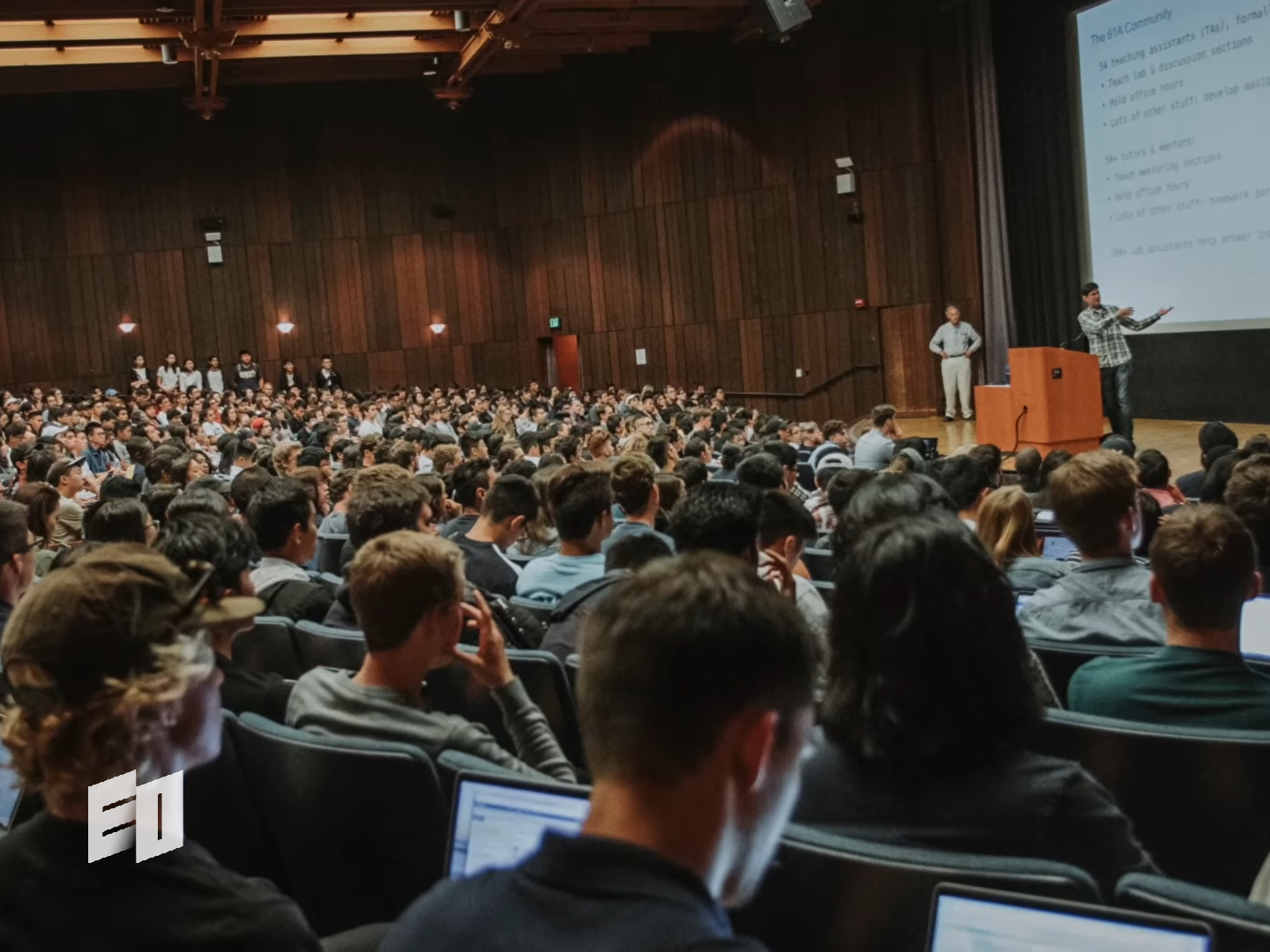
Yoonseok Yang: Coming to Berkeley, the first class I took was called CS61A. It had 2,000 students taking the same class. We had to get the largest auditorium on the entire campus to host all the students. I could barely see my professor's face and the professor obviously wouldn't even remember my name.
Imagine yourself as an instructor, you are grading 1,000 students' submissions in a single day. When you're over 500 submissions, you're just mechanically circling, citing the rubrics, going to the next one — 1,000 times. I think that was my biggest pain point when I was a tutor at Berkeley. So that's really the pain point that Pensive wanted to eliminate. How can we remove these routine, mechanical, and repetitive grading tasks so that faculty and TAs can actually focus on giving more feedback, opening more office hours, and giving more group tutoring sessions? That's where Pensive started.
Imagine yourself as an instructor, you are grading 1,000 students' submissions in a single day. When you're over 500 submissions, you're just mechanically circling, citing the rubrics, going to the next one — 1,000 times. I think that was my biggest pain point when I was a tutor at Berkeley. So that's really the pain point that Pensive wanted to eliminate. How can we remove these routine, mechanical, and repetitive grading tasks so that faculty and TAs can actually focus on giving more feedback, opening more office hours, and giving more group tutoring sessions? That's where Pensive started.
How did you validate that this was a real problem worth solving?
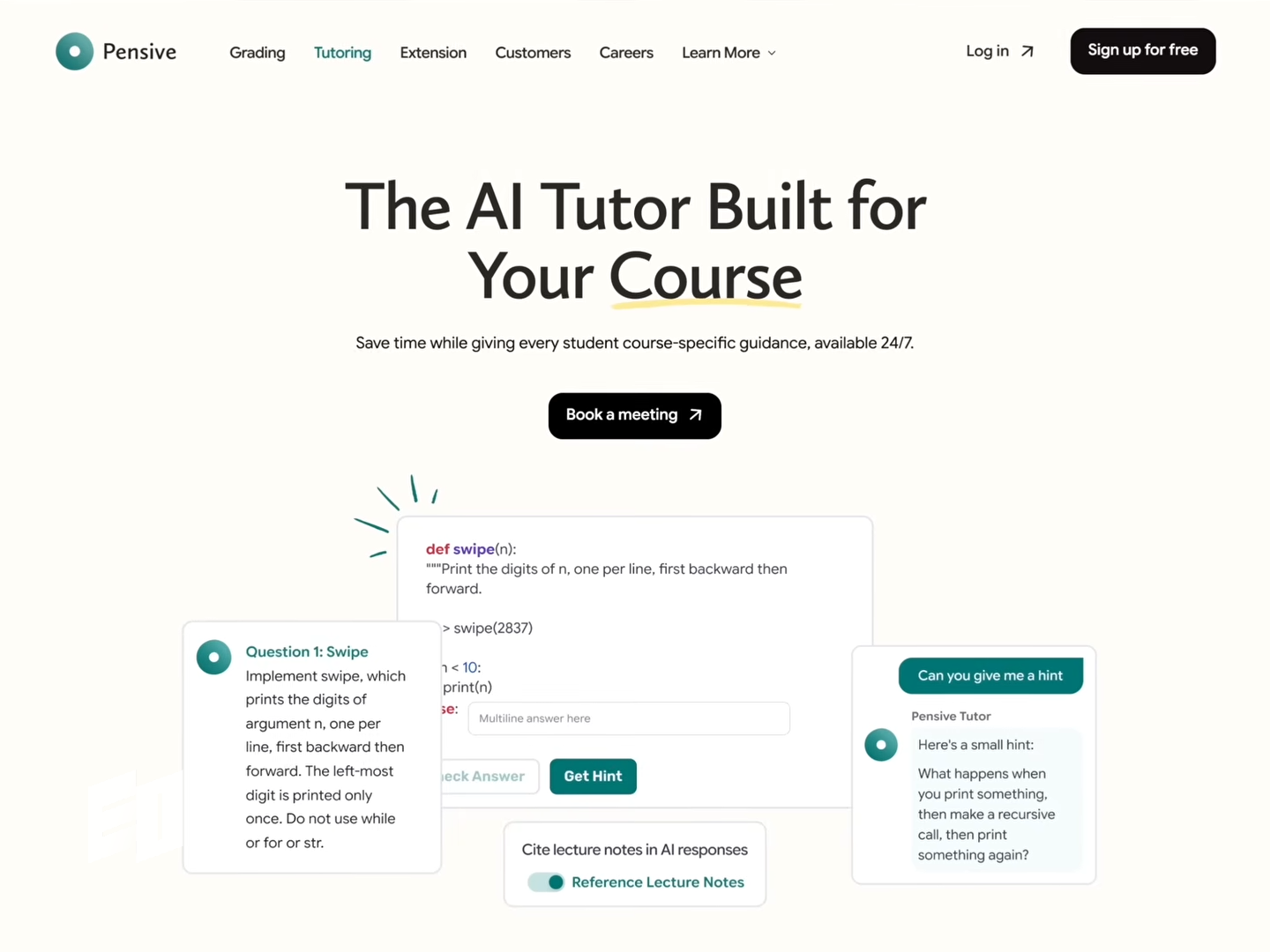
Yoonseok Yang: I remember this call with a Columbia professor, Tony Dear. The day before we met him, I was thinking "why don't we just create a landing page for AI grading and show it to him and see how he responds?" So we quickly designed a landing page as a Figma mockup. We didn't even deploy it, just a Figma mockup. After showing the AI tutor full demo for 30 minutes, in the last five minutes we showed the professor, "Hey, by the way, we have this new product. It's an AI grader that makes your grading time much faster. Do you think you'd want to use this kind of product?" And he said, "Actually, the AI tool looks cool, and the AI grader is the thing I need the most. I want to use it right away. Can I try it first?"
That was our aha moment. Grading as a whole is still a pain point for a lot of instructors across universities, and as we met more and more instructors, that validation just got stronger and stronger.
That was our aha moment. Grading as a whole is still a pain point for a lot of instructors across universities, and as we met more and more instructors, that validation just got stronger and stronger.
How did you land your first 10 colleges to use Pensive?
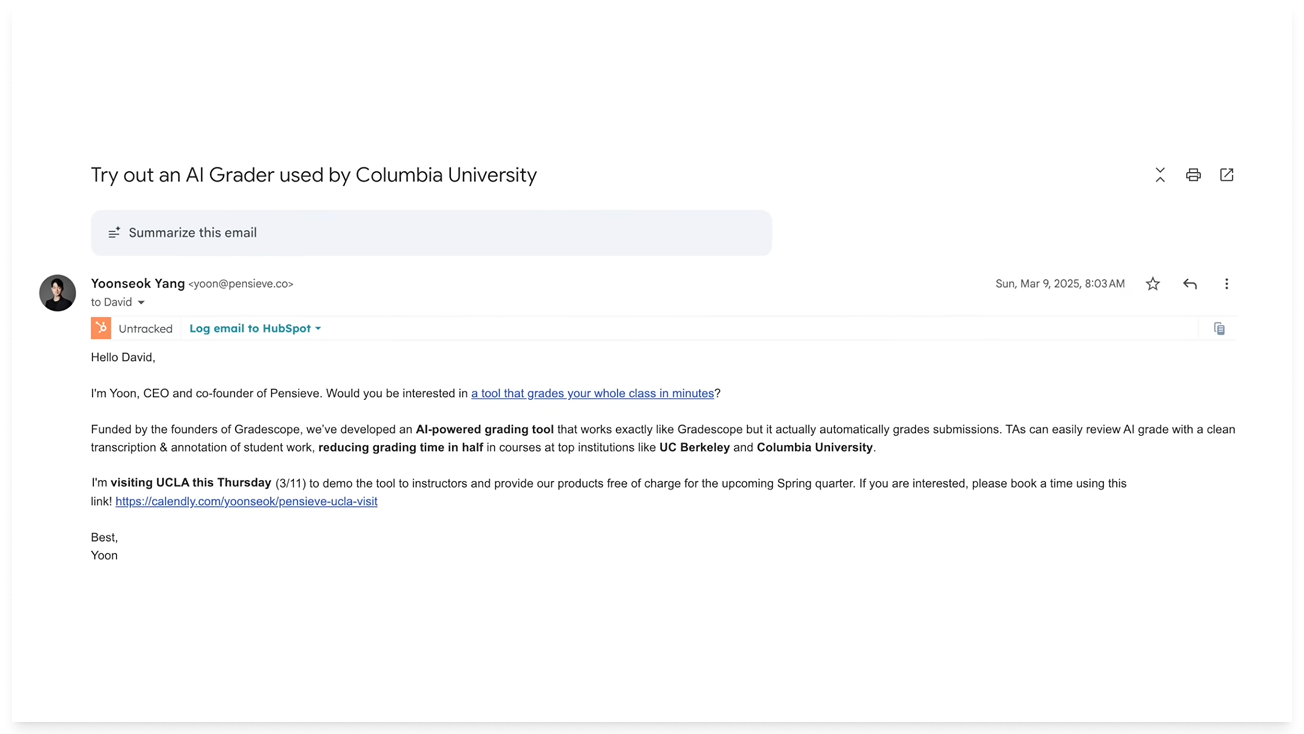
Yoonseok Yang: One of my core strengths is being resourceful. Being resourceful means understanding the resources around you and really reaching out even though it feels like a stretch. I would send emails to UCLA faculty: "Hey, I'm visiting UCLA campus on this date. If you're interested in a tool that would make your grading process much faster without losing accuracy, please book a time in my Calendly." If the full day actually got booked, I would fly in and meet the instructors throughout those days. If the meetings weren't booked, I would just skip the campus. That way I could be very efficient, validate the needs on a specific campus, fly in, meet the faculty one-on-one, and form a relationship. That's how we got the first 10 colleges. Basically me flying around the entire nation, meeting faculty in person and persuading them to use Pensive.
Chapter 4: What Truly Matters in the World of AGI
What's Pensive's roadmap from here?
Yoonseok Yang: Pensive's goal in 2026 is to be licensed by hundreds of universities across the nation. After that milestone, we want to go after direct-to-consumer, direct to students, and become an ideal AI-native learning institution. I think in the future, AI-native schools will transition more into socialization environments, whereas most of the components of gaining knowledge and learning new things will happen very intimately with one-on-one AI tutors — happening in homes and different environments. We think we'll be best positioned because we know how to build the best AI teaching assistant to really aid learning in a long-horizon manner.
You mentioned that today's generation will never be smarter than ChatGPT. What does that mean for why you're building Pensive?
Yoonseok Yang: The new generation being raised now will never have a single chance to be smarter than ChatGPT. From the time they're born to the time they're dying, every single occasion, ChatGPT will always be smarter than them. That's why I'm founding Pensive. If we cannot empower humanity with AI, we lose purpose. There's no meaning for humanity to evolve as AI gets smarter and smarter than us. Obviously, helping AI to automate the grunt work of humanity is meaningful. But at the same time, I don't think there are enough founders who are thinking about how to use AI to empower humanity. So I urge young and smart founders to go after bolder problems that would truly empower humanity with AI.
What do you think is the most important skill for humans to develop in this era?
Yoonseok Yang: The most unique skill I think people should learn is the ability to make good decisions in uncertain environments. Things are changing and they're changing very quickly. No one knows the answer and everyone has different context. It's very hard for someone else to make a decision for you and ultimately, that's not your decision anyway.
My personal life motto is that every event feels like a destiny if you know your path. As you practice making those conscious decisions in uncertain situations where you don't have full information, you are consciously making a step forward on your own path. That is a decision and a path that you are solely and wholly making as yourself. As these conscious choices accumulate, they form your unique path — and that road, because it is accumulated by countless decisions you made as your conscious self, no one including AI can replicate. That way you can truly be unique in society, and ironically, that is the way to create a unique path that other people also respect.
My personal life motto is that every event feels like a destiny if you know your path. As you practice making those conscious decisions in uncertain situations where you don't have full information, you are consciously making a step forward on your own path. That is a decision and a path that you are solely and wholly making as yourself. As these conscious choices accumulate, they form your unique path — and that road, because it is accumulated by countless decisions you made as your conscious self, no one including AI can replicate. That way you can truly be unique in society, and ironically, that is the way to create a unique path that other people also respect.
Are there any final thoughts you’d like to leave the audience with?
Yoonseok Yang: Act on it. Be bolder than others. Make bold bets. If you act on these bold opportunities, you'll be getting surprisingly bigger returns.
Explore more