
Jun 15, 2026
San Francisco really slapped us in the face with what high speed actually means
An interview with Liam & William, Founder of Rankad.ai
Inside Hacker Houses
0:00 / 0:00
* Introducing "Inside Hacker Houses" series:
The essence of startup culture has always lived in small, imperfect, grassroots spaces. Like hacker houses, hackathons, and early product meetups... where nothing is polished, and everything remains at risk.
EO believes that this early, messy phase is where startup culture is most alive. So instead of chasing main stages, we go inside the places where people are just beginning to build. This series documents founders at that moment, inside hacker houses, inside uncertainty, inside the act of starting.
The essence of startup culture has always lived in small, imperfect, grassroots spaces. Like hacker houses, hackathons, and early product meetups... where nothing is polished, and everything remains at risk.
EO believes that this early, messy phase is where startup culture is most alive. So instead of chasing main stages, we go inside the places where people are just beginning to build. This series documents founders at that moment, inside hacker houses, inside uncertainty, inside the act of starting.
On the Notion of Being Fast
Both Liam and I come from super small towns. We'd think we were super fast, super great, super smart. But San Francisco really slapped us in the face with what high speed actually means.William GyltmanCo-Founder, Rankad.ai
Coming from Sweden, they had every reason to feel ready. One built a web development business from scratch at fifteen. The other grew an e-commerce company to $6M in revenue. Fast, commercial, self-made. They arrived in San Francisco convinced they already had what it takes.
It only took a few days to find out they were wrong. Everything they'd built and learned back home meant little compared to what was actually happening around them. They had to unlearn years of instinct and shift gears fast.
What makes Rankad worth paying attention to isn't just the speed of their execution. Most founders who land in San Francisco would eventually need to figure that part out. The harder part is something most founders overlook: unlearning what made them successful in the past. Letting go of the habits, the instincts, the playbook they had spent years living by is the hidden bottleneck. Liam and William weren’t just fast at learning San Francisco’s speed. They were equally fast at letting go of everything that came before it. Combined, they are now one of the fastest-moving teams in Silicon Valley.
Built to Sell
You both started selling before most people your age were thinking about it. Liam, where did it start for you?
Liam: I had my first programming class in high school, and I hated it. But in the class after that, I had web development with my favorite teacher. And I fell in love. I thought it was so cool. So I actually started my first company when I was fifteen. It was a web development consultancy selling websites to local restaurants. First to my dad, then my local barber, then my local shop. And then that kind of snowballed and grew bigger throughout high school.
Then, when I was 18, we had a pitching competition in my hometown where all the young entrepreneurs could pitch their companies. I pitched, won Salesman of the Night, and got a job offer from Key Solutions in Gothenburg. So I took that job, did door-to-door sales while still running my consultancy on the side. For the six months I was there, I won Salesman of the Month twice in a row. And then I decided to quit that sales job and go all in on LK Innovations, my agency.
Then, when I was 18, we had a pitching competition in my hometown where all the young entrepreneurs could pitch their companies. I pitched, won Salesman of the Night, and got a job offer from Key Solutions in Gothenburg. So I took that job, did door-to-door sales while still running my consultancy on the side. For the six months I was there, I won Salesman of the Month twice in a row. And then I decided to quit that sales job and go all in on LK Innovations, my agency.
Why start so young? What drove you toward it?
Liam: One of the deciding factors was my dad. He had been working the same full-time job for years, good salary, same place forever, but then he decided to take that bet on himself and started his own company. I was super proud of that.
I always knew I wanted to do something by myself. I love web development, I'm actually good at it, and I'm quite good at talking to people. Not necessarily sales in the beginning, but my communication skills were okay. I always saw it as a personal development journey, because sales is super hard.
I always knew I wanted to do something by myself. I love web development, I'm actually good at it, and I'm quite good at talking to people. Not necessarily sales in the beginning, but my communication skills were okay. I always saw it as a personal development journey, because sales is super hard.
Do you remember a standout early sales moment?
Liam: I only expected to charge small tickets, like $500 to $1,000 for websites. But one time I had this huge client I never thought would trust me, because I was like sixteen at the time. I actually closed a deal with them in the five figures. That was crazy to me because I was so young.
Once you do something, you get a new base level. So the thing below that doesn't feel so exciting anymore. Every small step was exciting because I was so young. But that was probably the best one.
Once you do something, you get a new base level. So the thing below that doesn't feel so exciting anymore. Every small step was exciting because I was so young. But that was probably the best one.
William, what was your path into sales?
William: It started at a really early age as well, in a kind of strange way. I made some of my first online money through video games. I was actually building maps in Fortnite that were played by many people. I've always been super creative. I like creating and building stuff.
Then I got really into stocks. I was part of the biggest stock community in Sweden. I was Chairman of the Board for our region while still in high school. Somewhere there, I realized I'd probably be starting my own company, because I really wanted to be creative in my work.
So I decided to start with sales. I started in a store selling mobile phones, did some cold calling, and that was the worst thing that ever happened to me. I really hated cold calling. I hated it so much that I actually quit that job and started doing cold calling full-time. I was selling tools, mostly to plumbers and other blue-collar workers.
Then I got a job offer as a sales manager for Timotor. They helped pharmaceutical companies transport temperature-sensitive goods, such as vaccines and cancer medicines. When I was around nineteen or twenty, I was working with some of the biggest pharma companies in the world: Novo Nordisk, AstraZeneca. But I always felt it was moving too slowly. So I started my own e-commerce company.
Then I got really into stocks. I was part of the biggest stock community in Sweden. I was Chairman of the Board for our region while still in high school. Somewhere there, I realized I'd probably be starting my own company, because I really wanted to be creative in my work.
So I decided to start with sales. I started in a store selling mobile phones, did some cold calling, and that was the worst thing that ever happened to me. I really hated cold calling. I hated it so much that I actually quit that job and started doing cold calling full-time. I was selling tools, mostly to plumbers and other blue-collar workers.
Then I got a job offer as a sales manager for Timotor. They helped pharmaceutical companies transport temperature-sensitive goods, such as vaccines and cancer medicines. When I was around nineteen or twenty, I was working with some of the biggest pharma companies in the world: Novo Nordisk, AstraZeneca. But I always felt it was moving too slowly. So I started my own e-commerce company.
How did that e-commerce run go?
William: I started with dropshipping and was making quite a lot of money, enough to quit the sales job and go all in. Then I started selling candles. But all of a sudden, in the middle of getting multiple hundreds of orders per day, customs froze all my deliveries. I had thousands of orders to fulfill. I had to pivot fully. I opened up my first warehouse in Sweden and started buying candles from Swedish companies instead.
But after that, I outgrew my storage, so I shared a bigger space with some other entrepreneurs. They were exporting Swedish candy and white nicotine pouches. They asked me to join. When I joined them, they were doing about $400K in revenue. When I left to start Rankad.ai with Liam, we had made roughly $6M in revenue that year. I was doing all of the marketing.
But after that, I outgrew my storage, so I shared a bigger space with some other entrepreneurs. They were exporting Swedish candy and white nicotine pouches. They asked me to join. When I joined them, they were doing about $400K in revenue. When I left to start Rankad.ai with Liam, we had made roughly $6M in revenue that year. I was doing all of the marketing.
Founders who land in San Francisco have to build the sales instinct from scratch. The comfort with rejection, the obsession with talking to customers, and the willingness to close before the product is ready. Liam and William arrived with all of that already installed. The hardware had been running for years, in small Swedish towns, through door-to-door rejections and cold calls they hated but kept making anyway.
AI Ate Our Sales Traffic
How did Rankad.ai actually start? What was the signal you each noticed?
Liam: For me, it started when my clients began losing organic traffic to AI search in 2025. And then my mom, who's 57, showed me that she'd used an AI chatbot to search for running shoes. Bypassed Google entirely. She typed "What's the best running shoe for 2,000 Swedish crowns?" and got a direct recommendation. I was like, "What the fuck? This is crazy." And then Rankad.ai was born.
William: That's also actually the reason we started Rankad.ai, because Liam and I both noticed this problem of organic traffic disappearing. I noticed it on my own websites from my e-commerce businesses. Liam noticed it for his clients, whom he was building websites and doing SEO for. Liam pitched me the idea over a LinkedIn message.
William: That's also actually the reason we started Rankad.ai, because Liam and I both noticed this problem of organic traffic disappearing. I noticed it on my own websites from my e-commerce businesses. Liam noticed it for his clients, whom he was building websites and doing SEO for. Liam pitched me the idea over a LinkedIn message.

You were actually previous clients to each other before you became co-founders.
William: Yeah, I built a few e-commerce businesses, and Liam was the guy building all my websites for me. Then I got into AI automations. I thought there were many tasks you could automate with AI. And then Liam started using a few of my automations as well. So we'd been working together for maybe half a year before we started the company. When Liam pitched me, it was like the perfect moment.
Liam: I drove four hours to his house. We locked in for a weekend. And we were like, yeah, fuck it. Let's do this. Two months later, we moved in together. Shared an apartment in Sweden for about a month and a half. And then we flew here.
Liam: I drove four hours to his house. We locked in for a weekend. And we were like, yeah, fuck it. Let's do this. Two months later, we moved in together. Shared an apartment in Sweden for about a month and a half. And then we flew here.
What made you say yes so fast, William?
William: At that point, I was really into AI. I was building a lot of AI automations, genuinely looking for opportunities to build in AI because I thought it was going to be the next big thing. I also really didn't enjoy running e-commerce anymore. It's a pretty boring business. There's not much personal contact with clients. I just liked Liam as a person. He was really outgoing and straightforward. And I think the idea itself was attractive enough for me to say yes on the spot.
Sell, Sell, Sell
You guys are unfortunately not enough deep tech. But let's stay in touch.
That was the first answer Liam and William got when they applied to The Residency's Inventor House. Unbothered, they simply added him on LinkedIn and kept building.
Weeks later, an email arrived.
Weeks later, an email arrived.
Hey guys, I've been following your progress. Do you want to catch up again?
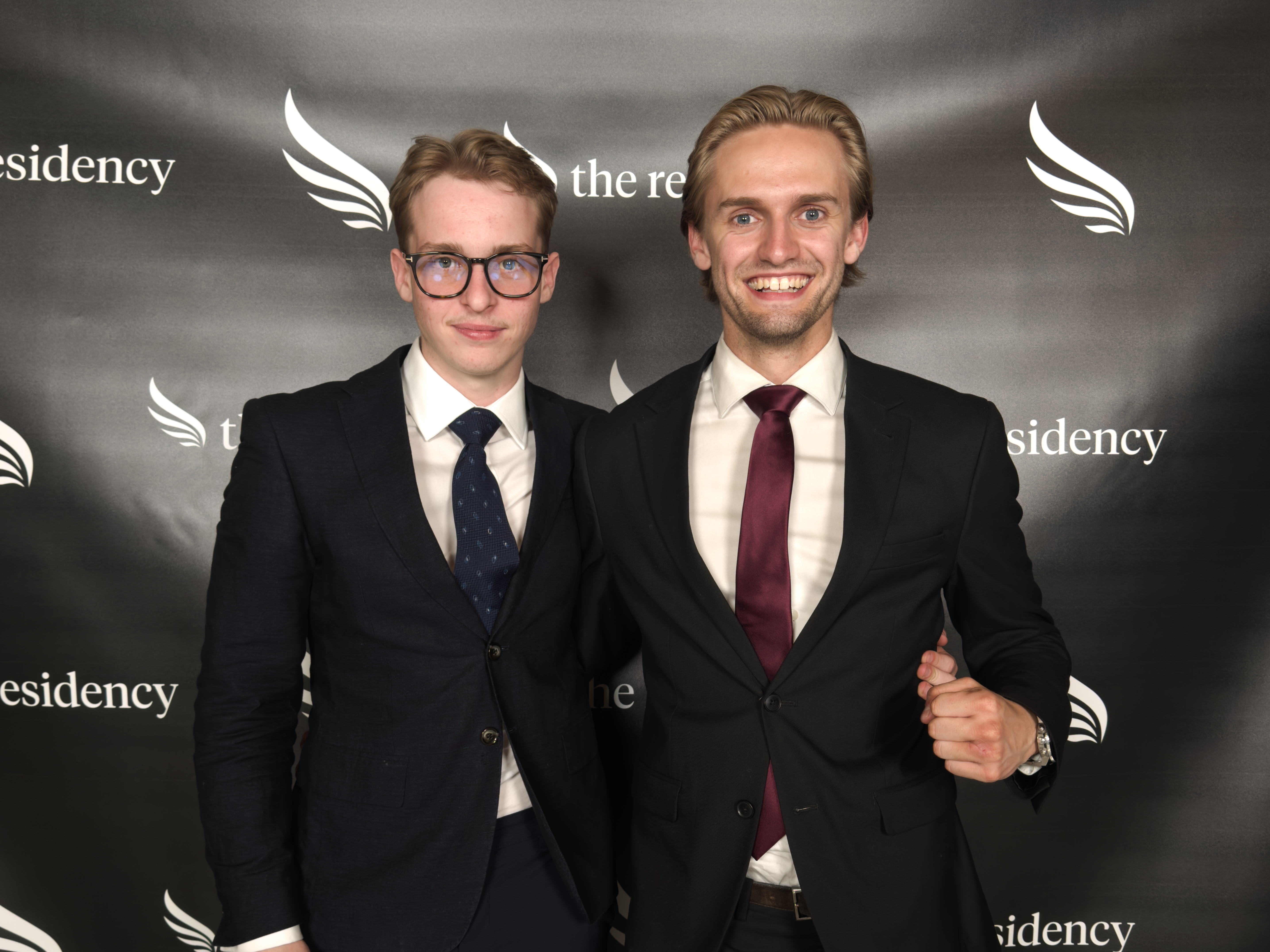
After the second meeting, Liam and William walked into Inventor House as the first B2B AI SaaS company ever accepted there. The architect hadn't changed his criteria but had seen something specific. When I asked Liam what he thought it was, he didn't pause: "High agency, the speed of execution, and making people actually believe in what we were building."
You had five paying customers before the product was even an MVP. How do you think about selling before you're ready?
William: We so strongly believe in selling first and then fixing it. And I think even if you're deep tech or whatever: sell, sell, sell. Talk to customers. Even if you don't have a product. Just talk to users. Understand their needs, their pain points. That's the mindset behind how we built this company, even when we were in San Francisco with a not-quite-finished product.
Liam: We got our first five paying customers before the product was even an MVP. One of our first customers was VAP Connections, an AI system provider. What convinced them had nothing to do with the product. It was me and William showing up with high ambition and a genuine willingness to help. We went out of our way to give them everything they wanted before anything was even built or announced. That meant building backlinks manually, fixing their pages, and creating blog content from scratch. All unscalable. All done by hand. But the unscalable scales when customers love you for it.
Liam: We got our first five paying customers before the product was even an MVP. One of our first customers was VAP Connections, an AI system provider. What convinced them had nothing to do with the product. It was me and William showing up with high ambition and a genuine willingness to help. We went out of our way to give them everything they wanted before anything was even built or announced. That meant building backlinks manually, fixing their pages, and creating blog content from scratch. All unscalable. All done by hand. But the unscalable scales when customers love you for it.
Why do so many founders delay customer conversations by chasing fundraising first?
Liam: A lot of early-stage founders want to raise money, and raising money isn't wrong. But if they're raising purely from a perspective of surviving on that money, I think that's completely wrong. You're just postponing the problem of talking to customers. That's one of the hardest parts of the founder journey. Founders want to raise money to postpone getting that "no" from a user.
And the customers love it too. They feel like they're part of an early-stage company, and they grow with it. With our enterprise customers, they're not just paying customers. They're design partners. They love being in the process. We're building the product with them because we can't read their minds. So we ask them every single day: what do you think of the product? Is it good? Is it bad? Where is it bad? And then we filter all of that feedback into the timeline.
And the customers love it too. They feel like they're part of an early-stage company, and they grow with it. With our enterprise customers, they're not just paying customers. They're design partners. They love being in the process. We're building the product with them because we can't read their minds. So we ask them every single day: what do you think of the product? Is it good? Is it bad? Where is it bad? And then we filter all of that feedback into the timeline.
How do you think about the shift in what kind of founder wins now — visionary vs. commercial?
Liam: I think a founder has to be a missionary. Either the CEO or all the founders must be visionary. You have to be delusional to build a big company. You can't build a big company purely on sales.
But the more technical type of founder had an advantage up until now. Now, when the level of skill needed to create something huge is very low. Basically, everyone can soon build the best product in the world. I think it comes down to who is best at talking to customers, understanding their problem, and selling. From now on, founders with a stronger sales persona will have a higher success rate than the technical ones.
But the more technical type of founder had an advantage up until now. Now, when the level of skill needed to create something huge is very low. Basically, everyone can soon build the best product in the world. I think it comes down to who is best at talking to customers, understanding their problem, and selling. From now on, founders with a stronger sales persona will have a higher success rate than the technical ones.
You just described the winning combination as visionary plus commercial. Do you two actually split that way?
Liam: I am very visionary. William isn't as visionary, but he's great at sales. So we balance that.
William: Yes, I like to do the math behind it.
William: Yes, I like to do the math behind it.
You were the most commercially advanced team in a house full of deep tech founders. What was that contrast like?
Liam: Many of these guys don't sell. They don't have traction, they don't have anything. Some of these guys are solving cancer. Some of them are solving, I don't even know, fucking gravity. They're super cool people building robots that can build themselves. Which is crazy. But they don't sell.
Everybody in the house is super amazing with their own thing. But there's a difference between building something amazing and building a business. I think it's good to sell because it shows that your product is actually valuable to people.
Everybody in the house is super amazing with their own thing. But there's a difference between building something amazing and building a business. I think it's good to sell because it shows that your product is actually valuable to people.
What did a typical day at The Residency actually look like?
William: A lot of our customers are in the Central European Time Zone, 9 hours ahead of San Francisco. So we had to be up at like 4 or 5 in the morning just to start taking meetings. Usually, the meetings ran until around 1 am. Then we could finally start working on the actual product. And in some cases, we had super late meetings too, because of time zones going the other way. Sometimes at 2 or 3 in the middle of the night. We'd wake up, take the meeting, and go back to sleep. It was horrible.
Liam: William had an average daily screen time of over 19 hours during that period. It was insane.
Liam: William had an average daily screen time of over 19 hours during that period. It was insane.
Forget Everything You Know About Business
Did the experience at The Residency change how you think?
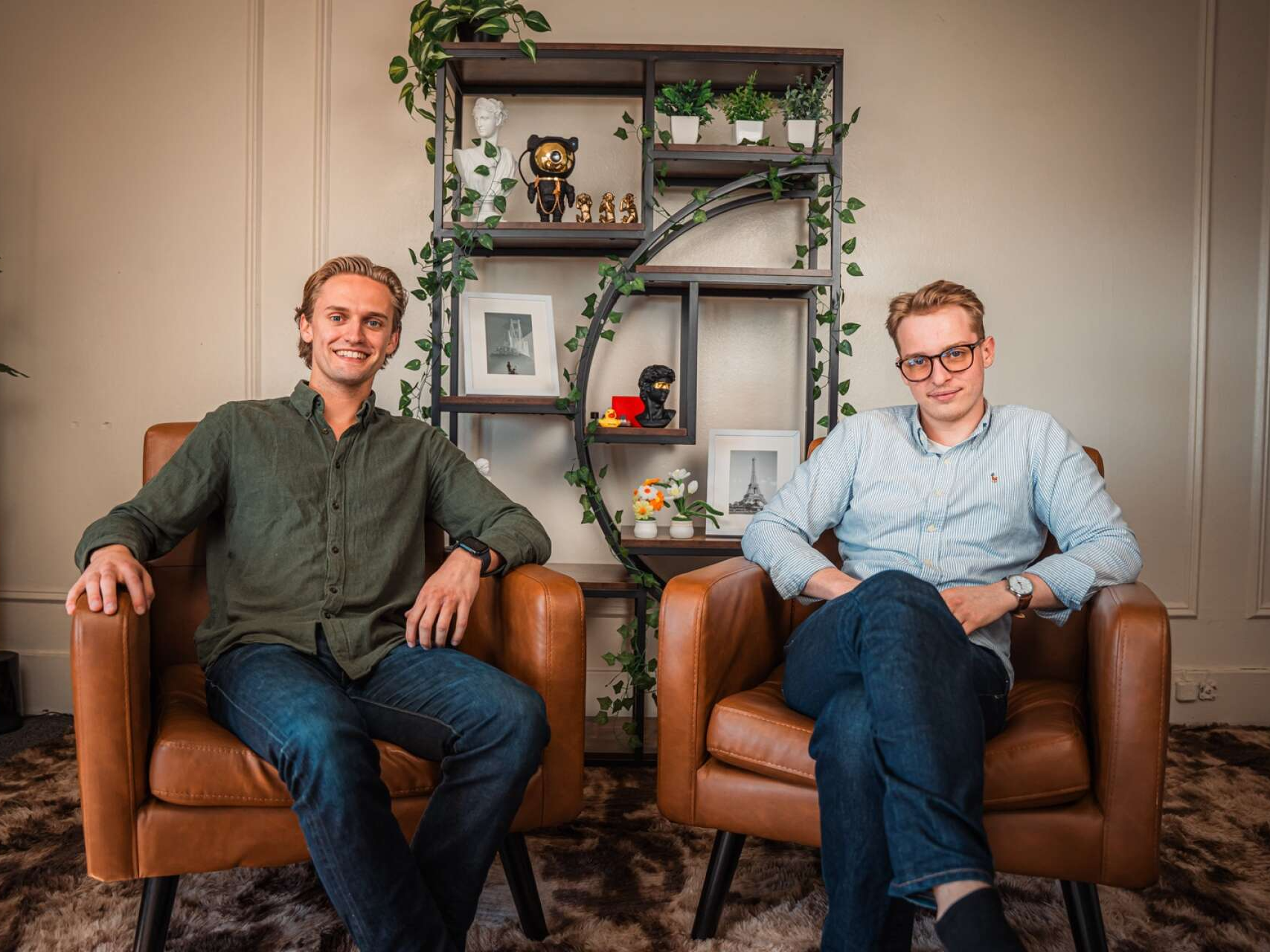
William: It definitely changed us. It put some things into perspective. I think the key takeaway for both me and Liam is: how much can you actually get done in a very short amount of time? How fast can you actually move? You can really, really work super hard. We just got another perspective on what hard work actually means and how much you can move a company within just weeks.
What was the most important thing you heard while you were in San Francisco?
Liam: I don't have any specific advice or questions. I think the overall kinds of conversations have just raised the bar. They were clear and straight to the point.
William: What really stuck with both of us wasn't a question. It was a sentence. One of our investors said, "Forget everything you know about how you build a business."
William: What really stuck with both of us wasn't a question. It was a sentence. One of our investors said, "Forget everything you know about how you build a business."
What did that actually mean?
William: It's about how Sweden, especially smaller towns, looks at building a company. They view risk as something bad. The pace is too slow. It's too structured. By trying to remove those kinds of barriers, you need to be thinking outside the box and move super fast. High risk, high agency, more speed. That's what he was trying to tell us.
We also learned that raising money from investors is not done the way our coaches and mentors told us. Some of them told us to talk to investors a lot, give monthly follow-ups, send emails, and call them. But in the real world, what you want to do is just build a really good product, get great clients, let that speak for you, and make investors run to you instead. It's completely different.
We also learned that raising money from investors is not done the way our coaches and mentors told us. Some of them told us to talk to investors a lot, give monthly follow-ups, send emails, and call them. But in the real world, what you want to do is just build a really good product, get great clients, let that speak for you, and make investors run to you instead. It's completely different.
What specifically did you have to unlearn?
Liam: The main thing I had to erase was advice from people who haven't done what I want to do. If someone gave me advice that sounded good but hadn't been tested in practice, I would always listen, but I'd be more likely to filter it out. Versus, say, one of our investors who was a six-time founder giving me advice backed by real experience. I'd take that.
William: Both Liam and I come from super small towns. Liam's town is less than 1,000 people. My town has fewer than 10,000 people. If we'd still been in our hometowns, we'd probably think we were super fast, super great, super smart. San Francisco really slapped us in the face with what high speed actually means.
William: Both Liam and I come from super small towns. Liam's town is less than 1,000 people. My town has fewer than 10,000 people. If we'd still been in our hometowns, we'd probably think we were super fast, super great, super smart. San Francisco really slapped us in the face with what high speed actually means.
What did Rankad.ai's numbers look like before The Residency and after?
Liam: When we arrived at The Residency, we were at around $25-$35K in ARR. A waitlist of 500-600 companies. 10-15 customers. When we left, we had ARR above six figures, 1,400 companies on the waitlist, and 35-40 paying customers. And this is all pre-launch.
About Rankad.ai: What Are You Building?
Walk me through how Rankad.ai works.
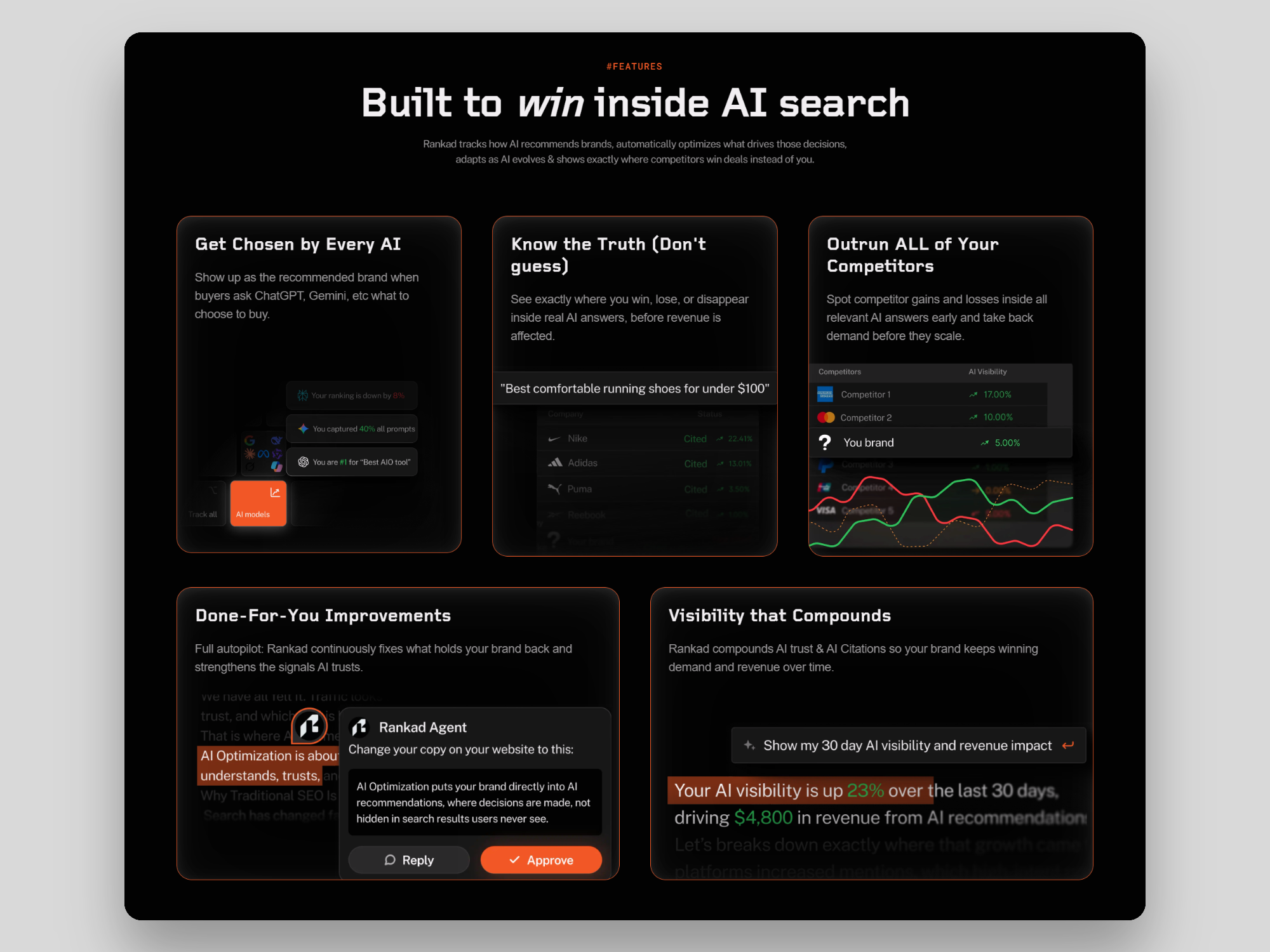
Liam: We have two main things. First, we have a tracker. It automatically monitors your brand's visibility across AI models: ChatGPT, Gemini, Perplexity, Copilot, and more. It tracks how often your brand is mentioned, in what context, and how it compares to competitors. So you can see whether you're winning in ChatGPT or losing in Perplexity, in granular detail.
Then 60 seconds later, you also get the agents ready to act on that data. Our Rank Agent reviews all your public data: your brand, positioning, internal knowledge base, and content gaps. It displays all of that in a structured to-do list. You just click one of the tasks and hit go, and the agent does everything: writes the copy, goes on your website, goes on Reddit, goes on Medium, goes on all of these different sources to make you win in AI search automatically. You just have to confirm the changes.
Then 60 seconds later, you also get the agents ready to act on that data. Our Rank Agent reviews all your public data: your brand, positioning, internal knowledge base, and content gaps. It displays all of that in a structured to-do list. You just click one of the tasks and hit go, and the agent does everything: writes the copy, goes on your website, goes on Reddit, goes on Medium, goes on all of these different sources to make you win in AI search automatically. You just have to confirm the changes.
How does AI search actually work mechanically and why does visibility optimization matter for it?
Liam: Take ChatGPT as an example. It's very consumer-facing and one of the biggest ones. What ChatGPT does is it has a previous window of data, but more importantly, it does a web search. When it searches for something like "best running shoes 2025," it performs a query fan-out. In the background, it sends out four other related questions like "best running shoes males," "best running shoes females," and so on. Then centralizes all of those answers into one response. What AI looks for can be UGC content from Reddit, because ChatGPT wants different opinions. It could be reviews, blog posts, or Reddit threads. It centralizes all of that and gives you back one answer.
Where are competitors missing the mark?
Liam: The competitors you've probably seen raise a lot of money. They give customers all the data on how they're cited in AI, and give some tips on what to do. But they don't do anything for the customer. There's this huge gap. It's like going to the doctor and them saying, "Yeah, you broke your arm, but we're not going to help you with anything. Go away." We actually heal your arm.
Where are you right now in terms of traction?
William: We closed so many new deals this week. It's probably around 35 paying customers.
Liam: We're growing by 55-60% week over week. We have a waitlist of about 1,400 companies. We reached out to some of them this week and signed around 10 new clients in two days. It's easily above six figures in ARR now. We've been talking about hitting $100~150K MRR per month by the end of 2026. And then we scale from there.
William: Also, we just received an email from an a16z partner who is interested. We just got that an hour ago.
Liam: We're growing by 55-60% week over week. We have a waitlist of about 1,400 companies. We reached out to some of them this week and signed around 10 new clients in two days. It's easily above six figures in ARR now. We've been talking about hitting $100~150K MRR per month by the end of 2026. And then we scale from there.
William: Also, we just received an email from an a16z partner who is interested. We just got that an hour ago.
You previously said a founder has to be delusional to build a big company. What's the delusional version of Rankad in 5 years?
Liam: Our delusional vision: every brand on earth runs its entire online presence through Rankad. AI search is just the entry point. The website, the ads, the content, the SEO, the social — every touchpoint a brand has with the internet, built, managed, and optimized by Rankad's agents. Automatically.
Our goal is not to build an AI search tool. We are building the operating system for a brand's existence on the internet.
In 5 years, the moment a company launches, one of the first three things they set up is their Rankad account, right next to their domain and their payment provider. They do not hire a marketing team. They do not hire an agency. They plug into Rankad, and their entire digital presence runs itself.
The timing is exact. AI is not a feature being added to the internet. It is replacing the human execution layer that underpins every marketing workflow. The company that owns autonomous execution owns everything downstream. Our goal is to win this and become one of the few Swedish decacorns and the first Swedish hectocorn.
Our goal is not to build an AI search tool. We are building the operating system for a brand's existence on the internet.
In 5 years, the moment a company launches, one of the first three things they set up is their Rankad account, right next to their domain and their payment provider. They do not hire a marketing team. They do not hire an agency. They plug into Rankad, and their entire digital presence runs itself.
The timing is exact. AI is not a feature being added to the internet. It is replacing the human execution layer that underpins every marketing workflow. The company that owns autonomous execution owns everything downstream. Our goal is to win this and become one of the few Swedish decacorns and the first Swedish hectocorn.
💡
Learn more about Rankad.ai
- Homepage
- William Gyltman — Co-founder
- Liam Karlsson — Co-founder
- Interview: Rankad on turning AI visibility into revenue | Fondo
Explore more