
May 17, 2026
From Devastated to Inspired: What AI Did to One Mathematician
An Interview with Ken Ono, the mathematician who went from devastated by AI to building the future of it
The Thinking Mode
💡
Summary
Ken Ono is an accomplished mathematician and University of Virginia professor who spent decades tracking the legacy of history's most mysterious genius, Ramanujan. But a sudden encounter with AI changed everything. Now the founding mathematician at Axiom Math, Ono is completely reimagining what intelligence means, what education is for, and what it means to be human in an age when knowledge is cheap.
In this conversation, Ono shares why he thinks the race to stay ahead of AI is a race we'll lose, what Ramanujan taught him about genius the system can't see, and why the most dangerous thing we can do to children is keep teaching them to chase grades.
Watch the full interview now on EO's YouTube channel! Below is the complete transcription of the interview. Minor edits have been made for clarity and readability.
Key Highlights:
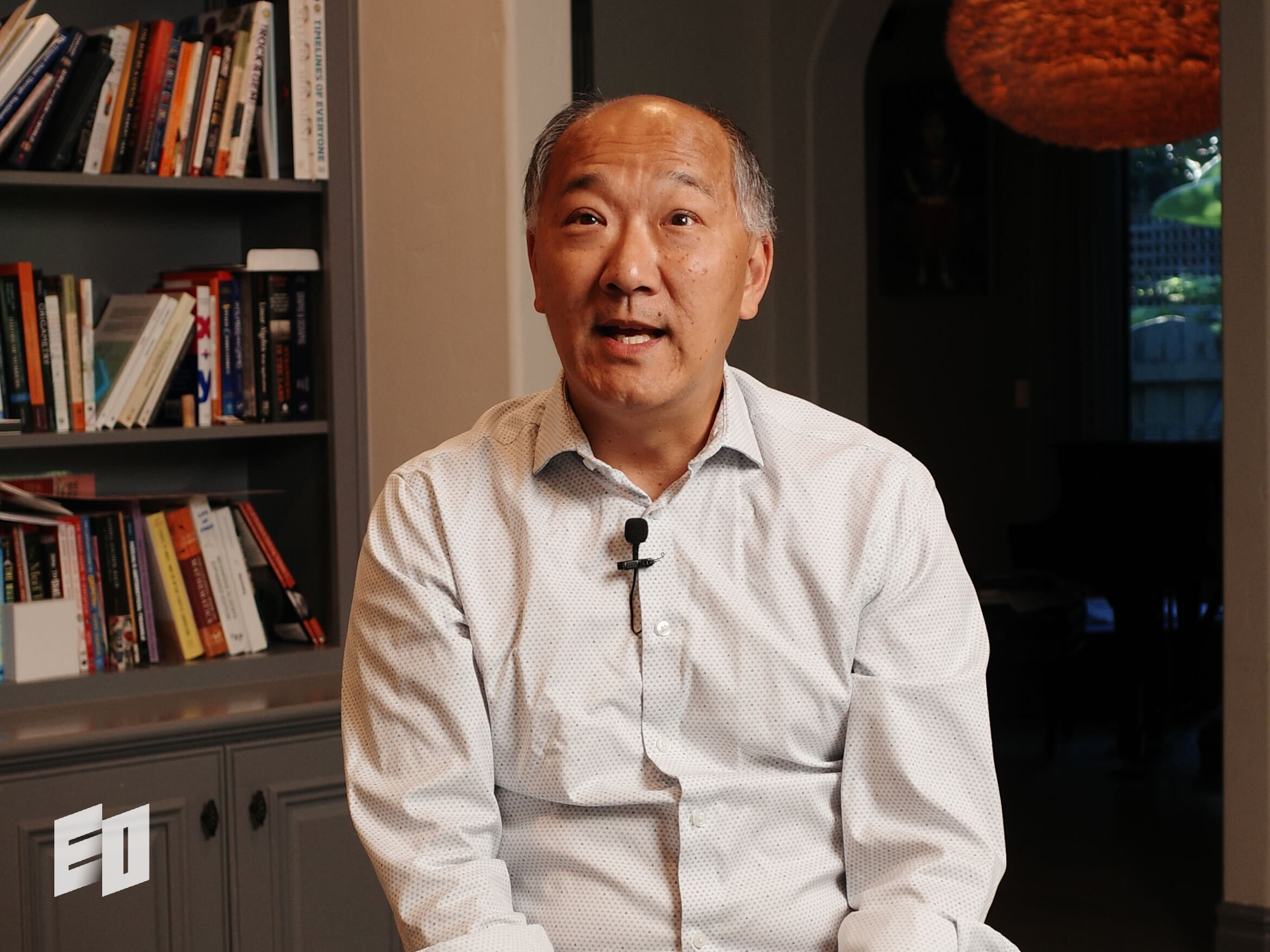
"For the first time, I struggled to assemble questions that ChatGPT would get wrong. I was devastated."
"If our goal is to always stay ahead of AI, then I think we're going to lose."
"Knowledge quickly became cheap. But how you use it and how you verify it has become more expensive."
"It was the first time I heard my parents look up to a hero who hadn't gone to Harvard or Princeton. On the contrary, my father's hero was a two-time college dropout."
"Education starts with inspiring people to want to know more about the world in which they live."
"I utterly hate the GPA obsession. Why? It's an opportunity lost."
"If our goal is to always stay ahead of AI, then I think we're going to lose."
"Knowledge quickly became cheap. But how you use it and how you verify it has become more expensive."
"It was the first time I heard my parents look up to a hero who hadn't gone to Harvard or Princeton. On the contrary, my father's hero was a two-time college dropout."
"Education starts with inspiring people to want to know more about the world in which they live."
"I utterly hate the GPA obsession. Why? It's an opportunity lost."
Lesson 1: What Remains When the Machine Knows More
You went from confident mathematician to deeply troubled in a single year. What happened?
Ken Ono: My name is Ken Ono. I'm a mathematician and I also work in the space called AI for math. I'm a professor at the University of Virginia on leave and I'm the founding mathematician at Axiom Math. Exactly one year ago, I was a happy-go-lucky university professor writing my papers, enjoying life at the University of Virginia. And then there was a dramatic change. I came face to face with large language models at work. The Frontier Math program, where a company based in Berkeley called Epoch AI hired professional mathematicians from around the world to assemble very difficult math problems. Their goal was to assess the capabilities of large language models as they improve.
For the first time, I struggled to assemble questions that ChatGPT would get wrong. I was devastated. I was one of the few scientists who had been given access to these state-of-the-art models. And I had to be patient for a few months before the world recognized it too. Yeah, these models know so much. These models know more facts than any human you would ever find. So for a few months, I was devastated. I was thinking, how am I going to stay ahead of AI?
I actually think that's the wrong question. If our goal is to always stay ahead of AI, then I think we're going to lose.
For the first time, I struggled to assemble questions that ChatGPT would get wrong. I was devastated. I was one of the few scientists who had been given access to these state-of-the-art models. And I had to be patient for a few months before the world recognized it too. Yeah, these models know so much. These models know more facts than any human you would ever find. So for a few months, I was devastated. I was thinking, how am I going to stay ahead of AI?
I actually think that's the wrong question. If our goal is to always stay ahead of AI, then I think we're going to lose.
How do you think about what AI actually is at this point?
Ken Ono: Nobody would be interested in watching Usain Bolt race against a motorcycle in the one mile run. It's not a fair race. But we still watch the Olympics. We as a society now know how to accept that machines can outperform humans in every physical way. But we're still coming to grips with the fact that in deep inquiry, computers have caught up.
The large language models should be thought of as the most extraordinary librarian the world has ever seen. If it has been written down, the large language model has probably seen it. If it's on YouTube, the large language model has probably been trained on it. If you read a newspaper article by the afternoon, the large language model has probably seen it. Good luck competing with that ability to collect information.
Knowledge is now cheap. But how you use it and how you verify it has become more expensive. Do you want your librarian to be your neurosurgeon? Do you want your librarian to be your air traffic controller somehow keeping an eye on the hundreds of planes flying over North America? No way. Because that human judgment is important.
The large language models should be thought of as the most extraordinary librarian the world has ever seen. If it has been written down, the large language model has probably seen it. If it's on YouTube, the large language model has probably been trained on it. If you read a newspaper article by the afternoon, the large language model has probably seen it. Good luck competing with that ability to collect information.
Knowledge is now cheap. But how you use it and how you verify it has become more expensive. Do you want your librarian to be your neurosurgeon? Do you want your librarian to be your air traffic controller somehow keeping an eye on the hundreds of planes flying over North America? No way. Because that human judgment is important.
If knowledge is no longer what makes us intelligent, what does?
Ken Ono: My identity has changed. My view on intelligence has changed quite a bit. The ability to reason, make proper inferences, whether you can do it quickly or slowly, it doesn't matter. But can you create a new concept? Can you generate ideas? Can you string concepts together in a deep way? That is intelligence. That is not the regurgitation of facts, and we're not good at teaching that.
Are you good at setting the dials to design a system from scratch that was going to produce some gadget, whether it's in industry, a computer program, or perhaps a whole new area of science? That's deep intelligence and it rarely is the form that is recognized in schools at any level.
Do you have the ability to recognize patterns in areas of thought that can be transferred from one discipline to another so that you can propel another area forward? I would have said five years ago, oh, that's just being in the right spot at the right time. But that's unfair. You still have to make that observation. So there's an element of recognizing a target of opportunity that is genius. And I don't use that word lightly.
Are you good at setting the dials to design a system from scratch that was going to produce some gadget, whether it's in industry, a computer program, or perhaps a whole new area of science? That's deep intelligence and it rarely is the form that is recognized in schools at any level.
Do you have the ability to recognize patterns in areas of thought that can be transferred from one discipline to another so that you can propel another area forward? I would have said five years ago, oh, that's just being in the right spot at the right time. But that's unfair. You still have to make that observation. So there's an element of recognizing a target of opportunity that is genius. And I don't use that word lightly.
Lesson 2: My Search for Ramanujan: Finding the Genius the System Misses
You have a deeply personal connection to the mathematician Ramanujan. How did that begin?
Ken Ono: I have a very unique personal story. I'm the son of a mathematician. When I was a child, I was considered gifted in mathematics and my parents decided at an early age that I was going to be a mathematician. My parents actually had a plan for all three of the boys. My oldest brother was going to be a pianist. He did it. I was the youngest and was going to be a mathematician. And the middle son, who they said wasn't good at math and wasn't gifted in music, well, he should just go work in a bank, just make a living. Which inspired him to do great things. My brother Santa has gone on to become the president of the University of Michigan. He was literally driven by this need to prove that his early assessment was incorrect.
For me, it almost went in a very bad way. I dropped out of high school. The last thing I wanted to be in high school was anything my parents wanted me to be. I didn't want to be the one Asian kid in class who was expected to be good at math when all the other kids had lives. I couldn't play baseball. I hated it.
In April of 1984, I was of the mindset that I'm going to run away from home. I'm never going to see my parents again, and I don't care. I'm going to strike out on my own.
For me, it almost went in a very bad way. I dropped out of high school. The last thing I wanted to be in high school was anything my parents wanted me to be. I didn't want to be the one Asian kid in class who was expected to be good at math when all the other kids had lives. I couldn't play baseball. I hated it.
In April of 1984, I was of the mindset that I'm going to run away from home. I'm never going to see my parents again, and I don't care. I'm going to strike out on my own.
Ken Ono: In April 1984, a letter came to the house addressed to my father. It was on a yellowed piece of paper that looked like it might as well have been 100 years old. It was a letter written by Janaki Amal, who was the widow of the Indian mathematician Ramanujan. She thanked my father for making a small gift to help commission a statue in memory of Ramanujan. Seeing my dad cry, he who almost never showed emotions, this letter brought him to tears. He brought the letter to me afterwards. He had to tell someone what it was about.
I learned that day that Ramanujan was a mystic, an autodidact. He had visions of mathematics that he believed his goddess gave him, formulas he would write down in his notebooks. Because of his passion for mathematics, he didn't study in any of his other courses. So he ended up flunking out of college twice. Here was my dad talking about someone who was a two-time college dropout, but had left behind three notebooks filled with formulas he was studying himself.
It was the first time I heard my parents look up to a hero who hadn't gone to Harvard or Princeton and been a perfect student. On the contrary, my father's hero was a two-time college dropout. And I needed that.
I learned that day that Ramanujan was a mystic, an autodidact. He had visions of mathematics that he believed his goddess gave him, formulas he would write down in his notebooks. Because of his passion for mathematics, he didn't study in any of his other courses. So he ended up flunking out of college twice. Here was my dad talking about someone who was a two-time college dropout, but had left behind three notebooks filled with formulas he was studying himself.
It was the first time I heard my parents look up to a hero who hadn't gone to Harvard or Princeton and been a perfect student. On the contrary, my father's hero was a two-time college dropout. And I needed that.
How did Ramanujan's story end up shaping your actual mathematical career?
Ken Ono: Later, at the University of Chicago, I was a horrible student. But right before my senior year, flipping through channels on television, I saw a documentary about Ramanujan on public broadcasting. Here in color on TV was more than the vaguest outline my dad had told me. There was the whole story, and it kind of jumpstarted me. I had a lot of catching up to do. I became a good student, and when the biography of Ramanujan came out called The Man Who Knew Infinity, I started to work on a thesis based on his work.
By the end of my PhD, what I worked on was called the theory of Galois representations, which was meant to study Ramanujan's backwater mathematics. But by 1993, the bombshell news in mathematics was a proof of Fermat's Last Theorem, and the proof of Fermat's Last Theorem depended on these Galois representations. I don't know what it is, but following Ramanujan, every time he has appeared, it has been like the best decision I've ever made in my life.
By the end of my PhD, what I worked on was called the theory of Galois representations, which was meant to study Ramanujan's backwater mathematics. But by 1993, the bombshell news in mathematics was a proof of Fermat's Last Theorem, and the proof of Fermat's Last Theorem depended on these Galois representations. I don't know what it is, but following Ramanujan, every time he has appeared, it has been like the best decision I've ever made in my life.
What did Ramanujan's near-disappearance from history teach you about undiscovered talent?
Ken Ono: One important theme for me is: where would we be, and I don't mean just me as a mathematician, but where would we all collectively be had he not been discovered? That is a world I cannot fathom. And because of that, you're left wondering: there must be other Ramanujans walking planet earth. Maybe they don't come from privilege. How do we find them? And how do we nurture them when we find them?
I was lucky enough for a number of years to run a program called the Spirit of Ramanujan where we looked for undiscovered talent. My former student Karina Hong studied with me in a research program and she was one of our first recipients. It makes me wonder where she would be today had she not received that fellowship. There are, I am sure, many many undiscovered people that we need to find.
I think the ability and the potential to be someone like Ramanujan, or at least creative in a productive way, I think it resides in us all. You just have to give students of all ages the opportunity to be brave enough to act on their curiosity, and then offer them a system that embraces it.
I was lucky enough for a number of years to run a program called the Spirit of Ramanujan where we looked for undiscovered talent. My former student Karina Hong studied with me in a research program and she was one of our first recipients. It makes me wonder where she would be today had she not received that fellowship. There are, I am sure, many many undiscovered people that we need to find.
I think the ability and the potential to be someone like Ramanujan, or at least creative in a productive way, I think it resides in us all. You just have to give students of all ages the opportunity to be brave enough to act on their curiosity, and then offer them a system that embraces it.
Lesson 3: What's Left to Teach When Knowledge is Free
What's wrong with how we're educating students today?
Ken Ono: Some of your best students in Korea, the best students in the United States, best students worldwide, they're stressed out in high school. They're probably even stressed out in middle school, worrying about how do I get into the right high school, how do I get into the right college, will I get the right test scores? If you're motivated to participate in those systems just because they are checkboxes, that's messed up. I'm not saying don't participate in a system that will ultimately decide your fate with regard to college. But pause and recognize you're participating in that system.
Education starts with inspiring people to want to know more about the world in which they live. Wanting to know more about cultures because we share the world together. That's why I went to college. That's why I travel the world. If you have children that are infants, how wonderful is it to play with them with a stack of building blocks? Play for children is science. They're not really learning about gravity, but they're really learning about gravity. Think about how wonderful the world is when you get to learn about it without worrying about what your future and your reputation will be.
Education starts with inspiring people to want to know more about the world in which they live. Wanting to know more about cultures because we share the world together. That's why I went to college. That's why I travel the world. If you have children that are infants, how wonderful is it to play with them with a stack of building blocks? Play for children is science. They're not really learning about gravity, but they're really learning about gravity. Think about how wonderful the world is when you get to learn about it without worrying about what your future and your reputation will be.
How did AI actually change your perspective on what education could be?
Ken Ono: This is actually how I transitioned from being devastated by AI. It has already read my papers. It understands my papers better than I remember them. Think about all the subjects in adjacent areas of mathematics that I could just ask AI about, and the AI is not going to laugh at me. As a great librarian it will dutifully answer any question I would ask.
If you are privileged enough to have access to the internet and a large language model, knowledge quickly became cheap. In the United States, it could cost $80,000 to spend one year attending a university. And here's the dirty secret: I could learn everything that you would learn bookwise, academically, from a large language model at my own pace, probably accelerated. What I would not get would be the human access, how the right questions were derived, what the next questions in a field might be. That's why we still go to college and that's why we still need professors. But all the other stuff, the tutoring, the precision learning, AI can help with that.
I actually believe that we in this world aren't doing the best we can at educating our children. And I don't say that to be critical of educators. I am an educator.
If you are privileged enough to have access to the internet and a large language model, knowledge quickly became cheap. In the United States, it could cost $80,000 to spend one year attending a university. And here's the dirty secret: I could learn everything that you would learn bookwise, academically, from a large language model at my own pace, probably accelerated. What I would not get would be the human access, how the right questions were derived, what the next questions in a field might be. That's why we still go to college and that's why we still need professors. But all the other stuff, the tutoring, the precision learning, AI can help with that.
I actually believe that we in this world aren't doing the best we can at educating our children. And I don't say that to be critical of educators. I am an educator.
What do you actually want for the next generation?
Ken Ono: It's always a treat to visit a kindergarten or first grade class on bring-your-parent-to-school day. The wonder in those children, I want to bottle up that energy. Because if we could maintain that wonder, and the energy that children have when everything around them is new, think about where we would be today.
The best scientists in the world still need to view the world as a wondrous thing. The best doctors in the world still need to recognize that what they practice is supposed to come from a place of benevolence. If we pay so much attention on and value so much perfection and speed in ordinary test taking, then how are we training someone to be the next Einstein?
For my children, I want them to be passionate about the world that they live in. And if you're passionate about the world you live in, then you're deeply worried about the climate. You're deeply worried about the conflicts between different cultures. In the United States, where education is so expensive, you could come out of college with $150,000 in debt, go on to professional school accruing another $200,000, and three years later discover you can't stand the sight of blood but now you can't leave your profession because of the loans. That is purgatory. You're stuck. And that's when your life becomes: I go to work because it pays the bills.
Who owns your identity? You do.
The best scientists in the world still need to view the world as a wondrous thing. The best doctors in the world still need to recognize that what they practice is supposed to come from a place of benevolence. If we pay so much attention on and value so much perfection and speed in ordinary test taking, then how are we training someone to be the next Einstein?
For my children, I want them to be passionate about the world that they live in. And if you're passionate about the world you live in, then you're deeply worried about the climate. You're deeply worried about the conflicts between different cultures. In the United States, where education is so expensive, you could come out of college with $150,000 in debt, go on to professional school accruing another $200,000, and three years later discover you can't stand the sight of blood but now you can't leave your profession because of the loans. That is purgatory. You're stuck. And that's when your life becomes: I go to work because it pays the bills.
Who owns your identity? You do.
Explore more