
Dec 03, 2023
Lessons learned from stepping down as a CEO
Interview with Bob Tinker and TaeHea Nahm, Co-authors of Survival to Thrival
Founder Focused

💡
At a Glance
- Who: Bob Tinker, founding CEO of MobileIron and founder of Metamorph, and TaeHea Nahm, managing Director at Storm Ventures and MobileIron co-founder, are multi-time enterprise tech leaders and co-authors
- What: Together, they developed frameworks on "Go-to-Market Fit" and executive leadership transitions, detailing how founders must unlearn legacy habits as companies scale from pioneer stages to public enterprises.
- Lesson: Why founder-led "heroic selling" must be replaced by a repeatable two-page GTM playbook, why CEOs have a 90-day window to evaluate if executives can transition to larger roles, and how leadership must evolve from hands-on execution to managing specialized leaders and setting overarching vision.
Bob Tinker and TaeHea Nahm spent eight years building MobileIron from an early concept into a public enterprise software company with $150 million in annual recurring revenue. After Tinker voluntarily initiated a CEO succession conversation following a public earnings miss, the duo spent four years co-authoring books to codify the missing link between product-market fit and repeatable growth. Their framework details how executives must unlearn old habits as companies transition from early-stage survival to enterprise scale. Their insights provide a roadmap for navigating executive changes, establishing repeatable sales playbooks, and managing the emotional demands of startup leadership.
Key Takeaways
CEOs Must Evolve Beyond Personal Execution
The interview contrasts an early CEO’s hands-on work with the later need to delegate and manage through goals and metrics. As a company grows, personal talent cannot remain the operating system, so leadership must evolve with organizational complexity.
Loyalty Makes Leadership Changes Emotionally Difficult
A leader who was excellent in an earlier stage may struggle when the role changes. The difficult decision is not always removing someone who is failing, but changing a loyal executive who was once a company hero and now needs different capabilities.
Company Stages Require Different Executive Strengths
The sales-leadership analogy moves from pioneer, to warrior, to Eisenhower-style manager as the company grows. Hiring the later-stage profile too early creates bureaucracy, while keeping an early-stage profile too long leaves a larger organization without the needed structure.
Unlearning Is A Leadership Requirement During Growth
Executives must recognize when their old job has changed and decide whether they are willing to change with it. The interview recommends naming the transition, finding a mentor, clarifying the new role, and giving leaders a defined chance to make the leap.
CEO Roles Shift From Tasks To Culture
The CEO evolves from Captain America, who manages tasks directly, to a leader of specialized executives and eventually a builder of organizational culture. Goals, metrics, vision, and culture provide increasing leverage as direct control becomes impossible.
Meaningful Relationships Outlast Company Balance Sheets
The interview closes by measuring success through meaningful relationships rather than financial statements. Building companies still matters, but the people worked with, customers helped, and personal connections become the durable record of a career.
Watch the full interview now on EO's YouTube channel! Below is the complete transcription of the interview. Minor edits have been made for clarity and readability.
Stepping Down as CEO
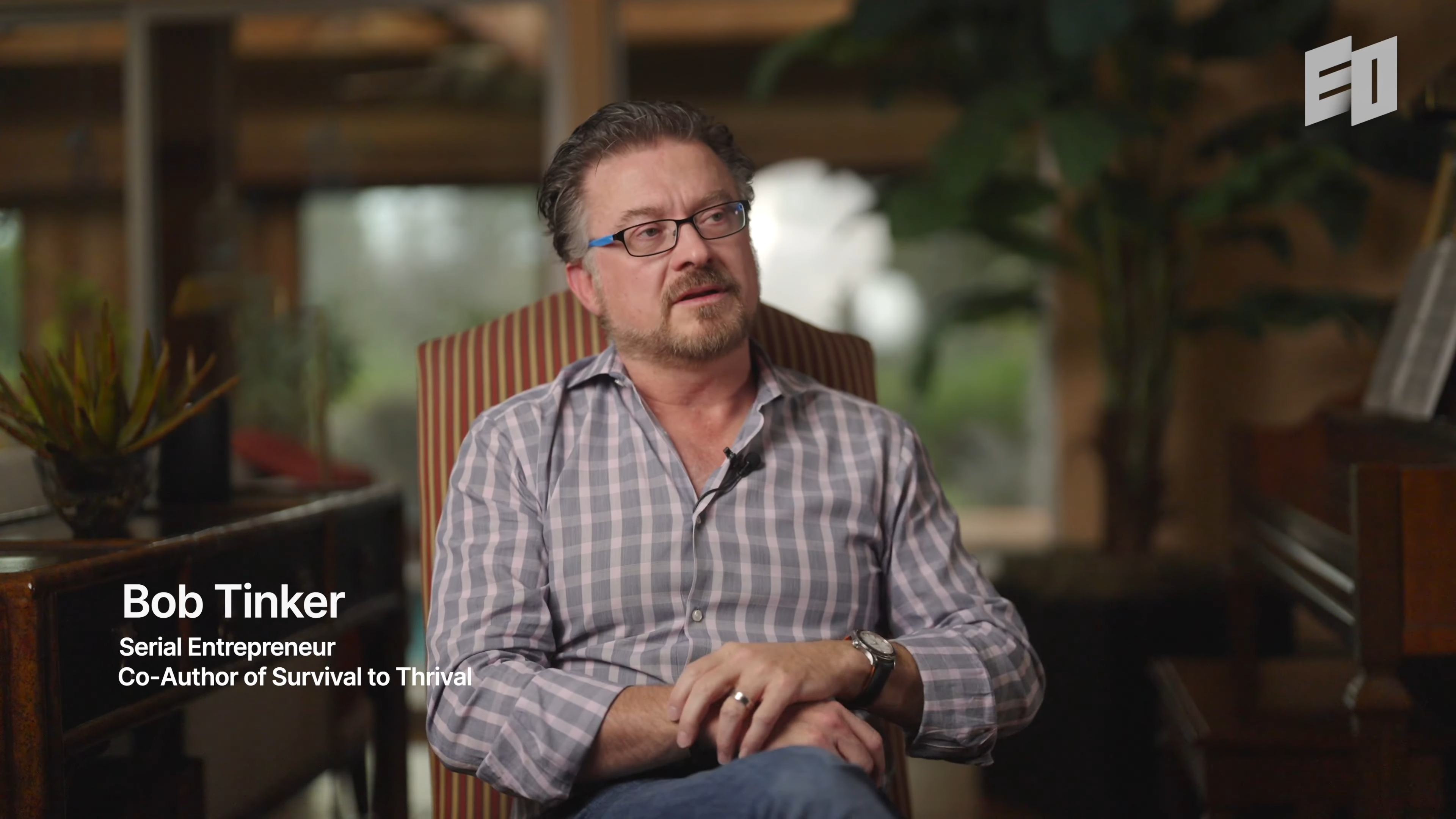
Bob Tinker: My name is Bob Tinker. I am a multi-time entrepreneur. The company I am probably best known for is MobileIron, which we started in 2008 and grew from zero to $150 million of ARR over five years before taking it public on NASDAQ in 2014.
In 2016, we missed our numbers. We lost about half of our market capitalization. It was really painful, and as CEO that responsibility was on me. In that board meeting I said, one of the things we should talk about is whether I should be the CEO of MobileIron going forward. Probably 60 days later, Tae Hea came back to me and said, remember that conversation we had in the board meeting? We are going to take you up on that.
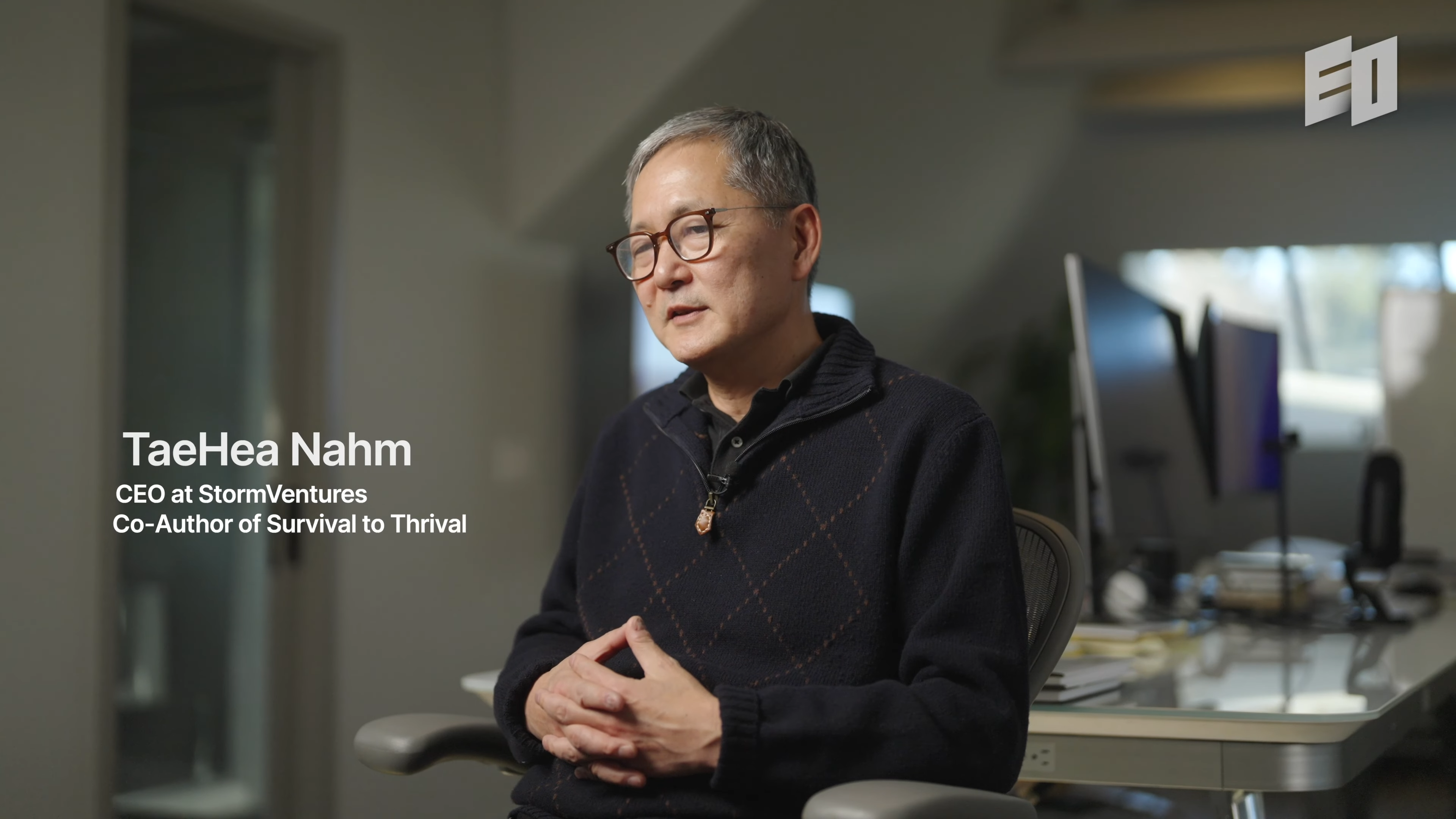
Tae Hea Nahm: Bob is so gifted. He can compensate for a lot of people, and he was doing a lot himself. What was really needed was to replace some of his executives, and that was a hard decision for him.
There are a lot of things Bob can change easily, because he is so talented. If it is anything related to him personally, he can internalize it and he knows how to change. In the beginning of a company you have to micromanage every detail as CEO, and he was very good at that. As the company grows, it becomes about delegating, setting goals and metrics, and he made that transition very easily. Many founder CEOs have a hard time giving up control.
What was hard for Bob was changing great people. If you have someone who is simply struggling, it is easy to say that person is struggling and we have to make a change. But what happens if you have someone who did a fantastic job, and then the company grew, the job changed, and that person is not changing? The person was a superhero yesterday but is struggling today. That is hard to change because you feel so much loyalty to them. Changing people who were great and are struggling now is an emotionally tough decision.

Bob Tinker: After I stepped aside from running MobileIron, like a lot of entrepreneurs after a run like that, I was tired. I took some time off, and that helped. But I also wanted to teach. There were a lot of things I learned at MobileIron that I wanted to share, and some frustrations from my time as an early-stage CEO that inspired Tae Hea and me to write two books.
The first frustration was that companies go through stages where things change, and I was always struggling to understand what comes next. As CEO you are working on what is happening right now, but you also have to look over the hill and figure out how to reach the next stage. I did not feel there was good content out there, and investors were not very good at helping me with it.
The second frustration was the gap between product-market fit and unlocking growth. I was mad that nobody told me how to solve for that. The advice was, get to product-market fit, hire salespeople and go. That did not work, and I was mad. Using that frustration, and what we learned about building a repeatable go-to-market playbook to find go-to-market fit, became the second book.
The third frustration is that as the company changes, your job changes, so people have to change. What surprised me was how hard it is to unlearn. We spend most of our time learning, and that is really important. But one of the things we never talk about is what we need to unlearn. That was a big lesson for me.
Different Stages Need Different Leaders
Tae Hea Nahm: I will give you a specific example. Take the VP of sales. In the beginning, the ideal VP of sales is a pioneer or an explorer, someone who can find a path through the wilderness to the promised land. That person can survive with no map, does not need a lot of supplies and is not worried about hostiles. Usually that person is good at managing a couple of sales reps.
As soon as you find that path through the wilderness, you no longer want a pioneer. You want a warrior leader, someone like Mel Gibson in Braveheart, who will go down that path with 50 warriors to fight the bigger competitors and win deals. But once you have 50 or 100 warriors and you are growing, the VP of sales you want is not a warrior but someone who is good at managing warrior leaders. That profile is someone like Dwight Eisenhower. He commanded the American, British, Canadian and French armies on the Western Front in World War II, and it turns out he never fought in battle. He was never a warrior, but he was very good at managing warrior leaders.
If you hired a Dwight Eisenhower at the beginning with two sales reps, it would be a total disaster, because that person would try to build structure and process like a big company when you do not even have a path through the wilderness. This is what I mean when I say at different stages of a company, you need different skill sets. It is about how to prevent someone from being a superstar today and being fired tomorrow.
Tips for Unlearning
Bob Tinker: Here are some tips for unlearning and helping teams navigate these change points. The first is recognizing when one of your leaders is going through a change point where they have to unlearn their old role and learn their new one. The second, and this is really hard, is that sometimes people do not want to unlearn. They are really good at their job and they want to keep doing it, while you as the leader need them to do the next job. As the company changes, their job changes, so the people have to change to adapt. If the people are not willing to change, you have to change the people. That is hard.
Some of your leaders and executives will make the leap. Others either will not or cannot, and you have to let them go. That is hard because these leaders have been a big part of making the company what it is. You feel loyal to them and you want to give them a chance to make the next level. But at some point, if they are not able to, you have to let them go.
The trick is how much time you give them, and for a CEO this is damned if you do, damned if you don't. If you act too quickly, you were not willing to work with them and let them learn, and you are a jerk. If you take too long, you are weak and you do not make decisions. My experience is that you have about 90 days to give a leader a chance to step up, unlearn their old role and learn their new role. Otherwise you have to make the change. Be respectful of the executive, thank them for what they did and give them an honorable exit. Sometimes the best thing for them is to go do their role again somewhere else. One of the great things about Silicon Valley is that someone who is a great VP of sales from zero to $50 million may simply not want the job of VP of sales from $50 million to $150 million. It is a different job. The best thing is for them to go be the VP of sales somewhere else from zero to $50 million.
The second category is people who are willing to unlearn and learn, and it is spectacular when you have a leader like that. Some of the most fun you will ever have as an executive is working with a leader who makes this leap. First, let them know the change is happening. Their job is changing, so they have to change. Second, get them a good mentor, because talking with other leaders who have been through the same change helps them know what to look for and how to think about it. Third, help them see what the new job looks like and have an explicit conversation about what needs to change. That helps them understand it, and it builds a powerful relationship between you and the leader making the leap. Unlearning and learning like this is typically a step function in somebody's career. By doing it, they have earned the right to play at the next level, and it is really fun to watch.
How the CEO Role Changes
Tae Hea Nahm: In the beginning, when the company is up to 20 or 25 people, the best founder CEO is Captain America, someone who goes out there, leads by example and fights everything. The ideal founder CEO is talking to customers in the morning, telling engineers what code to write in the afternoon and writing code themselves in the evening. It is right there with the people. It is inspirational leadership and fast decision-making, everything is aligned, and it works very well.
As the company gets bigger, you cannot maintain that, because the founder has too much control and the company will soon grow beyond them. The next profile is a founder who is good at leading a band of Avengers. You want each VP to have a superpower more powerful than the CEO's. The VP of marketing should be a better marketer than the CEO, and the VP of sales a better salesperson. The question becomes how to delegate while still maintaining control. In the first phase, it is about managing tasks. That is what Captain America does. In the next phase, it is about setting the right goals and watching the right metrics, so you can empower people while keeping accountability and visibility.
As the company gets even bigger, you want a CEO like Professor Xavier in X-Men, building a school of superheroes, so it is not just your executives but a broader team of emerging superheroes throughout the organization. To do that, vision and culture become very important, because if the CEO sets goals for everyone, you undercut the hierarchy. The CEO leads through vision and culture and makes the company grow even bigger. This is how the CEO role changes. If you try to be Professor Xavier on day one, the company will struggle.
Bob Tinker: Being a CEO is a tough job. The CEO is always making decisions. Some are easy, some are hard, and for some you have no idea what the right answer is and you just have to pick something. It is also exhausting. I learned a few things about what the job means for you personally.
The first is that it is a fascinating exercise in self-awareness, looking yourself in the mirror and asking what you are doing well and what you are not. The second is that it is really hard to draw boundaries in your life. I call it the Saturday morning problem. You have four hours on a Saturday morning. Do you spend them with your family and friends, doing the things you want to do, or do you spend them making the company better, because 900 families depend on it? That creates a low-grade stress for a CEO. The third is that being a good CEO requires a level of schizophrenia. You need to be super optimistic and inspiring, pointing people at the mountain and saying let's climb it together, while also being kind of paranoid, looking over your shoulder at everything that could go wrong and solving the issues that come up every day.
When I add it all up, you get to be part of building a company that makes a difference for customers and creates value for shareholders. You bring a great team together and you see them grow and learn. There is a lot of crap and a lot of hard stuff too. My advice for CEOs is to be able to zoom out. When I was in the soup bowl dealing with the day-to-day, it always seemed like there were issues everywhere. But when I zoomed out and looked at where we were a year ago versus now, I thought, look at all the progress we made. That filled up my gas tank.
Everybody has their own routines for staying mentally healthy. Some people exercise, some sleep, some socialize. I do not have a specific recommendation, but have a routine, whatever it is. For me, balance came from time with family and friends. I am wired as an extrovert, so I get energy from that. Spending time with my wife and kids is how I recharged. Looking back on my journey as a first-time CEO, it was crazy, hard and exhausting, but it was also a blast. I got to build a great business and I learned a ton about myself. I do not know this for sure, but I think what I learned on the journey made me a better person.
Advice for Future Entrepreneurs
Tae Hea Nahm: When Bob and I started writing the books, we thought it would take six months, not four years. It took that long to reconcile our views of working on MobileIron and Airespace. Even though we worked closely together on those two companies, it looked like we were watching two different movies. One view is the founder CEO, a surfer in the water riding the wave, whose number one goal is not to wipe out. The other is the investor and board member, me, in a helicopter above that surfer and maybe 20 others, not in the water, watching where the wave is going and trying to give direction. Reconciling the board member's view and the founder CEO's view took four years, and we felt that reconciliation would help.
Bob Tinker: I have three core pieces of advice for future entrepreneurs. First, start with a pain or a problem, not a technology, because customers buy because of pain, problems or gain. Second, figure out your own personal way to unlearn. To be successful you will have to unlearn what made you successful and learn what comes next, and you have to figure that out for yourself. Third, do your best to surround yourself with good people, both at work and in your personal life.
At the end of the day, the thing I am most proud of and remember the most is the people I worked with, the customers we made a difference for and the relationships I built. I am 53 now. How I evaluate my success in life is not my balance sheet or my checkbook. It is the relationships I have that mean something to me.
As for the future, on the work side I started a small private equity shop called Metamorph, where we buy small software companies and help make them better. We are looking to buy one or two more and to keep improving the ones we already own. On the personal side, my wife and I are recent empty nesters. I am looking forward to visiting my kids at university and spending time with my wife and friends in a way I have not in 20 years. Not super exciting, but for me, very satisfying.
Explore more