
Mar 11, 2026
The Secret Behind Every AI-Winning Founder: Intelligence Allocation
An interview with Rem Koning, Harvard Business School Professor, on AI-native organizations, intelligence allocation, and why AI made some entrepreneurs 10% poorer.
Founder Focused
For years, the dominant narrative around AI has been simple: the more access companies have to it, the more competitive they become. But research from Rem Koning suggests that assumption misses the point.
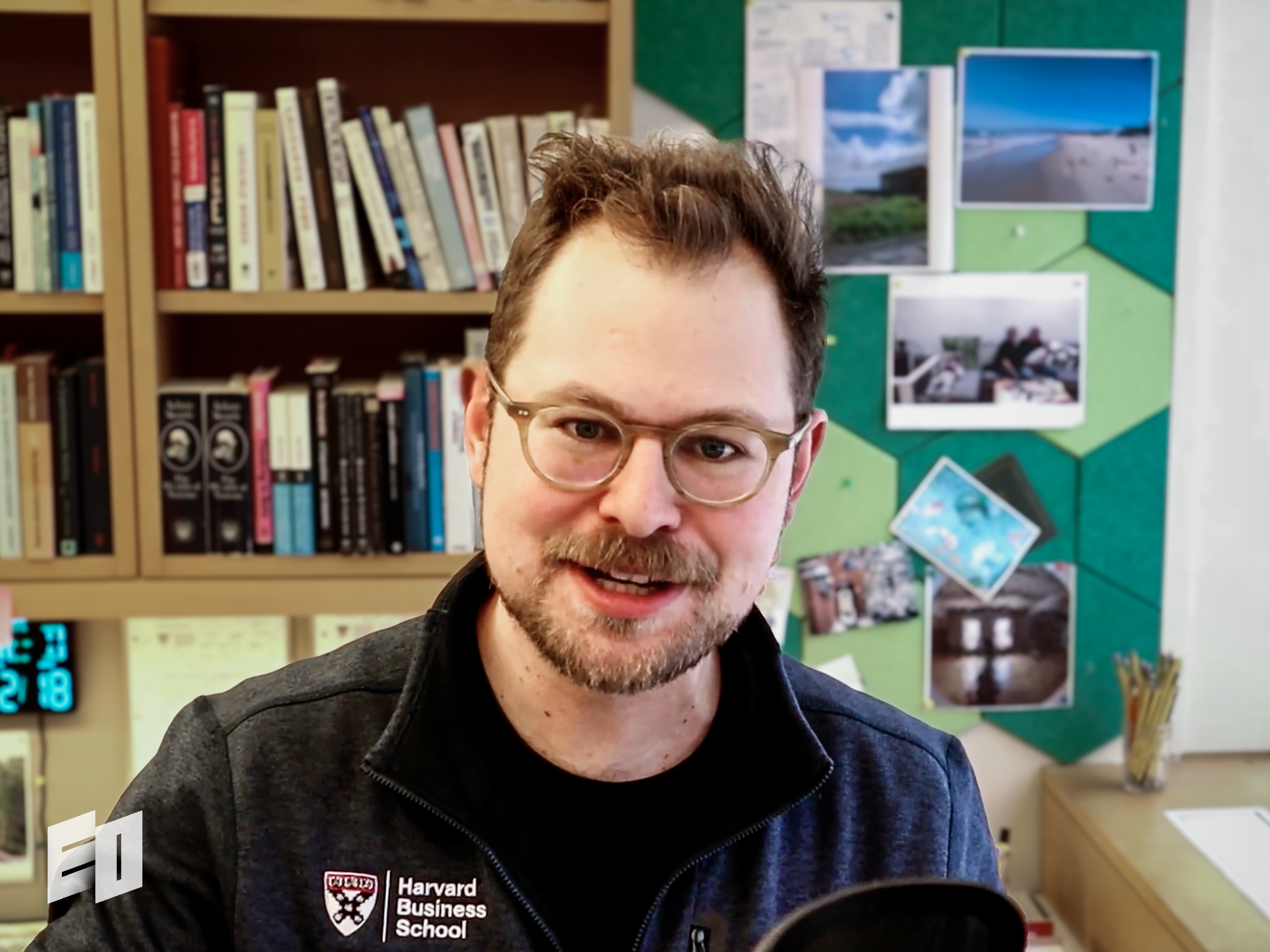
Koning, a professor at Harvard Business School, studies how entrepreneurs actually use AI inside real organizations.
His work focuses on a question that’s becoming increasingly important for founders; it's important to learn how to structure work between humans and machines. The companies that win in the AI era won’t simply adopt the technology. They’ll figure out how to allocate intelligence and decide what humans should do, what AI should do, and how the two should work together. That shift may end up defining the next generation of successful businesses.
His work focuses on a question that’s becoming increasingly important for founders; it's important to learn how to structure work between humans and machines. The companies that win in the AI era won’t simply adopt the technology. They’ll figure out how to allocate intelligence and decide what humans should do, what AI should do, and how the two should work together. That shift may end up defining the next generation of successful businesses.
In this interview, Rem Koning shares:
Why being AI-native is not about using AI more. It's about embedding it so your team doesn't need to be involved at all.
Why the real competitive edge in the AI era is not capital or talent, but the ability to allocate intelligence.
Why AI made struggling entrepreneurs 10% poorer and what that reveals about judgment, slop, and the dangerous assumption every AI founder is making right now.
Why being AI-native is not about using AI more. It's about embedding it so your team doesn't need to be involved at all.
Why the real competitive edge in the AI era is not capital or talent, but the ability to allocate intelligence.
Why AI made struggling entrepreneurs 10% poorer and what that reveals about judgment, slop, and the dangerous assumption every AI founder is making right now.
Watch the full interview now on EO's YouTube channel! Below is the complete transcription of the interview. Minor edits have been made for clarity and readability.
Key Highlights:

"I wrote this paper three years ago looking at whether ChatGPT delivered over WhatsApp could help small business entrepreneurs in Kenya. For entrepreneurs who before our study were struggling, they saw a 10% decline in their profits and revenues from talking to the AI."
"Unless you've developed the judgment, the mental models to actually know where to apply it, AI can lead you down a road of slop. And that slop can actually lead you to make less money."
"Conversely, when we look at the people who were performing really well, we find that they actually did better. They're asking the same sorts of questions as the low performers, but they're then following the good advice, not the bad advice."
"We're in a world where increasingly what matters is your ability to allocate intelligence. If you can work that out better than other people, I think you've got an edge in the market."
"The most dangerous assumption founders make is that by building with AI, they have made something people want. And that is just not true."
"Use last generation's model — it's probably fine for what you're building. What matters is: can you figure out where and how to apply it?"
"Unless you've developed the judgment, the mental models to actually know where to apply it, AI can lead you down a road of slop. And that slop can actually lead you to make less money."
"Conversely, when we look at the people who were performing really well, we find that they actually did better. They're asking the same sorts of questions as the low performers, but they're then following the good advice, not the bad advice."
"We're in a world where increasingly what matters is your ability to allocate intelligence. If you can work that out better than other people, I think you've got an edge in the market."
"The most dangerous assumption founders make is that by building with AI, they have made something people want. And that is just not true."
"Use last generation's model — it's probably fine for what you're building. What matters is: can you figure out where and how to apply it?"
Lesson 1: Your Organization Isn't AI-native Yet. The Key Is "Allocating Intelligence"
Could you please introduce yourself?
Rem Koning: Hi, my name is Rem Koning. I'm a professor at Harvard Business School and I study entrepreneurship and AI. I like helping entrepreneurs do better. It could be a mogul in Silicon Valley. It could be someone selling coconuts in Indonesia. How do we help entrepreneurs bring new products to markets, compete better, grow their firms. Most recently, thinking about the role of AI as something that's just going to unlock a crazy amount of entrepreneurial potential.
You've been tracking how founders around the world are using AI. What did you find?
Rem Koning: The AI Founder Sprint is an initiative that came out of INSEAD. We got over 500 entrepreneurs from all over the world. A quarter from Africa, a quarter from Asia, a quarter from the Americas, and a quarter from Europe. All building around AI. You're seeing people building for AI and maternal health in Africa. You're seeing people build new edtech startups in India. You're seeing stuff come out of Kenya. You're seeing awesome startups coming out of Europe and the United States. And really what we did was track how all these founders were using AI.
When you teach founders to be AI-native. When you tell them to really think about where they can apply generative AI, not just ChatGPT and Claude but the vibe coding tools, multimodal tools, all the agents that people are really excited about now, it helps entrepreneurs everywhere do better. If you're building in Nigeria, you are able to get about 20% more done every week. You're more likely to get customers, more likely to launch a product, more likely to have more revenue. And what's really crazy is that even though you're more successful and growing faster, these same founders say they want to raise less capital. Their demand for raising funds drops by $250,000.
When you teach founders to be AI-native. When you tell them to really think about where they can apply generative AI, not just ChatGPT and Claude but the vibe coding tools, multimodal tools, all the agents that people are really excited about now, it helps entrepreneurs everywhere do better. If you're building in Nigeria, you are able to get about 20% more done every week. You're more likely to get customers, more likely to launch a product, more likely to have more revenue. And what's really crazy is that even though you're more successful and growing faster, these same founders say they want to raise less capital. Their demand for raising funds drops by $250,000.
What does "AI-native" actually mean in practice?
Rem Koning: The first thing that's really important when you're thinking about AI-native is to understand that the value comes from two places. One is the process. You use AI in your coding, you use AI to do customer support tickets. That's what we're all really familiar with: using AI to make our work go faster or better. That gives a Gamma an edge. It helps. But really the key to being AI-native is the way you embed AI into your product. You're not just using it to do the work, you're embedding it in the product so that the AI can directly do the work with the customer. You want to take yourself as the human out of the loop.
I love humans. We're amazing. But the problem with humans is we don't scale particularly well. If you were trying to build Gamma pre-generative AI, they'd probably have to employ tens of thousands, maybe hundreds of thousands of graphic designers. The economics of the company would collapse. But instead, by putting AI into the product, Gamma is able to scale with compute rather than headcount. If you're trying to be an AI-native founder, that's what you need to find those places where you can create loops where the AI is working with a user, or another AI, or something on the website, where your team doesn't even need to be involved. That's the key to building AI-native organizations.
I love humans. We're amazing. But the problem with humans is we don't scale particularly well. If you were trying to build Gamma pre-generative AI, they'd probably have to employ tens of thousands, maybe hundreds of thousands of graphic designers. The economics of the company would collapse. But instead, by putting AI into the product, Gamma is able to scale with compute rather than headcount. If you're trying to be an AI-native founder, that's what you need to find those places where you can create loops where the AI is working with a user, or another AI, or something on the website, where your team doesn't even need to be involved. That's the key to building AI-native organizations.

Allocating Intelligence
You talk about "allocating intelligence" as the new competitive edge. What do you mean by that?
Rem Koning: There's a really interesting thing when we look at the history of business. One way you could get an edge was being better at allocating stuff. The classic one is allocating capital. Warren Buffett is better at allocating capital at Berkshire Hathaway than anyone else. He knew where to put his money and that made amazing returns. Other companies are really good at allocating talent. If you look at a company like McKinsey, they're really good at working out who should become partners, who to hire at the base of the pyramid, and matching that talent with the right clients.
I think we're in a world where increasingly what matters is your ability to allocate intelligence. What that means is you need to allocate what is done by different models. What are you going to have Claude do? What are you going to have Lovable do? What are you going to have Grok or DeepSeek do? Thinking about how you blend, orchestrate, and allocate your product to these different intelligences is just incredibly important.
I think we're in a world where increasingly what matters is your ability to allocate intelligence. What that means is you need to allocate what is done by different models. What are you going to have Claude do? What are you going to have Lovable do? What are you going to have Grok or DeepSeek do? Thinking about how you blend, orchestrate, and allocate your product to these different intelligences is just incredibly important.
But it's not just about which AI to use. It's also about when to keep humans in the loop, right?
Rem Koning: Exactly. You also need to work out how to allocate what's being done by the AI and what's being done by humans. At the end of the day, we still have some edge over some of these models. And even if they're better or faster at thinking, often we think differently. When you're thinking about strategy and how to gain an edge in the market, it's not necessarily about doing something better. It's about doing something different. Doing something in a way nobody else can.
If you can work out how you bring your human intelligence, allocate jobs in the company to humans in the places where they can add value over and above the models, and then blend those together. I think that's where we're going to see a real source of advantage moving forward. It's a really exciting time because all of us are struggling with how to allocate our own intelligence. What should I have ChatGPT do and what should I do myself? That's something I struggle with every day. But increasingly, this is going to be a question at the strategic level for firms. What should you as an entrepreneur do, and what should you give to an AI, and which AI should you give it to? If you can work that out better than other people, I think you've got an edge in the market.
If you can work out how you bring your human intelligence, allocate jobs in the company to humans in the places where they can add value over and above the models, and then blend those together. I think that's where we're going to see a real source of advantage moving forward. It's a really exciting time because all of us are struggling with how to allocate our own intelligence. What should I have ChatGPT do and what should I do myself? That's something I struggle with every day. But increasingly, this is going to be a question at the strategic level for firms. What should you as an entrepreneur do, and what should you give to an AI, and which AI should you give it to? If you can work that out better than other people, I think you've got an edge in the market.
Lesson 2: Equalizer or Amplifier? Why Some Thrive While Others Fall Behind.
Is AI an equalizer or an amplifier? What does your research actually show?
Rem Koning: I'll give the standard professor answer: it depends, or maybe it's both. We can all now code with Lovable. We can all build amazing decks with Gamma. All of us can use ChatGPT and Claude to get rid of typos and have a copy editor in our pocket. It is an equalizer. It moves everybody up, we can all do so much more. But here's the problem. When you're building a new kind of business or thinking about how AI is going to change your firm, the returns to thinking about how AI can do this are going to be greatest for those who already have the ability to do that. Those are going to be people who are already pretty good. Who've developed the judgment, maybe started a company before, probably have a stronger technical background. Those are the people who are going to be able to imagine the really big wins and get those huge returns. They're going to see their judgment and their agency amplified.
You did a study on this in Kenya. What did you find?
Rem Koning: I wrote this paper three years ago looking at whether ChatGPT delivered over WhatsApp could help small business entrepreneurs in Kenya improve their business performance. What we found was really surprising. For entrepreneurs who before our study were struggling, they had lower baseline profits and revenues, they saw a 10% decline in their profits and revenues from talking to the AI. It would have been better had we never given them the AI.
The reason is that they ask the AI a lot of questions, they use it, they interact with it, but they get a lot of advice from the AI and they don't know how to pick the good advice from the bad advice. They don't have the judgment to separate what's good from bad, which might explain why they were low-performing in the first place.
Conversely, when we look at the people who were performing really well, whose revenues and profits were above the median before our experiment, we find that they actually did better. When we look at the chat logs, the reason is that they're asking the same sorts of questions as the low performers, but they're then following the good advice, not the bad advice. Unless you've developed the judgment and the mental models to actually know where to apply it, AI can lead you down a road of slop. And that slop can actually lead you to make less money.
The reason is that they ask the AI a lot of questions, they use it, they interact with it, but they get a lot of advice from the AI and they don't know how to pick the good advice from the bad advice. They don't have the judgment to separate what's good from bad, which might explain why they were low-performing in the first place.
Conversely, when we look at the people who were performing really well, whose revenues and profits were above the median before our experiment, we find that they actually did better. When we look at the chat logs, the reason is that they're asking the same sorts of questions as the low performers, but they're then following the good advice, not the bad advice. Unless you've developed the judgment and the mental models to actually know where to apply it, AI can lead you down a road of slop. And that slop can actually lead you to make less money.
Would the results be different today with more advanced models like Claude Opus?
Rem Koning: I think if we took Claude Opus and put it behind WhatsApp, we'd get exactly the same results. The issue is you still have the same problem, the entrepreneur asks a question and the AI gives them four or five plausible things to do, and you need to know which one is actually right for you.
The second thing is that if we were doing the study now, we probably wouldn't do it through a chatbot. I think a big mistake you're seeing entrepreneurs make is that we're still stuck in the chatbot world. ChatGPT launched, it was huge, it changed the way we thought about artificial intelligence, but it also locked us into this idea that there was a chatbot for everything. It turns out we don't need more chatbots. Imagine you go to a chatbot and it says, "You need to update your website to get more sales." If you're a Kenyan entrepreneur and you don't know how to code, how are you updating your website?
The second thing is that if we were doing the study now, we probably wouldn't do it through a chatbot. I think a big mistake you're seeing entrepreneurs make is that we're still stuck in the chatbot world. ChatGPT launched, it was huge, it changed the way we thought about artificial intelligence, but it also locked us into this idea that there was a chatbot for everything. It turns out we don't need more chatbots. Imagine you go to a chatbot and it says, "You need to update your website to get more sales." If you're a Kenyan entrepreneur and you don't know how to code, how are you updating your website?
So what's the alternative to chatbots for entrepreneurs who are struggling?
Rem Koning: If I was doing this study today, the thing that would be really exciting is giving more agentic AI to entrepreneurs. Could you give them the tools to build better websites or launch better marketing campaigns? A lot of these entrepreneurs are struggling, they don't have extra money, extra staff, or extra people to do something for them. Could you build them virtual employees that help them run their business, expand the things they're good at, and get more done during the day? These are people who are working hard and often the constraint is just time. Could you use AI to help them do more in the time that they have?
I think the more we get into the mindset of not just having conversations with AI, but telling them to go take actions in the world on our behalf, that's really exciting. And it's a key unlock for startups all around the world. You're never going to build AI systems better than OpenAI or Anthropic. They're at the frontier with billions of dollars in funding. But what you do have is better contextual knowledge of a workflow, of a situation, of how things work in different parts of the world. If you can get that right context into the AI, what it can do is absolutely amazing.
I think the more we get into the mindset of not just having conversations with AI, but telling them to go take actions in the world on our behalf, that's really exciting. And it's a key unlock for startups all around the world. You're never going to build AI systems better than OpenAI or Anthropic. They're at the frontier with billions of dollars in funding. But what you do have is better contextual knowledge of a workflow, of a situation, of how things work in different parts of the world. If you can get that right context into the AI, what it can do is absolutely amazing.

Lesson 3: The Next Trillion-Dollar Businesses — The Playing Field Is Shifting
You're optimistic about AI's potential in emerging markets. Why?
Rem Koning: I think more people will be entrepreneurs. More people are going to go out and build their own businesses, and more people in companies are going to behave like entrepreneurs, partly because we can all build now. And when you look at developing markets, I think there's an opportunity for them to leapfrog like they've done with fintech. If you go to India, their payment infrastructure (UPI) is light years ahead of the United States. You can pay with everything on your phone. It's unlocked billions of dollars in value and spawned a huge number of startups. I think there's a similar opportunity with AI around knowledge work around the world.
To do that, we need to make sure AI systems have context from emerging markets. Do they know enough about the Kenyan entrepreneur to guide them? I think AI could have a profound effect on education particularly. And the economics are moving in the right direction, the cost of calling a GPT-4 quality model just keeps going down exponentially. A year or two from now, it's going to be basically free. When things become basically free, it opens up a lot of opportunity to work in markets where people have less money to spend.
To get really concrete on the business side, it can give people labor they couldn't hire otherwise. There's often a lack of experts. You just can't find someone to help you with marketing. If I can hire a virtual agent who's as good as a marketer in New York or Silicon Valley, and I'm in Nairobi, that is amazing.
To do that, we need to make sure AI systems have context from emerging markets. Do they know enough about the Kenyan entrepreneur to guide them? I think AI could have a profound effect on education particularly. And the economics are moving in the right direction, the cost of calling a GPT-4 quality model just keeps going down exponentially. A year or two from now, it's going to be basically free. When things become basically free, it opens up a lot of opportunity to work in markets where people have less money to spend.
To get really concrete on the business side, it can give people labor they couldn't hire otherwise. There's often a lack of experts. You just can't find someone to help you with marketing. If I can hire a virtual agent who's as good as a marketer in New York or Silicon Valley, and I'm in Nairobi, that is amazing.
What about the bigger picture? How does AI transform the economy overall?
Rem Koning: The flip side of more entrepreneurship is that we're going to see a proliferation of software tackling problems we never even imagined it could tackle. Some of these are going to be really deep, like AlphaFold. Some are going to be much more mundane. I'm in Thailand and there isn't a CRM for my restaurant business. Well, now somebody's going to take Lovable or Codex and make the world's best CRM for Thai restaurant owners. That's going to solve this person's problem and help that business grow. And I think there are probably millions if not billions of other problems that software could start to solve.
Software is awesome, marginal costs are low, it's incredibly scalable, it can turn knowledge into something that helps millions if not billions of people. So I think we're going to see a world that looks more like the software economy. Though I do think there's a downside. The past 20 to 40 years of software have also led to a concentration in wealth. We have these mega billionaires at the top who have marketplace, platform, and network effects businesses that have really controlled a lot of the digital ecosystem. There's a big policy question around how we prevent that from happening again.
One thing that's exciting about vibe coding and how it might change the economy is that I don't think we're in a world of network effects anymore. I think we're in a world of small SaaS applications, of bootstrapping businesses that don't need VC investment. So I am a little hopeful that this might spread prosperity more broadly.
Software is awesome, marginal costs are low, it's incredibly scalable, it can turn knowledge into something that helps millions if not billions of people. So I think we're going to see a world that looks more like the software economy. Though I do think there's a downside. The past 20 to 40 years of software have also led to a concentration in wealth. We have these mega billionaires at the top who have marketplace, platform, and network effects businesses that have really controlled a lot of the digital ecosystem. There's a big policy question around how we prevent that from happening again.
One thing that's exciting about vibe coding and how it might change the economy is that I don't think we're in a world of network effects anymore. I think we're in a world of small SaaS applications, of bootstrapping businesses that don't need VC investment. So I am a little hopeful that this might spread prosperity more broadly.
What's the biggest mistake you're seeing AI founders make right now?
Rem Koning: The most dangerous assumption they make is that by building with AI, they have made something people want. And that is just not true. Just like traditional software, you can build with AI and nobody wants it. I'm seeing this loop where people get stuck because the AI tools are so fun. You're like, "Claude, make me something. Codex, make me something." And then you add another feature, and another one. A month goes by and you've built the most beautiful piece of software, it's crazy over engineered. Then you launch and nobody wants it.
Some of the traditional stuff around building software still holds, get it in front of users, have users play with it, see what they want. A little bit of AI goes a long way. Going back to Gamma, really the core of their AI at the beginning was just: let people write a couple of sentences and then generate a deck. Everything else was traditional software. That one unlock led to an amazing business. Can you find that one place in someone's workflow where you can apply just a drop or two of AI, and that changes a problem that was really hard for them? That's what you really want to find.
Some of the traditional stuff around building software still holds, get it in front of users, have users play with it, see what they want. A little bit of AI goes a long way. Going back to Gamma, really the core of their AI at the beginning was just: let people write a couple of sentences and then generate a deck. Everything else was traditional software. That one unlock led to an amazing business. Can you find that one place in someone's workflow where you can apply just a drop or two of AI, and that changes a problem that was really hard for them? That's what you really want to find.
What's your final advice for founders navigating all of this?
Rem Koning: I think it's more important than ever for founders to have a real earned insight to have the judgment, the taste, to know how and where to apply these tools. That's the thing you need to spend your time on, not thinking about how to get access to the next foundation model. Use last generation's model, it's probably fine for what you're building. What matters is: can you figure out where and how to apply it? And that's a different skill set than just cranking through the AI engineering.

Explore more